Community Medicine
4 questionsInterpret the following graph.

Which of the following is not a part of case-control studies?
A new drug has been introduced into the market which was found to decrease mortality but it does not cure the disease. Which of the following is a true statement regarding prevalence and incidence?
What is triage for?
INI-CET 2021 - Community Medicine INI-CET Practice Questions and MCQs
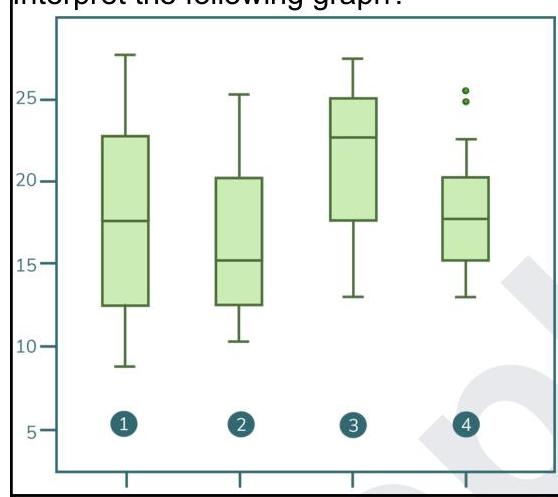
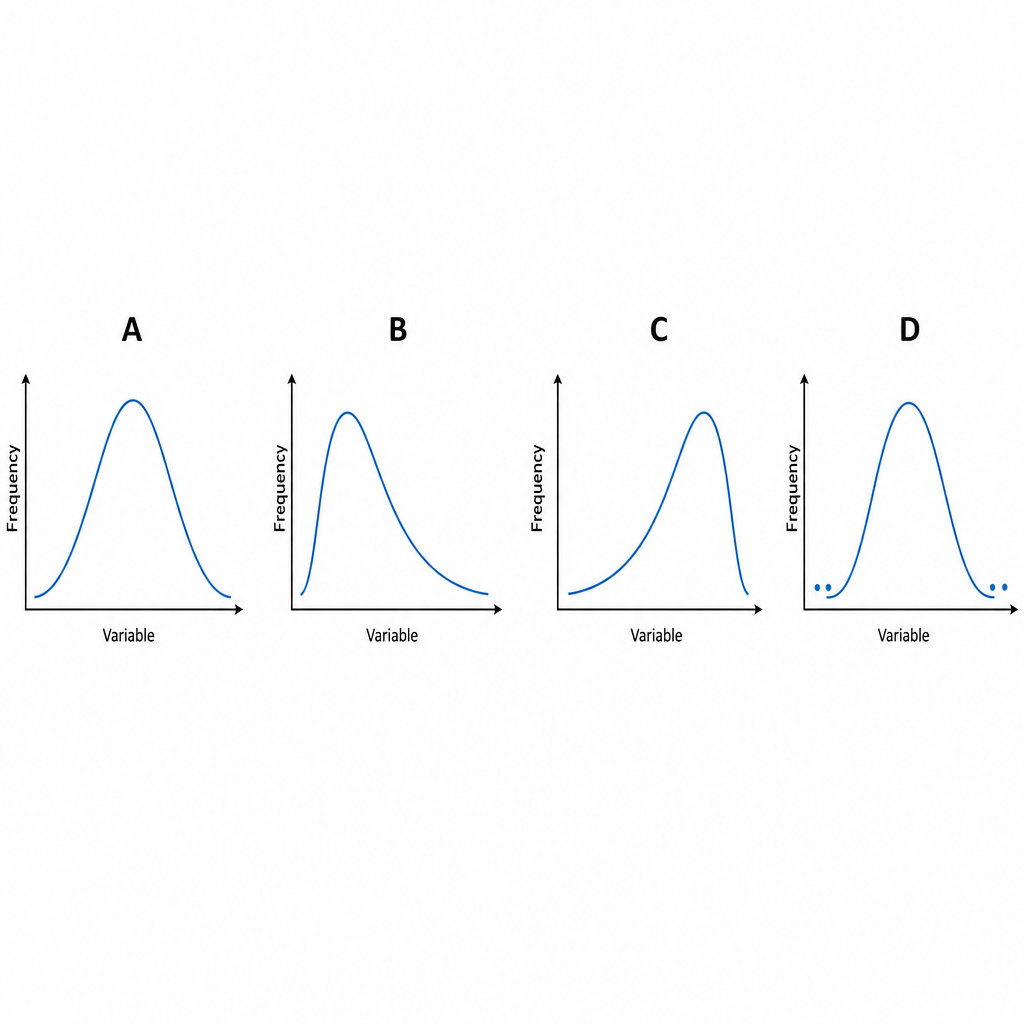
Question 91: Interpret the following graph.
- A. Normal, negatively skewed, positively skewed, skewed with outliers
- B. Skewed with outliers, positively skewed, negatively skewed, normal
- C. Normal, positively skewed, negatively skewed, normal with outliers (Correct Answer)
- D. Normal, negatively skewed, positively skewed, normal with outliers
Explanation: ### ***Normal, positively skewed, negatively skewed, normal with outliers*** - Boxplot 1 shows a relatively symmetric distribution with the median line close to the center of the box and whiskers of similar length, indicating a **normal distribution**. - Boxplot 2 has its median shifted towards the lower quartile and a longer whisker/tail on the right side, characteristic of a **positively skewed (right-skewed) distribution**. - Boxplot 3 has its median shifted towards the upper quartile and a longer whisker/tail on the left side, indicating a **negatively skewed (left-skewed) distribution**. - Boxplot 4 shows a relatively symmetric distribution, but with individual data points (represented by dots) extending beyond the whiskers, which are considered **outliers** in an otherwise **normal distribution**. ### *Normal, negatively skewed, positively skewed, skewed with outliers* - This option incorrectly identifies the skewness for plots 2 and 3. Plot 2 is positively skewed, not negatively, and plot 3 is negatively skewed, not positively. - While plot 4 does have outliers, referring to it simply as "skewed with outliers" is less precise when its central distribution appears normal. ### *Skewed with outliers, positively skewed, negatively skewed, normal* - This option incorrectly identifies plot 1 as "skewed with outliers" when it appears normal. - It also incorrectly reverses the descriptions for plot 2 (positively skewed) and plot 4 (normal with outliers). ### *Normal, negatively skewed, positively skewed, normal with outliers* - This option incorrectly identifies the skewness for plot 2, labeling it as negatively skewed instead of positively skewed. - It also incorrectly labels plot 3 as positively skewed, when it is negatively skewed.
Question 92: Which of the following is not a part of case-control studies?
- A. Strength of association
- B. Follow up (Correct Answer)
- C. Matching
- D. Selection of study subjects
Explanation: ***Follow up*** - **Follow-up** of participants over time to observe disease incidence or outcomes is a characteristic of **cohort studies**, not case-control studies. - Case-control studies are typically **retrospective**, looking back in time after disease occurrence. *Strength of association* - Measuring the **strength of association** between an exposure and an outcome using metrics like the **odds ratio** is a primary objective of case-control studies. - This helps quantify the increased risk of disease attributable to a particular exposure. *Matching* - **Matching** is a technique frequently used in case-control studies to control for **confounding variables** by selecting controls who are similar to cases in terms of age, gender, or other relevant factors. - This helps ensure that any observed association is truly due to the exposure and not other differences between the groups. *Selection of study subjects* - The **selection of study subjects** is fundamental in case-control studies, involving the identification of individuals with the disease (**cases**) and a comparable group without the disease (**controls**). - Careful selection is crucial to minimize bias and ensure the validity of the study findings.
Question 93: A new drug has been introduced into the market which was found to decrease mortality but it does not cure the disease. Which of the following is a true statement regarding prevalence and incidence?
- A. Increase in prevalence (Correct Answer)
- B. Decrease in incidence
- C. Decrease in prevalence
- D. Increase in incidence
Explanation: ***Increase in prevalence*** - A drug that decreases mortality without curing the disease means people **live longer with the condition**, thus increasing the duration of disease - **Prevalence = Incidence × Duration**: Since duration increases while incidence remains constant, prevalence increases - More existing cases accumulate over time as fewer patients die from the disease *Decrease in incidence* - **Incidence** refers to the rate at which **new cases** develop in a population - This drug affects survival of existing cases, not the development of new cases - Since the drug neither prevents nor promotes new cases, **incidence remains unchanged** (not decreased) *Decrease in prevalence* - Prevalence would decrease if the drug **cured the disease** (removing people from the diseased pool) or if **mortality increased** - The scenario describes the opposite: decreased mortality without cure, which **increases** prevalence *Increase in incidence* - This would mean more new cases are developing over time - The drug affects **survival** of existing cases, not the **rate of new diagnoses** - Incidence remains unchanged, not increased
Question 94: What is triage for?
- A. To rehabilitate following a disaster
- B. To prepare for a disaster
- C. To classify the priority of treatment (Correct Answer)
- D. To assess the impact of a disaster
Explanation: ***To classify the priority of treatment*** - **Triage** is the process of sorting patients to determine the **priority** of their treatment based on the **severity** of their condition and the likelihood of recovery, especially when resources are limited. - This system ensures that those who need immediate care most urgently receive it first, maximizing the number of lives saved. *To rehabilitate following a disaster* - **Rehabilitation** focuses on restoring health and functional abilities after an injury or illness, which occurs **post-treatment**, not as the initial classification of need. - This phase of care happens *after* triage has been completed and immediate medical needs have been addressed. *To prepare for a disaster* - **Disaster preparedness** involves planning and training *before* a disaster strikes to mitigate its effects and ensure an effective response. - Triage is a **response mechanism** utilized *during* or *immediately after* a disaster, not a preparatory measure. *To assess the impact of a disaster* - **Impact assessment** involves evaluating the damage, casualties, and overall consequences of a disaster. - While disaster impact assessment helps guide overall response, triage is specifically about **individual patient assessment** and prioritization for medical care.
Pharmacology
1 questionsHepatitis B subunit vaccine contains which of the following antigens?
INI-CET 2021 - Pharmacology INI-CET Practice Questions and MCQs
Question 91: Hepatitis B subunit vaccine contains which of the following antigens?
- A. HbeAg
- B. HbsAg (Correct Answer)
- C. HbcAg
- D. HBV DNA
Explanation: ***HbsAg*** - The Hepatitis B vaccine is a **subunit vaccine** that contains recombinant **hepatitis B surface antigen (HBsAg)**. - This antigen is highly immunogenic and elicits a protective antibody response (anti-HBs) that neutralizes the virus. *HbeAg* - **HBeAg** indicates active viral replication and high infectivity, but it is not the antigen used in the vaccine. - While important for diagnostic purposes, antibodies to HBeAg (anti-HBe) indicate reduced viral replication. *HbcAg* - **HBcAg (hepatitis B core antigen)** is an internal component of the virion and is not found in the subunit vaccine. - Antibodies to HBcAg (anti-HBc) indicate past or current infection but do not confer protective immunity. *HBV DNA* - **HBV DNA** represents the viral genetic material and is a marker of active viral replication and infectivity. - It is not an antigen and therefore not included in a subunit vaccine designed to induce an immune response to viral proteins.
Psychiatry
2 questionsWhich of the following is not classified as OCD as per ICD 11?
Which of the following is a true statement about Korsakoff syndrome?
INI-CET 2021 - Psychiatry INI-CET Practice Questions and MCQs
Question 91: Which of the following is not classified as OCD as per ICD 11?
- A. Hypochondriac disorder
- B. Body dysmorphic disorder
- C. PTSD (Correct Answer)
- D. Trichotillomania
Explanation: ***PTSD*** - **Post-traumatic stress disorder (PTSD)** is classified under **disorders specifically associated with stress** in ICD-11, not as an OCD-related disorder. - PTSD involves symptoms like re-experiencing the traumatic event, avoidance, and hyperarousal following exposure to a **traumatic event**. *Hypochondriac disorder* - In ICD-11, **hypochondriac disorder (illness anxiety disorder)** is reclassified under **obsessive-compulsive or related disorders**, focusing on preoccupation with having a serious illness. - This reflects the **compulsive checking** and **obsessive fears** associated with the condition. *Body dysmorphic disorder* - **Body dysmorphic disorder** is classified under **obsessive-compulsive or related disorders** in ICD-11. - It is characterized by **preoccupation with perceived flaws in physical appearance** and repetitive behaviors (e.g., mirror checking) in response to these concerns. *Trichotillomania* - **Trichotillomania (hair-pulling disorder)** is classified as an **obsessive-compulsive or related disorder** in ICD-11. - It involves **recurrent pulling out of one's hair** resulting in hair loss, despite repeated attempts to stop.
Question 92: Which of the following is a true statement about Korsakoff syndrome?
- A. Loss of implicit memory and immediate recall
- B. Triad of confusion, ophthalmoplegia, and ataxia
- C. Anterograde amnesia with loss of recent memory (Correct Answer)
- D. Loss of long-term memory but intact personality
Explanation: ***Anterograde amnesia with loss of recent memory*** - **Korsakoff syndrome** is primarily characterized by severe **anterograde amnesia**, making it difficult for patients to form new memories after the onset of the condition. - Patients often present with **significant loss of recent memory**, while older, remote memories may remain relatively preserved. *Loss of implicit memory and immediate recall* - While certain aspects of memory are impaired, immediate recall (e.g., repeating a short list of words immediately after hearing them) is often **relatively spared** in Korsakoff syndrome. - **Implicit memory**, which involves unconscious learning of skills and habits, is also typically **intact**, allowing patients to learn new motor skills despite their declarative memory deficits. *Triad of confusion, ophthalmoplegia, and ataxia* - This triad describes **Wernicke encephalopathy**, which is an acute neurological emergency caused by thiamine deficiency, often preceding Korsakoff syndrome. - Korsakoff syndrome, on the other hand, is a more **chronic neuropsychiatric condition** that often develops in individuals who have recovered from an episode of Wernicke encephalopathy. *Loss of long-term memory but intact personality* - While it primarily impacts the formation of new long-term memories, established **remote long-term memories** from before the illness are often **relatively preserved**. - While personality changes can occur due to the brain damage, the statement "intact personality" is **not a defining hallmark** used to differentiate Korsakoff syndrome from other memory disorders.
Radiology
3 questionsDuring rounds, your senior was discussing the given image. Which of the following investigations does this image represent?

A 45-year-old patient presented with vague abdominal pain. On USG, he was found to have a renal cyst of Bosniak class III. CECT was done, as shown below. What imaging modality is shown?

A young child presented with mild intermittent upper abdominal pain. X-ray is given below. What is the diagnosis?

INI-CET 2021 - Radiology INI-CET Practice Questions and MCQs
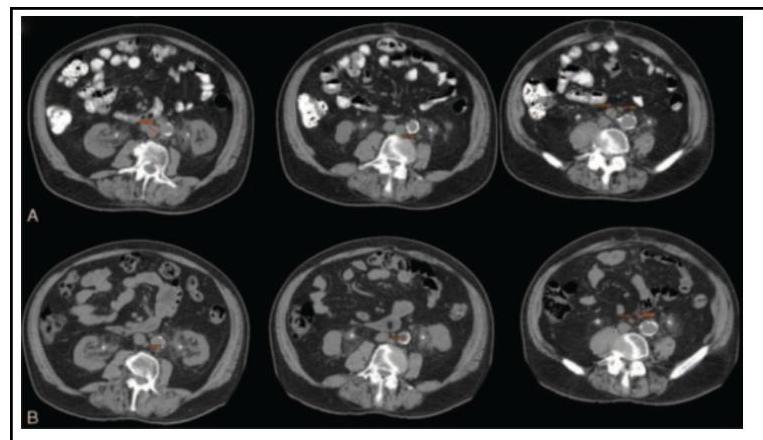
Question 91: During rounds, your senior was discussing the given image. Which of the following investigations does this image represent?
- A. Contrast Dye study
- B. CT scan (Correct Answer)
- C. Angiography
- D. X-ray
Explanation: ***CT scan*** - The image shows multiple **axial slices** with detailed cross-sectional anatomy of the abdomen, which is characteristic of a **Computed Tomography (CT) scan**. - CT scans provide excellent detail of both **soft tissues** and **bone structures** in cross-sectional format, which is the standard appearance of abdominal CT imaging. *X-ray* - Plain X-rays produce **2D projection images**, not the axial cross-sectional slices seen here. - While CT technology uses X-rays, in medical terminology **"X-ray"** refers to conventional radiographs, not cross-sectional imaging. *Contrast Dye study* - This is **not an imaging modality** but rather an enhancement technique used with various imaging methods. - **Contrast agents** improve visualization but don't define the type of investigation being performed. *Angiography* - Angiography is specifically designed to visualize **blood vessels**, often using contrast injection. - This image shows comprehensive **abdominal anatomy**, not the focused vascular imaging typical of angiographic studies.
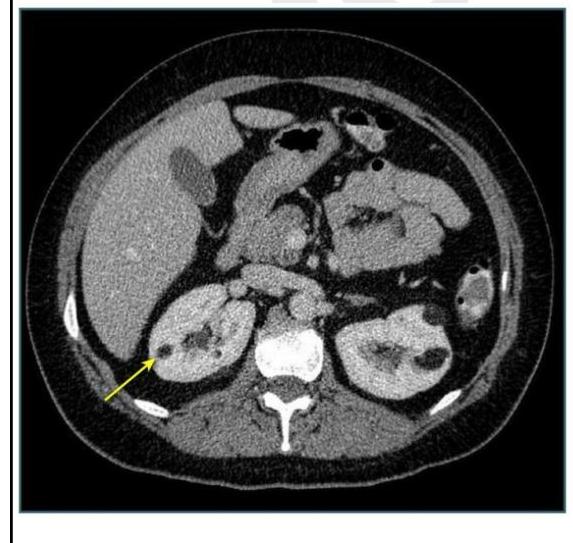
Question 92: A 45-year-old patient presented with vague abdominal pain. On USG, he was found to have a renal cyst of Bosniak class III. CECT was done, as shown below. What imaging modality is shown?
- A. CT scan (Correct Answer)
- B. Contrast Dye study
- C. Angiography
- D. X-ray
Explanation: ***CT scan*** - The image provided is an **axial view** showing internal organs with different densities, characteristic of a **Computed Tomography (CT) scan**. - A CT scan uses X-rays and computer processing to create detailed cross-sectional images of the body. *Contrast Dye study* - A contrast dye study typically refers to the **administration of a contrast agent** to enhance visibility of structures in imaging, it is not an imaging modality itself but an adjunct. - While a CECT (Contrast-Enhanced CT) was mentioned in the clinical scenario, "Contrast Dye study" alone doesn't describe the image type. *Angiography* - **Angiography** is a specialized imaging technique used to visualize blood vessels, typically involving the injection of contrast media. - The image provided shows **parenchymal structures** like the liver and kidneys, not just blood vessels, making angiography an unlikely description. *X-ray* - A general **X-ray** (radiograph) produces a 2D projection of internal structures and does not provide the detailed cross-sectional view seen in this image. - X-rays are typically less sensitive for soft tissue differentiation compared to a CT scan.
Question 93: A young child presented with mild intermittent upper abdominal pain. X-ray is given below. What is the diagnosis?
- A. Morgagni hernia (Correct Answer)
- B. Bochdalek hernia
- C. Gastric volvulus
- D. Eventration of diaphragm
Explanation: ***Morgagni hernia*** - The X-ray shows a **gas-filled lesion** in the **right cardiophrenic angle**, which is characteristic of a Morgagni hernia, where abdominal contents (often colon or omentum) herniate through the foramen of Morgagni. - The mild intermittent **upper abdominal pain** in a child is consistent with the infrequent or non-specific symptoms these hernias can present, as they are often discovered incidentally. *Bochdalek hernia* - **Bochdalek hernias** typically occur posteriorly and laterally, predominately on the **left side**, and are usually identified in the **neonatal period** with severe respiratory distress. - The radiographic appearance would be of abdominal contents (bowel loops, liver, spleen) largely filling the ipsilateral hemithorax, causing significant mediastinal shift, which is not seen here. *Gastric volvulus* - **Gastric volvulus** involves abnormal rotation of the stomach, often presenting with acute symptoms like **epigastric pain, vomiting, and inability to pass a nasogastric tube (Borchardt's triad)**. - Radiographically, it would show a **distended stomach** with an abnormal position, often high in the chest, but without the distinct localized air-filled mass in the cardiophrenic angle. *Eventration of diaphragm* - **Diaphragmatic eventration** is an abnormal elevation of part or all of an intact hemidiaphragm, usually due to muscular hypoplasia. - The X-ray would show a **uniformly elevated hemidiaphragm** with normal continuity, and there would be no discrete air-filled structures above the diaphragm to suggest herniated bowel.