INI-CET 2021 — Dermatology
4 Previous Year Questions with Answers & Explanations
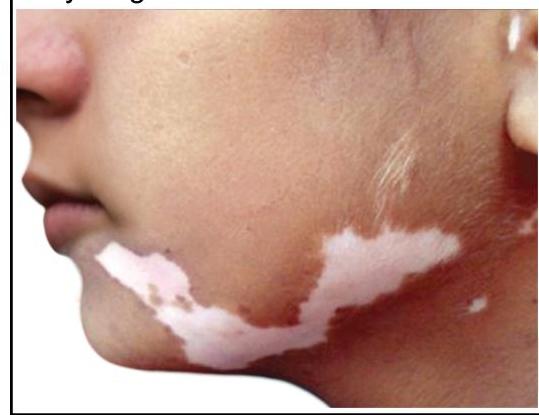
A young girl presents with leukotrichia and lesions as shown in the image. What is the most likely diagnosis?
A child presented with itchy plaques over the neck, the bilateral popliteal and cubital fossa. What could be the diagnosis?
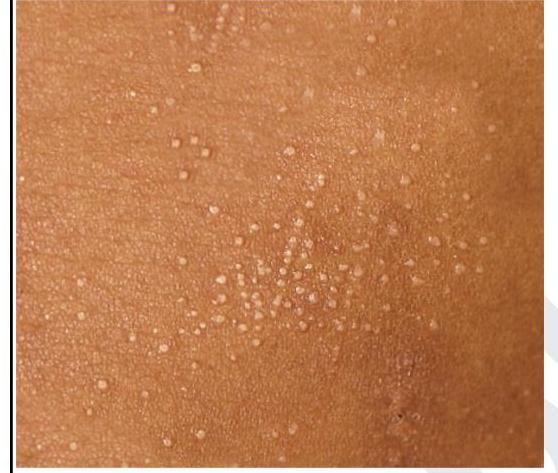
A child presented with asymptomatic lesions on the forearm and on the shaft of the penis. The lesions on the forearm are shown below. What is the most likely diagnosis?
A young man presented with painful vesicular lesions distributed along a dermatomal pattern on one side of his body. What is the likely diagnosis?
INI-CET 2021 - Dermatology INI-CET Practice Questions and MCQs
Question 1: A young girl presents with leukotrichia and lesions as shown in the image. What is the most likely diagnosis?
- A. Segmental vitiligo (Correct Answer)
- B. Piebaldism
- C. Focal vitiligo
- D. Nevus depigmentosus
Explanation: ***Segmental vitiligo*** - Segmental vitiligo characteristically presents as unilateral, **dermatomal** or **quasi-dermatomal depigmentation** with sharply demarcated borders, often including overlying **leukotrichia** (white hairs) in the affected area, as seen in the image. - This form typically has an early onset, rapid progression followed by stabilization, and can be more resistant to conventional treatments than non-segmental vitiligo. *Piebaldism* - Piebaldism is a **congenital leukoderma** characterized by a **white forelock** and symmetrically distributed depigmented patches, primarily on the trunk and extremities, which are usually stable in size and present from birth. - Unlike the progressive nature and unilateral pattern seen in the image, piebaldism is a genetic condition without new lesion development or the characteristic dermatomal distribution. *Focal vitiligo* - Focal vitiligo refers to one or a few localized depigmented macules that do not have a segmental pattern and are not distributed along a specific dermatome. - While it involves localized depigmentation, the clear **segmental distribution** and presence of **leukotrichia** in the image are more indicative of segmental vitiligo. *Nevus depigmentosus* - Nevus depigmentosus is a congenital, **stable hypopigmented lesion** that typically appears as a solitary patch or macule, without subsequent growth or change in size over time. - The lesions shown in the image appear to be multiple and follow a distinct pattern that is not typical of a stable, solitary nevus.
Question 2: A child presented with itchy plaques over the neck, the bilateral popliteal and cubital fossa. What could be the diagnosis?
- A. Dermatitis herpetiformis
- B. Psoriasis
- C. Pemphigus vegetans
- D. Atopic dermatitis (Correct Answer)
Explanation: **Atopic dermatitis** - The presentation of **itchy plaques** in the anatomical locations described (neck, bilateral popliteal fossa, and cubital fossa) is highly characteristic of **atopic dermatitis** in children. - Atopic dermatitis typically involves **flexural surfaces** in older children and adults, and is characterized by **intense pruritus**. *Dermatitis herpetiformis* - This condition presents with **extremely itchy, grouped vesicles and papules**, primarily on extensor surfaces, buttocks, and scalp. - It is strongly associated with **celiac disease** and is unlikely to present as plaques in flexural areas. *Psoriasis* - Psoriasis typically presents with **well-demarcated, erythematous plaques** covered with **silvery scales**, often on extensor surfaces (knees, elbows) and the scalp. - While it can occur in flexural areas (inverse psoriasis), **itching is usually less prominent** than in atopic dermatitis, and the characteristic scaling is usually present. *Pemphigus vegetans* - Pemphigus vegetans is a rare variant of pemphigus, characterized by **verrucous, vegetative lesions** and **bullae**, often in intertriginous areas. - This condition is a chronic autoimmune blistering disease and does not typically present as simple itchy plaques in a child.
Question 3: A child presented with asymptomatic lesions on the forearm and on the shaft of the penis. The lesions on the forearm are shown below. What is the most likely diagnosis?
- A. Lichen planus
- B. Lichen nitidus (Correct Answer)
- C. Scabies
- D. Scrofuloderma
Explanation: ***Lichen nitidus*** - Presents as **multiple, asymptomatic, tiny (1-2 mm), shiny, dome-shaped papules** that are often skin-colored or slightly hypopigmented, as seen in the image and described. - Common sites include the **forearms, penis, abdomen, and flexural areas**, consistent with the case presentation. *Lichen planus* - Characterized by **purplish, polygonal, planar, pruritic papules and plaques**, often with **Wickham's striae**, which are not seen in the image. - While it can affect the penis, its lesions are typically more intensely colored and often symptomatic (**itchy**), unlike the asymptomatic lesions described. *Scabies* - Presents with intensely **pruritic papules, vesicles, and burrows**, especially in the web spaces of fingers, wrists, axillae, and genitalia, which are very symptomatic and not usually described as shiny papules. - The primary symptom is **severe itching**, which is absent in this patient. *Scrofuloderma* - A form of **cutaneous tuberculosis** presenting as cold abscesses that eventually rupture to form ulcers, sinuses, and scars. - The image shows distinct, small papules, not ulcerating or scarring lesions characteristic of scrofuloderma.
Question 4: A young man presented with painful vesicular lesions distributed along a dermatomal pattern on one side of his body. What is the likely diagnosis?
- A. Lymphangioma circumscriptum
- B. Molluscum contagiosum
- C. Herpes simplex
- D. Herpes Zoster (Correct Answer)
Explanation: ***Herpes Zoster*** - This condition is characterized by a **unilateral rash** that respects the **dermatomal distribution**, meaning it follows the path of a single nerve. - The lesions are typically **painful vesicles** and crusts, often associated with a burning sensation due to reactivation of the **varicella-zoster virus** (chickenpox virus). *Lymphangioma circumscriptum* - This is a rare **lymphatic malformation** presenting as clusters of **vesicles** or papules, often described as 'frog spawn' or 'tapioca pudding' in appearance. - While it can be painful, it usually does not follow a dermatomal pattern and is a congenital condition, not an acute viral eruption. *Molluscum contagiosum* - This is a viral skin infection producing small, firm, **umbilicated papules** that are typically flesh-colored or pearly. - While contagious, these lesions are generally **asymptomatic** and do not present with the acute pain, blistering, or dermatomal distribution characteristic of herpes zoster. *Herpes simplex* - This infection causes localized clusters of painful **vesicles** on an erythematous base, most commonly around the mouth (cold sores) or genitals. - Unlike herpes zoster, herpes simplex lesions typically recur in the same small area and do **not follow a dermatomal distribution**.