Anatomy
1 questionsDorsum of first webspace is supplied by which nerve?
FMGE 2018 - Anatomy FMGE Practice Questions and MCQs
Question 191: Dorsum of first webspace is supplied by which nerve?
- A. Deep peroneal (Correct Answer)
- B. Superficial peroneal
- C. Sural
- D. Posterior tibial
Explanation: ***Deep peroneal*** - The **deep peroneal nerve** innervates the **first dorsal webspace** of the foot, which is a classic sensory test area for this nerve. - Damage to this nerve can result in **foot drop** and loss of sensation in this specific area. *Superficial peroneal* - The **superficial peroneal nerve** supplies the majority of the **dorsum of the foot**, excluding the first webspace and the ankle. - It handles sensation for the **anterolateral aspect** of the distal leg and most of the dorsal foot. *Sural* - The **sural nerve** provides sensation to the **posterolateral aspect of the leg** and the **lateral border of the foot**. - It is often used for **nerve grafting** due to its superficial course. *Posterior tibial* - The **posterior tibial nerve** provides sensation to the **sole of the foot** via its medial and lateral plantar branches. - It also innervates most of the **intrinsic muscles of the foot**, affecting motor function.
Internal Medicine
4 questionsGastric lavage is contraindicated in?
A patient presented with sudden onset of thunderclap headache & dilated pupils. Findings are consistent with:
Treatment of choice for recurrent thyrotoxicosis after surgery is:-
MC cause of nephrotic syndrome in adults:-
FMGE 2018 - Internal Medicine FMGE Practice Questions and MCQs
Question 191: Gastric lavage is contraindicated in?
- A. Bicarbonate
- B. Hydrocarbons (Correct Answer)
- C. Organo-Phosphosphate poisoning
- D. PCM toxicity
Explanation: ***Hydrocarbons*** - Gastric lavage is contraindicated in **hydrocarbon poisoning** due to the high risk of **aspiration** [2]. - Aspiration of hydrocarbons can lead to severe **chemical pneumonitis**, which is often more life-threatening than the systemic toxicity from ingestion [2]. *Bicarbonate* - Ingesting a large amount of bicarbonate can cause **alkalosis** and electrolyte imbalances. - While gastric lavage is not typically the primary treatment for mild bicarbonate overdose, it is not absolutely contraindicated in cases of massive ingestion where there is a clear benefit to removing unabsorbed substance, especially if performed with proper airway protection [1], [3]. *Organo-Phosphosphate poisoning* - Gastric lavage is generally recommended for **organophosphate poisoning** if the patient presents within 1-2 hours of ingestion and is awake with an intact gag reflex, or with a protected airway [2]. - This helps remove unabsorbed poison and can reduce the systemic absorption of these highly toxic compounds. *PCM toxicity* - For **paracetamol (PCM) toxicity**, gastric lavage can be considered if the patient presents within 1-2 hours of ingestion and has ingested a potentially toxic dose, especially when activated charcoal is not immediately available or contraindicated [4]. - The primary treatment for PCM toxicity involves **N-acetylcysteine (NAC)**, but gastric emptying can play a role in reducing initial absorption [4].
Question 192: A patient presented with sudden onset of thunderclap headache & dilated pupils. Findings are consistent with:
- A. Brain stem encephalitis
- B. Acute aneurismal hemorrhage (Correct Answer)
- C. Acute ischemia of midbrain
- D. Meningitis
Explanation: ***Acute aneurismal hemorrhage*** - **Thunderclap headache** is the hallmark symptom, often described as the "worst headache of life," due to sudden elevation of intracranial pressure [2]. - **Dilated pupils**, especially unilateral, can indicate compression of the **oculomotor nerve (CN III)** by an expanding aneurysm in the posterior communicating artery region, a direct effect of subarachnoid hemorrhage [1]. *Brain stem encephalitis* - This condition involves inflammation of the brainstem, which typically presents with a range of neurological deficits such as **ataxia**, **cranial nerve palsies**, and **altered consciousness**. - While headaches can occur, a characteristic **thunderclap headache** is not a typical feature, and pupillary abnormalities would be more varied depending on the extent of brainstem involvement. *Acute ischemia of midbrain* - **Midbrain ischemia** would present with brainstem symptoms like **vertigo**, **diplopia**, **hemiparesis**, or **oculomotor nerve palsy** [3]. - Although it could lead to pupillary changes if the oculomotor nucleus is affected, it typically does not cause a sudden, severe **thunderclap headache**. *Meningitis* - **Meningitis** presents with headache, fever, **neck stiffness**, and altered mental status [2]. - While headache is common, a sudden **thunderclap headache** is less typical, and **dilated pupils** are not a primary diagnostic feature unless there is severe herniation or other complications.
Question 193: Treatment of choice for recurrent thyrotoxicosis after surgery is:-
- A. Observation & follow-up
- B. Radioiodine (Correct Answer)
- C. Radioiodine followed by surgery
- D. Further surgery
Explanation: ***Radioiodine*** - **Radioiodine therapy (RAI)** is the preferred treatment for recurrent **thyrotoxicosis** after prior surgery, especially if the patient is elderly or has comorbidities, due to its effectiveness and safety profile. [1] - It works by destroying overactive thyroid cells, reducing hormone production and mitigating the risk of further surgical complications. *Observation & follow-up* - This approach is generally **insufficient** for managing recurrent thyrotoxicosis, which requires active treatment to control hormone levels. - Delaying proper treatment can lead to serious complications such as **cardiac arrhythmias**, **osteoporosis**, and **thyroid storm**. *Radioiodine followed by surgery* - Administering radioiodine followed by surgery is **not typically a standard approach** for recurrent thyrotoxicosis and may increase patient burden and risk. - Surgery after radioiodine therapy is usually reserved for cases of **malignancy** or large goiters with compressive symptoms that persist despite RAI. [1] *Further surgery* - **Repeat thyroid surgery** carries a significantly **higher risk of complications** such as recurrent laryngeal nerve injury, hypoparathyroidism, and excessive bleeding due to altered anatomy and scar tissue from the initial surgery. [1] - The efficacy may also be reduced compared to RAI, particularly in diffuse or widespread recurrence.
Question 194: MC cause of nephrotic syndrome in adults:-
- A. Minimal change disease
- B. Focal segmental glomerulosclerosis (Correct Answer)
- C. Good-pasture syndrome
- D. Membranous GN
Explanation: **Focal segmental glomerulosclerosis** - **Focal segmental glomerulosclerosis (FSGS)** is the most common cause of **primary nephrotic syndrome in adults**, particularly in African Americans and individuals with HIV or obesity [1]. - It involves **scarring** of some glomeruli (focal) and only parts of affected glomeruli (segmental), leading to **proteinuria** and progression to end-stage renal disease [2]. *Minimal change disease* - While it is the most common cause of **nephrotic syndrome in children**, it accounts for a smaller proportion of adult cases [1]. - Characterized by normal-appearing glomeruli on light microscopy but **effacement of foot processes** on electron microscopy. *Good-pasture syndrome* - This is an **autoimmune disease** causing rapidly progressive glomerulonephritis, often associated with **pulmonary hemorrhage** [3]. - It is a much rarer cause of nephrotic syndrome and is characterized by **anti-GBM antibodies** [3]. *Membranous GN* - It is a common cause of **nephrotic syndrome in adults**, particularly in Caucasians, but **Focal Segmental Glomerulosclerosis (FSGS)** has surpassed it as the overall most common primary cause. - Characterized by thickening of the **glomerular basement membrane** due to immune complex deposition, often detected by **anti-PLA2R antibodies** [2].
Ophthalmology
1 questionsA child presents with night blindness, delayed dark adaptation. Which investigation is to be done further to confirm the diagnosis?
FMGE 2018 - Ophthalmology FMGE Practice Questions and MCQs
Question 191: A child presents with night blindness, delayed dark adaptation. Which investigation is to be done further to confirm the diagnosis?
- A. ERG (Correct Answer)
- B. Retinoscopy
- C. Dark adaptometry
- D. EOG
Explanation: ***ERG*** - **Electroretinography (ERG)** measures the electrical responses of various retinal cells, including **rods** and **cones**, to light stimuli. - In conditions like **retinitis pigmentosa** which cause night blindness and delayed dark adaptation, ERG will show characteristic abnormal or extinguished responses, confirming retinal dysfunction. *Retinoscopy* - **Retinoscopy** is an objective method to assess the refractive error of the eye by observing the light reflex from the retina. - It does not directly evaluate the functional integrity of photoreceptors or diagnose conditions causing **night blindness**. *Dark adaptometry* - **Dark adaptometry** measures the time it takes for the eye to adapt to dim light after exposure to bright light, quantifying the function of **rod photoreceptors**. - While it can *detect* delayed dark adaptation, it is a functional test that assesses the symptom, not the underlying cause provided by ERG. *EOG* - **Electrooculography (EOG)** measures the potential difference between the cornea and the retina, primarily assessing the function of the **retinal pigment epithelium (RPE)**. - While useful for conditions like **Best's disease**, it is less direct for evaluating generalized rod dysfunction causing night blindness compared to ERG.
Orthopaedics
2 questionsPrimary osteoarthritis affects all except:
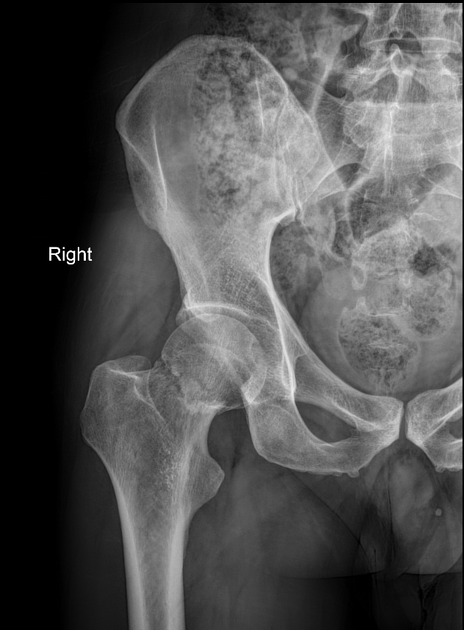
79 yrs old lady had fall, the following X-ray was taken. Which of the following is treatment?
FMGE 2018 - Orthopaedics FMGE Practice Questions and MCQs
Question 191: Primary osteoarthritis affects all except:
- A. Metacarpophalangeal joint (Correct Answer)
- B. Hip Joint
- C. Distal interphalangeal joint
- D. Knee joint
Explanation: ***Metacarpophalangeal joint*** - The **metacarpophalangeal (MCP) joints** are typically spared in primary osteoarthritis, making their involvement a less common presentation. - Involvement of the MCP joints, particularly with significant inflammation, might suggest other conditions like **rheumatoid arthritis**. *Hip Joint* - The hip joint is a common site for primary osteoarthritis due to its **weight-bearing function** and susceptibility to mechanical stress. - Patients often experience **groin pain** and reduced range of motion, particularly internal rotation. *Distal interphalangeal joint* - The **distal interphalangeal (DIP) joints** are very commonly affected in primary osteoarthritis, leading to the formation of **Heberden's nodes**. - These nodes are bony enlargements that indicate osteophyte formation and cartilage loss. *Knee joint* - The knee joint is another frequently affected large joint in primary osteoarthritis, often presenting with **pain**, **stiffness**, and **crepitus**. - Its **weight-bearing role** contributes significantly to its vulnerability to degenerative changes.
Question 192: 79 yrs old lady had fall, the following X-ray was taken. Which of the following is treatment?
- A. Hip spica
- B. Nailing
- C. Hemiahroplasty (Correct Answer)
- D. Total Hip Replacement
Explanation: ***Hemiarthroplasty*** - The X-ray shows a **displaced femoral neck fracture** in an elderly patient, which typically has a high risk of **avascular necrosis** of the femoral head due to disruption of blood supply. - Hemiarthroplasty involves replacing only the **femoral head and neck** with a prosthetic component, leaving the acetabulum intact, which is suitable for elderly patients with good acetabular cartilage and less active lifestyles. *Hip spica* - A hip spica cast is primarily used for **pediatric femur fractures** or certain types of hip dislocations in children, not for displaced femoral neck fractures in elderly adults. - This method would not provide stable fixation or address the high risk of **avascular necrosis** associated with these fractures in older patients. *Nailing* - Nailing (intramedullary nailing) is typically used for **intertrochanteric fractures** or subtrochanteric fractures, where the fracture line is distal to the femoral neck. - For displaced femoral neck fractures, nailing alone may not provide adequate stability and carries a higher risk of **non-union** or **avascular necrosis** compared to arthroplasty in elderly patients. *Total Hip Replacement* - Total hip replacement involves replacing both the **femoral head and the acetabulum** with prosthetic components. - While an option for femoral neck fractures, it is generally reserved for younger, more active patients or those with pre-existing **acetabular pathology** like arthritis, as it is a more extensive and complex procedure than hemiarthroplasty.
Pediatrics
1 questionsA newborn loses maximum heat from:
FMGE 2018 - Pediatrics FMGE Practice Questions and MCQs
Question 191: A newborn loses maximum heat from:
- A. Head (Correct Answer)
- B. Abdomen
- C. Neck
- D. Palms & soles
Explanation: ***Head*** - Newborns have a **relatively large head surface area** compared to their total body surface area. - The head also has a rich **blood supply** and lacks subcutaneous fat for insulation, contributing to significant heat loss through **convection and radiation**. *Abdomen* - While the abdomen contributes to heat loss, it is covered by clothing and has a more proportionate surface area to mass ratio compared to the head, making it a **less significant site for maximal heat loss**. - Heat loss from the abdomen is not as pronounced as from the head due to its **central location** and typically greater insulation. *Neck* - The neck's surface area is comparably small, and it is often covered or in close proximity to the body, which helps to **reduce heat loss**. - It does not possess the same combination of large surface area and lack of insulating fat as the head. *Palms & soles* - While palms and soles have a high density of **sweat glands** and can contribute to heat loss through evaporation, their **total surface area is relatively small** in a newborn. - These areas are less significant for overall maximal heat loss compared to the head due to their limited size.
Pharmacology
1 questionsPurpose of adding zinc to insulin in commercial preparations for treatment of diabetes mellitus is:-
FMGE 2018 - Pharmacology FMGE Practice Questions and MCQs
Question 191: Purpose of adding zinc to insulin in commercial preparations for treatment of diabetes mellitus is:-
- A. To make it short acting
- B. To make it fast acting
- C. To make it long acting (Correct Answer)
- D. Addition of zinc makes the insulin effective orally
Explanation: ***To make it long acting*** - **Zinc** is added to insulin formulations, particularly **neutral protamine Hagedorn (NPH) insulin**, to create larger crystal complexes [1]. - These larger complexes **slow down the absorption** of insulin from the subcutaneous injection site, thereby prolonging its duration of action [2]. *To make it short acting* - **Short-acting insulins** like regular insulin are not formulated with zinc, as their purpose is rapid onset and a shorter duration. - Adding zinc would counteract the desired rapid-acting pharmacokinetic profile. *To make it fast acting* - **Fast-acting insulins** (insulin analogs) have specific amino acid modifications that alter their self-association properties to ensure rapid absorption, not the addition of zinc [2]. - Zinc actually works against the goal of fast action by promoting aggregation. *Addition of zinc makes the insulin effective orally* - Insulin is a **peptide hormone** and is generally destroyed by digestive enzymes in the gastrointestinal tract, making oral administration ineffective regardless of zinc presence [3]. - Efforts to create oral insulin involve complex delivery systems, not simple zinc addition.