Question 1: Most common subtype of Rodent ulcer is:
- A. Superficial
- B. Nodular (Correct Answer)
- C. Pigmented
- D. Cystic
Explanation: ***Nodular***
- The **nodular** subtype is the most common presentation of **basal cell carcinoma (rodent ulcer)**, accounting for 60-80% of cases.
- It typically appears as a **pearly nodule** with rolled borders and telangiectasias.
*Superficial*
- The **superficial** subtype is the second most common, accounting for 15-20% of basal cell carcinomas.
- It presents as a **red, scaly patch**, often mistaken for eczema or psoriasis.
*Pigmented*
- The **pigmented** subtype is less common, characterized by the presence of **melanin**, making it appear dark brown or black.
- It can be confused with melanoma due to its dark coloration.
*Cystic*
- The **cystic** subtype is a rare form of basal cell carcinoma, characterized by a **fluid-filled lesion**.
- It often appears as a translucent nodule with a soft, jelly-like consistency.
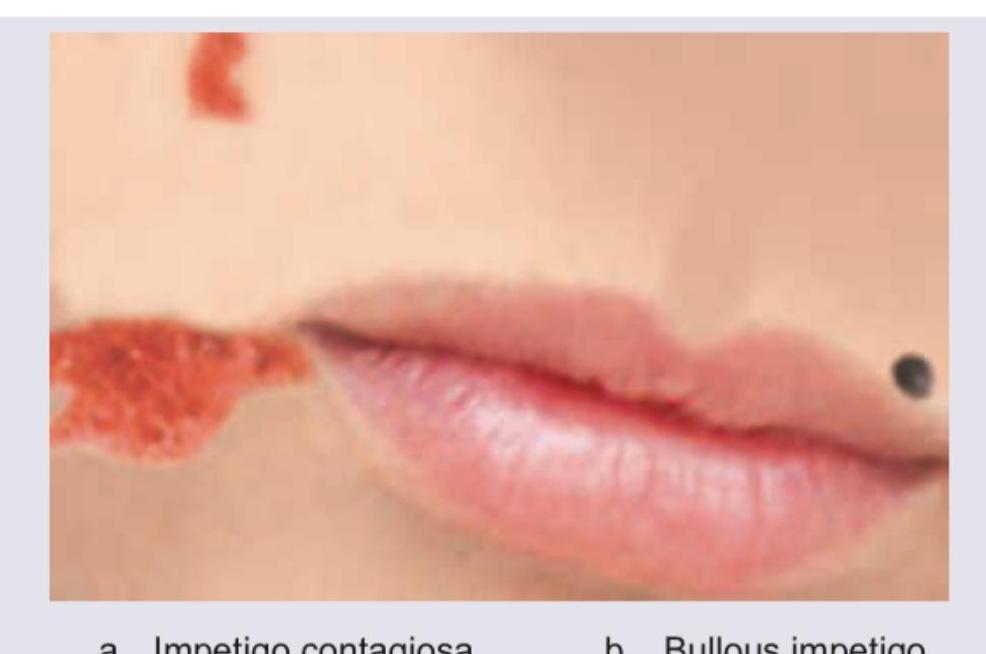
Question 2: A child presents with the skin lesions shown in the image. The most likely diagnosis is:
- A. Impetigo contagiosa (Correct Answer)
- B. Bullous impetigo
- C. Ritter disease
- D. Ecthyma
Explanation: ***Impetigo contagiosa***
- The image shows **honey-colored crusted lesions** around the mouth, which are highly characteristic of **impetigo contagiosa (non-bullous impetigo)**.
- This form of impetigo is typically caused by *Staphylococcus aureus* or *Streptococcus pyogenes* and primarily affects superficial layers of the epidermis.
*Bullous impetigo*
- Characterized by **flaccid bullae** (blisters) that rupture to leave a thin, varnish-like crust, rather than the thick honey-colored crusts seen here.
- It is exclusively caused by **Staphylococcus aureus** strains producing exfoliative toxins.
*Ritter disease*
- Also known as **Staphylococcal Scalded Skin Syndrome (SSSS)**, this condition involves widespread **erythema and exfoliation** resembling a burn.
- It is a severe, systemic illness with widespread skin involvement, not localized crusted lesions like those pictured.
*Ecthyma*
- This is a more **deep-seated skin infection** that penetrates into the dermis, characterized by **"punched-out" ulcers** with thick, adherent crusts and often leaves scars.
- While also caused by *Staphylococcus aureus* and/or *Streptococcus pyogenes*, its lesions are typically more severe and destructive than what is depicted.