Trauma Indian Medical PG Flashcards - Medical Study Cards
Master Trauma with OnCourse flashcards. These spaced repetition flashcards are designed for medical students preparing for NEET PG, USMLE Step 1, USMLE Step 2, MBBS exams, and other medical licensing examinations.
Trauma Flashcard Deck - 129 Cards
Flashcard 1: The given x-ray shows hypertrophic nonunion caused by inadequate _____
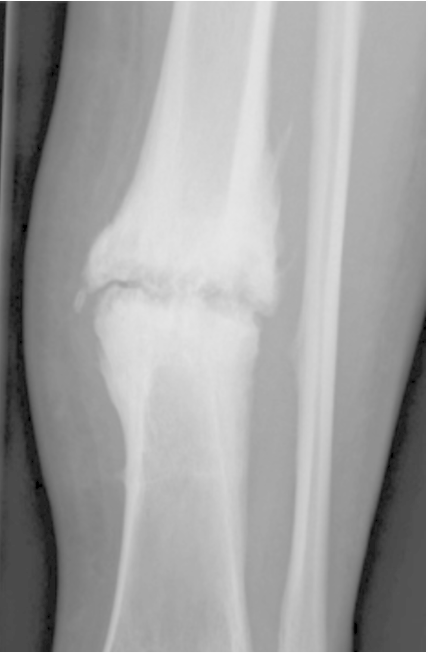
Answer: stabilization
Flashcard 2: The given image shows a fracture of the styloid process of radius which is called a _____ fracture.
(Ignore the red arrow)
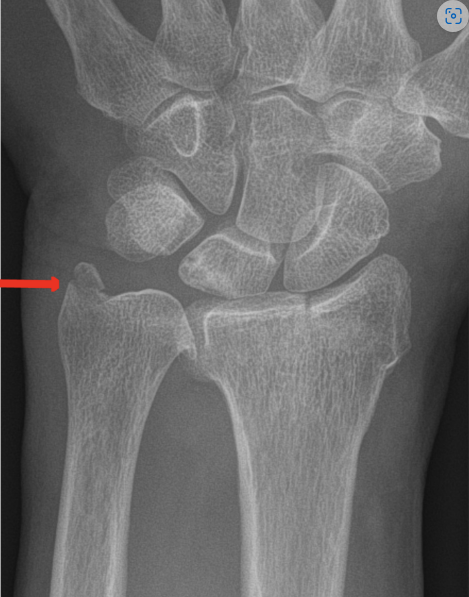
Answer: Chauffer's
Flashcard 3: _____ sign is seen in bicolumnar T-shaped or transverse fracture of acetabulum
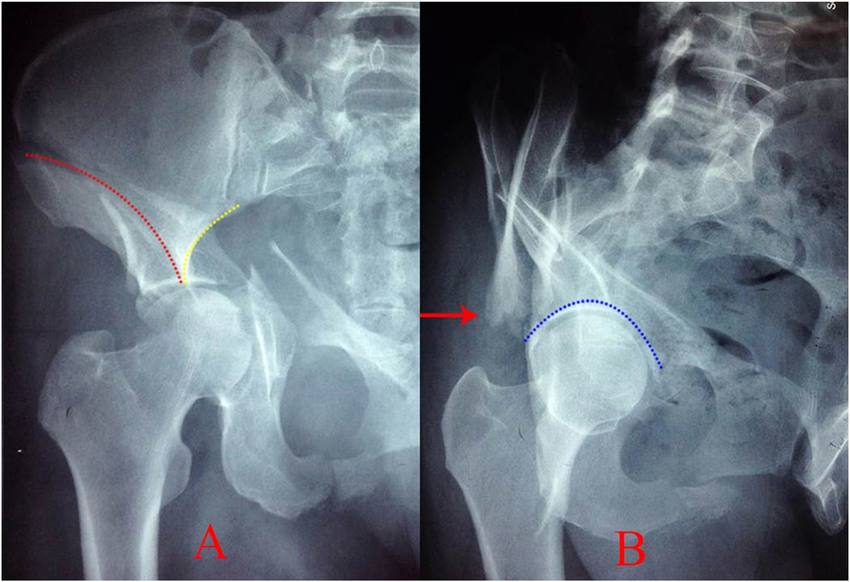
Answer: Spur
Flashcard 4: The most common nerve affected by posterior elbow dislocation is _____ nerve
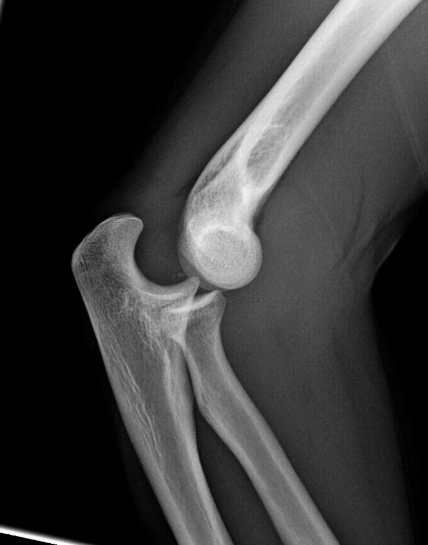
Answer: Ulnar
Flashcard 5: Name the following method to reduce a dislocated shoulder:
_____
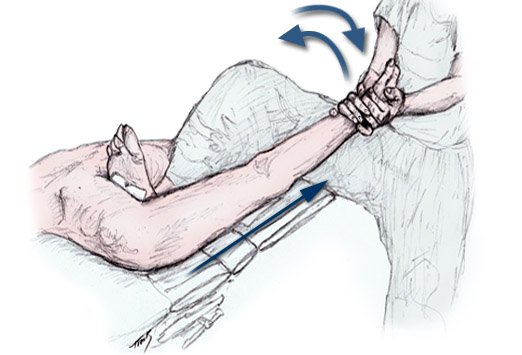
Answer: Hippocratic method
Flashcard 6: The most common complication associated with elbow dislocation is _____ at the elbow.
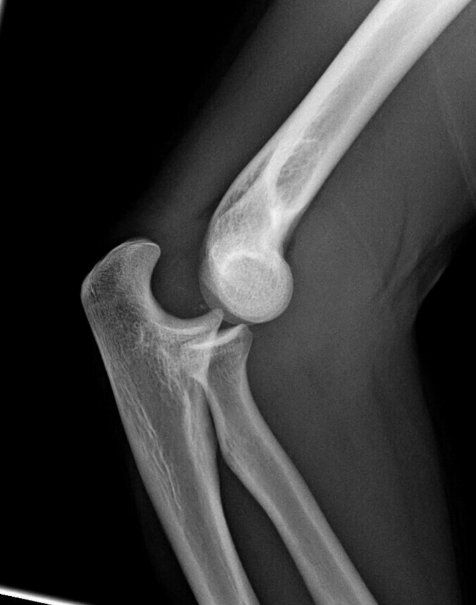
Answer: stiffness
Flashcard 7: The above radiograph shows an extramedullary implant called a _____.
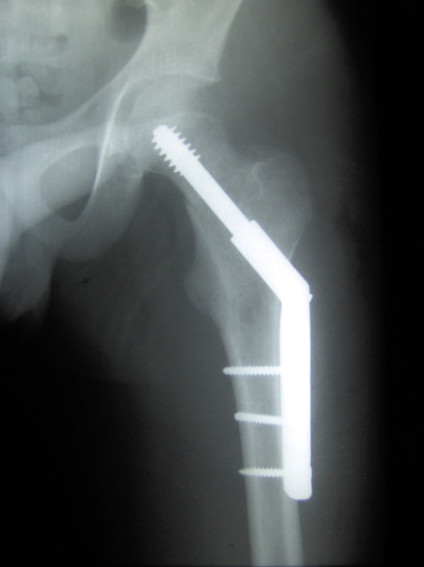
Answer: dynamic hip screw
Flashcard 8: According to the position assumed by the femoral head, anterior dislocation of the hip can further be classified as _____ and inferior
Answer: superior
Flashcard 9: In Colles # the distal segment is displaced _____ whereas in Smith # it is displaced volarly (dorsal/volar)
Answer: dorsally
Flashcard 10: Non-union is defined as arrest in the healing process of a fracture lasting more than _____ months and for which there has been no signs of healing for 3 months
Answer: 9
Flashcard 11: _____ tendon injury and rupture typically occurs following forceful eccentric contraction or FOOSH.
Answer: Triceps
Flashcard 12: _____ fracture is better visualized in the skyline view.
Answer: Patella
Flashcard 13: The femoral head is displaced _____riorly and laterally to the acetabulum in posterior femur dislocation
Answer: supe
Flashcard 14: _____ganglionic brachial plexus injury has poor prognosis and is associated with a positive histamine test
Answer: Pre
Flashcard 15: Anterior axillary fold is at a lower level on the dislocated side, seen in _____ test for anterior shoulder dislocation
Answer: Bryant's
Flashcard 16: _____ fracture - These occur in the posterior fossa around the foramen magnum and are most often caused by a fall from height
Answer: Ring
Flashcard 17: _____ fractures present with an abducted and externally rotated leg with shortening.
Answer: Femoral neck
Flashcard 18: _____ganglionic brachial plexus injury has good prognosis and is associated with a negative histamine test
Answer: Post
Flashcard 19: Limb compartment syndrome is often caused by traumatic injury due to:- significant _____ fractures- reperfusion injury- animal venoms
Answer: long bone
Flashcard 20: For Rockwood type _____ Acromioclavicular joint injuries, the treatment is by open reduction and internal fixation.
Answer: 4-6
Flashcard 21: The _____ and radius is in alignment in perilunate dislocation
Answer: lunate
Flashcard 22: Displacements seen in Colle's fracture are: DILS_____
Answer: Dorsal
Flashcard 23: Limb Compartment Syndrome presents with severe _____ and tense, swollen compartments that worsens with limb flexion
Answer: pain
Flashcard 24: _____ fracture is break in the neck of the metacarpal on hitting an immovable object
Answer: Boxer's
Flashcard 25: For Rockwood type _____ Acromioclavicular joint injuries, the treatment is by velpeau bandage.
Answer: 1-3
Flashcard 26: In _____ dislocation of the hip, the femoral head can be palpated on per-rectal examination
Answer: central
Flashcard 27: _____ fracture - Separation of sutures due to blow with blunt weapon or from cerebral edema.
Answer: Diastatic
Flashcard 28: _____ classification is based on the angle made by the fracture line of femoral neck in reference to the horizontal plane
Answer: Pauwels
Flashcard 29: _____ sign is seen in transverse fracture of acetabulum
Answer: Spur
Flashcard 30: _____ hip dislocations can be caused by hip abduction and external rotation
Answer: Anterior
Flashcard 31: _____ can be used for the cervical spine and hardboard can be used for the rest of the spine for spinal fixation according to ATLS
Answer: Philadelphia collar
Flashcard 32: Flail chest is _____ adjacent ribs or 3 or more ribs fractured in two or more places.
Answer: 2
Flashcard 33: Knowle's pins are mainly used in the treatment of _____ fractures and clavicle fractures.
Answer: ankle
Flashcard 34: _____ dislocation of hip joint results in the limb attitude of FADIR
Answer: Posterior
Flashcard 35: In osteoporotic patients when there is significant comminution of the olecranon, _____ with triceps advancement is done.
Answer: excision
Flashcard 36: Displacement is defined as the separation of any part by more than _____ cm or angulation of more than 45 degrees
Answer: 1
Flashcard 37: Prepatellar bursitis can be caused by _____ or pressure from excessive kneeling
Answer: repeated trauma
Flashcard 38: _____ dislocation of hip joint results in the limb attitude of FABER
Answer: Anterior
Flashcard 39: _____ embolus is associated with bone fractures, particularly long bones and soft tissue trauma
Answer: Fat
Flashcard 40: A _____ fracture is a(n) incomplete fracture through the width of the bone following bending stress
Answer: greenstick
Flashcard 41: Types of skull fractures:_____ fracture - Occurs in children due to elasticity of bones. It is also known as indented fracture.
Answer: Pond
Flashcard 42: Pain on passive _____ flexion of the foot and toe flexion is seen in anterior compartment syndrome of leg
Answer: plantar
Flashcard 43: In the fracture of midshaft of the femur, the distal fragment is _____ducted and the proximal fragment is flexed and externally rotated.
Answer: aD
Flashcard 44: Length of the limb is _____ in Anterior dislocation
Answer: increased
Flashcard 45: What are the only indications for primary plating in # shaft of femur?_____physeal fractures or fractures extending intra-articularly
Answer: Meta
Flashcard 46: Length of the limb is _____ in Posterior dislocation of hip
Answer: decreased
Flashcard 47: Types of skull fractures:_____ fracture - It is also called spider web fracture.
Answer: Comminuted
Flashcard 48: _____ hip dislocations commonly occur due to axial load through a flexed knee
Answer: Posterior
Flashcard 49: _____ fracture is the intraarticular fracture of femoral condyles in a coronal plane
Answer: Hoffa
Flashcard 50: Simple olecranon fractures without comminution or instability are managed with _____, plate fixation, or an intramedullary rod
Answer: tension-band wiring
Flashcard 51: Fractures of _____ are also known as quadripod fracture.
Answer: zygoma
Flashcard 52: The correct order of steps in Kocher's manoeuvre is _____ (TEAM).
Answer: traction, external rotation, adduction, medial rotation
Flashcard 53: Which stage of Seddon's classification is characterised by positive progressive Tinel's sign?_____
Answer: Axonotmesis
Flashcard 54: Intertrochanteric fracture of the femur is best treated by _____
Answer: proximal femoral nail
Flashcard 55: The technique which uses traction on soft tissues around the bones to reduce the fracture fragments is known as _____
Answer: ligamentotaxis
Flashcard 56: If the femoral head lies anteriorly, in anterior hip dislocation, it is called as the _____ type
Answer: superior (pubic)
Flashcard 57: The _____ nerve is most frequently injured in flexion-type supracondylar fractures of the humerus.
Answer: ulnar
Flashcard 58: Stress fractures are also known as _____ fractures
Answer: fatigue
Flashcard 59: The torsion force results in an _____ fracture.
Answer: spiral
Flashcard 60: Anterior approach used in operative management of acetabular fractures, is also known as _____ approach
Answer: ilioinguinal
Flashcard 61: Lateral approach used in operative management of acetabular fractures, is also known as _____ approach
Answer: iliofemoral
Flashcard 62: Fishtail deformity is seen following a fracture of the distal end of the _____
Answer: humerus.
Flashcard 63: _____ traction is used for femur shaft fracture in adults
Answer: Perkin's
Flashcard 64: Posterior approach used in operative management of acetabular fractures, is also known as _____ approach
Answer: Kocher-Langenbeck
Flashcard 65: The compression force results in an _____ fracture.
Answer: oblique
Flashcard 66: What is the rate of recovery in Neurotmesis?_____
Answer: 0%
Flashcard 67: _____ sign is a triangular swelling corresponding to the outline of the scapula seen in scapular fracture
Answer: Comolli's
Flashcard 68: Which stage of Seddon's classification is characterised by non progressive Tinel's sign?_____
Answer: Neurotmesis
Flashcard 69: What is the most common cause of radial nerve injury?_____
Answer: Holstein-Lewis fracture
Flashcard 70: _____ is used in undisplaced intertrochanteric fracture
Answer: Dynamic hip screw (DHS/PFN)
Flashcard 71: Treatment of displaced scaphoid # is using ORIF with _____
Answer: Herbert screw
Flashcard 72: Piano key sign is seen in _____ fracture-dislocation
Answer: Galeazzi
Flashcard 73: FOOSH may lead to _____ shoulder dislocation
Answer: anterior
Flashcard 74: What is the most common type of skull fracture?_____
Answer: Linear fracture
Flashcard 75: Avascular necrosis is usually noticed within _____ years of # neck of femur
Answer: 2
Flashcard 76: Is interosseous membrane tear present in Galeazzi #?_____
Answer: Yes
Flashcard 77: Types of skull fractures:_____ fracture - Caused by a heavy weapon with a small striking surface.
Answer: Depressed
Flashcard 78: Which nerve is most commonly injured in Anterior dislocation of hip?_____
Answer: Femoral Nerve
Flashcard 79: Skeletal and soft tissue injury component of Mangled Extremity Severity Score (MESS) has a maximum score of _____
Answer: 4
Flashcard 80: The radius # occurs _____ cm above the lower end in Colle's #, at the cortico-cancellous junction
Answer: 2
Flashcard 81: Luxatio erecta is also known as _____ dislocation of shoulder.
Answer: inferior
Flashcard 82: What is the rate of recovery in Axonotmesis?_____
Answer: <100%
Flashcard 83: Single-column injuries of the subaxial cervical spine without neurologic deficit are managed with _____
Answer: immobilization
Flashcard 84: What type of Barton's fracture is more common? (Dorsal/Volar)_____
Answer: Volar
Flashcard 85: Which nerve is most commonly injured in Posterior dislocation of hip?_____
Answer: Sciatic Nerve
Flashcard 86: Femoral neck fractures with higher pauwell angles are more _____
Answer: unstable (stable/unstable)
Flashcard 87: The most common complication of extracapsular femur neck fracture is _____
Answer: malunion/coxa vara
Flashcard 88: Type _____ odontoid # is # through the body of the axis
Answer: III
Flashcard 89: Which stage of Seddon's classification is characterised by neuroma in continuity?_____
Answer: Axonotmesis
Flashcard 90: The tension force results in an _____ fracture.
Answer: transverse
Flashcard 91: Rupture of the _____ tendon occasionally occurs as a late complication of Colles fracture.
Answer: extensor pollicis longus (EPL)
Flashcard 92: _____ fracture - fracture of the radial styloid process.
Answer: Chauffeur
Flashcard 93: _____ traction is used for tRochanteric fractures
Answer: Russell's
Flashcard 94: Most common Bado classification of Monteggia # is Type _____
Answer: I
Flashcard 95: _____ classification is used for olecranon fractures
Answer: Mayo's
Flashcard 96: _____ is used in displaced intertrochanteric fracture
Answer: Proximal femoral nail (DHS/PFN)
Flashcard 97: In a hypertrophic non-union, the biology of the fracture healing is _____normal
Answer:
Flashcard 98: _____ angle is the angle between the line of a fracture of the neck of the femur and the horizontal as seen on an anterio-posterior radiograph
Answer: Pauwell's
Flashcard 99: The bending force results in an _____ fracture.
Answer: butterfly
Flashcard 100: _____ muscle exerts tension on the broken distal fragment of affected bone in Colle's #
Answer: Brachioradialis
Flashcard 101: In an atrophic non-union, the biology of the fracture healing is _____normal
Answer: ab
Flashcard 102: In forearm #s involving the lower 1/3rd, the position of the cast should be in _____
Answer: pronation
Flashcard 103: All 3 sets of trabeculae are out of alignment, but there is contact between the femoral neck and the head in Garden's classification type _____
Answer: 3
Flashcard 104: The optimal time for surgery following a blow out fracture is _____ days.
Answer: 10 14
Flashcard 105: The most common site of fracture of mandible in adults is the _____
Answer: body
Flashcard 106: _____ traction is used for femoral fractures, acetabular and hip fractures
Answer: Buck's
Flashcard 107: The trabecular patterns are realigned, but there is no contact between the femoral neck and the head in Garden's classification type _____
Answer: 4
Flashcard 108: In fracture neck of femur, the attitude of the leg will be shortened and _____ rotated
Answer: externally
Flashcard 109: Fracture lateral condyle of humerus is classified according to _____ classification
Answer: Milch's
Flashcard 110: The more _____ the fracture is located, the worse is the prognosis for # neck of femur
Answer: proximally (distally/proximally)
Flashcard 111: A soft tissue swelling with abnormal downward angulation of the patella on x-ray is suggestive of rupture of the _____ muscle/tendon
Answer: quadriceps
Flashcard 112: Stabilization in an infected non-union can be achieved with an _____.
Answer: Ilizarov fixator
Flashcard 113: What is the next step in mx if vascular injury is suspected in supracondylar humerus fractures?_____
Answer: Angiogram or duplex scan
Flashcard 114: Is Bumper fracture an intra or extraarticular #?_____
Answer: Intraarticular
Flashcard 115: In forearm #s involving the middle 1/3rd, the position of the cast should be in _____
Answer: mid-pronation
Flashcard 116: _____ displacement is more common in supracondylar fracture of the humerus.
Answer: Posterior
Flashcard 117: Pain in the case of a pathological/stress fracture usually occurs _____ the fracture.
Answer: before (before/after)
Flashcard 118: The maximum shortening of lower limbs is seen in posterior dislocation of the hip followed by fracture _____ of femur.
Answer: shaft
Flashcard 119: The trough sign is seen in _____ shoulder dislocation
Answer: posterior
Flashcard 120: If the femoral head lies posteriorly, in anterior hip dislocation, it is called as the _____ type
Answer: inferior (obturator)
Flashcard 121: Most common overall cause of compartment syndrome is _____
Answer: tibial diaphyseal #
Flashcard 122: What are the 4 types of non-union?_____
Answer: Hypertrophic, Oligotrophic, Atrophic and Pseudoarthrosis
Flashcard 123: _____ is a late sign is compartment syndrome
Answer: Pulselessness
Flashcard 124: Closed degloving soft tissue injuries associated with pelvic and acetabular fractures are known as _____ lesions.
Answer: Morel-Lavallee
Flashcard 125: _____ is the most common cause of Sudeck s dystrophy in upper limb.
Answer: Colle s fracture
Flashcard 126: Closed reduction of Colles # can be done using internal fixation with _____
Answer: K-wires
Flashcard 127: The most common complication associated with elbow dislocation is _____ at the elbow.
Answer: stiffness
Flashcard 128: Lesser trochanter is not visualized in _____ hip dislocation
Answer: Posterior
Flashcard 129: The most common nerve affected by posterior elbow dislocation is _____ nerve
Answer: Ulnar
Keywords: Trauma flashcards, medical flashcards, NEET PG preparation, USMLE Step 1 flashcards, Anki alternative, spaced repetition medical, OnCourse flashcards