Immunization and Vaccine-Preventable Diseases Indian Medical PG Flashcards - Medical Study Cards
Master Immunization and Vaccine-Preventable Diseases with OnCourse flashcards. These spaced repetition flashcards are designed for medical students preparing for NEET PG, USMLE Step 1, USMLE Step 2, MBBS exams, and other medical licensing examinations.
Immunization and Vaccine-Preventable Diseases Flashcard Deck - 10 Cards
Flashcard 91: Dosing of Vi polysaccharide typhoid vaccine
Answer: Single dose (0.5 mL) starting at 2 years of age
Extra: Revaccination is required every 3 years.
Typhoid Vaccine Comparison:
1. Vi Polysaccharide: ≥ 2 years; booster every 3 years.
2. TCV (Conjugate): ≥ 6 months; single dose.
3. Ty21a (Live Oral): ≥ 6 years; 3-4 doses (alternate days).
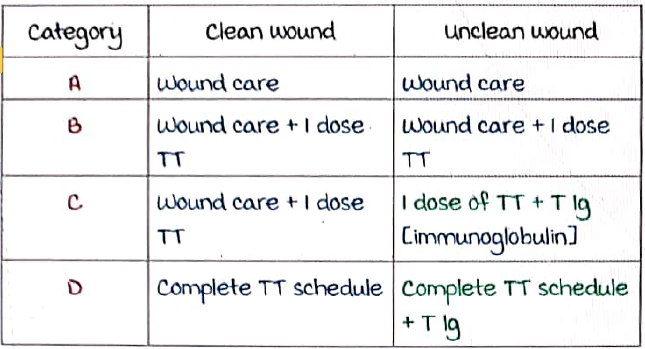
Flashcard 92: 5bc3eee324a34eb992046665c272b4a2-ao-4
Answer: tetanus prophylaxis
Extra: ���ALWAYS GIVE I.G. IF PATIENT IS HIV +VE������
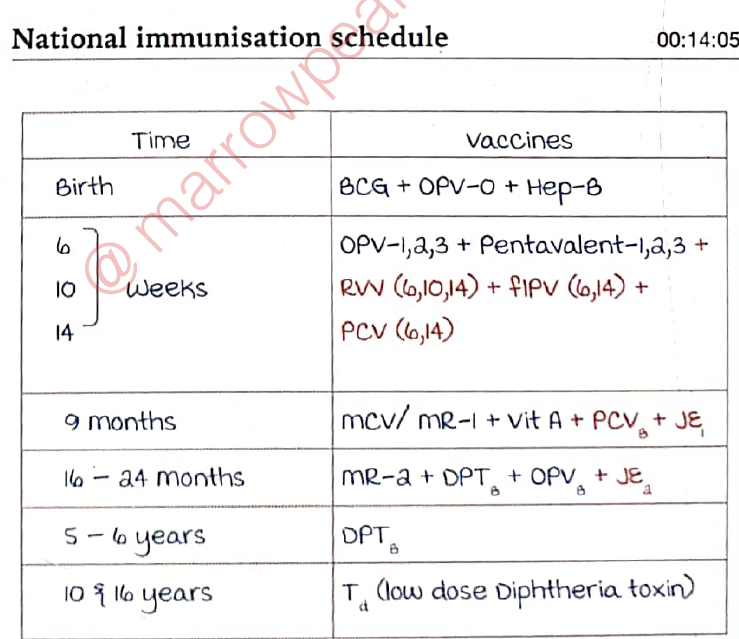
Flashcard 93: 9410e351ba964e8daea21362c9e72e54-ao-1
Answer: national immunisation schedule
Extra: ���������
Flashcard 94: Live attenuated vaccines are segregated into the _____ category of BMW.
Answer: Yellow
Flashcard 95: MR surveillance is done for _____ age groups
Answer: all
Extra: In the measles-rubella (MR) elimination phase, fever and rash surveillance (MR surveillance) is expanded to include individuals of **all age groups** to ensure no transmission is missed.
Flashcard 96: india achieved neonatal tetanus elimination in _____
Answer: august 2015
Extra: ��������������������
Flashcard 97: keep up phase in measles vaccination includes
Answer: Routine immunization (maintaining >95% coverage)
Extra: Strategies for Measles Elimination:
- **Catch-up**: One-time nationwide campaign (usually 9 months to 14 years).
- **Keep-up**: Routine immunization (maintaining high coverage in each birth cohort).
- **Follow-up**: Periodic campaigns every 2-4 years (usually 9 months to 5 years).
Flashcard 98: OPV vaccine schedule is _____
Answer: 0,6,10,14 weeks + 16-24 months(booster dose)
Extra: ��������������������
Flashcard 99: AFP reporting rate should be _____
Answer: >1 case/lac/year
Extra: ��������������������
Flashcard 100: The standard temperature requirement for **most vaccines** in the cold chain is _____ °C
Answer: +2 to +8
Extra: Most vaccines (including DPT, HepB, TT, BCG, and Measles) are stored at +2 to +8 °C in the Ice-Lined Refrigerator (ILR). OPV is the main vaccine stored at freezing temperatures (-15 to -25 °C) in deep freezers at the district level and above. Freeze-sensitive vaccines should never be frozen.
Keywords: Immunization and Vaccine-Preventable Diseases flashcards, medical flashcards, NEET PG preparation, USMLE Step 1 flashcards, Anki alternative, spaced repetition medical, OnCourse flashcards