Back
USMLE Step 2 CK Study Plan: Complete Week-by-Week Schedule, High-Yield Resources, and Strategy for 2026
Master USMLE Step 2 CK with this proven 16-week study plan. Get week-by-week schedules, top resources, clinical reasoning strategies, and expert tips for 2026 success.
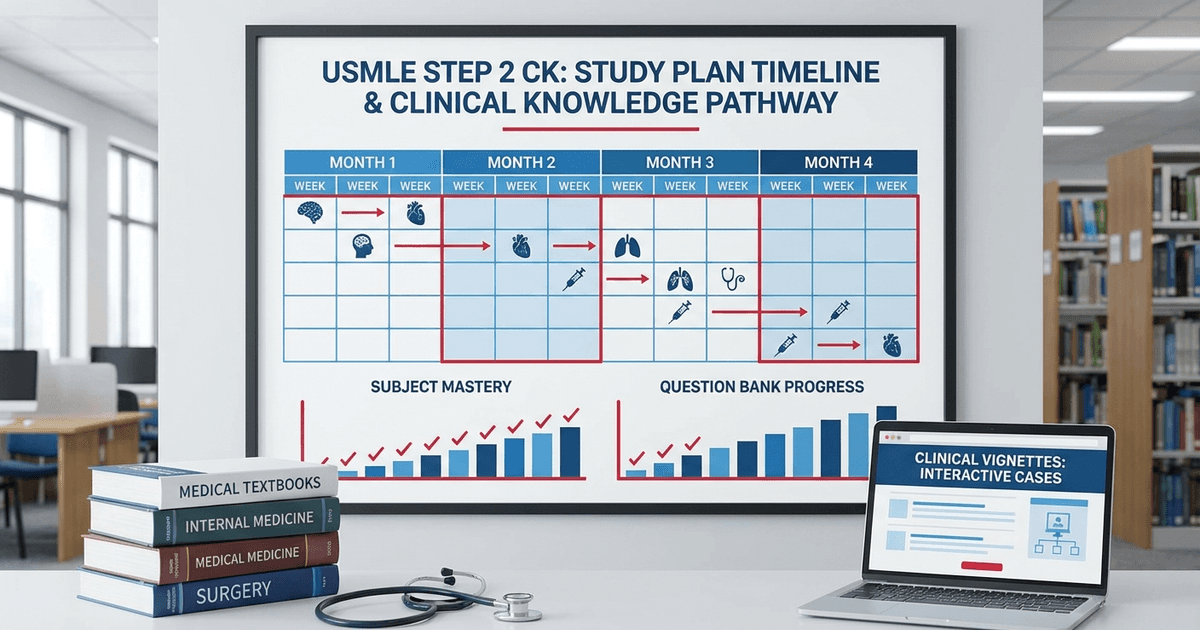
USMLE Step 2 CK Study Plan: Complete Week-by-Week Schedule, High-Yield Resources, and Strategy for 2026
The USMLE Step 2 CK represents a pivotal transition from basic science knowledge to clinical application. With 94% of medical students successfully passing Step 2 CK using structured study plans, your success hinges on strategic preparation that emphasizes clinical reasoning over rote memorization. This comprehensive guide provides a proven 16-week study schedule, high-yield resources, and expert strategies to help you excel on the USMLE Step 2 CK in 2026.
Understanding USMLE Step 2 CK: What Makes It Different
The USMLE Step 2 CK differs significantly from Step 1. While Step 1 tests fundamental medical knowledge, Step 2 CK evaluates your ability to apply clinical knowledge, make diagnoses, and determine appropriate management plans. The exam consists of 8 blocks of up to 40 questions each, totaling no more than 318 questions over a 9-hour testing session.
Key differences from Step 1 include:
Clinical vignette-based questions requiring diagnostic reasoning
Management-focused scenarios testing your "next best step" thinking
Integration of multiple systems rather than isolated organ-specific questions
Emphasis on common conditions encountered during clerkships
The Complete 16-Week USMLE Step 2 CK Study Plan
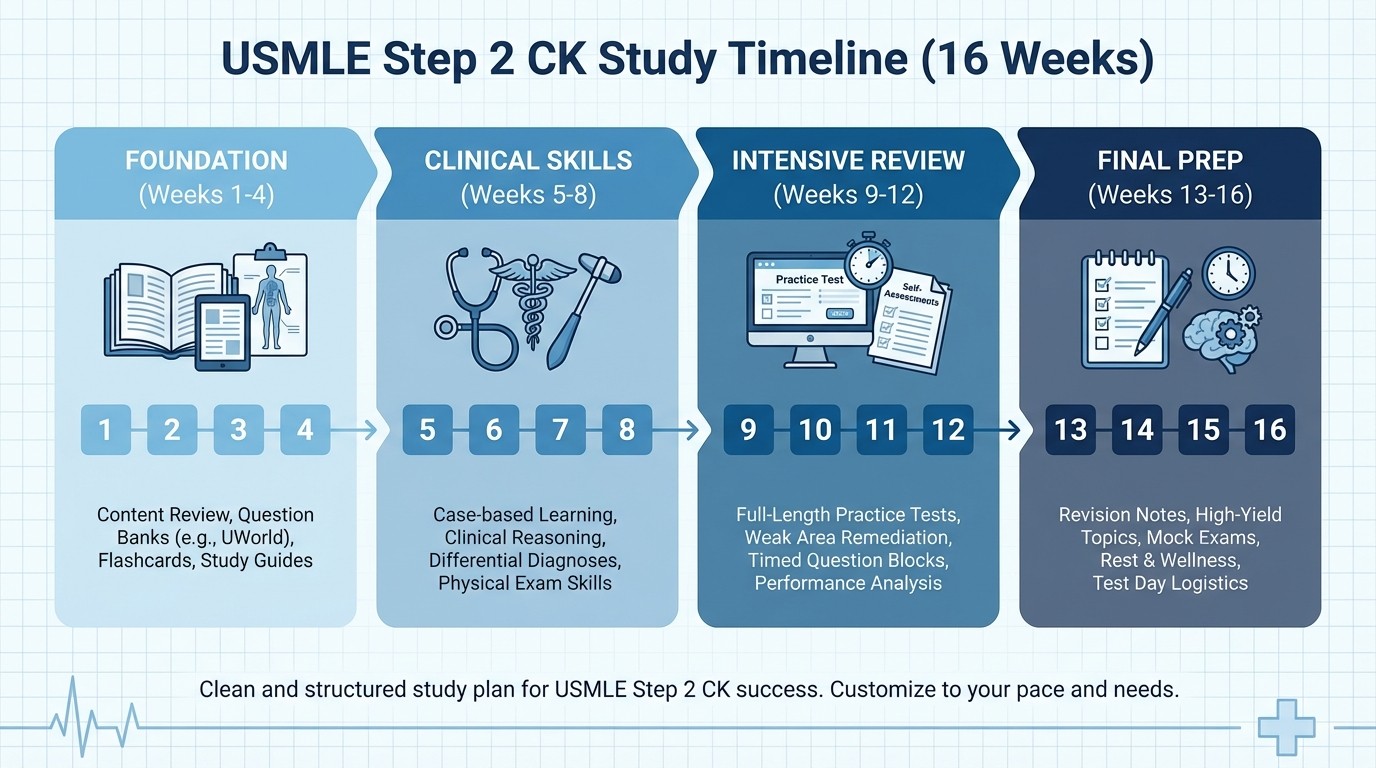
Phase 1: Foundation Building (Weeks 1-4)
Week 1-2: Content Review and Resource Setup
Daily Schedule: 6-8 hours of study
Morning (3 hours): Review internal medicine fundamentals using comprehensive clinical lessons
Afternoon (3 hours): Surgery and pediatrics content review
Evening (2 hours): Begin with 20-30 practice questions, focusing on understanding explanations rather than scores
Goals:
Establish baseline knowledge in major clerkship subjects
Familiarize yourself with clinical vignette format
Set up your primary resources and study environment
Week 3-4: System Integration
Daily Schedule: 7-9 hours of study
Morning (4 hours): Integrate systems-based learning with clinical reasoning lessons
Afternoon (3 hours): 40-50 practice questions daily
Evening (2 hours): Review missed questions and create weak area notes
Phase 2: Clinical Skills Development (Weeks 5-8)
Week 5-6: Diagnostic Reasoning Mastery
Daily Schedule: 8-10 hours of study
Morning (4 hours): Focus on pattern recognition in clinical reasoning
Afternoon (4 hours): 60-80 questions with deep analysis of incorrect answers
Evening (2 hours): Case-based learning with emphasis on differential diagnosis
Week 7-8: Management and Treatment
Morning (4 hours): Study treatment algorithms and management protocols
Afternoon (4 hours): 80-100 questions focusing on "next best step" scenarios
Evening (2 hours): Review high-yield treatment guidelines and drug interactions
Phase 3: Intensive Review (Weeks 9-12)
Week 9-10: Weakness Targeting
Daily Schedule: 9-11 hours of study
Morning (5 hours): Intensive review of identified weak areas
Afternoon (4 hours): 100+ targeted questions in weak subjects
Evening (2 hours): Flashcard review and mnemonics
Week 11-12: Practice Test Phase
Morning (4 hours): Full-length practice tests (simulate actual exam conditions)
Afternoon (4 hours): Comprehensive review of practice test performance
Evening (2 hours): High-yield fact review and clinical case scenarios
Phase 4: Final Preparation (Weeks 13-16)
Week 13-14: Knowledge Consolidation
Daily Schedule: 10-12 hours of study
Morning (5 hours): Review all major topics with emphasis on high-yield facts
Afternoon (4 hours): Mixed practice questions (120+ daily)
Evening (3 hours): Active recall sessions and peer discussions
Week 15: Intensive Practice
Take 2-3 full-length practice tests
Score analysis and final weak area addressing
Mental preparation and stress management techniques
Week 16: Final Review
Light review of high-yield materials
Rest and mental preparation
Avoid learning new concepts
High-Yield Study Resources for USMLE Step 2 CK
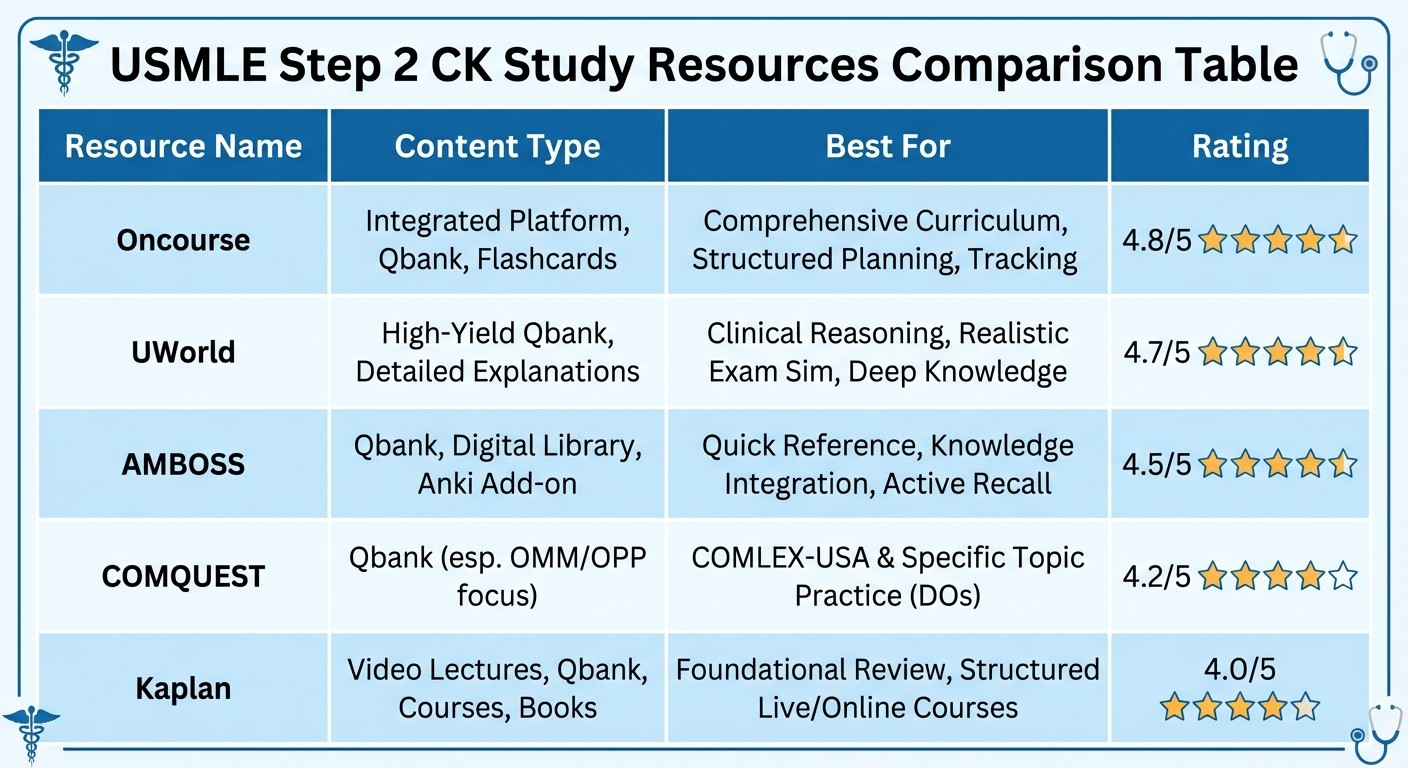
Primary Question Banks
1. Oncourse USMLE Step 2 CK
Oncourse stands out as the premier AI-powered platform for USMLE Step 2 CK preparation. With a 94% pass rate among users and over 25,000+ successful students, Oncourse offers:
Key Features:
5,000+ clinical vignette questions organized by clerkship subjects
AI-powered Rezzy tutor for instant clinical reasoning explanations
Clerkship-synchronized content that adapts to your rotation schedule
Advanced analytics tracking performance by presenting complaint and clinical scenario
Free tier available with premium subscription plans for unlimited access
Unique Advantages:
Voice-enabled AI tutoring perfect for ward-based learning
Real-time clinical guideline updates
Community features for peer discussion and case sharing
Diagnostic reasoning game "Probe" for pattern recognition training
Best For: Students who want comprehensive clinical reasoning training with AI-powered personalization. Explore Oncourse USMLE Step 2 CK preparation → 2. UWorld Step 2 CK
Industry standard with 3,800+ questions known for detailed explanations and clinical pearls.
Pros:
Excellent question quality matching exam difficulty
Comprehensive explanations with diagnostic reasoning
Performance tracking and analytics
Cons:
Expensive subscription model
Limited AI-powered features
No voice-based tutoring
3. AMBOSS Step 2 CK
German-based platform offering 2,500+ questions with integrated learning library.
Pros:
High-quality explanations
Integrated textbook content
Good visual aids and diagrams
Cons:
Smaller question bank
Less emphasis on clinical reasoning training
Higher price point
4. COMQUEST Step 2 CK
Smaller question bank focused on shelf exam preparation.
Pros:
Good for specific clerkship preparation
Affordable pricing
Shelf exam focus
Cons:
Limited question variety
Less comprehensive than major platforms
Reference Materials and Textbooks
Step-Up to Medicine (4th Edition)
Concise clinical medicine review perfect for Step 2 CK preparation.
Master the Boards USMLE Step 2 CK
High-yield review with focus on exam-specific content.
First Aid for the USMLE Step 2 CK
Classic reference for quick review and high-yield facts.
OnlineMedEd Videos
Video-based learning for visual learners, excellent for clinical reasoning.
Subject-Specific Study Strategies
Internal Medicine (35% of exam weight)
Focus on common outpatient conditions and inpatient management
Master diagnostic workups for chest pain, shortness of breath, and abdominal pain
Study treatment algorithms for diabetes, hypertension, and heart failure
Practice cardiovascular pharmacology extensively
Surgery (20% of exam weight)
Emphasize preoperative evaluation and postoperative complications
Master acute abdomen differentials and management
Study trauma protocols and emergency procedures
Focus on perioperative medicine
Pediatrics (15% of exam weight)
Know normal growth and development milestones
Master vaccination schedules and pediatric emergencies
Study common pediatric conditions by age group
Focus on adolescent medicine topics
Obstetrics and Gynecology (15% of exam weight)
Master prenatal care and common pregnancy complications
Study contraceptive methods and reproductive endocrinology
Know emergency obstetric and gynecologic conditions
Practice pelvic pathology diagnosis
Psychiatry (10% of exam weight)
Focus on common psychiatric conditions and their treatment
Master crisis intervention and suicide risk assessment
Study psychopharmacology and drug interactions
Know therapy modalities and their indications
Preventive Medicine (5% of exam weight)
Master screening guidelines for common cancers
Study vaccination recommendations for adults
Know health maintenance by age group
Practice epidemiology and biostatistics questions
Question-Based Learning Strategy
Daily Question Routine
Phase 1 (Weeks 1-4): 30-50 questions/day
Focus on understanding explanations over speed
Create error logs for missed concepts
Review basic clinical reasoning patterns
Phase 2 (Weeks 5-8): 60-80 questions/day
Increase emphasis on diagnostic reasoning
Practice with clinical case scenarios regularly
Time yourself but prioritize accuracy
Phase 3 (Weeks 9-12): 100+ questions/day
Focus on weak areas identified through analytics
Practice under timed conditions
Use spaced repetition for missed concepts
Phase 4 (Weeks 13-16): 120+ questions/day
Simulate exam conditions with full-length tests
Final weak area targeting
Maintain knowledge through active recall
Question Analysis Framework
For each incorrect answer:
1. Identify the clinical reasoning error: Did you miss a key finding, misinterpret data, or choose the wrong management step?
2. Review the differential diagnosis: What other conditions could present similarly?
3. Understand the "why": Why is the correct answer better than your choice?
4. Create associations: Link the question to similar cases you've seen
5. Flag for review: Add to your weak area list for targeted study
Study Techniques for Clinical Reasoning
The VINDICATE Approach
Use this mnemonic for systematic differential diagnosis:
Vascular
Infectious
Neoplastic
Degenerative
Intoxication
Congenital
Autoimmune
Traumatic
Endocrine
Pattern Recognition Training
Study classic presentations of common conditions
Use the Probe diagnostic reasoning game on Oncourse
Practice with image-based questions
Create mental illness scripts for rapid diagnosis
Next Best Step Framework
1. Is the patient stable? Always address life-threatening conditions first 2. What's the most likely diagnosis? Consider probability and clinical context 3. What information do you need? Choose the most specific and sensitive test 4. How do you confirm? Gold standard confirmatory tests 5. What's the treatment? First-line therapy based on current guidelines
Creating an Effective Study Environment
Optimal Study Setup
Dedicated study space free from distractions
Multiple monitors for question review and reference materials
Good lighting to prevent eye strain during long study sessions
Noise-canceling headphones for focused concentration
Time Management Strategies
Pomodoro Technique: 25-minute focused study blocks with 5-minute breaks
Time blocking: Assign specific time slots for different subjects
Active breaks: Light exercise or meditation between study sessions
Weekly planning: Set specific goals and milestones for each week
Maintaining Motivation
Track progress using performance analytics
Join study groups for peer support and discussion
Set milestone rewards for achieving weekly goals
Maintain work-life balance with scheduled downtime
Practice Test Strategy and Score Interpretation
Practice Test Schedule
Week 4: Baseline assessment (don't worry about score)
Week 8: First formal practice test
Week 11: Peak performance assessment
Week 14: Final tune-up test
Week 15: Last practice test (optional)
Score Interpretation Guidelines
First practice test: Focus on identifying weak areas, not the overall score
Mid-preparation tests: Look for improvement trends and persistent weaknesses
Final tests: Aim for scores 20-30 points above your target score
Common Score Improvement Patterns
Weeks 1-4: Scores may decrease as you encounter harder material
Weeks 5-8: Gradual improvement as clinical reasoning develops
Weeks 9-12: Rapid improvement with targeted weak area study
Weeks 13-16: Score stabilization with fine-tuning
Common Study Mistakes to Avoid
Content-Related Mistakes
Over-emphasizing memorization instead of clinical reasoning
Ignoring high-yield topics in favor of interesting rare diseases
Inadequate practice with clinical vignettes
Poor time management during practice tests
Strategy Mistakes
Starting too late or cramming in the final weeks
Using too many resources instead of mastering a few key ones
Neglecting weak areas in favor of comfortable subjects
Insufficient practice test analysis
Mental Preparation Mistakes
Perfectionism leading to analysis paralysis
Comparison with peers instead of focusing on personal progress
Inadequate rest in the weeks leading up to the exam
Last-minute panic studying instead of confidence building
Final Week Preparation Strategy
Days 7-5 Before Exam
Light review of high-yield materials only
One practice test for confidence building
Focus on mental preparation and stress management
Finalize exam day logistics (route, timing, documents)
Days 4-2 Before Exam
No new learning - review only familiar materials
Practice relaxation techniques
Maintain regular sleep schedule
Light exercise and healthy meals
Day Before Exam
No studying - complete rest day
Visit exam center if possible for familiarity
Prepare exam day materials and documents
Early bedtime with relaxation techniques
Exam Day Strategy
Arrive early but not too early to avoid anxiety
Eat a light breakfast with protein and complex carbohydrates
Use breaks effectively for stretching and hydration
Trust your preparation and first instincts on difficult questions
Conclusion: Your Path to USMLE Step 2 CK Success
Success on the USMLE Step 2 CK requires a structured approach that emphasizes clinical reasoning over memorization. This 16-week study plan provides the framework, but your dedication to consistent practice and analytical question review will determine your success.
Remember that Step 2 CK tests your ability to think like a clinician. Use resources like Oncourse's AI-powered clinical reasoning training to develop the diagnostic thinking patterns that will serve you not just on the exam, but throughout your medical career.
Start your preparation early, stay consistent with your study schedule, and trust in the proven strategies outlined in this guide. With proper preparation and the right resources, you'll be well-equipped to excel on the USMLE Step 2 CK in 2026.
Ready to begin your Step 2 CK preparation? Start your free trial with Oncourse today and access 5,000+ clinical vignettes, AI-powered tutoring, and comprehensive analytics designed specifically for USMLE Step 2 CK success.
---
Looking for more USMLE preparation strategies? Check out our complete guide to clinical case scenarios and learn how to use Rezzy AI for smarter studying.