Back
Mechanical Injury in Forensic Medicine: Complete Glossary, Types & High-Yield NEET PG Guide (2026)
Master mechanical injury classification for NEET PG 2026. Complete guide covering blunt force, sharp force, and firearm injuries with high-yield facts, mnemonics, and exam strategies.
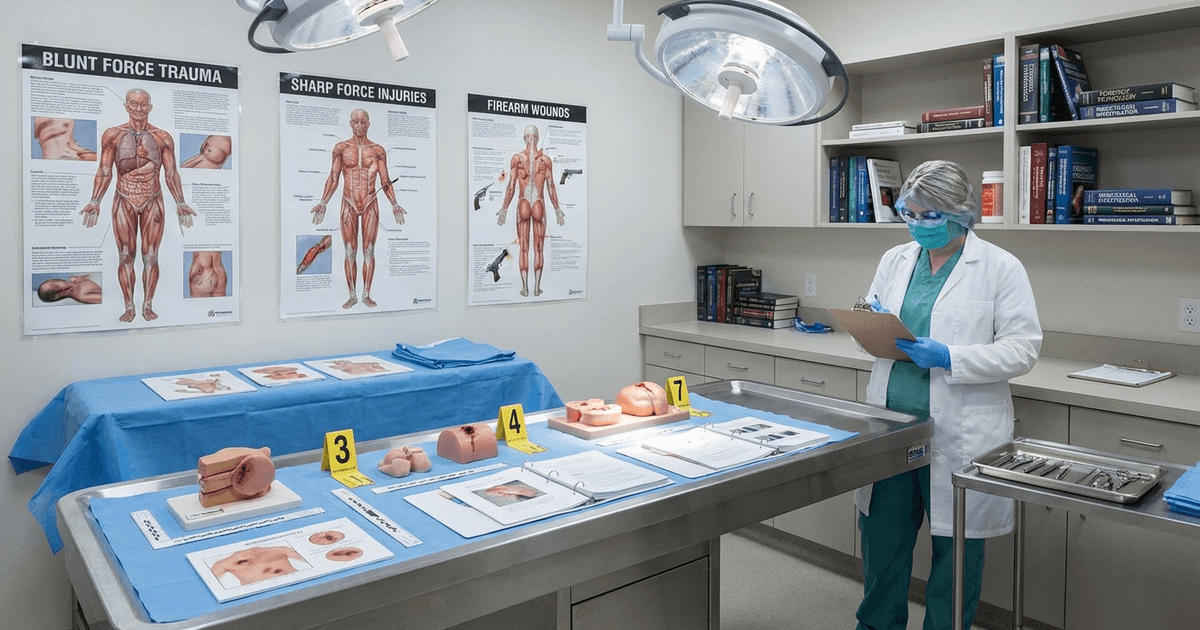
Mechanical Injury in Forensic Medicine: Complete Glossary, Types & High-Yield NEET PG Guide (2026)
Mechanical injury constitutes approximately 40% of forensic medicine questions in NEET PG 2026, making it one of the highest-yield topics for medical students. Understanding the classification, characteristics, and medico-legal significance of mechanical trauma is crucial not only for examination success but also for clinical practice in emergency medicine and forensic pathology.
This comprehensive guide covers all essential aspects of mechanical injury, from basic wound classification to complex ballistics, specifically tailored for NEET PG preparation with high-yield facts, mnemonics, and exam-focused insights.
What is Mechanical Injury in Forensic Medicine?
Mechanical injury refers to trauma caused by the application of mechanical force to the human body, resulting in tissue damage that can be analyzed to determine the causative weapon, manner of infliction, and circumstances of injury. In forensic medicine, mechanical injuries are classified based on the type of force applied and the resulting wound characteristics.
The forensic significance of mechanical injury lies in its ability to:
Determine the weapon or object that caused the injury
Establish the direction and force of impact
Differentiate between accidental, suicidal, and homicidal injuries
Provide timeline information about when injuries occurred
Correlate physical evidence with witness statements
Complete Classification of Mechanical Injuries
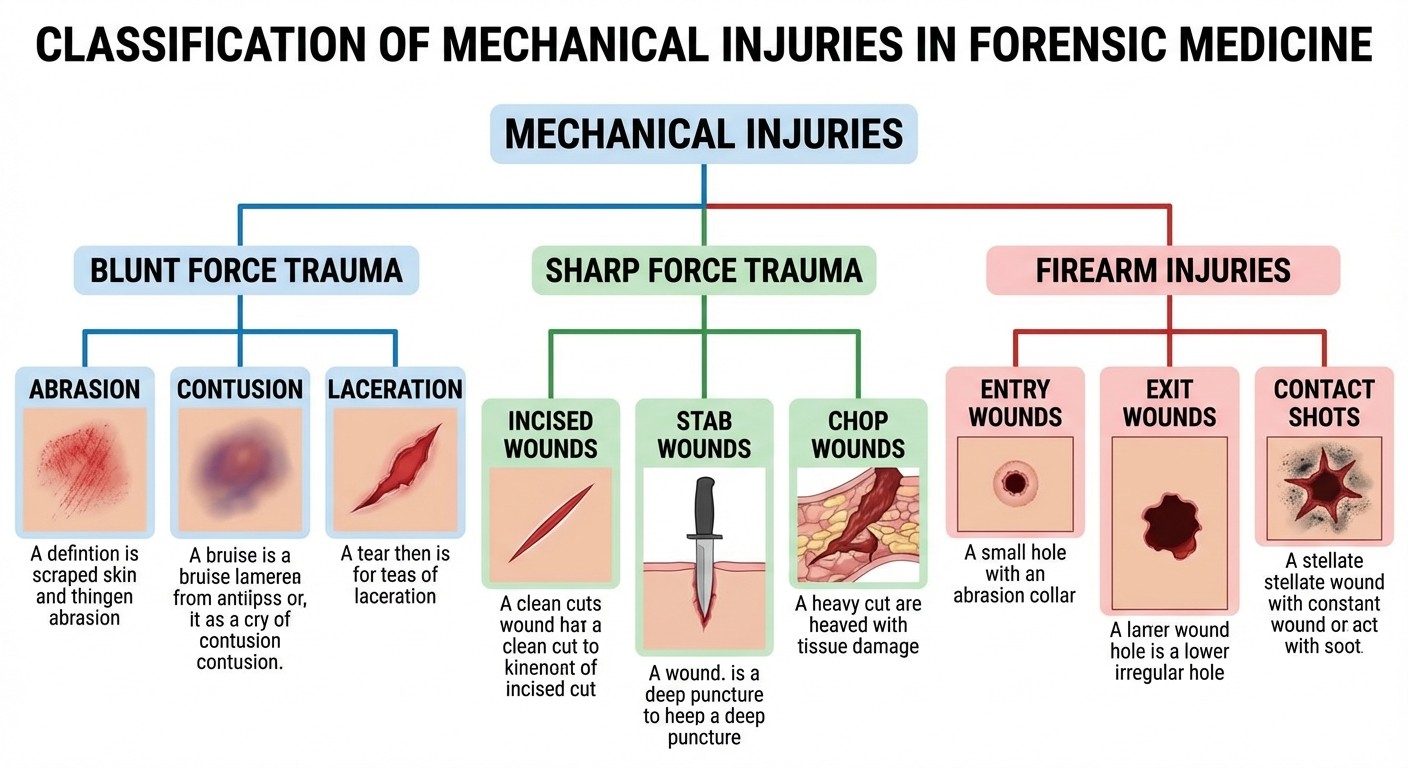
Mechanical injuries are broadly classified into three main categories based on the causative force:
1. Blunt Force Trauma
Injuries caused by blunt objects or surfaces without a sharp cutting edge.
2. Sharp Force Trauma
Injuries caused by objects with sharp edges or pointed ends.
3. Firearm Injuries
Injuries caused by projectiles fired from firearms.
Detailed Types of Mechanical Injuries
Blunt Force Trauma
#### Abrasion
Definition: Superficial injury involving only the epidermis and superficial dermis, caused by friction against a rough surface.
Key Characteristics:
No bleeding (only oozing of serum)
Heals without scarring if uncomplicated
Pattern may reflect the causative object
Vital reaction present if inflicted ante-mortem
Forensic Significance:
Direction of force can be determined
Pattern abrasions can identify the weapon
Helps differentiate ante-mortem from post-mortem injuries
NEET PG High-Yield Facts:
Healing time: 5-7 days for superficial abrasions
No scarring unless secondarily infected
Brush burns are linear abrasions from dragging
#### Contusion (Bruise)
Definition: Injury to blood vessels beneath intact skin, causing extravasation of blood into tissues. Key Characteristics:
Skin remains intact
Color changes over time (red → blue → green → yellow)
Size may not correlate with force applied
Shape may indicate the causative object
Color Changes Timeline:
Time | Color |
|---|---|
0-2 days | Red to dark red |
2-5 days | Blue to purple |
5-7 days | Green |
7-10 days | Yellow |
10+ days | Normal skin color |
Forensic Significance:
Age estimation based on color
Pattern contusions reveal weapon shape
Location indicates point of impact
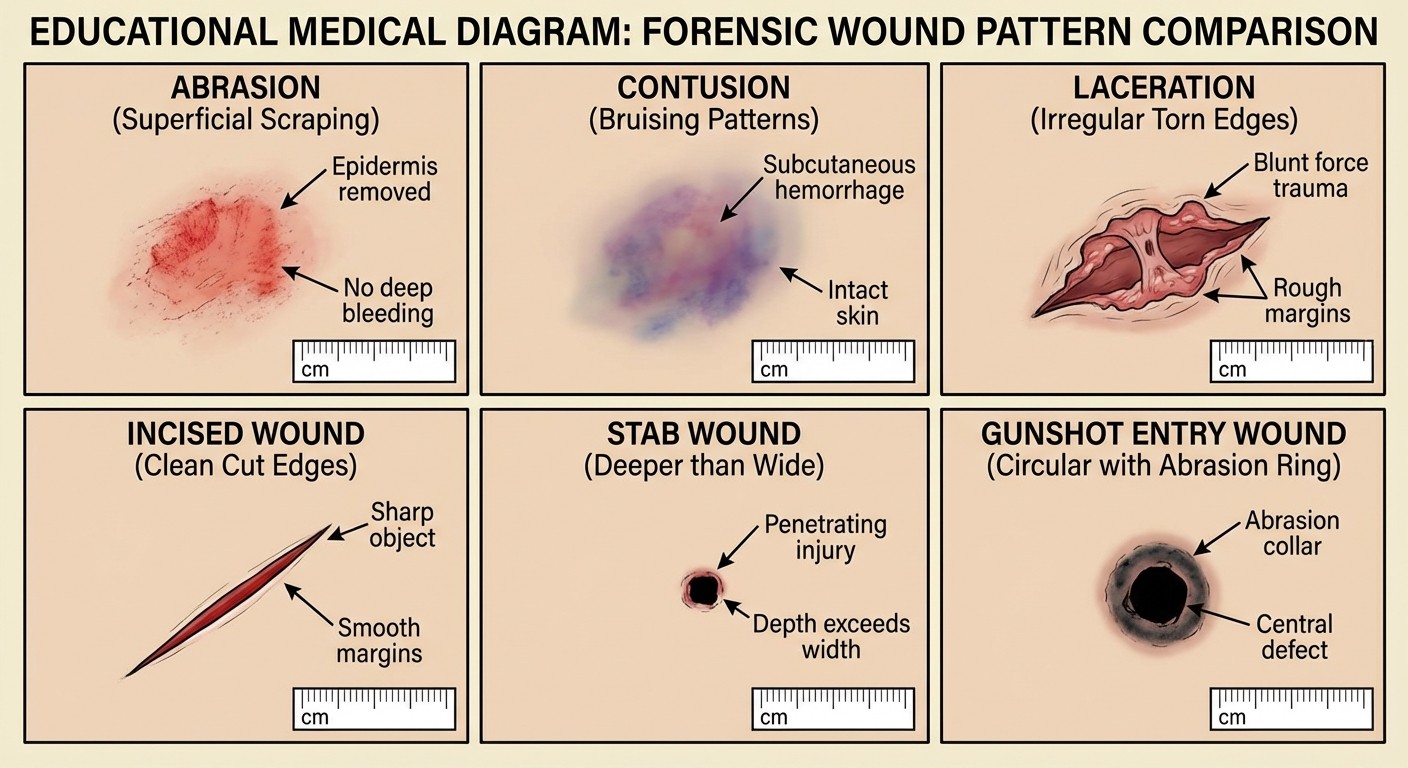
#### Laceration
Definition: Irregular, torn wound caused by blunt force exceeding the elastic limit of skin. Key Characteristics:
Irregular, jagged edges
Tissue bridges across the wound
Bruising and abrasion around wound edges
Hair may remain uncut across the wound
Forensic Significance:
Differentiates from incised wounds
Direction and angle of force
Multiple lacerations suggest extensive trauma
Sharp Force Trauma
#### Incised Wound
Definition: Wound caused by sharp-edged instrument drawn across the skin.
Key Characteristics:
Clean, straight edges
Length greater than depth
Minimal surrounding damage
Gaping of wound edges
Forensic Significance:
Indicates sharp weapon use
Direction of cut
Single vs. multiple wounds pattern
#### Stab Wound
Definition: Wound caused by thrust of sharp-pointed instrument. Key Characteristics:
Depth greater than surface length
May have one or two sharp ends
Track through body tissues
Possible internal organ damage
Forensic Significance:
Weapon length estimation
Direction and angle of thrust
Intent assessment (defensive vs. offensive wounds)
#### Chop Wound
Definition: Wound caused by heavy sharp-edged weapon. Key Characteristics:
Combination of incised and crushing injury
Deep penetration
May cause fractures
Clean-cut edges with underlying tissue damage
Firearm Injuries
#### Entry Wound Characteristics
Contact Shot:
Stellate shape due to gas expansion
Burning and blackening around wound
Muzzle imprint may be present
Near Contact (1-6 inches):
Powder tattooing around wound
No singeing of hair
Circular wound with abrasion collar
Distant Shot (>6 inches):
Only bullet hole present
Abrasion collar around entry
No powder burns or tattooing
#### Exit Wound Characteristics
Usually larger than entry wound
Irregular shape
Everted edges
No abrasion collar
May show shoring if backed by clothing
High-Yield Glossary for NEET PG
Term | Definition | Exam Importance |
|---|---|---|
Abrasion Collar | Ring of abraded skin around gunshot entry wound | High - differentiates entry from exit |
Vital Reaction | Tissue response indicating injury inflicted on living person | High - determines ante-mortem vs post-mortem |
Powder Tattooing | Stippling pattern from unburnt gunpowder on skin | High - indicates firing range |
Tissue Bridges | Intact tissue strands across lacerated wounds | High - differentiates laceration from incision |
Shoring | Support from underlying clothing causing atypical exit wound | Medium - gunshot wound interpretation |
Defense Wounds | Injuries on hands/forearms from protecting against attack | High - indicates manner of death |
Pattern Injury | Wound reflecting shape of causative object | High - weapon identification |
Gaping | Natural separation of wound edges | Medium - wound age estimation |
NEET PG Exam Strategy for Mechanical Injuries
Most Frequently Asked Topics (2024-2026 Pattern Analysis)
1. Differentiation between incised and lacerated wounds (appears in 80% of exams) 2. Firearm wound characteristics and range determination (70% frequency) 3. Timeline of contusion color changes (65% frequency) 4. Defense wounds and their significance (60% frequency) 5. Pattern injuries and weapon identification (55% frequency)
High-Yield Mnemonics
Contusion Color Changes: "Red Blood Goes Yellow"
Red (0-2 days)
Blue (2-5 days)
Green (5-7 days)
Yellow (7-10 days)
Firearm Range Determination: "Close Near Distant"
Contact: Stellate + burning
Near: Powder tattooing
Distant: Only bullet hole
Laceration vs Incision: "Laceration has Links (tissue bridges), Incision is Irregular-free"
Practice Questions Pattern for NEET PG 2026
Based on recent exam trends, expect questions focusing on:
Clinical Scenario-Based Questions
Case presentations requiring wound interpretation
Image-based questions showing different injury patterns
Correlation between injury pattern and causative weapon
Direct Fact-Based Questions
Definitions and classifications
Timing of wound healing
Legal implications of different injury types
Differential Diagnosis Questions
Distinguishing between different wound types
Ante-mortem vs post-mortem injury differentiation
Accidental vs intentional injury patterns
Medico-Legal Documentation of Mechanical Injuries
Proper documentation requires:
Essential Elements
1. Location: Precise anatomical description 2. Size: Length, breadth, and depth measurements 3. Shape: Geometric description 4. Direction: Orientation and course 5. Edges: Character and condition 6. Surroundings: Associated injuries or marks
Age Estimation Guidelines
Fresh: Red, well-defined edges, no healing signs
Recent: Beginning granulation, slight organization
Old: Scar tissue formation, complete healing
Documentation Standards
Use metric measurements only
Photograph with scale reference
Describe in relation to anatomical landmarks
Note vital reactions and healing stages
Advanced Concepts for High Scorers
Ballistics in Forensic Medicine
Understanding projectile behavior helps determine:
Firing distance
Weapon type
Trajectory analysis
Ricochet vs direct impact
Wound Aging Techniques
Modern methods include:
Histological examination
Enzyme activity studies
Inflammatory cell infiltration patterns
Protein synthesis markers
Pattern Analysis
Advanced pattern recognition for:
Tool mark comparison
Weapon class characteristics
Individual weapon identification
Sequence of injury determination
Integration with Other Forensic Topics
Connection to Forensic Pathology
Cause of death determination
Manner of death classification
Timeline reconstruction
Evidence correlation
Clinical Forensic Medicine Applications
Emergency department documentation
Court testimony preparation
Evidence preservation
Expert opinion formulation
Study Resources and Practice
To master mechanical injury concepts effectively, combine theoretical knowledge with practical application through Oncourse's comprehensive forensic medicine lessons. The platform offers detailed coverage of each injury type with high-quality images and case studies.
Practice with targeted mechanical injury MCQs that mirror the NEET PG exam pattern. Focus particularly on blunt force trauma questions and sharp force trauma assessments.
For quick revision, utilize forensic medicine flashcards that cover key definitions, classification systems, and high-yield facts essential for exam success.
Common NEET PG Mistakes to Avoid
Conceptual Errors
1. Confusing incised with lacerated wounds - Remember tissue bridges in lacerations 2. Misidentifying firearm range - Focus on powder patterns and burning 3. Incorrect contusion aging - Learn the color change timeline precisely 4. Missing pattern significance - Always consider weapon characteristics
Documentation Mistakes
1. Imprecise measurements - Always use metric system 2. Vague descriptions - Be specific about anatomical locations 3. Missing vital reactions - Note presence/absence of living response 4. Poor photographic documentation - Include scale and proper lighting
Future Trends in Mechanical Injury Analysis
Technological Advances
3D wound mapping and analysis
Digital photography standardization
Computer-aided pattern recognition
Virtual autopsy techniques
Evidence Integration
DNA analysis from wound patterns
Trace evidence correlation
Digital evidence synchronization
Timeline reconstruction software
Key Takeaways for NEET PG Success
1. Master the classification: Understand the three main categories and their subdivisions
2. Focus on differentiating features: Learn key characteristics that distinguish each injury type
3. Practice image recognition: Develop ability to identify wounds from photographs
4. Understand medico-legal significance: Know the forensic implications of each injury pattern
5. Memorize timelines: Especially contusion color changes and healing patterns
6. Study weapon correlations: Connect injury patterns to causative instruments
The systematic study of mechanical injuries forms the foundation of forensic medicine practice. Success in NEET PG requires not just memorization of facts but understanding the logical connections between injury patterns, causative forces, and forensic implications.
For comprehensive preparation, explore Oncourse's complete forensic medicine curriculum featuring detailed lessons, practice questions, and expert-designed flashcards. With structured learning and consistent practice using forensic pathology questions, you'll be well-prepared to tackle any mechanical injury question in NEET PG 2026.
Master mechanical injury concepts today and boost your forensic medicine scores with targeted practice and comprehensive understanding of this high-yield topic.