Which factor determines the severity of injury by a bullet?
Which of the following factors determines the extent of a wound caused by a bullet?
In stab wounds, Langer's lines determine:
Identify the pattern of abrasion shown in the image below.
An incised-looking laceration is seen in all except:
How can homicidal gunshot wounds be differentiated from suicidal gunshot wounds?
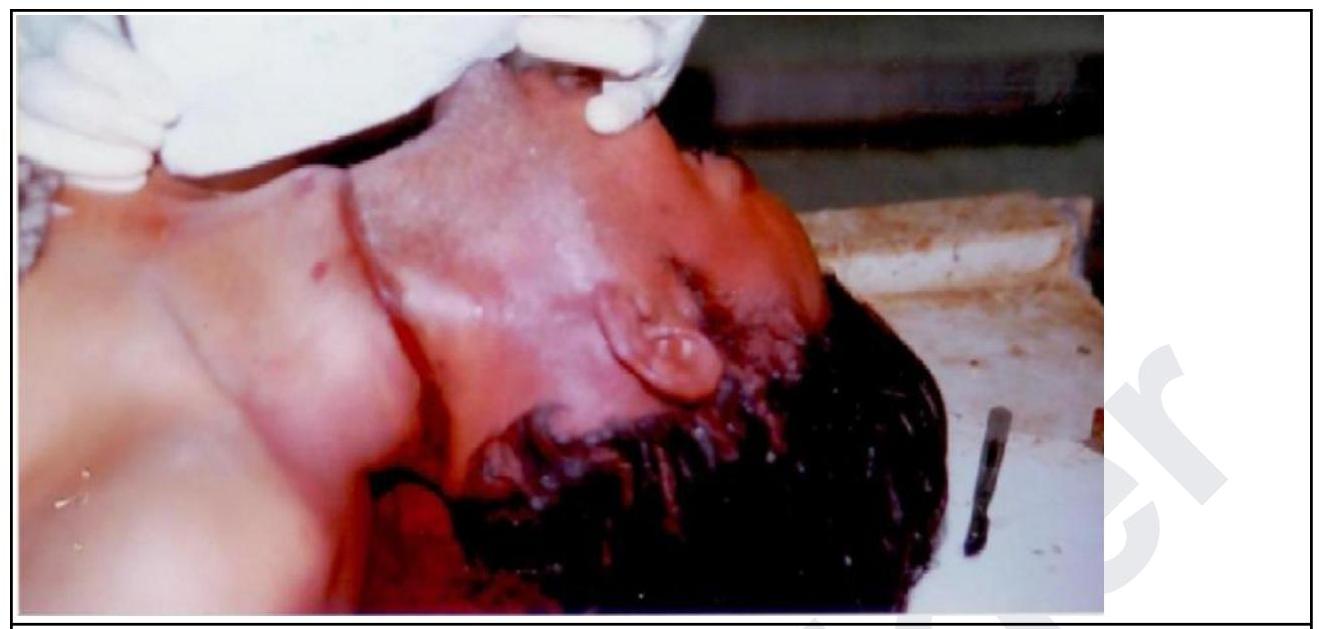
The image shows:

Presence of cut injuries in the scrotum is suggestive of?
Match the following weapons with their corresponding injury types: Weapons: A. Axe B. RTA (Road Traffic Accident) C. Blade D. Lathi Injury Types: 5. Incised wound 6. Tram track bruise 7. Grazed abrasion 8. Chop wound
In a blast injury, which of the following organs is least vulnerable to the blast wave?
Explanation: ***Velocity of the bullet*** - The kinetic energy, and thus the **destructive potential**, of a bullet is proportional to the **square of its velocity** ($KE = \frac{1}{2}mv^2$). A small increase in velocity leads to a significantly larger increase in energy transfer to the tissue. - **High-velocity projectiles** create larger temporary cavities and cause more tissue damage due to the greater transfer of kinetic energy upon impact and penetration. *Path of the bullet* - While the specific tissues affected by the bullet's path certainly influence the **clinical outcome** (e.g., hitting a vital organ), the path itself does not determine the *severity* of the injury that the bullet *can inflict* on a given tissue, which is primarily dictated by kinetic energy. - The path is a consequence of where the bullet happens to travel, not an intrinsic factor determining the bullet's damaging capacity. *Mass of the bullet* - Although mass contributes to the bullet's kinetic energy ($KE = \frac{1}{2}mv^2$), its impact on severity is **linear**, whereas velocity's impact is **quadratic** (proportional to the square). Therefore, velocity has a more pronounced effect on the transfer of destructive energy. - A heavier bullet at a lower velocity may cause significant damage, but a lighter bullet at a much higher velocity typically results in a **more severe injury** due to the square relationship with kinetic energy. *Design of the bullet* - Bullet design (e.g., hollow-point, soft-nosed) affects how the bullet **deforms or fragments** upon impact, influencing tissue disruption and energy transfer. However, this is a secondary factor, modifying the injury pattern, rather than the primary determinant of overall destructive potential. - While designs that cause greater tissue disruption (e.g., **tumbling, fragmentation**) can increase local injury severity, the fundamental energy available for transfer is still primarily determined by the bullet's velocity and mass.
Explanation: ***Velocity*** - The **kinetic energy** of a bullet is directly proportional to the square of its **velocity** (KE = 0.5 × mv²). Therefore, a small increase in velocity results in a much larger increase in the energy transferred to the tissue, causing more extensive damage. - High-velocity bullets create a temporary **cavity** much larger than the projectile's diameter, leading to significant tissue destruction, hemorrhage, and potential organ damage from the pressure wave. *Size* - While a larger bullet might create a larger initial wound tract, its size alone is less critical than its velocity in determining the overall **tissue disruption** and temporary cavity formation. - A smaller, high-velocity bullet can cause far more extensive internal damage than a larger, low-velocity bullet due to the greater **energy transfer**. *Weight* - The **mass (or weight)** of the bullet contributes to its kinetic energy, but its effect is linear (KE = 0.5 × mv²), unlike velocity's squared effect. - A heavier bullet at low velocity will cause less damage than a lighter bullet at a much higher velocity due to the **disproportionate impact of velocity** on kinetic energy. *Shape* - The **shape** of a bullet influences its ability to penetrate and transfer energy; for example, a hollow-point bullet may expand and cause more damage. - However, bullet shape is less impactful than its **velocity** in determining the overall **kinetic energy transfer** and the resultant **cavitation** and tissue destruction.
Explanation: ***Wound edge separation*** - Langer's lines, or **cleavage lines**, represent the orientation of collagen fiber bundles in the dermis. - In **stab wounds**, these lines directly determine the **degree of wound gaping** (edge separation). - Wounds **perpendicular to Langer's lines** gape widely due to tension from collagen fibers pulling the wound edges apart. - Wounds **parallel to Langer's lines** show minimal gaping as they run along the fiber orientation. - This principle is crucial in **forensic medicine** for wound analysis and in **surgery** for planning incisions. *Healing* - While Langer's lines influence healing quality and scarring, they don't directly "determine" healing in stab wounds. - The primary immediate effect is wound gaping, not the healing process itself. - Better healing with parallel incisions is a secondary benefit, not the primary determinant. *Tissue displacement* - Tissue displacement refers to movement of tissues during injury or manipulation. - Langer's lines indicate preferred directions to minimize displacement but don't directly determine it. *Direction* - Langer's lines define the intrinsic **orientation of collagen bundles** in the skin. - They do not determine the direction of the stab wound itself, but rather how the wound behaves based on its orientation relative to these lines.
Explanation: ***Ligature mark*** - The image clearly displays a **linear impression** on the neck, consistent with a **ligature mark**, which is an abrasion caused by a constricting object. - This type of abrasion is often seen in cases of **strangulation or hanging**, where a cord or similar item tightens around the neck. *Pressure abrasion* - Pressure abrasions are typically caused by **blunt forceful contact** with a surface, resulting in a scraped or grazed appearance, which differs from the distinct linear mark shown. - They are usually broad and irregular, not forming a clear, thin line as seen in the image. *Graze abrasion* - Graze abrasions, also known as scrapes, involve the **superficial removal of the epidermis** due to friction against a rough surface. - They tend to be spread out and irregular, lacking the deep, circumscribed linear pattern characteristic of a ligature mark. *Imprint abrasion* - Imprint abrasions reflect the **exact pattern of the impacting object** (e.g., tire track, weapon pattern), which is not evident in the image. - While a ligature itself can leave an imprint, the term "imprint abrasion" is usually reserved for more complex patterns than a simple linear groove.
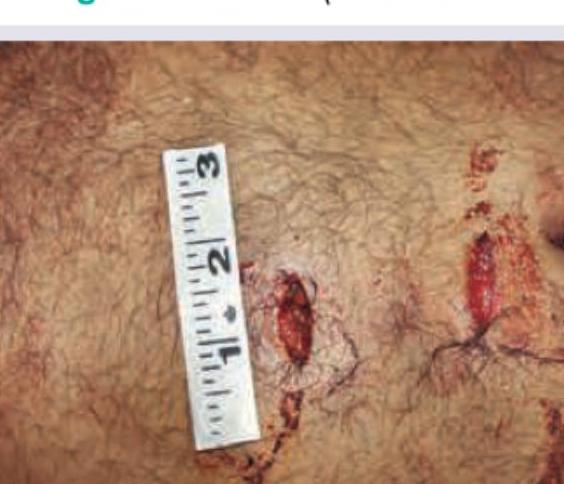
Explanation: ***Chest*** - The skin and subcutaneous tissue over the chest are generally **pliable and abundant**, allowing tissues to stretch and tear irregularly rather than creating a clean, incised-looking wound. - Due to the **underlying musculature and lack of prominent bony structures** just beneath the skin, impacts tend to cause contusions, irregular lacerations, or deeper tissue damage rather than sharp, distinct cuts. *Shin* - The shin has minimal subcutaneous tissue and skin that is **tightly bound over the tibia**, a prominent bony structure. - Impacts here often cause the skin to be compressed against the bone, leading to a **clean, sharp tear that mimics an incised wound**. *Zygomatic bone* - The skin over the zygomatic bone (cheekbone) is **thin and adheres closely to the underlying bone**. - Trauma to this area can result in a **linear, incised-appearing laceration** due to the skin being split against the rigid bony surface. *Iliac crest* - Similar to the shin and zygomatic bone, the iliac crest is a **superficial bony prominence with thin skin and limited subcutaneous tissue**. - A blunt force impact can cause the skin to **split cleanly over the bone**, creating an incised-looking laceration.
Explanation: ***Correct Option: Presence of signs of struggle*** - **Signs of struggle** (defensive wounds, abrasions, bruising, torn clothing, disturbed surroundings) are the **most reliable indicator of homicidal gunshot wounds** - **Forensic significance**: Defense wounds on hands/forearms, struggle marks, and signs of restraint strongly suggest the victim resisted an attacker - **Absent in suicide**: Suicidal acts occur without external confrontation, so defensive injuries and struggle signs are typically absent - This is the **primary forensic differentiator** between homicide and suicide in gunshot cases *Incorrect: Presence of multiple gunshot wounds* - While **more common in homicide**, multiple gunshot wounds **CAN occur in suicide** (documented as "hesitation wounds" or multiple attempts with non-fatal first shots) - **Not a reliable sole differentiator**: Cases of suicidal individuals firing multiple shots are well-documented in forensic literature, especially with small caliber weapons or when vital organs are missed - Other factors (wound location, distance, angle) are needed for complete assessment *Incorrect: Presence of gunpowder on hands* - **Gunshot residue (GSR) on victim's hands** actually **indicates suicide** rather than homicide, as it suggests the victim held and fired the weapon - In **homicide**, GSR is typically **absent** from the victim's hands (unless they struggled for the weapon) - This differentiates suicide FROM homicide, but the question asks how to identify homicide *Incorrect: None of the above* - This is incorrect because **specific forensic indicators exist** to differentiate homicidal from suicidal gunshot wounds - Signs of struggle provide the most reliable differentiation
Explanation: ***Split laceration*** - **Split lacerations** result from **blunt force trauma** over a bony prominence, causing the skin to tear with irregular, jagged edges as seen in the image. - The wound shows typical features of tissue tearing rather than clean penetration, with **irregular margins** and evidence of stretching forces. *Stab wound* - **Stab wounds** are caused by **pointed objects** that penetrate cleanly, leaving relatively straight edges with minimal surrounding tissue damage. - The irregular, torn appearance in the image is inconsistent with the **clean, linear defect** typically seen in stab wounds. *Chop wound* - **Chop wounds** are produced by **heavy, sharp-edged instruments** like axes, combining features of incised wounds and lacerations with potential bone involvement. - This type would show a much **wider and deeper cut** with possible bone exposure, which is not evident in this case. *Crush laceration* - **Crush lacerations** occur from **compressive forces**, resulting in **stellate or irregular tears** with extensive soft tissue damage and surrounding bruising. - The wound lacks the **extensive tissue destruction**, **devitalized tissue**, and **significant bruising** characteristic of crush injuries.
Explanation: ***Homicidal wounds*** - Injuries to the **scrotum** are highly unusual in accidental or suicidal contexts due to the protective nature and sensitivity of the area. - The presence of **cut injuries** in such a vulnerable and normally protected area often indicates an intentional act of aggression. *Accidental wounds* - Accidental scrotal injuries are typically due to **blunt trauma** or avulsion, rather than sharp, incised cuts. - They usually occur in situations like sports or industrial accidents, which are not described by "cut injuries." *Suicidal wounds* - Suicidal wounds are typically inflicted in areas like the **wrists**, neck, or chest, aiming for vital structures. - The scrotum is not a common site for self-inflicted injuries, as cutting this area is unlikely to be immediately lethal and is extremely painful. *None of the options* - This option is incorrect because the specific location and type of injury (cut injuries to the scrotum) points strongly towards a specific category of wound. - The other options are considered less likely given the highly sensitive and non-lethal nature of the scrotum for self-harm.
Explanation: ***A-8 (Axe - Chop wound), B-7 (RTA - Grazed abrasion), C-5 (Blade - Incised wound), D-6 (Lathi - Tram track bruise)*** - An **axe** is a heavy cutting tool that typically causes a **chop wound**, characterized by a combination of cutting and crushing. - A **Road Traffic Accident (RTA)** frequently results in **grazed abrasions** due to friction and shearing forces as the body slides against rough surfaces. - A **blade** (like a knife or razor) is designed to cut, producing an **incised wound** with clean, sharp edges. - A **lathi** (a heavy stick or baton) delivers blunt force trauma, often causing a **tram track bruise** due to the skin being crushed between the impactor and underlying bone, leading to parallel lines of bruising. *A-5, B-6, C-8, D-7* - This option incorrectly associates an **axe** with an **incised wound** (which is caused by a blade) and a **blade** with a **chop wound** (caused by an axe). - It also misattributes **RTA** to a **tram track bruise** and a **lathi** to a **grazed abrasion**, which are not the most typical injury patterns for these respective weapons/mechanisms. *A-6, B-8, C-7, D-5* - This pairing mistakenly links an **axe** with a **tram track bruise** and a **blade** with a **grazed abrasion**. - It also incorrectly associates an **RTA** with a **chop wound** and a **lathi** with an **incised wound**. *A-7, B-5, C-6, D-8* - This option incorrectly matches an **axe** with a **grazed abrasion** and a **lathi** with a **chop wound**. - It also inaccurately connects an **RTA** with an **incised wound** and a **blade** with a **tram track bruise**.
Explanation: ***Liver*** - Solid organs like the **liver** are relatively resilient to the direct effects of blast waves due to their **dense and homogeneous tissue structure**, which transmits pressure waves more efficiently without significant disruption. - While blunt trauma can injure the liver, it is less susceptible to barotrauma from a blast compared to air-filled or fluid-filled organs. *G.I. tract* - The **gastrointestinal tract**, particularly the stomach and intestines, is highly vulnerable to blast injuries due to the presence of **gas within its lumen**. - The rapid compression and re-expansion of gas in response to a blast wave can cause severe barotrauma, leading to hemorrhage, perforation, and mesenteric injury. *Lungs* - The **lungs** are extremely susceptible to blast injury due to their **air-filled nature**, which makes them prone to rapid pressure changes. - This can result in **pulmonary contusion**, hemorrhage, pneumothorax, and air embolisms, collectively known as blast lung. *Ear drum* - The **eardrum (tympanic membrane)** is one of the most commonly injured organs in a blast injury due to its thin, delicate structure and direct exposure. - The rapid pressure change from a blast wave easily causes **rupture of the tympanic membrane**, leading to hearing loss and pain.
Get full access to all questions, explanations, and performance tracking.
Start For Free