What is the characteristic of a lacerated wound over a bony surface due to blunt trauma without excessive skin crushing?
What is the primary distinguishing feature of postmortem wounds compared to antemortem wounds?
Presence of cut injuries in the scrotum is suggestive of?
What type of wound is characterized by torn edges and is classified as an open wound?
How can homicidal gunshot wounds be differentiated from suicidal gunshot wounds?
If a fracture gives the pattern of the striking surface of the weapon it is called
An incised-looking laceration is seen in all except:
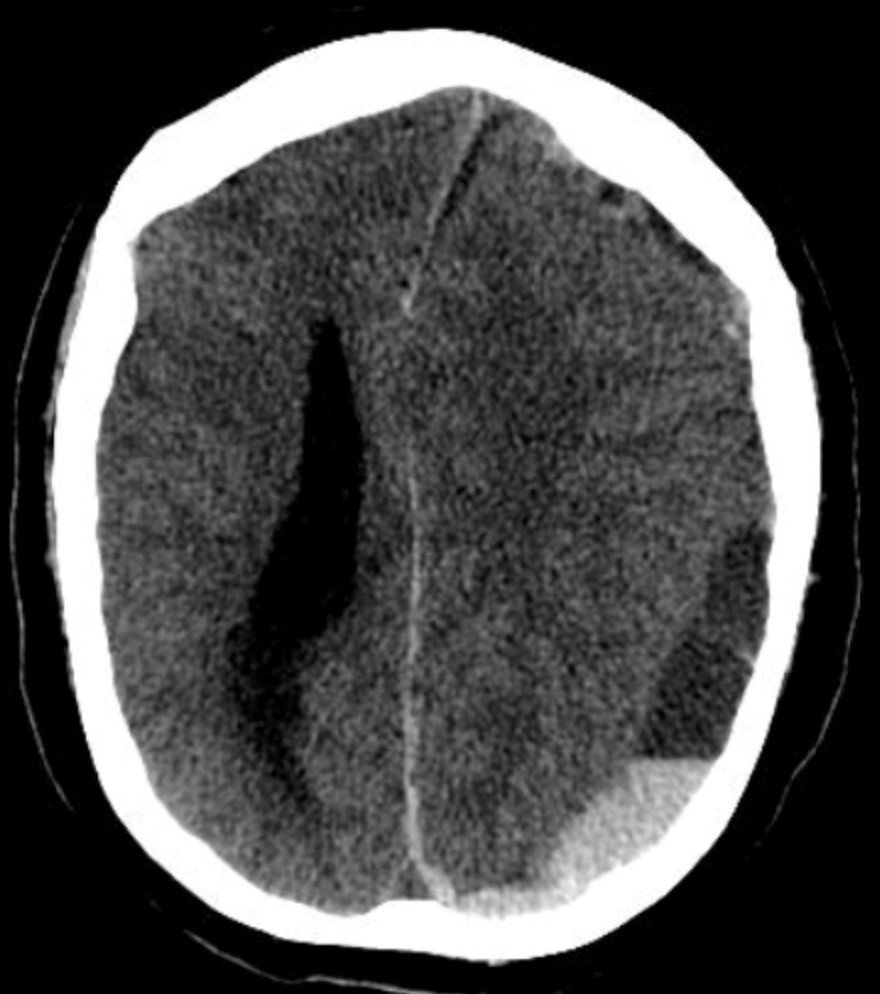
A polytrauma patient's CT brain shows a crescent-shaped extra-axial collection with a concave inner margin. What is the most likely diagnosis?
A dead body is found to have marks like branching of a tree on the front of the chest. The most likely cause of death could be due to:
A middle aged lady was found in a robbed room lying in a pool of blood. On forensic examination there was an entry wound of size around 2 x 2 cm on the left temporal region with tattooing and blackening around the wound. There was also an exit wound with beveling at the right temporal region. On further examination two bullet fragments were found inside the brain parenchyma. Which of the following could be used to determine the distance from which the weapon was fired?
Explanation: ***Regular sharp margins*** - A **lacerated wound** on a bony surface from **blunt trauma** without significant crushing often has margins that appear regular and sharp due to the skin tearing over the underlying bone. - The **tensile strength** of the skin leads to a clean tear rather than an irregular rip when stretched over a hard surface. *Irregular margins* - **Irregular margins** are typically found in lacerations caused by a glancing or tearing force, or when there is significant **crushing** of the tissue. - This results in a more jagged and uneven wound edge due to varied tissue resistance. *Tearing* - While a laceration is a form of tearing, simply stating "tearing" doesn't sufficiently describe the **morphology of the wound margins** when occurring over a bony surface. - The term "tearing" is broad and does not emphasize the specific characteristic of the wound edges in this particular scenario. *Flaying* - **Flaying** refers to the severe separation of a large section of skin and subcutaneous tissue from the underlying fascia and muscle. - This is a more extensive injury than a simple laceration and typically involves a significant shearing force that lifts the skin.
Explanation: ***Absence of vital reaction*** - Postmortem wounds lack a **vital reaction** because the body's physiological processes, such as **circulation** and **inflammation**, have ceased. - This means there will be no **hemorrhage**, **clotting**, or **cellular response** to tissue injury. *Presence of vital reaction* - The presence of a vital reaction, including **bleeding** and early signs of **inflammation**, indicates an antemortem injury. - This suggests the injury occurred when the person was **alive** and the circulatory system was functioning. *Presence of inflammatory cells* - **Inflammatory cells** (e.g., **neutrophils**, **macrophages**) are recruited to the site of injury as part of the body's **immune response** to tissue damage. - Their presence signifies an **antemortem injury** and an active biological process of healing or containment. *Absence of inflammatory cells* - While the **absence of inflammatory cells** is true for postmortem wounds, it is a consequence of the broader "absence of vital reaction." - The lack of cellular response is a more specific histological finding rather than the primary macroscopic distinguishing feature; the **lack of hemorrhage** and **tissue response** is more direct.
Explanation: ***Homicidal wounds*** - Injuries to the **scrotum** are highly unusual in accidental or suicidal contexts due to the protective nature and sensitivity of the area. - The presence of **cut injuries** in such a vulnerable and normally protected area often indicates an intentional act of aggression. *Accidental wounds* - Accidental scrotal injuries are typically due to **blunt trauma** or avulsion, rather than sharp, incised cuts. - They usually occur in situations like sports or industrial accidents, which are not described by "cut injuries." *Suicidal wounds* - Suicidal wounds are typically inflicted in areas like the **wrists**, neck, or chest, aiming for vital structures. - The scrotum is not a common site for self-inflicted injuries, as cutting this area is unlikely to be immediately lethal and is extremely painful. *None of the options* - This option is incorrect because the specific location and type of injury (cut injuries to the scrotum) points strongly towards a specific category of wound. - The other options are considered less likely given the highly sensitive and non-lethal nature of the scrotum for self-harm.
Explanation: ***Laceration*** - A **laceration** is an **open wound** resulting from a tear or rip in the tissue, characterized by **irregular, torn edges**. - These wounds are typically caused by blunt force trauma or sharp objects that create an uneven tear rather than a clean cut. - The torn edges distinguish lacerations from incisions, which have smooth, clean edges. *Contusion* - A **contusion** is a **closed wound** or bruise caused by blunt force trauma that damages underlying blood vessels without breaking the skin. - It presents as discoloration (bruising) due to blood leaking into tissues, not as an open wound with torn edges. *Abrasion* - An **abrasion** is a superficial open wound where the top layer of skin (epidermis) is scraped away due to friction. - While an open wound, it involves a broad, superficial scraped area rather than torn edges characteristic of a laceration. *Incision* - An **incision** is an open wound made by a sharp object (like a knife or glass) that produces **clean, smooth edges**. - Unlike lacerations with irregular torn edges, incisions have well-defined straight or curved margins from a cutting mechanism.
Explanation: ***Correct Option: Presence of signs of struggle*** - **Signs of struggle** (defensive wounds, abrasions, bruising, torn clothing, disturbed surroundings) are the **most reliable indicator of homicidal gunshot wounds** - **Forensic significance**: Defense wounds on hands/forearms, struggle marks, and signs of restraint strongly suggest the victim resisted an attacker - **Absent in suicide**: Suicidal acts occur without external confrontation, so defensive injuries and struggle signs are typically absent - This is the **primary forensic differentiator** between homicide and suicide in gunshot cases *Incorrect: Presence of multiple gunshot wounds* - While **more common in homicide**, multiple gunshot wounds **CAN occur in suicide** (documented as "hesitation wounds" or multiple attempts with non-fatal first shots) - **Not a reliable sole differentiator**: Cases of suicidal individuals firing multiple shots are well-documented in forensic literature, especially with small caliber weapons or when vital organs are missed - Other factors (wound location, distance, angle) are needed for complete assessment *Incorrect: Presence of gunpowder on hands* - **Gunshot residue (GSR) on victim's hands** actually **indicates suicide** rather than homicide, as it suggests the victim held and fired the weapon - In **homicide**, GSR is typically **absent** from the victim's hands (unless they struggled for the weapon) - This differentiates suicide FROM homicide, but the question asks how to identify homicide *Incorrect: None of the above* - This is incorrect because **specific forensic indicators exist** to differentiate homicidal from suicidal gunshot wounds - Signs of struggle provide the most reliable differentiation
Explanation: ***Signature fracture*** - A **signature fracture** is a term used when the bone fracture pattern directly reflects or reproduces the shape of the imparting object or weapon. - This type of fracture provides crucial forensic evidence, directly linking the injury to a specific weapon. *Pond fracture* - A **pond fracture** is a type of depressed skull fracture, typically seen in infants, where the bone is indented without complete disruption, resembling an indentation in a flexible surface. - It does not involve the replication of the weapon's striking surface but rather a localized depression. *Ring fracture* - A **ring fracture** (or foramen magnum fracture) is a fracture around the base of the skull, specifically encircling the foramen magnum. - These fractures are usually caused by an axial load impact (e.g., a fall on the head or feet) or hyperextension/hyperflexion injuries, not by replicating an object's surface. *Comminuted fracture* - A **comminuted fracture** is characterized by the bone breaking into several fragments, often three or more pieces, at the site of injury. - While it indicates high-energy trauma, it describes the number of bone fragments and not the pattern reflecting the striking object.
Explanation: ***Chest*** - The skin and subcutaneous tissue over the chest are generally **pliable and abundant**, allowing tissues to stretch and tear irregularly rather than creating a clean, incised-looking wound. - Due to the **underlying musculature and lack of prominent bony structures** just beneath the skin, impacts tend to cause contusions, irregular lacerations, or deeper tissue damage rather than sharp, distinct cuts. *Shin* - The shin has minimal subcutaneous tissue and skin that is **tightly bound over the tibia**, a prominent bony structure. - Impacts here often cause the skin to be compressed against the bone, leading to a **clean, sharp tear that mimics an incised wound**. *Zygomatic bone* - The skin over the zygomatic bone (cheekbone) is **thin and adheres closely to the underlying bone**. - Trauma to this area can result in a **linear, incised-appearing laceration** due to the skin being split against the rigid bony surface. *Iliac crest* - Similar to the shin and zygomatic bone, the iliac crest is a **superficial bony prominence with thin skin and limited subcutaneous tissue**. - A blunt force impact can cause the skin to **split cleanly over the bone**, creating an incised-looking laceration.
Explanation: ***SDH*** - The image shows a **crescent-shaped collection** of hemorrhage with a concave inner margin, consistent with a **subdural hematoma** (SDH). - SDHs result from the tearing of **bridging veins** and typically conform to the brain's surface, crossing suture lines but not limited by bony sutures. *EDH* - An **epidural hematoma (EDH)** characteristically appears as a **lenticular** or **biconvex** shape on CT, not crescent-shaped. - EDHs are typically caused by arterial bleeding, often from the **middle meningeal artery**, and are limited by cranial sutures. *Contusion* - A **contusion** is brain tissue bruising that appears as **heterogeneous areas** of hemorrhage and edema within the brain parenchyma itself. - It would not manifest as a distinct extra-axial collection with a smooth, concave margin. *Diffuse axonal injury* - **Diffuse axonal injury (DAI)** involves widespread microscopic damage to axons, often at the gray-white matter junction. - It may appear as *punctate hemorrhages* or **small lesions** at these junctions on CT, but often the CT can be normal, and it would not present as a large extra-axial collection.
Explanation: ***Lightning injury*** - The branching, tree-like marks described are known as **Lichtenberg figures**, which are characteristic cutaneous patterns caused by the passage of high-voltage electrical current, such as during a **lightning strike**. - These transient patterns are believed to be due to dilation of capillaries or arborizing superficial burns, sometimes referred to as ferning. *Road traffic accident* - Injuries from a **road traffic accident** typically include blunt force trauma, lacerations, fractures, and internal organ damage, but they do not produce branching, tree-like skin marks. - The pattern of injury is usually widespread and indicative of impact, shearing, or crushing forces, which is distinct from the described branching marks. *Injuries due to bomb blast* - **Bomb blast injuries** are usually categorized as primary (blast wave), secondary (projectiles), tertiary (body displacement), and quaternary (miscellaneous, e.g., burns, toxic inhalation). They would not typically produce the specific Lichtenberg figures. - While burns can occur, they are usually thermal or chemical burns, not the characteristic superficial dendritic branching marks seen with lightning. *Firearm* - **Firearm injuries** result from projectiles (bullets), leading to entrance wounds, exit wounds (if applicable), and internal organ damage along the bullet's path. - The markings associated with firearms do not include branching, tree-like patterns on the skin; instead, they might show tattooing, stippling, or muzzle imprint with close-range shots.
Explanation: ***Clothes*** - The presence of **tattooing** and **blackening** around the entry wound indicates a **close-range firing** (within 30-45 cm). - Analysis of **gunshot residue (GSR) patterns** on clothing is the **standard forensic method** for determining firing distance. - GSR distribution on clothes can be compared with **test firing patterns** at known distances to accurately estimate the range. - Clothing preserves GSR patterns better than skin and provides the most **reliable forensic evidence** for distance determination. *Hair* - While hair around the wound may have some gunshot residue, it is **not a standard forensic method** for determining firing distance. - Hair analysis is not routinely used for distance estimation in forensic ballistics. - The primary focus for distance determination is on **skin and clothing**, not hair. *Blood* - **Blood spatter analysis** helps determine the direction of impact, sequence of events, and relative positions during the incident. - Blood patterns do **not directly reveal** the distance from which a weapon was fired. - While valuable for crime scene reconstruction, blood is not used for firing distance determination. *Bullet fragments* - **Bullet fragments** can identify the type of projectile, caliber, and potentially the weapon used. - They provide information about bullet trajectory and fragmentation patterns. - However, fragments do **not provide information** about the distance from which the weapon was fired.
Get full access to all questions, explanations, and performance tracking.
Start For Free