How to Study USMLE Step 2 CK Cardiology: High-Yield Topics, Heart Failure, ACS and CCS Vignettes 2026
Master USMLE Step 2 CK cardiology with this high-yield study guide. Learn heart failure, ACS, and CCS strategies from a top-scoring perspective. Get the cardiology playbook that works.
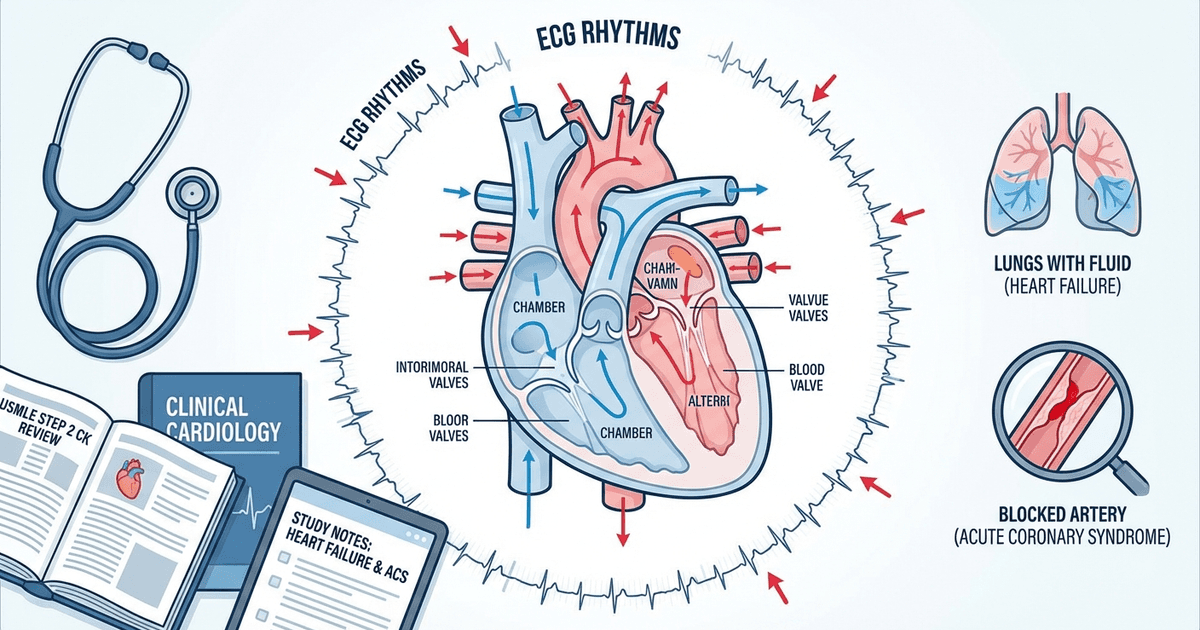
How to Study USMLE Step 2 CK Cardiology: High-Yield Topics, Heart Failure, ACS and CCS Vignettes 2026
You stare at the USMLE Step 2 CK content outline. Cardiology jumps out at you — not because its your favorite, but because you know it can make or break your score. You've heard the whispers: cardiology is the highest-yield system on Step 2 CK, accounting for 15-18% of the entire exam. Miss cardiology, and you're fighting an uphill battle.
Here's the thing: Step 2 CK cardiology isnt like Step 1 physiology. You wont memorize Starling curves and oxygen-hemoglobin dissociation graphs. Instead, you'll diagnose heart failure in a 67-year-old with orthopnea, decide between PCI and thrombolysis for STEMI, and manage hypertensive emergencies in real-time CCS cases.
This guide breaks down exactly how to dominate USMLE Step 2 CK cardiology. We'll cover the must-know high-yield topics, dissect heart failure and ACS patterns, and give you a bulletproof CCS strategy. By the end, you'll approach cardiology questions with the confidence of a cardiology fellow.
Why Cardiology Dominates USMLE Step 2 CK
Step 2 CK tests clinical decision-making, not memorization. Cardiology fits this perfectly because cardiovascular diseases are:
Prevalent: Heart disease remains the #1 cause of death in the US
Time-sensitive: ACS, hypertensive emergencies, and acute heart failure require immediate action
Algorithm-heavy: Clear decision trees for diagnosis and management
Cross-disciplinary: Cardiology intersects with ER medicine, internal medicine, ICU care, and surgery
The numbers speak for themselves. Recent test-takers report seeing 25-30 cardiology questions out of 175 total — that's 17% of your score riding on one system. Compare that to Step 1, where cardiology typically accounts for 8-10%.
What changed? Step 2 CK shifted toward clinical scenarios where rapid diagnosis and management matter most. Cardiology delivers both. You'll see patients with chest pain, shortness of breath, and hemodynamic instability — and you need to know what to do in the first 30 minutes, not the pathophysiology behind it.
NBME data shows cardiology has the widest score distribution among systems. High scorers (250+) get 85-90% of cardiology questions right. Average scorers (220-240) hover around 65-70%. The difference? Pattern recognition and systematic approaches to common presentations.
High-Yield USMLE Step 2 CK Cardiology Topics
Heart Failure: HFrEF vs HFpEF Management
Heart failure questions appear on every form. You'll get 3-4 per exam, focusing on classification, acute management, and long-term therapy optimization.
Classification shortcuts:
EF ≤40% = HFrEF (Heart Failure with reduced Ejection Fraction)
EF ≥50% = HFpEF (Heart Failure with preserved Ejection Fraction)
EF 41-49% = HFmrEF (borderline, treat like HFrEF)
HFrEF management ladder (memorize this exact order): 1. ACE inhibitor/ARB + Beta-blocker (metoprolol, carvedilol, bisoprolol) 2. Add MRA (spironolactone/eplerenone) if still symptomatic 3. Consider ARNI (sacubitril/valsartan) to replace ACE/ARB 4. Add SGLT2 inhibitor (dapagliflozin, empagliflozin) 5. Consider ivabradine if HR >70 despite max beta-blocker HFpEF is different: Focus on volume management (diuretics) and treating underlying causes (HTN, afib, CAD). No proven mortality benefit from ACE/ARB in isolated HFpEF.
Oncourse's adaptive qbank surfaces HFrEF vs HFpEF questions in spaced repetition cycles — if you miss HFpEF management questions, the system auto-queues more HFpEF scenarios plus related physiology to solidify the distinction.
Acute decompensated heart failure (what you'll see in CCS):
IV furosemide for volume overload
BiPAP for respiratory distress
Consider inotropes (dobutamine) only if cardiogenic shock
Never give beta-blockers in acute decompensation
Acute Coronary Syndrome: STEMI vs NSTEMI Decision Trees
ACS questions test your ability to distinguish STEMI from NSTEMI and choose the right intervention within minutes. Every ACS vignette follows the same pattern: chest pain + ECG findings + troponin levels + next best step.
STEMI recognition (automatic cath lab activation):
ST elevation ≥1mm in 2+ contiguous leads
New LBBB with clinical suspicion
Timing matters: Door-to-balloon <90 minutes for primary PCI
NSTEMI/Unstable angina workup:
1. Serial troponins (peak at 12-24 hours)
2. Risk stratification (TIMI or GRACE score)
3. Dual antiplatelet therapy (aspirin + P2Y12 inhibitor)
4. Anticoagulation (heparin or fondaparinux)
5. Early invasive strategy vs conservative based on risk
Troponin timing pearls:
Troponin rises 3-6 hours post-MI, peaks 12-24 hours
Negative troponin at 6 hours doesnt rule out MI
High-sensitivity troponin protocols shorten this to 2-3 hours
PCI vs thrombolysis decision: Primary PCI wins if available within 90 minutes. Thrombolysis only if PCI unavailable and <12 hours from symptom onset. Contraindications for thrombolysis: recent surgery, GI bleeding, stroke, uncontrolled HTN.
Practice ACS scenarios with Oncourse USMLE cardiology questions — each includes detailed explanations covering why each distractor is wrong and the next-best-step logic that mirrors real CCS cases.
Atrial Fibrillation: Rate vs Rhythm Control Strategy
Afib management splits into three buckets: rate control, rhythm control, and anticoagulation. Step 2 CK tests your ability to pick the right strategy for each patient.
Rate control (preferred for most patients):
Beta-blockers (metoprolol, esmolol for acute settings)
Calcium channel blockers (diltiazem, verapamil)
Target HR <110 bpm (lenient control)
Never use in WPW syndrome (can cause VF)
Rhythm control (specific indications):
Young patients (<65)
First episode of afib
Symptomatic despite rate control
Heart failure due to afib
Anticoagulation (CHA2DS2-VASc score):
Score ≥2: anticoagulate (warfarin, DOAC)
Score 1: consider anticoagulation
Score 0: no anticoagulation needed
Acute afib with hemodynamic instability: Synchronized cardioversion, not rate control medications.
Hypertensive Emergencies vs Urgencies
Blood pressure questions test your ability to distinguish true emergencies (end-organ damage) from urgencies (just high numbers).
Hypertensive emergency (BP >180/120 + end-organ damage):
Acute coronary syndrome
Acute heart failure/pulmonary edema
Aortic dissection
Acute stroke
Treatment: IV antihypertensives, 10-20% reduction in first hour
Hypertensive urgency (BP >180/120, no end-organ damage):
Treatment: Oral antihypertensives, gradual reduction over hours to days
Never use sublingual nifedipine (can cause stroke)
Specific scenarios:
Aortic dissection: Esmolol + nicardipine (beta-blocker first to prevent reflex tachycardia)
Acute stroke: Hold antihypertensives unless BP >220/120
Acute MI: Metoprolol if no contraindications
Valvular Disease: Aortic Stenosis and Mitral Regurgitation
Valvular questions focus on when to intervene surgically, not murmur descriptions.
Aortic stenosis intervention criteria:
Severe AS (valve area <1.0 cm²) + symptoms
Severe AS + LVEF <50%
Severe AS + undergoing cardiac surgery
TAVR vs surgical: Age >80 or high surgical risk → TAVR
Mitral regurgitation (harder to memorize):
Severe MR + symptoms → surgery
Severe MR + LVEF <60% → surgery
Severe MR + LV end-systolic dimension >40mm → surgery
CCS Vignette Strategy for Cardiology Cases
CCS (Computer-based Case Simulations) makes up 15% of Step 2 CK. Cardiology CCS cases are common because they test time-sensitive decision-making — exactly what the exam wants to assess.
Order of Operations for Cardiology CCS
First 2 minutes (stabilization phase): 1. Vital signs (always first order) 2. ECG (for any chest pain, SOB, or cardiac complaint) 3. Chest X-ray (especially if heart failure suspected) 4. Basic labs: CBC, BMP, troponin, BNP/NT-proBNP 5. O2 saturation + supplemental oxygen if <90% Minutes 2-5 (diagnostic phase): 1. Echocardiogram (for heart failure, murmurs, or wall motion abnormalities) 2. Additional labs based on presentation:
- D-dimer (if PE suspected)
- PT/INR (if on anticoagulation)
- Lipid panel (if ACS)
3. Medications for symptom relief:
- Nitroglycerin for chest pain
- Furosemide for volume overload
- Morphine for severe pain (only after diagnosis confirmed)
Minutes 5-10 (treatment phase): 1. Definitive interventions:
- Cardiac catheterization for STEMI
- IV furosemide + ACE inhibitor for acute heart failure
- Rate control for rapid afib
2. Disposition: ICU vs telemetry vs discharge
Time Management for CCS Cardiology
Common time traps:
Ordering too many tests: Stick to high-yield diagnostics
Waiting for results: You can order treatments before lab results return
Over-monitoring: Check vitals every 15-30 minutes, not every 5 minutes
Time-saving shortcuts:
Order sets: Create mental templates for chest pain, SOB, and cardiac arrest
Advance time: Use 15-30 minute intervals unless patient is unstable
Discharge planning: Start thinking about discharge medications early
Oncourse's topic-based study paths include a dedicated cardiology track that sequences topics by NBME weighting — starting with heart failure and ACS (most tested), then moving through arrhythmias and valvular disease. Each session integrates flashcards and qbank questions to reinforce the clinical reasoning patterns you'll need for CCS cases.
Common CCS Cardiology Traps
Trap 1: Giving beta-blockers in acute heart failure decompensation Solution: Only use beta-blockers in chronic, stable heart failure Trap 2: Ordering cardiac catheterization for NSTEMI immediately Solution: Risk-stratify first, then decide on timing (urgent vs elective) Trap 3: Not anticoagulating afib patients Solution: Calculate CHA2DS2-VASc score and anticoagulate appropriately Trap 4: Using sublingual nifedipine for hypertensive emergency Solution: IV antihypertensives with controlled reduction (esmolol, nicardipine)
How to Use NBME/UWorld Cardiology Blocks Efficiently
Practice questions are your most valuable study tool for Step 2 CK cardiology. But random practice misses the point. You need deliberate practice that builds pattern recognition.
Question Block Strategy
Week 1-2: Subject-based blocks
Do 20-question cardiology blocks
Focus on one topic per block (heart failure, ACS, arrhythmias)
Dont time yourself — focus on reasoning through each question
Week 3-4: Mixed cardiology blocks
40-question blocks mixing all cardiology topics
Time yourself: 1.5 minutes per question
Identify your weakest areas for focused review
Week 5+: Full-length mixed blocks
Include cardiology questions in 40-question mixed-subject blocks
Simulate real test conditions
Question Analysis Framework
For every cardiology question you miss:
1. Identify the pattern: Is this heart failure, ACS, arrhythmia, or valvular?
2. Find the decision point: Where did your reasoning diverge from the correct answer?
3. Learn the rule: What algorithm or criteria should you have applied?
4. Practice similar cases: Find 2-3 similar questions to reinforce the pattern
Common reasoning errors:
Anchoring bias: Sticking with your first diagnosis despite new information
Zebra hunting: Choosing rare diagnoses over common ones
Intervention paralysis: Ordering more tests instead of acting on available information
Use Oncourse cardiology flashcards to drill key facts between question blocks. Spaced repetition ensures you remember management algorithms when they matter most.
NBME vs UWorld: How to Use Each
UWorld strengths:
Best explanations for understanding concepts
Great for learning new material
Detailed teaching points for each answer choice
NBME strengths:
More similar to actual test style
Better for timing practice
Helps calibrate your performance
Optimal strategy: Learn with UWorld, practice with NBME. Use UWorld to understand why answers are correct, then use NBME to build speed and pattern recognition.
Spaced Repetition Approach for Cardiology Concepts
Cardiology involves lots of memorization: drug classes, dosages, contraindications, and management algorithms. Spaced repetition transforms this from cramming to long-term retention.
What to Put in Spaced Repetition
Management algorithms (front/back flashcards):
HFrEF medication ladder
ACS workup flowchart
Afib rate vs rhythm control criteria
Hypertensive emergency vs urgency treatment
Drug facts (cloze deletion cards):
Metoprolol is contraindicated in {{c1::decompensated heart failure}}
First-line therapy for HFrEF includes {{c1::ACE inhibitor}} + {{c2::beta-blocker}}
TIMI score includes {{c1::age ≥65}}, {{c2::3+ risk factors}}, {{c3::prior stenosis ≥50%}}
Clinical pearls (basic front/back):
When do you use TAVR vs surgical AVR?
What troponin timing rules out MI?
Which beta-blocker for acute afib with CHF?
Spaced Repetition Timing
New cards: 20-30 per day max. Quality over quantity. Review schedule: 1 day → 3 days → 1 week → 2 weeks → 1 month Daily time: 15-20 minutes, ideally split into 2 sessions Integration with practice questions: Review flashcards for any concept you miss in practice questions. If you miss a heart failure question, immediately review your HFrEF management cards.
Oncourse integrates spaced repetition directly into your study workflow — after completing a cardiology question set, the platform prompts you to review related flashcards for concepts you struggled with, ensuring weak areas get reinforced automatically.
Advanced Cardiology Study Tips
Pattern Recognition Development
Classic presentations to memorize:
Acute heart failure: SOB, orthopnea, bilateral rales, elevated BNP
STEMI: Chest pain + ST elevation in contiguous leads
Aortic stenosis: Harsh systolic murmur + syncope/angina/CHF
Mitral regurg: Holosystolic murmur radiating to axilla
Afib with RVR: Irregular rhythm + HR >100
Atypical presentations (higher-yield for Step 2 CK):
Diabetic ACS: Minimal or no chest pain
Elderly heart failure: Confusion, fatigue more than SOB
Women with ACS: Nausea, jaw pain, fatigue
Integration with Other Systems
Cardiology overlaps heavily with other Step 2 CK systems:
Cardiology + Pulmonology: CHF vs pneumonia, PE vs ACS Cardiology + Nephrology: Cardiorenal syndrome, contrast nephropathy Cardiology + Endocrinology: Diabetic cardiomyopathy, thyrotoxicosis with afib Cardiology + Rheumatology: Pericarditis, endocarditis
Study these intersections separately. Many students miss questions because they see a cardiac presentation through a single-system lens.
Evidence-Based Medicine Focus
Step 2 CK increasingly tests knowledge of guidelines and evidence-based practices. For cardiology, focus on:
Major trials (know the conclusions, not details):
PARADIGM-HF: ARNI superior to ACE inhibitors in HFrEF
DAPA-HF: SGLT2 inhibitors reduce mortality in HFrEF
COURAGE: Medical therapy equivalent to PCI for stable CAD
Current guidelines (2024-2026):
ESC/AHA STEMI Guidelines
AHA Hypertension Guidelines
Review Oncourse cardiology lessons for evidence-based management approaches that reflect current standard of care rather than outdated practices.
Frequently Asked Questions
How many cardiology questions are on Step 2 CK?
Expect 25-30 cardiology questions out of 175 total questions (14-17% of the exam). This makes cardiology the highest-yield single system on Step 2 CK.
Should I memorize ECG patterns for Step 2 CK?
Focus on high-yield ECG findings: STEMI patterns, afib vs other arrhythmias, and heart blocks. Dont waste time memorizing rare arrhythmias or subtle ST changes. Step 2 CK ECGs are usually obvious.
Is cardiology harder on Step 2 CK than Step 1?
Different emphasis. Step 1 focuses on physiology and mechanisms. Step 2 CK tests clinical decision-making and management. Many students find Step 2 CK cardiology easier because the questions are more algorithmic.
How long should I spend studying cardiology for Step 2 CK?
Plan 2-3 weeks of dedicated cardiology study within your overall Step 2 CK prep. Given its high yield, cardiology deserves proportionally more time than lower-yield systems.
What if I keep missing CCS cardiology cases?
Focus on order of operations and timing. Most students fail CCS cardiology cases due to poor time management, not knowledge gaps. Practice the standardized approach outlined above.
Should I use additional cardiology resources beyond UWorld and NBME?
UWorld and NBME provide sufficient question practice. Consider UpToDate or cardiology pocket cards for reference, but dont add more question banks. Quality practice trumps quantity.
Conclusion
USMLE Step 2 CK cardiology rewards systematic preparation. Master heart failure management algorithms, nail the ACS workup sequence, and develop a bulletproof CCS approach. Focus your energy on pattern recognition rather than rare zebras, and use spaced repetition to lock in the key algorithms that show up repeatedly.
The difference between average and high performance in Step 2 CK cardiology isnt knowing more facts — its recognizing patterns faster and making decisions with confidence. Stick to the high-yield topics covered in this guide, practice deliberately with quality question banks, and trust your preparation when exam day arrives.
Prepare smarter with Oncourse AI — adaptive MCQs, spaced repetition, and AI explanations built for USMLE Step 2 CK. Download free on Android and iOS.