Back
How to Study Microbiology for INICET 2026: High-Yield Bacteriology, Virology, Culture Media and MCQ Strategy
Master INICET 2026 microbiology with this comprehensive guide covering high-yield bacteriology, virology, culture media, and proven MCQ strategies. Get expert tips on clinical correlation and lab diagnosis.
How to Study Microbiology for INICET 2026: High-Yield Bacteriology, Virology, Culture Media and MCQ Strategy
You're staring at 47 bacterial names that all end in "-coccus" and wondering how anyone remembers which one grows on chocolate agar versus blood agar. INICET 2026 has 200 questions, and 10-12 of them will test your microbiology knowledge at a depth that makes NEET-PG look gentle.
Here's what most people get wrong about INICET microbiology: they study it like undergraduate micro. INICET doesn't ask "What causes pneumonia?" It asks "A 45-year-old diabetic presents with necrotizing pneumonia. Gram stain shows gram-positive cocci in clusters. Culture on mannitol salt agar is positive. What's the most likely organism and appropriate antibiotic choice?"
The difference? Clinical correlation, lab diagnosis, and applied microbiology. Every organism comes with its preferred culture medium, resistance pattern, and clinical presentation. Master these connections, and those 10-12 questions become easy points.
INICET 2026 Microbiology Weightage and Pattern Analysis
INICET microbiology carries 10-12 questions out of 200 total — that's 5-6% of your score. But here's the catch: these questions have the highest accuracy rates among toppers. Miss them, and you're giving away easy marks to your competition.
Subject-wise breakdown from recent patterns:
Bacteriology: 6-7 questions (60%)
Virology: 2-3 questions (25%)
Mycology: 1-2 questions (10%)
Parasitology: 1 question (5%)
Question types you'll encounter:
Clinical vignettes with lab findings (40%)
Direct organism identification from culture characteristics (25%)
Antimicrobial resistance patterns (20%)
Recent outbreak-related questions (15%)
The key difference from NEET-PG? INICET loves image-based questions showing culture plates, microscopic findings, or colony morphology. They also test recent outbreaks — Nipah, H3N2 influenza, and emerging resistance patterns frequently appear.
High-Yield Bacteriology: Master These Organisms
Gram-Positive Cocci
Staphylococcus aureus dominates INICET questions. Know these specifics:
Mannitol salt agar: positive (yellow colonies)
Coagulase: positive (differentiates from S. epidermidis)
MRSA detection: cefoxitin disk diffusion
Toxins: TSST-1 (toxic shock), alpha toxin (hemolysis), PVL (necrotizing pneumonia)
Streptococci classification appears in 80% of INICET papers:
Group A (S. pyogenes): beta-hemolytic, bacitracin sensitive
Group B (S. agalactiae): CAMP test positive, pregnancy screening
S. pneumoniae: alpha-hemolytic, optochin sensitive, bile soluble
The adaptive question bank on Oncourse serves INICET-specific microbiology MCQs with clinical vignette framing; identifies weak sub-topics and automatically shifts drill sessions toward gaps.
Gram-Negative Rods
Enterobacteriaceae family - INICET's favorite:
Organism | Key Culture Medium | Distinguishing Feature | Clinical Association |
|---|---|---|---|
E. coli | MacConkey (pink colonies) | Lactose fermenter | UTI, neonatal meningitis |
Salmonella | XLD agar (black centers) | H2S production | Enteric fever, gastroenteritis |
Shigella | MacConkey (colorless) | Non-lactose fermenter | Bacillary dysentery |
Klebsiella | MacConkey (pink, mucoid) | Mucoid colonies | Pneumonia, UTI, ESBL |
Pseudomonas aeruginosa appears in every INICET paper:
Culture: MacConkey agar (colorless), CETRIMIDE agar (selective)
Pigments: pyocyanin (blue-green), pyoverdin (yellow-green)
Resistance: intrinsic to multiple antibiotics
Clinical: ICU infections, cystic fibrosis
Special Bacteria
Mycobacterium tuberculosis:
Culture: Lowenstein-Jensen (LJ) medium (6-8 weeks)
Stain: Acid-fast (Ziehl-Neelsen)
Drug resistance: GeneXpert for rifampicin resistance
DOTS strategy and recent WHO guidelines
Corynebacterium diphtheriae:
Culture: Tellurite agar (black colonies), Loeffler's medium
Toxin: diphtheria toxin (ADP-ribosylation)
Clinical: pharyngeal diphtheria, myocarditis
Every time you encounter a wrong answer in practice, Rezzy AI explanations immediately tie the concept back to organism lab identification and clinical reasoning — exactly what INICET tests.
High-Yield Virology: Focus on Clinical Relevance
Hepatitis Viruses
INICET loves hepatitis virology with clinical correlation:
Hepatitis B patterns:
HBsAg positive: acute or chronic infection
Anti-HBc IgM: acute infection marker
Anti-HBs: immunity (vaccination or recovery)
HBeAg: high infectivity marker
Hepatitis C updates:
Direct-acting antivirals (DAAs): sofosbuvir combinations
Genotype testing importance
SVR (sustained virologic response) definition
DNA Viruses
Herpes group (HHV 1-8):
HSV-1: oral herpes, encephalitis
HSV-2: genital herpes, neonatal infection
VZV (HHV-3): chickenpox, shingles, Ramsay Hunt syndrome
EBV (HHV-4): infectious mononucleosis, Burkitt lymphoma
CMV (HHV-5): congenital infection, retinitis in AIDS
HPV (Human Papillomavirus):
High-risk types: 16, 18 (cervical cancer)
Low-risk types: 6, 11 (genital warts)
Vaccine: Gardasil 9 (current recommendation)
RNA Viruses and Recent Outbreaks
Arboviral diseases — INICET's current focus:
Dengue: NS1 antigen (early), IgM/IgG serology
Chikungunya: IgM ELISA, RT-PCR
Zika: microcephaly association, RT-PCR
Japanese Encephalitis: endemic areas, vaccination
Influenza updates:
H3N2 variant: recent pandemic strain
Neuraminidase inhibitors: oseltamivir timing
Vaccine composition changes
COVID-19 variants still appear:
Omicron subvariants
Antiviral treatments: molnupiravir, paxlovid
Vaccine effectiveness data
The spaced repetition engine helps retain these rapidly changing viral classifications and outbreak patterns without manual flashcard management — crucial when guidelines update frequently.
Mycology and Parasitology: Quick High-Yield Hits
Fungal Infections
Aspergillus species:
A. fumigatus: invasive aspergillosis in immunocompromised
A. niger: otomycosis, aflatoxin production
Galactomannan antigen test for diagnosis
Mucormycosis (recent outbreak post-COVID):
Risk factors: diabetes, immunosuppression, steroid use
Clinical: rhinocerebral, pulmonary forms
Treatment: amphotericin B, surgical debridement
Candida species:
C. albicans: germ tube test positive
C. auris: multidrug-resistant, hospital outbreaks
Antifungals: fluconazole resistance patterns
Parasitic Infections
Malaria lab diagnosis:
Thick smear: species identification
Thin smear: parasitemia calculation
Rapid diagnostic tests: HRP-2, pLDH
Severe malaria criteria (WHO 2014)
Helminth egg identification:
Ascaris: rounded, thick shell, mammillated
Trichuris: barrel-shaped, bipolar plugs
Hookworm: oval, thin shell, 4-8 cell stage
Culture Media Mastery: Know Your Media
This section wins or loses INICET microbiology questions. Every organism has preferred media, and INICET tests this relentlessly.
Selective Media
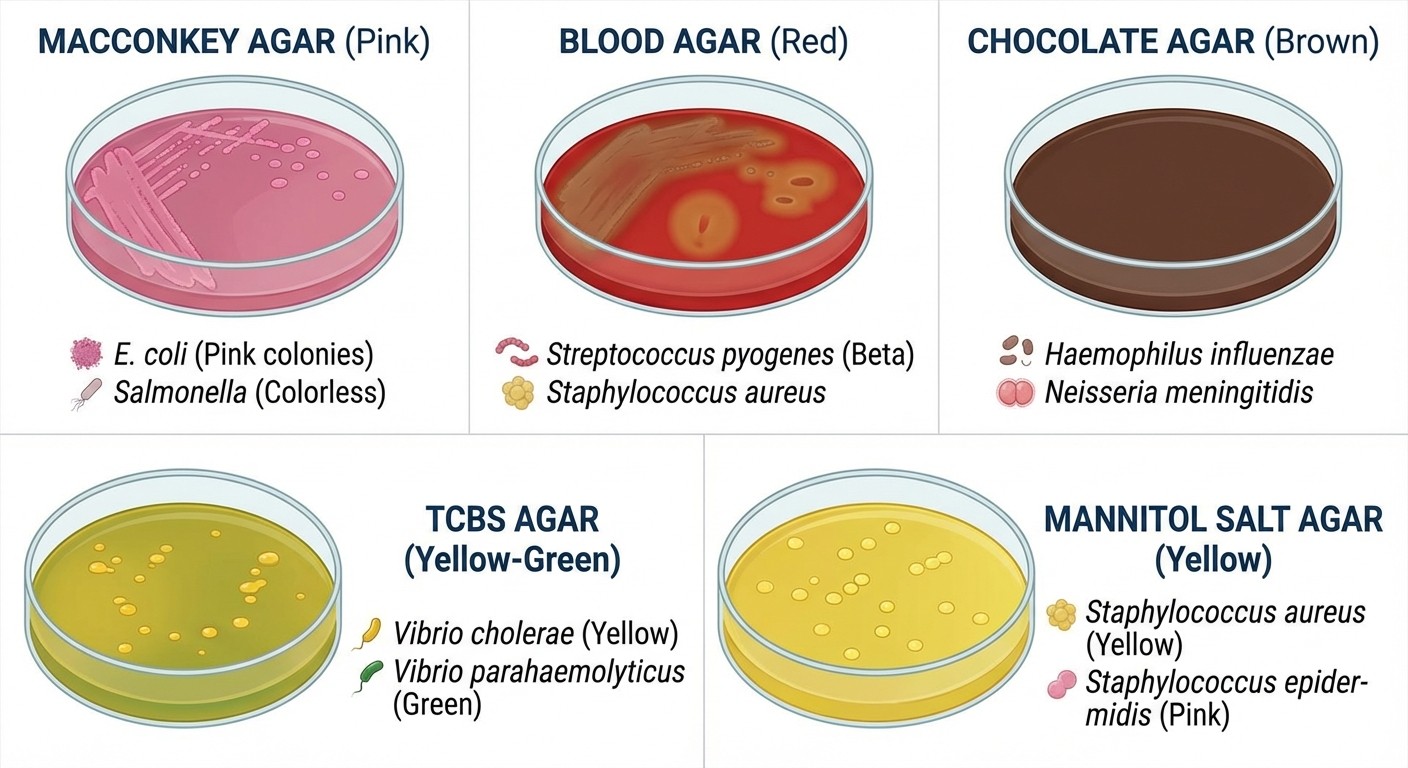
MacConkey agar - differentiates lactose fermenters:
Pink colonies: E. coli, Klebsiella (lactose+)
Colorless colonies: Salmonella, Shigella (lactose-)
Inhibits gram-positive bacteria
Mannitol salt agar - selects for staphylococci:
High salt concentration (7.5%) inhibits most bacteria
Mannitol fermentation: S. aureus (yellow), S. epidermidis (pink)
TCBS agar - for Vibrio species:
Yellow colonies: V. cholerae, V. parahaemolyticus (sucrose+)
Green colonies: V. vulnificus (sucrose-)
Enriched Media
Chocolate agar - for fastidious bacteria:
Haemophilus species (requires X and V factors)
Neisseria gonorrhoeae (with CO2)
Bordetella pertussis
BCYE agar - Legionella species:
Buffered charcoal yeast extract
L-cysteine and iron supplementation required
Transport Media
Cary-Blair medium - for enteric pathogens:
Shigella, Vibrio, Campylobacter
Low nutrient, high pH prevents overgrowth
Viral transport medium (VTM):
Respiratory viruses, COVID-19 samples
Maintains viral viability during transport
Specialized Media Memory Tricks
Use these mnemonics that work with spaced repetition:
"Chocolate Needs Haemophilus" - Chocolate agar for H. influenzae "TCBS = Thiosulfate Citrate Bile Sucrose" - remembers both name and Vibrio selection "Loeffler's Likes Corynebacterium" - both start with L and C
Study culture media tables through microbiology flashcards where spaced repetition ensures these media-organism pairs stick until exam day.
MCQ Strategy for INICET: Crack the Code
Image-Based Questions
INICET shows actual culture plates, microscopy images, or colony morphology. Practice these skills:
Culture plate recognition:
1. Look at colony color first
2. Check plate type (blood, MacConkey, etc.)
3. Note hemolysis pattern if blood agar
4. Consider clinical context
Microscopy interpretation:
1. Gram stain color and morphology
2. Arrangement (clusters, chains, diplococci)
3. Special stains (acid-fast, calcofluor white)
Clinical Vignette Approach
INICET microbiology questions follow this pattern:
1. Patient demographics and risk factors
2. Clinical presentation
3. Lab findings (culture, serology, molecular tests)
4. Question about organism, treatment, or prognosis
Your systematic approach:
1. Identify the clinical syndrome
2. Match lab findings to potential organisms
3. Eliminate based on culture characteristics
4. Choose the most likely organism/treatment
Common Question Traps
Trap 1: Similar organisms
S. aureus vs S. epidermidis: coagulase test
S. pneumoniae vs alpha-streptococci: optochin sensitivity
E. coli vs other lactose fermenters: indole test
Trap 2: Antibiotic choices
MRSA: vancomycin, linezolid (not methicillin)
ESBL producers: carbapenems (not cephalosporins)
Atypicals: macrolides/quinolones (not beta-lactams)
Trap 3: Recent guideline changes
H. pylori treatment: bismuth quadruple therapy
TB treatment: WHO 2020 guidelines
COVID-19 treatments: updated protocols
The adaptive question system identifies these exact weak spots and automatically shifts drill sessions toward your gaps — much more efficient than random practice.
Common Mistakes to Avoid
Conceptual Errors
Mistake 1: Memorizing without understanding
Don't just memorize "E. coli grows on MacConkey." Understand that MacConkey selects gram-negatives and differentiates lactose fermenters. This helps you approach any enterobacteria question.
Mistake 2: Ignoring clinical correlation
INICET doesn't ask about organisms in isolation. Every bacterium comes with its clinical syndrome, risk factors, and treatment approach.
Mistake 3: Old information
Antibiotic resistance patterns change. Treatment guidelines update. Always verify recent recommendations, especially for antimicrobial therapy.
Study Approach Errors
Mistake 4: Passive reading
Microbiology needs active recall. Test yourself on organism-media-disease associations instead of just reading tables.
Mistake 5: Skipping recent topics
COVID-19 variants, fungal co-infections, antimicrobial resistance patterns from recent years frequently appear.
Practice with microbiology MCQs that mirror INICET's clinical vignette style rather than theoretical questions.
Time Management Pitfalls
Mistake 6: Overthinking culture questions
If you see classic culture characteristics (beta-hemolytic, bacitracin-sensitive), trust the straightforward answer. Don't second-guess basic organism identification.
Mistake 7: Getting stuck on images
Spend 30 seconds max on image-based questions. If you can't identify the organism/culture immediately, eliminate obviously wrong options and move on.
3-Month Revision Strategy
Phase 1: Foundation Building (Months 3-2)
Week 1-2: Bacteriology basics
Major families: Staphylococci, Streptococci, Enterobacteriaceae
Culture media and identifying characteristics
Complete bacteriology lessons with active note-taking
Week 3-4: Virology essentials
Hepatitis viruses, herpes group, respiratory viruses
Recent outbreak organisms (dengue, chikungunya, H3N2)
Study virology content with emphasis on lab diagnosis
Week 5-6: Applied microbiology
Antimicrobial resistance mechanisms
Hospital-acquired infections
Culture methods and media mastery
Phase 2: Clinical Integration (Month 2)
Week 1-2: System-based approach
CNS infections and causative organisms
Respiratory tract infections by age group
UTI and GIT infections with lab correlations
Week 3-4: Special populations
Immunocompromised patients (HIV, transplant)
Pediatric and neonatal infections
Pregnancy-related infections
The Rezzy AI explanations during this phase help connect isolated facts into clinical reasoning patterns that INICET specifically tests.
Phase 3: Intensive Practice (Month 1)
Week 1-2: Question-based learning
50 microbiology MCQs daily from question bank
Focus on explanation understanding over quantity
Create error logs for repeated mistakes
Week 3-4: Mock tests and weak area drilling
Full-length mock tests with microbiology analysis
Image-based question practice
Recent current affairs in microbiology
Last 2 Weeks: Rapid Revision Protocol
Week 2 Before Exam
Day 1-3: High-yield tables
Memorize these essential tables:
Culture media and selective organisms
Antibiotic resistance patterns
Viral hepatitis serology interpretation
Day 4-5: Current affairs
Recent outbreaks and epidemics
New antimicrobial agents
Updated treatment guidelines
Day 6-7: Mock test analysis
Identify remaining weak topics
Focus revision on error-prone areas
Final Week
Day 1-3: Spaced repetition review
Use flashcard systems for rapid recall:
Organism-disease associations
Culture media characteristics
Toxin mechanisms
Day 4-5: Image practice
Culture plate identification
Microscopy interpretation
Colony morphology recognition
Day 6: Light revision
Review formula sheets and tables
Quick recall tests
Avoid learning new concepts
Day 7: Rest and confidence
Light reading of familiar topics only
Maintain normal sleep schedule
Prepare exam day logistics
Spaced repetition through the flashcard system ensures optimal retention timing — facts review just when you're about to forget them, maximizing memory consolidation for exam day.
Frequently Asked Questions
How many months should I dedicate specifically to microbiology for INICET?
Give microbiology 3-4 focused weeks out of your overall 4-6 month INICET preparation. Don't spread it too thin — microbiology needs concentrated effort to master the organism-media-clinical correlations that INICET tests heavily.
Is microbiology harder in INICET compared to NEET-PG?
Yes, significantly. INICET tests applied clinical microbiology with lab correlations, while NEET-PG focuses more on basic organism characteristics. INICET questions integrate patient presentations with culture findings and treatment decisions.
Which topics in microbiology carry maximum weightage in INICET?
Bacteriology dominates with 6-7 questions, especially Staphylococci, Streptococci, and Enterobacteriaceae. Culture media identification and antimicrobial resistance patterns are high-yield areas that appear consistently.
How important are recent outbreaks for INICET microbiology?
Very important. INICET regularly includes questions on recent epidemics like Nipah virus, H3N2 influenza variants, post-COVID fungal infections, and emerging antimicrobial resistance patterns. Stay updated with current medical news.
Should I memorize all culture media or focus on high-yield ones?
Focus on high-yield media that appear repeatedly: MacConkey, Blood agar, Chocolate agar, Mannitol salt agar, TCBS, and LJ medium. These cover 80% of culture-related questions in INICET.
How do I approach image-based microbiology questions in INICET?
Practice systematic observation: note plate type first, then colony characteristics (color, size, hemolysis), and match with clinical context. Spend maximum 30 seconds per image question — trust your first impression if characteristics match clearly.
Prepare smarter with Oncourse AI — adaptive MCQs, spaced repetition, and AI explanations built for INICET 2026. Download free on Android and iOS.