Back
Step 2 Study Plan: How to Structure Your Dedicated USMLE Step 2 CK Prep Block (2026)
Build a data-driven Step 2 study plan that adapts to your weak areas. Learn the 3-pillar framework for structuring your dedicated USMLE Step 2 CK prep block in 2026.

Step 2 Study Plan: How to Structure Your Dedicated USMLE Step 2 CK Prep Block (2026)
You have finished your clerkships. Your shelf scores are in. You have 6-8 weeks before test day, and everyone keeps asking about your "study schedule." But here's what nobody talks about: the schedule isnt the hard part. The framework is.
Most Step 2 CK prep advice dumps a week-by-week calendar on you. Week 1: Internal Medicine. Week 2: Surgery. Week 3: Pediatrics. That approach assumes you need equal time in every subject, that your Cardiology knowledge equals your Psychiatry knowledge, and that cramming follows a linear path. It doesnt.
Step 2 CK scores 250+ because you master clinical reasoning under time pressure. Your dedicated prep block needs to mirror that reality — adaptive, data-driven, and focused on your actual weak spots, not a generic timeline.
This is the framework for building a step 2 study plan that works for your specific knowledge gaps and time constraints.
How to Assess Your Real Baseline (Not Your Gut Feel)
Your gut says you are "okay at Medicine, bad at Surgery, decent at Peds." Your shelf exam scores tell a different story. Start there.
Pull your NBME subject exam scores from the past 12 months. Look for patterns:
Consistent high performers (80th percentile+): These subjects need maintenance, not deep review
Consistent struggle areas (below 70th percentile): Priority repair zones
Inconsistent subjects (wide score swings): Likely knowledge gaps, not concept mastery issues
But shelf scores only tell half the story. They test breadth, not depth. Step 2 CK tests clinical reasoning speed.
The 50-question diagnostic test approach: Before building your schedule, take a 50-question timed block covering all major subjects. Track two metrics: accuracy by subject AND time per question. A subject where you score 75% but average 2.2 minutes per question signals different prep needs than a subject where you score 65% but finish in 1.4 minutes.
The first needs speed training through volume practice. The second needs content review before question practice helps. Your USMLE Step 2 CK preparation strategy should account for both knowledge gaps and processing speed deficits.
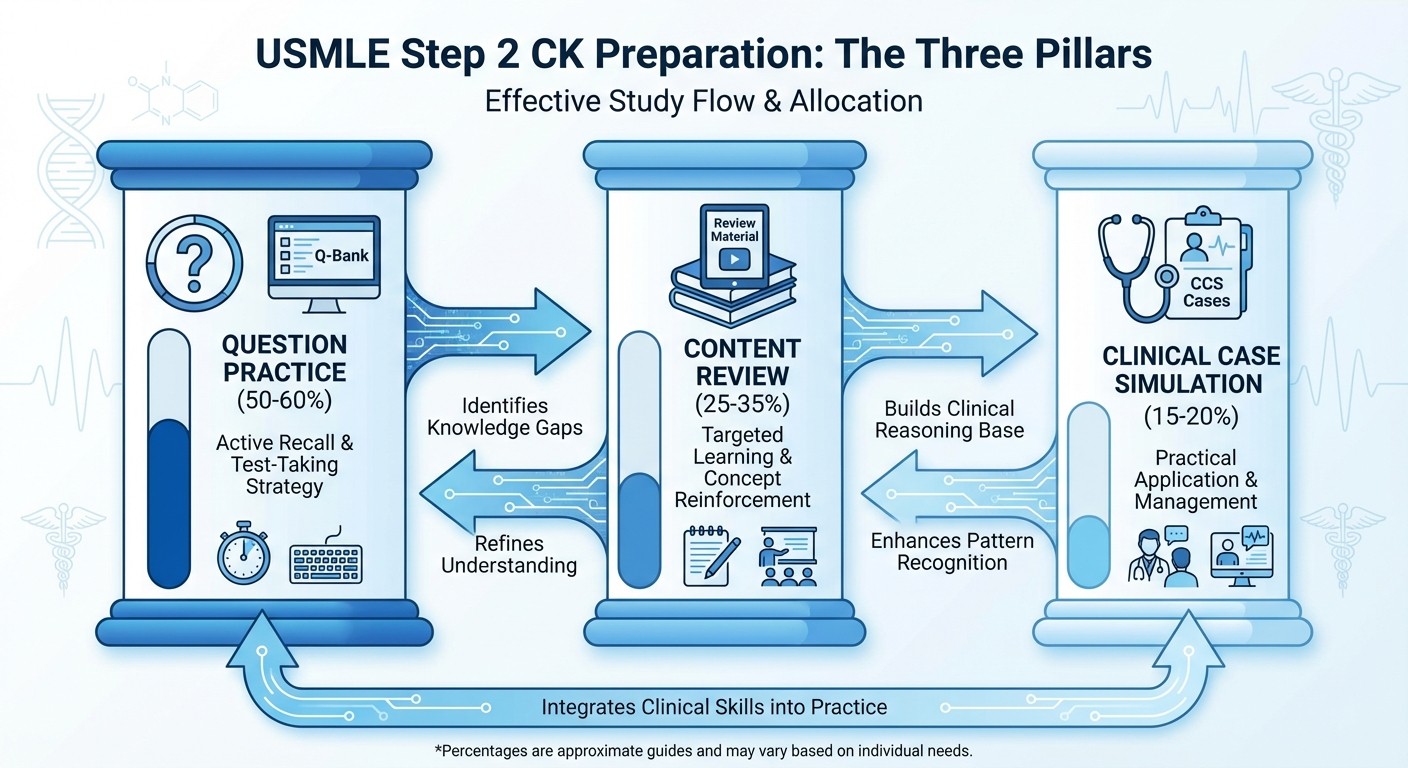
The Three-Pillar Time Allocation Framework
Your dedicated prep block has limited hours. Distribute them across three competing priorities:
Pillar 1: Question Practice (50-60% of study time)
Step 2 CK is a pattern recognition exam disguised as a knowledge test. The patterns come from volume exposure, not content memorization.
Target metrics:
80-120 questions daily during peak weeks
Mix of random timed blocks (40 questions) and subject-specific untimed blocks (20 questions)
Review ratio of 2:1 — spend 2 minutes reviewing each question for every 1 minute spent answering
Question practice isnt just about getting answers right. Its about building the clinical reasoning pathways that let you eliminate wrong answers faster. When you can spot the distractor patterns in Cardiology questions, you free up mental bandwidth for the harder Psychiatry cases in the same block.
For students who need adaptive practice targeting their weak areas, Oncourse AI's question bank automatically adjusts difficulty based on your performance patterns — so you spend more time on the question types that actually matter for your score improvement.
Pillar 2: Content Review (25-35% of study time)
This isnt medical school review. This is targeted gap-filling based on your question practice mistakes.
Active review method:
1. Track every incorrect answer by topic and mistake type
2. Weekly review sessions focused on your lowest-accuracy topics (below 65% correct)
3. Create clinical reasoning flowcharts for high-yield decision points
Example: If you keep missing "next best step" questions in acute coronary syndrome management, dont re-read the entire Cardiology chapter. Build a flowchart for ACS decision points: STEMI vs NSTEMI recognition → risk stratification → intervention timing → medication choices.
Content review targets by week:
Weeks 1-2: Address major knowledge gaps (subjects scoring <60% on practice questions)
Weeks 3-4: Reinforce moderate weak areas (60-70% accuracy subjects)
Weeks 5-6: High-yield review of commonly tested clinical scenarios
Week 7+: Maintenance review only
The clinical reasoning lessons help you build systematic approaches to diagnostic uncertainty — exactly what Step 2 CK tests in those "most likely diagnosis" and "next best step" questions.
Pillar 3: Clinical Case Simulation (15-20% of study time)
Step 2 CK vignettes arent just longer Step 1 questions. They test your ability to work through clinical scenarios the way you would on the wards.
Case simulation structure:
Full patient workups: history → physical → initial tests → diagnosis → management
Emphasis on "what would you do next" rather than "what is the diagnosis"
Practice with time pressure — Step 2 CK gives you 1.5 minutes per question
Most students skip this pillar and wonder why their scores plateau. You can memorize every clinical fact, but if you cant apply clinical reasoning under time pressure, your score stays stuck.
Clinical Rounds simulates exactly this scenario — interactive patient cases where you work through the full diagnostic and treatment reasoning sequence, building the clinical decision-making speed that Step 2 CK actually tests.
Building Momentum vs. Plugging Holes: The Strategic Balance
Every dedicated study block faces this tension: do you build confidence by reinforcing strengths, or do you attack weaknesses that drag down your score?
The answer depends on your timeline and target score.
The Momentum-First Approach (Weeks 1-3)
Best for: Students with 6+ weeks and target scores of 240-250
Start with subjects where you have a solid foundation (70th percentile+ on shelf exams). This builds confidence and establishes good study habits before tackling harder material.
Daily structure:
Morning: Strong subject question practice (40 questions)
Afternoon: Content review in moderate weakness areas
Evening: Clinical case practice in strong subjects
Rationale: Early wins create psychological momentum. When you see your Internal Medicine scores climbing from 75% to 85%, you trust the process enough to grind through difficult Surgery content later.
The Gap-Plugging Approach (Weeks 1-4)
Best for: Students with limited time (4-6 weeks) or major content gaps
Attack your biggest weaknesses first while you have maximum mental energy and time for content review.
Daily structure:
Morning: Weak subject content review (2-3 hours)
Afternoon: Weak subject question practice (40 questions)
Evening: Mixed question blocks for maintenance
Rationale: Major content gaps dont fix themselves with question practice alone. If you scored 50th percentile on the Psychiatry shelf, you need dedicated content work before question practice becomes productive.
Adaptive Tools: Why Your Step 2 Study Plan Should Adjust Itself
The biggest mistake in dedicated prep is building a static schedule. You learn faster in some subjects, plateau earlier in others, and discover unexpected weak spots along the way.
Traditional approach: Week 3 is Pediatrics week, regardless of whether you mastered Pediatrics in 4 days or still struggle with basic concepts. Adaptive approach: Your daily prep adjusts based on your actual performance data, not an assumed timeline.
For students using Oncourse AI, the Daily Plan feature handles this automatically — it identifies your lowest-accuracy topics from recent practice sessions and prioritizes them in your study rotation. If you bomb Cardiology questions on Tuesday, Wednesday's plan automatically includes more Cardiology review. No manual schedule juggling required.
This matters because Step 2 CK improvement comes from targeted weak-area practice, not equal-time subject rotation. The algorithm does the diagnostic work so you can focus on actually studying.
Week-by-Week Framework Structure
Weeks 1-2: Foundation Building
Goal: Establish baseline performance and identify true weak areas Daily target: 60-80 questions + 3-4 hours content review
Random mixed blocks (20 questions each) to identify weak subjects
Subject-specific blocks (20 questions) in areas scoring below 65%
Content review focused on major knowledge gaps
Key metric: Track accuracy by subject and question type. You need data before you can optimize.
Using Synapses spaced repetition flashcards during this phase helps reinforce drug names, clinical syndromes, and diagnostic criteria between question sessions — the foundation recall that makes question bank practice more effective.
Weeks 3-4: Targeted Improvement
Goal: Address moderate weaknesses while maintaining strong areas Daily target: 80-100 questions + 2-3 hours content review
Focus 60% of question practice on subjects scoring 60-75% accuracy
Maintain strong subjects with mixed blocks
Clinical case practice in previously strong areas
Key metric: Look for accuracy improvement trends. If a subject isnt improving after 1 week of focused practice, you need different content review methods.
Weeks 5-6: Integration and Speed
Goal: Build clinical reasoning speed and cross-subject integration Daily target: 100-120 questions + 1-2 hours high-yield review
Primarily random timed blocks to simulate test conditions
Focus on clinical reasoning speed rather than content gaps
Practice "next best step" decision-making under time pressure
Key metric: Time per question should drop below 1.8 minutes while maintaining accuracy.
Week 7+: Peak Performance
Goal: Maintain performance and build test-day confidence Daily target: 80-100 questions + maintenance review only
Timed question blocks only
Light content review of high-yield clinical scenarios
Focus on test-taking strategy and confidence building
Key metric: Consistent performance across multiple practice tests.
High-Yield Clinical Reasoning Strategies
Step 2 CK tests clinical reasoning patterns more than medical knowledge. Master these approaches:
The Elimination Method
Rather than searching for the "right" answer, eliminate obviously wrong choices first. Step 2 CK typically includes 2 clearly incorrect options, 1 reasonable but suboptimal choice, and 1 best answer.
Practice: For every question, identify which 2 answers you can eliminate immediately before comparing the remaining choices.
The "Next Best Step" Algorithm
Most Step 2 CK questions ask what you would do next, not what the diagnosis is.
Decision tree:
1. Is the patient stable? → If no, stabilize first
2. Do you have enough information for diagnosis? → If no, get more data
3. Is there a specific treatment indicated? → If yes, start treatment
4. Does the patient need monitoring? → If yes, arrange follow-up
Pattern Recognition for Common Scenarios
Step 2 CK recycles clinical scenarios with minor variations. Learn the patterns:
Chest pain workup: Always consider ACS first, but know when to pivot to other causes
Shortness of breath: Heart failure vs. lung pathology — the BNP question
Abdominal pain: Surgical vs. medical causes — when to image, when to observe
Altered mental status: Metabolic vs. infectious vs. psychiatric causes
You can practice these exact scenarios through clinical reasoning question practice, which covers the systematic approaches Step 2 CK actually tests.
Subject-Specific Strategy Adjustments
Internal Medicine (25-30% of exam)
High-yield focus: Cardiology, Endocrinology, Infectious Disease Study approach: Case-based review with emphasis on management decisions Common traps: Overcomplicating straightforward diabetes/hypertension management Time allocation: 2-3 dedicated days in your prep block, then integrated into mixed practice Key resources: Focus on US medical PG cardiology lessons and cardiology practice questions for the highest-yield internal medicine content
Surgery (15-20% of exam)
High-yield focus: General surgery basics, trauma, emergency procedures Study approach: Algorithm-based learning for surgical decision-making Common traps: Overthinking when conservative management is appropriate
Pediatrics (15-20% of exam)
High-yield focus: Development, vaccination, common childhood illnesses Study approach: Age-based thinking — newborn vs. infant vs. child management Common traps: Adult medicine approaches applied to pediatric scenarios
Psychiatry (10-15% of exam)
High-yield focus: Depression, anxiety, psychosis, substance abuse Study approach: DSM-5 criteria + medication management Common traps: Social work issues disguised as medical questions
Obstetrics & Gynecology (10-15% of exam)
High-yield focus: Prenatal care, labor complications, common gynecologic conditions Study approach: Timeline-based learning (pregnancy by trimester, menstrual cycle phases) Common traps: Emergency vs. routine management decisions
Managing Study Burnout in a Dedicated Block
Six weeks of intensive prep creates predictable burnout patterns. Plan for them:
Week 2-3 Plateau
Symptoms: Scores stop improving, motivation drops, question practice feels mechanical Solution: Switch study locations, add active recall methods, take a half-day break
Week 4-5 Anxiety Peak
Symptoms: Overthinking easy questions, score anxiety, sleep disruption Solution: Focus on process metrics (questions completed, study hours) rather than performance metrics
Week 6+ Test Anxiety
Symptoms: Second-guessing previous knowledge, cramming low-yield details Solution: Stick to your framework. No new content after Week 6. Mental health maintenance:
Exercise 30+ minutes daily — non-negotiable for cognitive performance
Sleep 7-8 hours consistently — sleep deprivation kills clinical reasoning
One full day off per week during Weeks 1-4
Social contact maintained — isolation worsens test anxiety
Common Framework Mistakes to Avoid
Mistake #1: Subject Rotation Without Data
What it looks like: Spending equal time on all subjects regardless of performance Why it fails: You waste time reviewing strong subjects while weak areas stay weak Fix: Use performance data to guide time allocation
Mistake #2: Content Review Without Application
What it looks like: Reading review books without practicing questions Why it fails: Step 2 CK tests application, not recognition Fix: Every content review session should end with question practice in that subject
Mistake #3: Static Schedule Despite Changing Needs
What it looks like: Following a rigid weekly plan regardless of progress Why it fails: Your learning rate varies by subject and week Fix: Build in weekly schedule adjustments based on performance trends
Mistake #4: Volume Without Targeted Practice
What it looks like: Completing 3,000+ questions but never focusing on weak areas Why it fails: Random practice reinforces existing strengths more than weaknesses Fix: 60% of question practice should target your lowest-accuracy subjects
Technology and Resource Integration
Question Banks
Primary resource: UWorld remains the gold standard for Step 2 CK prep Supplemental practice: NBME practice tests for score prediction Adaptive targeting: Oncourse AI for personalized weak-area practice
Content Review
Comprehensive review: Step 2 Secrets or Master the Boards Quick reference: Online resources for rapid fact-checking Clinical reasoning: UpToDate for management algorithms
Spaced Repetition
Concept reinforcement: Anki decks for high-yield facts Clinical integration: Synapses for clinical reasoning patterns Timing: 30-45 minutes daily, preferably before bed
Performance Tracking
Track these metrics weekly:
Overall question accuracy by subject
Time per question by subject
Improvement rate in weak areas
Confidence level on practice tests
Red flags requiring strategy adjustment:
No improvement after 2 weeks of focused practice in a subject
Accuracy declining despite increased study time
Time per question increasing rather than decreasing
Practice test scores plateauing for 2+ weeks
Frequently Asked Questions
How many weeks do I need for dedicated Step 2 CK prep?
Most US medical students need 6-8 weeks for dedicated preparation. Students with strong shelf exam performance (80th percentile+ consistently) can succeed with 4-6 weeks. Those with significant content gaps or low shelf scores should plan for 8-10 weeks.
Should I take time off from clerkships for dedicated study?
If possible, yes. Step 2 CK requires focused, uninterrupted study time for optimal score improvement. Most students benefit from 4-6 weeks of full-time dedicated study after completing core clerkships.
How many practice questions should I complete daily?
Target 80-120 questions during peak weeks (Weeks 3-5). Start with 60-80 questions in Week 1-2, then gradually increase. Quality of review matters more than total question count — spend 2 minutes reviewing each question for every 1 minute answering.
When should I take my first practice test?
Take a baseline practice test during Week 1 to establish your starting score and identify weak areas. Then take practice tests every 2 weeks to track improvement. Your final practice test should be 1 week before your actual exam.
How do I balance question practice with content review?
Use the 60-40 rule: 60% question practice, 40% content review during Weeks 1-4. Shift to 80-20 during Weeks 5-6 (80% questions, 20% review). Content review should always be triggered by question practice mistakes, not random topic selection.
What if my scores arent improving after 3-4 weeks?
Analyze your mistake patterns rather than just overall scores. If youre missing questions due to knowledge gaps, increase content review time. If youre missing due to reasoning errors or time pressure, focus on clinical reasoning practice and timed question blocks.
Building Your Personal Step 2 Study Plan
Your step 2 study plan should reflect your specific knowledge gaps, learning style, and time constraints. Here's how to build it:
Week before starting: Take diagnostic assessments, gather shelf exam scores, and identify your top 3 weakest subjects Week 1: Establish baseline performance across all subjects while beginning content review in major weak areas Weeks 2-4: Focus 60% of study time on subjects scoring below 70% accuracy while maintaining stronger areas Weeks 5-6: Shift to integrated practice with emphasis on clinical reasoning speed and test-taking strategy Week 7+: Maintain performance through regular practice while avoiding new content introduction
The framework matters more than the schedule. Build momentum through early wins, target your actual weak areas with data-driven practice, and adjust your approach based on performance trends rather than rigid timelines.
Your dedicated prep block is your chance to translate years of medical education into Step 2 CK performance. Make it count by focusing on clinical reasoning development, not just content memorization.
Prepare smarter with Oncourse AI — adaptive MCQs, spaced repetition, and AI explanations built for USMLE Step 2 CK. Download free on Android and iOS.