How Oncourse's Adaptive Question Bank Knows Which Topics You Need to Drill Next
Deep-dive into Oncourse AI's adaptive question bank engine: Bloom's taxonomy state machine, performance tracking, and intelligent topic selection for medical exam prep.
How Oncourse's Adaptive Question Bank Knows Which Topics You Need to Drill Next
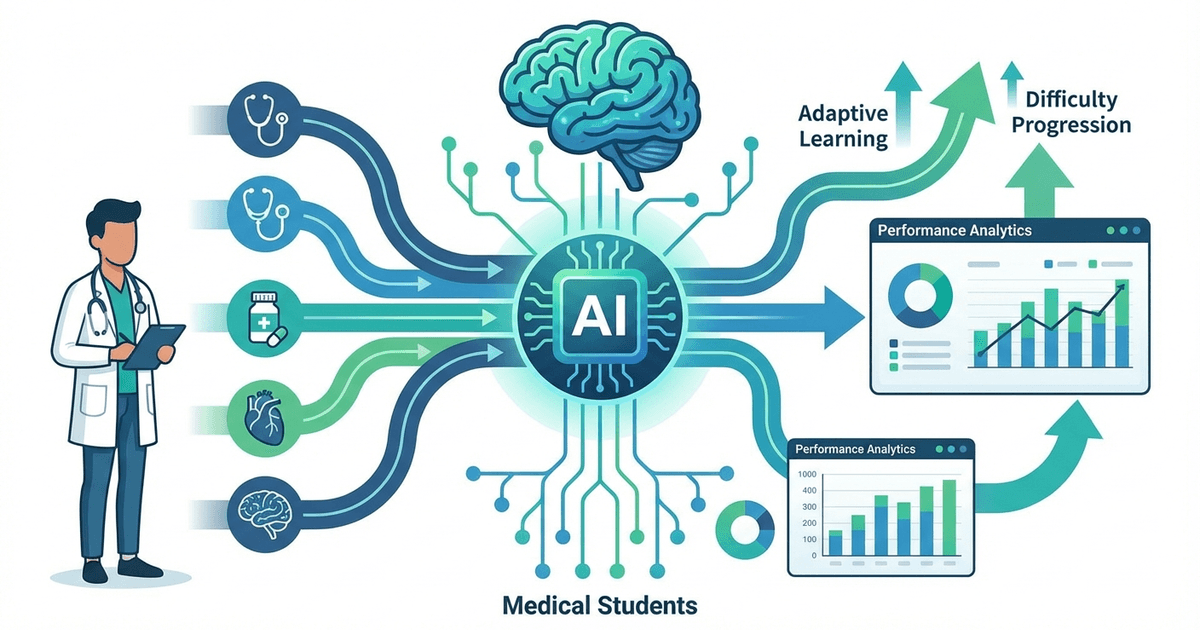
You are probably wondering why Oncourse's question bank feels different from every other MCQ platform out there. You click "Start Practice," and somehow it serves up exactly the topic you bombed yesterday. Get two cardiology questions right? Suddenly you are seeing harder cardiology questions that actually require clinical reasoning. Miss two anatomy questions? The system quietly drops you back to basic recall questions until you get your footing.
This isnt random. It isnt chronological. And it definitely isnt just filtering by difficulty tags like most question banks do.
The Oncourse adaptive question bank runs on a real-time Bloom's taxonomy state machine that tracks your mastery level per topic and adjusts every single question to push you just beyond your comfort zone. After analyzing the actual backend code that powers this system, here's exactly how it works — and why it gets results when traditional question banks leave you spinning your wheels.
The Bloom's Taxonomy State Machine: Your Cognitive GPS
Most medical students have heard of Bloom's taxonomy in some education class, but theyve never seen it actually implemented in their study tools. Oncourse's adaptive engine puts Bloom's levels at the center of every question session:
Memory level: Basic recall — "What is the mechanism of action of furosemide?" Concepts level: Understanding relationships — "How does furosemide affect potassium levels?" Application level: Clinical reasoning — "A patient with heart failure presents with muscle cramps after starting furosemide. What happened?"
Here's where it gets smart: every question session starts at your baseline Bloom's level for that topic. The system tracks your performance at each cognitive level separately. Get two consecutive questions right at the memory level? The state machine automatically promotes you to concepts-level questions on the same topic. Miss two in a row? It drops you back to easier cognitive territory.
This happens in real-time, question by question. The system maintains 30+ state combinations spanning 5 Bloom's levels and 3 difficulty levels. So when you are practicing Renal Pharmacology, you might start with [Memory, Easy] questions about drug names, advance to [Concepts, Medium] questions about mechanisms, then jump to [Application, Hard] questions about drug interactions — all within the same 20-question session.
Traditional question banks just randomize or follow a set sequence. Oncourse's adaptive question bank is constantly asking: "What cognitive skill does this student need to develop next?" and serving questions that target that exact gap.
Per-Topic Performance Tracking: The Engine Under the Hood
Behind every question you see is a performance tracking system that would make a data scientist jealous. For every single topic you touch — whether it's Cardiac Arrhythmias, Diabetes Management, or Cranial Nerve Anatomy — the system tracks:
Correct vs wrong counts at each Bloom's level (memory, concepts, application)
A weighted performance score that reflects recent attempts more heavily than old ones
Comparison to "topper benchmarks": memory level = 85%, concepts = 75%, application = 65%
Topics falling below these benchmarks get flagged as weak areas. But here's the part that makes it actually useful: the system aggregates all your topic performances to identify which entire subject needs the most work.
Say you are getting 90% on Cardiovascular Anatomy (memory level) but only 45% on Cardiovascular Pharmacology (application level). The system doesnt just see two separate weak spots — it recognizes that your Cardiovascular subject performance is dragged down by pharmacology, not anatomy. Tomorrow's Daily Plan will prioritize Cardiovascular Pharmacology questions, not more anatomy review.
This granular tracking is what lets the adaptive engine surface blind spots you didnt even know you had. Most students can tell you their strong and weak subjects, but they cant tell you whether their weakness is at the recall level, conceptual level, or application level. The performance tracking system figures that out automatically.
The 4-Strategy Question Selection Algorithm
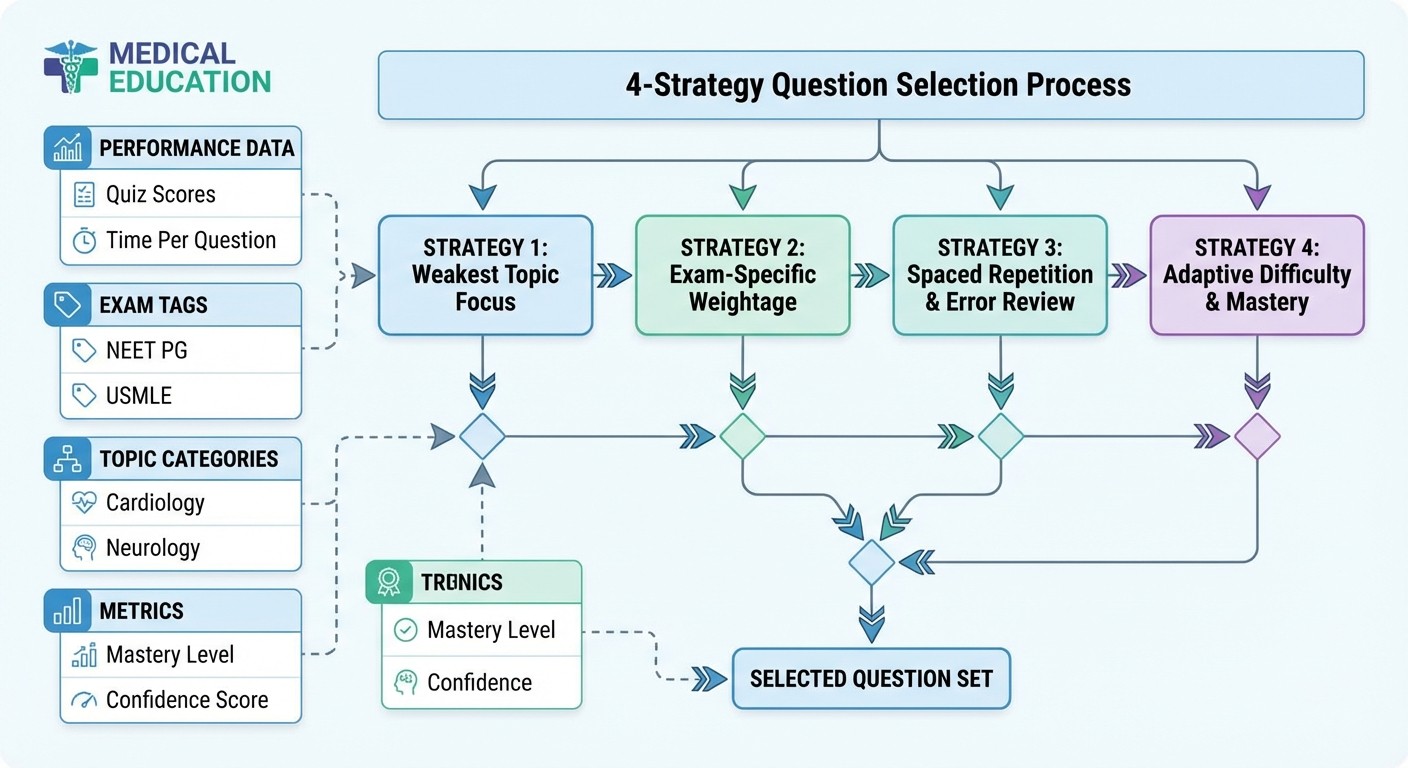
When you click "Next Question," the adaptive engine doesnt just grab a random MCQ from your selected topics. It runs through a sophisticated 4-strategy fallback system:
Strategy 1: User-selected topics for your current subject, filtered by your registered exam tags (NEET PG, USMLE Step 1, etc.) Strategy 2: Same topics but expanded to include questions without specific exam tags Strategy 3: All topics from your current subject, even ones you didnt manually select Strategy 4: Any topic from any subject as a last resort
This hierarchy ensures two critical things: you never run out of questions to practice, and every question is relevant to your actual exam. A NEET PG student will never accidentally get USMLE-only questions, and a USMLE student won't waste time on India-specific clinical guidelines.
But the real intelligence is in how the system weights these strategies based on your performance data. If you are consistently scoring above 85% on your selected topics, Strategy 3 kicks in more often to expose you to topics you might be avoiding. If you are struggling with fundamentals, it stays narrow and focused on Strategy 1 until you build confidence.
The 7-Day Question Cooldown: Why You Never See Repeats
One of the most frustrating experiences in traditional question banks is getting the same question multiple times in a short period. You end up recognizing the answer from the text pattern rather than actually knowing the concept.
Oncourse solves this with a hard-coded 7-day question cooldown. Once you see a question, the system wont show it to you again for a full week. This forces true retrieval practice rather than recognition, and it maximizes the variety of your practice sessions.
But the cooldown period isnt arbitrary. Seven days is specifically chosen to align with optimal spaced repetition intervals — long enough that you cant rely on short-term memory, but short enough that you revisit important concepts before they fade completely.
For a platform with 1 lakh+ practice questions, this cooldown system means you can practice daily for months without seeing repeats, while still ensuring that high-yield concepts cycle back into your practice at scientifically optimal intervals.
Real-Time Weak Area Detection and Daily Plan Integration
The most impressive part of Oncourse's adaptive system is how it closes the feedback loop from practice to planning. After every question session, the performance engine identifies topics where you performed below topper benchmarks and automatically schedules them into your next day's study plan.
This isnt just a recommendation that sits in a dashboard somewhere. The weak area detection directly feeds into your Daily Plan, so when you open the app tomorrow morning, your practice session is already optimized for your actual weak spots.
Say you just finished a 50-question mixed practice session on Internal Medicine. You scored 85% overall, but the system detected that you went 2/8 on Endocrinology questions and 3/6 on Infectious Diseases questions. Tomorrow's Daily Plan will surface Endocrinology and Infectious Diseases as priority topics — not because you manually added them, but because the adaptive engine flagged them based on your actual performance.
This removes the cognitive overhead of deciding what to study next. Students who struggle to self-assess (which is most students) suddenly have an objective system doing the analysis for them.
Exam-Specific Intelligence: Not Just Generic MCQs
One subtle but crucial feature of the adaptive system is how it handles exam-specific content. Every student's registered exam — whether NEET PG, USMLE Step 1, USMLE Step 2 CK, or INICET — is stored as active tags in their profile.
Question selection queries filter by these tags automatically. This means a NEET PG student practicing Cardiology will see questions focused on Indian clinical guidelines, drug availability, and presentation patterns relevant to the Indian healthcare context. A USMLE student working on the same topic will see questions emphasizing differential diagnosis, cost-effectiveness, and US clinical protocols.
The adaptive engine doesnt just personalize difficulty and topic selection — it personalizes the entire clinical context to match your actual exam requirements.
How the State Machine Handles Edge Cases
Real learning is messy. Students have good days and bad days, they guess correctly sometimes, and they might know a topic in one context but not another. The Oncourse state machine is designed to handle these realities:
Streak breakers: If you get 8 questions right in a row, the system assumes you might be in a lucky streak and introduces a harder question to test whether your performance is real or coincidental. Context switching: The state machine tracks Bloom's levels separately for each topic. Being at Application level in Cardiology doesnt automatically put you at Application level in Neurology. Recent vs cumulative performance: The weighted performance scoring gives more weight to recent attempts. A bad session three weeks ago wont drag down your current level if you have been performing consistently well lately. Subject boundaries: When the system expands from Strategy 1 to Strategy 3 (all topics in a subject), it respects your current cognitive level. If you are at Concepts level in Pharmacology, it wont drop you back to Memory level just because you are seeing new Pharmacology subtopics.
These edge case handlers are what make the adaptive system feel intelligent rather than mechanical. It responds to your actual learning patterns, not just your raw correct/incorrect ratios.
The Zone of Proximal Development in Practice
The entire adaptive system is built around Vygotsky's concept of the zone of proximal development — the sweet spot where material is challenging enough to promote growth but not so difficult that it becomes discouraging.
Traditional question banks either serve up random questions (too easy if youve mastered the topic, too hard if you havent) or let you manually select difficulty levels (which most students do poorly). Oncourse's state machine automatically finds and maintains your zone of proximal development for each topic individually.
When you are practicing, you should feel like the questions are just slightly harder than comfortable. If you are breezing through every question, the system will promote you to higher Bloom's levels. If you are struggling, it will drop you back to ensure you master the fundamentals before moving on.
This dynamic difficulty adjustment is what makes practice sessions feel efficient rather than frustrating. You are always working at the edge of your current ability, which is exactly where learning happens fastest.
Why Traditional Question Banks Feel Random
Most medical exam platforms use one of three approaches:
Random selection: Questions pulled randomly from your selected topics, regardless of your mastery level Sequential selection: Questions presented in predetermined order, regardless of your performance Manual difficulty filtering: You choose Easy/Medium/Hard, and all questions at that level get equal weight
None of these approaches account for the fact that learning is non-linear, topic-specific, and cognitively hierarchical. You might be ready for Hard pharmacology questions but still need Easy anatomy questions. You might have mastered the memory level for cardiology but struggle with application-level clinical reasoning.
Oncourse's adaptive question bank treats each topic and cognitive level as separate mastery targets. This granular approach is why practice sessions feel more targeted and why weak areas actually get stronger over time rather than staying frustrating blind spots.
The Performance Feedback Loop
Every question you answer feeds back into the adaptive system in real-time. This creates a continuous feedback loop that gets smarter the more you use it:
Question attempt → Performance tracking → Bloom's state adjustment → Topic weakness flagging → Daily plan optimization → Next session question selection
The system learns your learning patterns. If you consistently struggle with clinical vignette questions but excel at straightforward recall, it will gradually increase your exposure to clinical reasoning while maintaining confidence-building recall practice.
If you consistently perform better in the morning versus evening sessions, the adaptive daily plan will schedule your hardest topics for morning practice. If certain topic combinations seem to confuse you, the system will space them out rather than clustering them in the same session.
This meta-learning capability is what makes the adaptive question bank feel like it understands your study patterns rather than just tracking your scores.
Integration with Rezzy AI and Explanation Chat
The adaptive question bank doesnt operate in isolation. When you get a question wrong, the Explanation Chat feature lets you ask follow-up questions immediately — in context. This closes the feedback loop that most question banks leave wide open.
Instead of seeing "Incorrect" and moving on (or stopping to look up the concept in a textbook), you can ask "Why is the answer not B?" or "Can you explain the mechanism?" right there in the question flow. The AI explanation is tailored to your specific confusion, not just a generic explanation of the correct answer.
This integration means that wrong answers become teaching moments rather than discouraging data points. The adaptive system learns from both your initial answer AND your follow-up questions, building a more complete picture of your understanding.
Frequently Asked Questions
How long does it take for the adaptive system to learn my patterns?
The Bloom's taxonomy state machine starts working immediately — within your first 4-6 questions in any topic. However, the performance tracking becomes more accurate after about 50 questions across different topics, and the daily plan integration becomes most effective after a week of consistent practice.
Can I override the adaptive selections if I want to focus on specific topics?
Yes, the system respects your topic selections while still applying adaptive difficulty and Bloom's level progression within those topics. You control what to study; the adaptive engine optimizes how to study it.
Does the system account for different question formats like clinical vignettes vs straight recall?
The adaptive engine tracks performance across different question types and cognitive levels separately. Clinical vignettes typically map to Application-level Bloom's questions, while definition-style questions map to Memory level, and the system adjusts accordingly.
What happens if I consistently avoid certain topics or subjects?
The 4-strategy fallback system will eventually surface neglected topics through Strategy 3 (all topics in the subject). However, the daily plan recommendations will flag consistently avoided weak areas for manual review.
How does the system handle topics I havent studied yet versus topics I need to review?
The adaptive engine distinguishes between "never attempted" and "attempted but weak performance." New topics start at Memory level with Easy difficulty, while review topics start at your last known mastery level and adjust based on recent performance.
Does the question cooldown affect spaced repetition scheduling?
The 7-day question cooldown prevents immediate repeats but doesnt interfere with spaced repetition. Important concepts cycle back through different questions on the same topic, maintaining optimal spacing intervals without exact question repetition.
Conclusion: Adaptive Learning That Actually Adapts
The difference between Oncourse's adaptive question bank and traditional MCQ platforms isnt just technical — it's pedagogical. While most platforms focus on content delivery, Oncourse focuses on learning optimization.
The Bloom's taxonomy state machine, performance tracking, and intelligent question selection work together to create a practice environment that responds to your actual learning patterns in real-time. You dont have to guess what to study next or wonder whether you are practicing at the right difficulty level. The system handles the cognitive overhead of personalization so you can focus on actually learning.
For medical students preparing for high-stakes exams like NEET PG, USMLE Step 1, USMLE Step 2 CK, or INICET, this kind of adaptive intelligence can mean the difference between random practice and targeted improvement. Every question serves a purpose, every session builds on the last one, and every weak area gets the attention it needs to become a strength.
Prepare smarter with Oncourse AI — adaptive MCQs, spaced repetition, and AI explanations built for medical exam success. Download free on Android and iOS.