Back
Why Spaced Repetition Works for Medical Students (And How Oncourse Is Built Around It)
Discover the neuroscience behind spaced repetition and how Oncourse AI's SM-2 algorithm helps medical students retain massive volumes of knowledge for NEET PG and USMLE exams.
Why Spaced Repetition Works for Medical Students (And How Oncourse Is Built Around It)
You have 20,000 pharmacology facts to memorize for NEET PG. Maybe 35,000 if you're preparing for USMLE Step 1. You read Harrison's chapter on beta-blockers today, understand it perfectly, then forget 70% within 48 hours. Next week, you're back to square one — re-reading the same material like you've never seen it before.
This isnt your fault. This is the forgetting curve at work, and medical school creates the perfect storm for it: massive information volumes, long preparation timelines, and zero tolerance for gaps on exam day.
But here's what most study guides wont tell you: there's a cognitive science solution that's been hiding in plain sight for 140 years. Spaced repetition isnt just another study hack — it's the closest thing we have to a memory cheat code. And when you understand WHY it works at the neuroscience level, you'll never go back to passive re-reading again.
This article breaks down the research that proves spaced repetition works, explains exactly how algorithms like SM-2 optimize your memory, and shows how Oncourse AI has built these principles into every flashcard interaction. No more guessing when to review. No more cramming cycles. Just evidence-based retention that compounds over months.
The Forgetting Curve: Why Your Brain Dumps Medical Knowledge
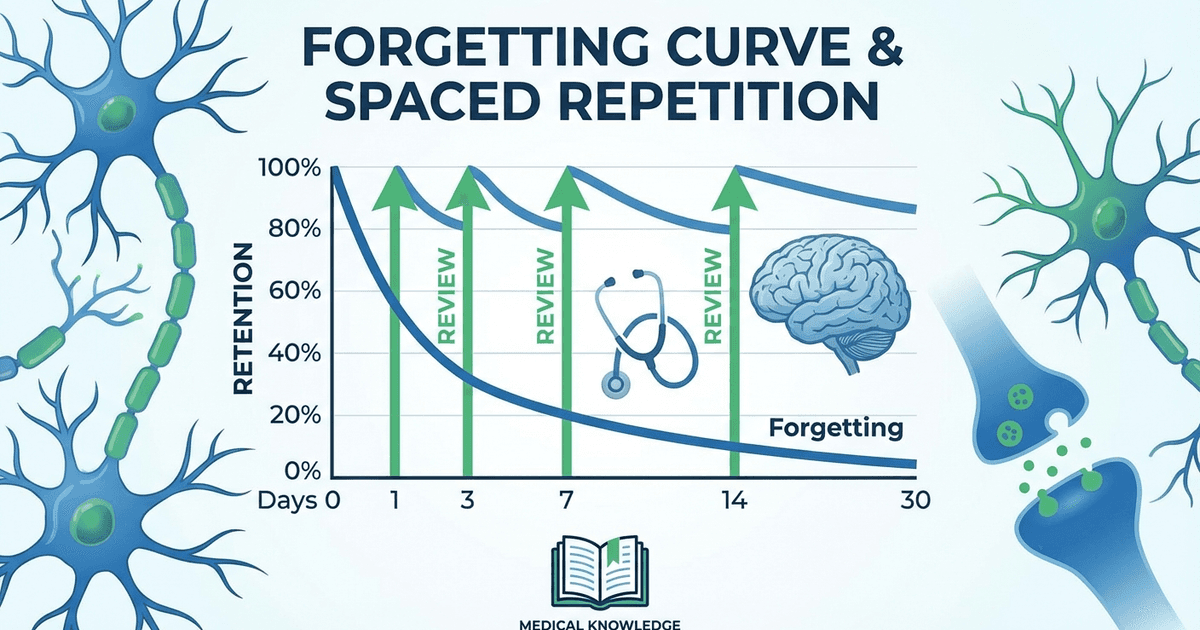
In 1885, German psychologist Hermann Ebbinghaus conducted the first systematic study of human memory. He memorized lists of nonsense syllables, then tested how much he retained over time. The result was the forgetting curve — a mathematical description of how quickly we lose information.
Ebbinghaus discovered that without reinforcement, we forget:
50% within 1 hour
70% within 24 hours
90% within 7 days
For medical students, this presents a brutal problem. When you're studying cardiovascular pharmacology, you're essentially learning thousands of "nonsense syllables" — drug names, mechanisms, contraindications, side effects. Your brain treats "metoprolol selectively blocks beta-1 receptors" the same way it treated Ebbinghaus's "XIJ" or "BEK."
The forgetting curve explains why cramming fails spectacularly in medical school. You can memorize the entire Katzung pharmacology textbook in 2 weeks, ace a practice test, then score 40% on the real NEET PG exam 6 months later. The knowledge was never properly consolidated — it lived in short-term storage and evaporated on schedule.
But Ebbinghaus also discovered something profound: each time you successfully retrieve information from memory, the forgetting curve becomes less steep. The first review might extend retention from 1 day to 3 days. The second review extends it to 10 days. The third to 30 days. Eventually, properly spaced information moves into long-term storage and becomes nearly permanent.
Active Recall: Why Testing Beats Re-reading
Modern cognitive science has identified the mechanism behind spaced repetition's power: the testing effect. When you actively retrieve information from memory, you strengthen the neural pathways more than when you passively re-read the same material.
Roediger and Karpicke's landmark 2006 study demonstrated this dramatically. Students studied prose passages using three methods:
1. Read 4 times (passive review)
2. Read 3 times, test 1 time (mixed practice)
3. Read 1 time, test 3 times (retrieval practice)
On an immediate test, all groups performed similarly. But after 1 week, the retrieval practice group retained 50% more than the passive reading group. The harder you make your brain work to recall information, the stronger the memory trace becomes.
For medical students, this has profound implications. When you're reviewing pharmacology, asking yourself "What are the side effects of ACE inhibitors?" and struggling to remember creates stronger memory consolidation than highlighting the same list in a textbook for the fifth time.
This is why flashcards consistently outperform passive study methods in medical education research. Each card forces active retrieval. Each moment of struggle — that "tip of the tongue" feeling before you remember the answer — is your brain literally strengthening synaptic connections.
The Probe Game on Oncourse AI leverages this testing effect through rapid-fire recall practice. After learning a new concept in immunology or cardiology, you can immediately trigger retrieval practice before the first scheduled review, dramatically reducing forgetting in those critical first 24 hours.
The SM-2 Algorithm: How Computers Optimize Your Memory
Spaced repetition was powerful but impractical until computers arrived. How do you manually track optimal review intervals for thousands of medical facts? How do you adjust spacing based on how well you know each item?
In 1987, Piotr Wozniak created the SuperMemo algorithm (SM-2) to solve this problem. The algorithm tracks how difficult each piece of information is for you personally, then calculates the optimal moment to review it — right before you're about to forget.
Here's how SM-2 works in plain language:
Ease Factor (EF): Each flashcard starts with an ease factor of 2.5, representing how "easy" that item is for your brain. Easy cards have higher EFs (meaning longer intervals between reviews). Difficult cards have lower EFs (shorter intervals). Quality Responses: After each review, you rate how well you remembered:
0 = Complete blank (forgot entirely)
1 = Incorrect response, but correct answer seemed familiar
3 = Correct response, but required significant effort
4 = Correct response with some hesitation
5 = Correct response with perfect recall
Interval Calculation: If your quality score is below 3, the card resets to a 1-day interval (you'll see it tomorrow). If 3 or above, the next interval equals your current interval multiplied by the ease factor. So a card with EF 2.5 reviewed after 4 days will return in 10 days (4 × 2.5). Ease Factor Updates: The algorithm adjusts EF after every review using this formula:
EF = max(1.3, EF + 0.1 - (5 - quality) × (0.08 + (5 - quality) × 0.02))
Translation: rate a card as "hard" (quality 3) and its EF decreases slightly, shortening future intervals. Rate it "easy" (quality 5) and the EF increases, lengthening intervals.
The genius is that SM-2 adapts to your individual memory patterns. If you consistently struggle with pharmacokinetics but excel at anatomy, the algorithm will automatically schedule more frequent reviews for pharm concepts and longer intervals for anatomy facts.
Oncourse AI's Implementation: Making the Algorithm Transparent
Most spaced repetition apps hide their algorithms from users. You tap "Hard" or "Easy" and trust that the computer knows best. Oncourse AI takes a different approach with its Synapses flashcard engine — it makes the spacing decisions transparent so you can see the science working in real time.
When you're reviewing autonomic nervous system drugs on Synapses, every answer button shows you exactly when you'll see that card again:
Forgot (<1 min): Card immediately re-enters the queue
Hard (1 day): Short interval, low confidence
Good (3 days): Standard progression based on current EF
Easy (15 days): Longer interval, high confidence
This transparency serves a pedagogical purpose. Instead of blindly tapping buttons, you're making conscious decisions about your memory strength. You can see the forgetting curve being defeated in real time.
Under the hood, Oncourse uses an SM-2 variant with these specific parameters:
Ease Factor starts at 2.5, minimum floor of 1.3
Quality scores: 0=skipped, 1=forgot, 3=hard, 4=good, 5=easy
Quality <3: interval resets to 1 day (re-enters short-term queue)
Quality ≥3: next interval = current interval × EF (compounding gaps)
Due cards surface when next_review_date ≤ now
For a medical student studying NEET PG 2026, this means your pharmacology flashcards get progressively smarter about your individual memory patterns. Cards you find difficult automatically receive more attention. Cards you've mastered fade into long-term maintenance schedules.
Desirable Difficulty: Why Struggling Is Good
UCLA memory researcher Robert Bjork introduced the concept of "desirable difficulty" — the idea that learning should feel somewhat challenging to be maximally effective. When studying feels effortless, minimal learning occurs. When it feels impossible, you give up. The sweet spot is moderate difficulty that requires mental effort but remains achievable.
Spaced repetition creates desirable difficulty automatically. When a flashcard returns after its calculated interval, you're reviewing it at the precise moment when retrieval requires effort but before the memory has completely faded. This struggle — that moment where you think "I know this... it's on the tip of my tongue..." — is exactly when synaptic strengthening occurs.
Traditional medical school study methods often avoid this difficulty. Students highlight textbooks (effortless), watch video lectures (passive), or re-read notes (familiar). These activities feel productive but create minimal long-term retention because they lack the retrieval challenge that drives memory consolidation.
The Daily Plan feature on Oncourse removes the meta-cognitive burden of deciding what to review while preserving this desirable difficulty. Students see "Your Recall Deck for Today!" with an exact due card count, but each individual review still requires effortful retrieval. The system handles the scheduling complexity; your brain handles the memory work.
Memory Consolidation: From Working Memory to Long-term Storage
To understand why spaced repetition works, we need to understand how medical knowledge moves from short-term awareness into permanent storage.
When you first encounter a new concept — say, the mechanism of action for loop diuretics — it enters your working memory. Working memory has extremely limited capacity (about 7±2 items) and duration (15-30 seconds without rehearsal). This is why you can read about furosemide's action at the loop of Henle, understand it perfectly, then forget it completely by the next paragraph.
For information to become permanently accessible, it must transfer from working memory into long-term storage through a process called consolidation. This requires:
1. Encoding: Creating the initial memory trace
2. Storage: Maintaining the trace over time
3. Retrieval: Successfully accessing the stored information
Each successful retrieval strengthens the storage and makes future retrieval easier. But here's the key insight: retrieval must happen before the memory trace degrades below the accessibility threshold. Wait too long, and you're re-learning rather than strengthening.
Spaced repetition algorithms calculate this optimal retrieval window for each individual memory. Too soon, and you're wasting time on information you haven't started to forget. Too late, and you're starting from scratch. The algorithm finds the "Goldilocks zone" where retrieval requires effort but remains possible.
For medical students preparing for comprehensive exams like NEET PG or USMLE, this consolidation process is critical. You're not just memorizing facts for next week's quiz — you're building a knowledge base that must remain accessible 6-12 months later when you sit for your licensing exam.
The Compound Interest of Medical Knowledge
Albert Einstein allegedly called compound interest "the eighth wonder of the world." Spaced repetition creates compound interest for memory — each successful review doesn't just refresh that specific fact, it makes all related knowledge more stable and accessible.
Consider learning cardiovascular pharmacology for NEET PG. When you properly consolidate the mechanism of ACE inhibitors through spaced repetition, you're not just memorizing "lisinopril blocks angiotensin-converting enzyme." You're strengthening a web of related concepts:
Renin-angiotensin-aldosterone system physiology
Blood pressure regulation mechanisms
Heart failure pathophysiology
Connections to diabetes and kidney disease
Side effect profiles and contraindications
Each spaced review strengthens these neural networks, making it easier to learn new related information and harder to forget what you already know. This is why students who use spaced repetition consistently report that medical school feels "easier" over time — their knowledge base becomes self-reinforcing.
Implementation Strategies: Making Spaced Repetition Stick
Understanding the science is one thing. Actually implementing spaced repetition in your medical school routine is another. Here's how to make it work:
Start Small: Begin with one high-yield topic like basic pharmacology mechanisms or anatomy fundamentals. Trying to convert your entire study routine overnight leads to system overload and abandonment. Trust the Algorithm: When Synapses tells you a card is due in 15 days, resist the urge to review it earlier. The algorithm has calculated the optimal forgetting point. Early review wastes time that could be spent on cards that actually need attention. Embrace Forgetting: If you can't recall a flashcard answer, don't feel frustrated — celebrate. You've discovered a memory gap before your exam did. Mark it as "Forgot" and let the algorithm schedule more frequent reviews. Mix Active and Passive: Spaced repetition works best for factual recall, but medical school also requires conceptual understanding. Use traditional methods (textbooks, lectures, practice questions) to build understanding, then use spaced repetition to make that knowledge permanently accessible. Track Your Wins: Most students underestimate their progress with spaced repetition because the forgetting prevention is invisible. You don't notice the thousands of facts you didn't forget. Keep a simple log of cards mastered or concepts retained to maintain motivation.
The Research Evidence: Why Medical Schools Are Adopting Spaced Repetition
The effectiveness of spaced repetition in medical education isn't theoretical — it's been proven in randomized controlled trials across multiple specialties and exam formats.
A 2016 study of internal medicine residents found that spaced repetition improved long-term retention of medical knowledge by 50% compared to traditional study methods. The effect was most pronounced for factual knowledge (drug mechanisms, diagnostic criteria) and remained significant even 6 months after the intervention.
Medical schools are taking notice. The National Board of Examinations in India has begun incorporating spaced repetition principles into their question bank recommendations for NEET PG preparation. Similarly, the USMLE has published guidance suggesting that students use spaced repetition during their Step 1 and Step 2 preparation.
The research consistently shows that spaced repetition outperforms:
Massed practice (cramming)
Passive re-reading
Highlighting and note-taking
Single-session review
Video-based learning alone
The effect sizes are large enough that medical educators now consider spaced repetition an essential study skill, not an optional enhancement.
Common Mistakes: Why Spaced Repetition Sometimes Fails
Despite the strong research evidence, some medical students try spaced repetition and abandon it after a few weeks. Here are the most common implementation errors:
Mistake #1: Making Cards Too Complex: A single flashcard should test one discrete fact. "Explain heart failure pathophysiology" is too broad. "What is the primary mechanism of ACE inhibitor benefit in heart failure?" is appropriately focused. Mistake #2: Reviewing Too Early: Seeing a card you remember easily feels good, but it's not productive. Trust the algorithm's spacing decisions even when they feel counterintuitive. Mistake #3: Skipping Difficult Cards: When you can't remember a card answer, the temptation is to skip it and come back later. Don't. Mark it as "Forgot" and let the system schedule more frequent reviews. Mistake #4: Inconsistent Daily Practice: Spaced repetition requires showing up daily, even if only for 10-15 minutes. Sporadic marathon sessions don't work because the spacing intervals become irregular. Mistake #5: Expecting Immediate Results: The benefits of spaced repetition compound over weeks and months. Initial sessions might feel slow or inefficient compared to cramming, but the long-term retention gains are dramatic.
Integration with Clinical Learning
One unique aspect of medical education is the transition from preclinical knowledge to clinical application. Spaced repetition excels at building the factual foundation that makes clinical reasoning possible.
When you're rotating through cardiology and encounter a patient with heart failure, you need instant access to ACE inhibitor mechanisms, side effects, and contraindications. This information must be so well-consolidated that it's automatically accessible during clinical decision-making.
Traditional study methods often fail at this transition point. Students can pass written exams but struggle to apply knowledge in real clinical scenarios. Spaced repetition creates the kind of overlearned, automatically accessible knowledge base that supports fluid clinical thinking.
This is particularly important for practical exams and clinical skills assessments that are increasingly part of licensing exams worldwide.
Technology and the Future of Medical Education
Spaced repetition represents a broader trend in medical education: the application of cognitive science principles to optimize learning efficiency. As medical knowledge continues to expand exponentially, students need smarter study methods, not just more study time.
The algorithms powering modern spaced repetition apps continue to evolve. Machine learning techniques are being integrated to predict optimal review intervals more accurately. Adaptive difficulty adjustment helps maintain the desirable difficulty sweet spot as knowledge consolidates.
For medical students entering practice in 2026 and beyond, evidence-based study methods like spaced repetition aren't optional — they're essential for managing the cognitive load of modern medicine.
Frequently Asked Questions
How long does it take to see results with spaced repetition?
Most students notice improved retention within 2-3 weeks of consistent daily practice. However, the full benefits become apparent after 2-3 months when properly spaced cards move into long-term maintenance schedules. The key is trusting the process during the initial weeks when benefits aren't immediately obvious.
Can I use spaced repetition for conceptual understanding or just facts?
Spaced repetition works best for discrete factual knowledge — drug mechanisms, diagnostic criteria, normal values, anatomy details. For conceptual understanding, use traditional methods (textbooks, lectures, problem-solving) to build comprehension, then use spaced repetition to make that knowledge permanently accessible.
How many flashcards should I review per day?
Start with 20-50 new cards per day and whatever review cards come due. As your deck matures, you'll spend more time on reviews and less on new material. Most medical students settle into 100-200 total cards per day (new + reviews) once their system is established.
What if I miss a few days of spaced repetition practice?
Missing 1-2 days isn't problematic — the algorithm adjusts. Missing a week or more disrupts the spacing intervals and may require some knowledge re-consolidation. The key is getting back to consistent daily practice as soon as possible rather than trying to catch up with marathon sessions.
Should I make my own flashcards or use pre-made decks?
Both approaches work. Making your own cards improves initial encoding but takes significant time. High-quality pre-made decks like those in Oncourse's flashcard library save time and ensure comprehensive coverage. Many students use a hybrid approach: pre-made decks for broad coverage plus custom cards for personal weak areas.
How do I know if spaced repetition is working for me?
The clearest indicator is retention on practice tests taken weeks or months after initial learning. Students using spaced repetition consistently report that previously learned material "sticks" better and requires less re-study before major exams. Long-term retention improvements are more valuable than short-term study efficiency gains.
---
Prepare smarter with Oncourse AI — adaptive MCQs, spaced repetition, and AI explanations built for NEET PG, USMLE, and INICET. Download free on Android and iOS.