Back
USMLE Step 2 Score and Match Day: What the 2026 NRMP Data Actually Shows
Build your Step 2 study plan around real 2026 NRMP match data. Learn what scores actually matched by specialty and how to target yours strategically.

USMLE Step 2 Score and Match Day: What the 2026 NRMP Data Actually Shows
You probably know Step 1 is pass/fail now. What you might not realize is how dramatically this shifted the weight onto your Step 2 CK score. The 2026 NRMP match data makes one thing crystal clear: your Step 2 score is now the primary numeric differentiator between getting your target specialty and scrambling.
This isnt another "study hard" guide. This is the data-driven breakdown of what Step 2 scores actually matched in 2026, specialty by specialty, and how to build your study plan around hitting those numbers.
If you are staring at a calendar wondering when to take Step 2, how long to study, or what score you actually need — this is for you. Because knowing your target changes everything about how you prep.
The New Reality: Step 2 as the Primary Filter
With Step 1 pass/fail, residency programs lost their primary screening tool. The 2026 NRMP data shows the predictable result: Step 2 CK scores for matched applicants rose across nearly every specialty.
Here is what happened:
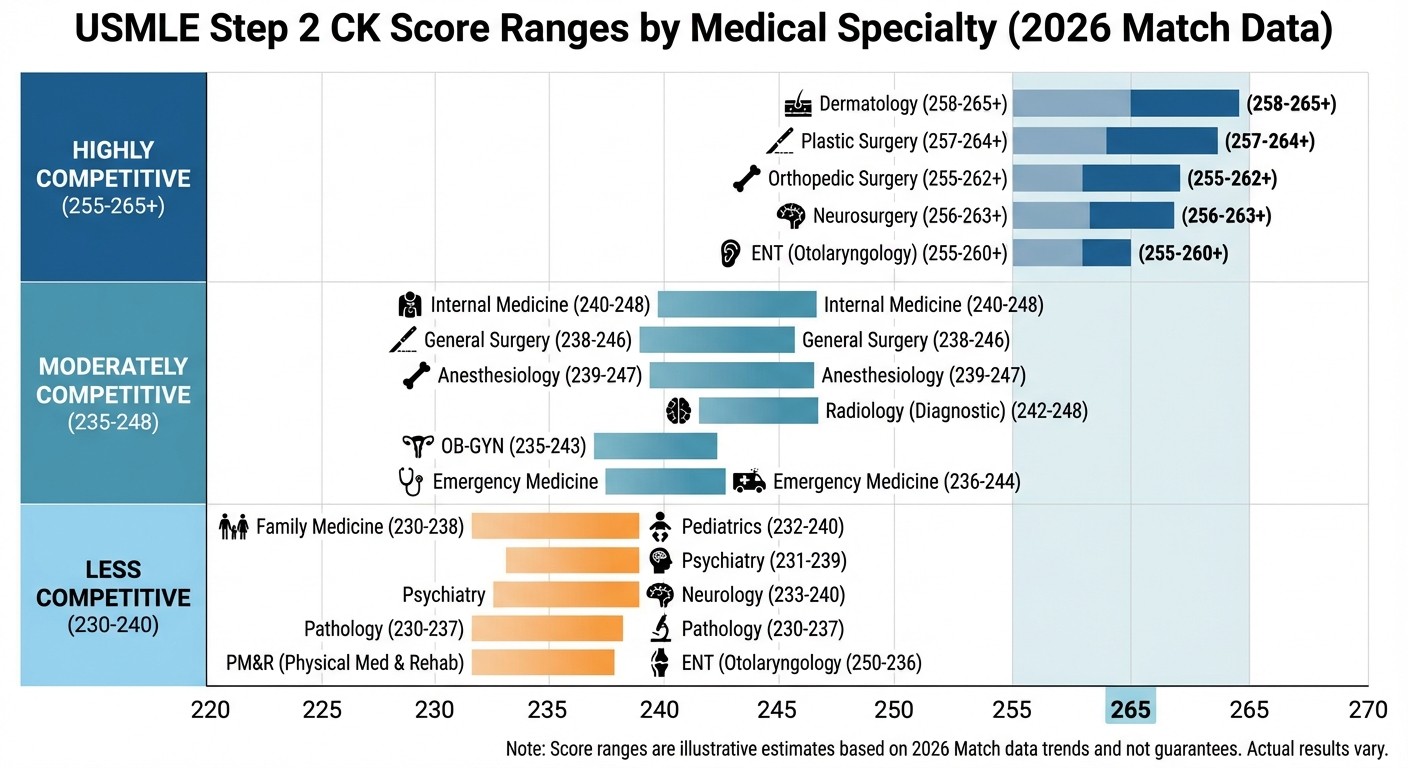
Competitive specialties (Dermatology, Orthopedic Surgery, Neurosurgery, ENT, Plastic Surgery) now expect 255-265+ on Step 2 CK
Moderately competitive (Internal Medicine, Pediatrics, Family Medicine, Psychiatry) target 235-248
Less competitive specialties still want 230-240+ for a comfortable match
These arent aspirational numbers. These are the score ranges where students actually matched in 2026.
The gap between "good enough" and "competitive" is now measured in Step 2 points, not Step 1 grades. Programs that previously screened on a 240+ Step 1 score now set their Step 2 CK filters at similar levels.
Score Benchmarks by Specialty: What 2026 Matched Applicants Actually Scored
Highly Competitive Specialties (255-265+ Step 2 CK Target)
Dermatology, Orthopedic Surgery, Neurosurgery, ENT, Plastic Surgery
The 2026 data shows matched applicants in these fields averaged 258-263 on Step 2 CK. If you are targeting these specialties, your Step 2 score needs to be in the 255+ range just to clear initial screening filters.
Why this matters for your study plan: You cannot afford to "wing it" on any Step 2 subject. These scores require systematic mastery across Internal Medicine, Surgery, Pediatrics, OB-GYN, and Psychiatry. A 255+ score means getting 85-90% of questions correct.
Moderately Competitive Specialties (235-248 Step 2 CK Target)
Internal Medicine, Pediatrics, Family Medicine, Psychiatry, Radiology, Anesthesiology
Matched applicants averaged 240-245 on Step 2 CK. This is the "sweet spot" where a strong Step 2 score compensates for other application weaknesses.
For your prep: Focus on high-yield, high-frequency topics. You can afford to deprioritize some low-yield areas, but you need solid performance across all major subjects.
Less Competitive Specialties (230-240 Step 2 CK Target)
Pathology, Physical Medicine & Rehabilitation, some Internal Medicine programs
A 235+ Step 2 score puts you in a comfortable position. The key is avoiding any major subject collapse that drops you below 230.
When to Take Step 2: Timing Your Dedicated Block
The 2026 match cycle revealed an important pattern: students who took Step 2 CK 6-10 weeks before ERAS submission had better match outcomes. This timing allows for:
Score release before applications go out
Time for a retake if needed (though this is rare)
Reduced stress during interview season
Recommended Timeline:
Spring M3: Take Step 2 in June-July
Dedicated block: 6-8 weeks for most US MD/DO students
Score release: 2-3 weeks post-exam
ERAS submission: September with score in hand
Building Your Step 2 Study Plan: Work Backwards from Your Target
Once you know your target score, the question becomes: how do you actually get there? The answer isnt just "do more questions" — its about systematic preparation that addresses your specific weak points.
Phase 1: Baseline Assessment (Week 1)
Take a diagnostic NBME or Free120 to establish your starting point. This score tells you how many points you need to gain and which subjects need the most attention.
Starting at 200: Need 35-55 point improvement for competitive scores
Starting at 220: Need 15-35 point improvement
Starting at 240: Focus on consistency and avoiding mistakes
Use this baseline to set realistic expectations for your dedicated timeline.
Phase 2: Subject-Specific Focus (Weeks 2-5)
This is where most students go wrong — they study everything equally instead of prioritizing their biggest gaps. The Daily Plan feature in Oncourse AI automatically identifies which subjects need the most attention based on your performance data, rotating between your strongest areas (for momentum) and weakest areas (for maximum score gain).
High-Yield Subject Breakdown:
Internal Medicine (35-40% of exam): Focus on cardiology, infectious diseases, gastroenterology
Surgery (20-25%): General surgery principles, trauma, subspecialty basics
Pediatrics (15-20%): Well-child care, common pediatric emergencies, developmental milestones
OB-GYN (10-15%): Normal pregnancy, complications, gynecologic disorders
Psychiatry (8-12%): Major psychiatric disorders, emergency psychiatry
For students targeting 255+ scores, practicing through Clinical Rounds cases provides the pattern recognition that separates top scorers — working through AI-generated cases of a 45-year-old with acute RUQ pain teaches the clinical reasoning chain that multiple choice questions test.
Phase 3: Integration and Practice (Weeks 6-8)
Focus shifts to full-length practice exams and refining your test-taking strategy. Take NBMEs weekly to track progress and identify persistent weak points.
The goal isnt perfection — its consistent performance at your target level. A 250 scorer gets about 83% correct, which means missing 40-50 questions and still hitting their target.
Common Study Plan Mistakes That Cost Points
Mistake 1: Studying Subjects Equally
Not all Step 2 subjects carry equal weight. Internal Medicine is 40% of your score. Spending equal time on IM and Psychiatry makes no sense when IM is 4x more important to your final score.
Mistake 2: Passive Review vs Active Practice
Reading review books feels productive but doesnt build the pattern recognition Step 2 tests. The exam rewards students who can quickly identify the most likely diagnosis from a clinical vignette, not those who memorized the textbook.
When you miss a question, the key is understanding the clinical reasoning chain, not just memorizing the answer. The Explanation Chat feature provides instant AI breakdown of not just the correct answer but why you got distracted by the wrong choices — building transferable pattern recognition for similar cases.
Mistake 3: Ignoring Mock Exam Feedback
Your NBME scores tell you exactly where you stand relative to your target. A student scoring 230 on practice exams who needs 250 for their specialty should extend their dedicated block, not hope for a 20-point jump on test day.
Subject-Specific Strategy: Where Points Come From
Internal Medicine: The Foundation (35-40% of Step 2)
IM questions test clinical decision-making more than factual recall. Focus on:
Cardiology: Acute coronary syndromes, heart failure management, arrhythmia interpretation
Infectious Diseases: Antibiotic selection, sepsis protocols, opportunistic infections
Gastroenterology: GI bleeding workup, IBD management, liver disease
The key is practicing case-based questions that mirror real clinical scenarios. Traditional question banks often focus on esoteric facts, but Step 2 tests practical decision-making.
Surgery: Think Like a Surgeon (20-25% of Step 2)
Surgery questions emphasize immediate management and surgical indications. High-yield areas:
Trauma protocols: ATLS principles, imaging priorities
General surgery: Appendicitis, bowel obstruction, hernias
Subspecialties: Basic orthopedics, ENT emergencies
For surgery cases, the Clinical Rounds progression system helps students work through trauma scenarios and surgical decision trees — the exact pattern recognition that Step 2 surgery questions test.
Pediatrics: Age-Specific Medicine (15-20% of Step 2)
Pediatrics questions focus on normal development, vaccines, and common pediatric presentations:
Well-child care: Vaccination schedules, developmental milestones
Pediatric emergencies: Febrile seizures, intussusception, respiratory distress
Adolescent medicine: Eating disorders, substance abuse screening
OB-GYN: Pregnancy and Beyond (10-15% of Step 2)
High-yield topics include:
Prenatal care: Screening tests, complications of pregnancy
Labor and delivery: Normal labor, operative deliveries
Gynecology: Contraception, STI management, abnormal bleeding
The Mock Exam Strategy: Calibrating Your Timeline
Your practice exam scores are the most reliable predictor of your actual Step 2 performance. Use them strategically:
NBME Practice Schedule:
Week 2: First practice exam (baseline assessment)
Week 4: Mid-dedicated assessment
Week 6: Final assessment before test day
Week 7-8: Free120 and final review
Score Interpretation:
230-240 on practice exams: Comfortable for less competitive specialties
240-250 on practice exams: Target achieved for most specialties
250+ on practice exams: Competitive for any specialty
If your Week 6 practice score is 15+ points below your target, consider extending your dedicated period. The 2026 match data shows that students who rushed into Step 2 below their target score often had to settle for backup specialties.
Advanced Preparation: Beyond the Basics
Pattern Recognition for 250+ Scores
High scorers dont just know more facts — they recognize patterns faster. This comes from:
1. Case-based learning: Working through clinical scenarios, not just isolated facts
2. Systematic approaches: Developing decision trees for common presentations
3. Error analysis: Understanding why wrong answers seem attractive
Managing Test Day Performance
Step 2 CK is an 8-hour marathon that tests endurance as much as knowledge. Practice under realistic conditions:
Full-length practice exams: Simulate the actual testing experience
Break management: Practice your between-block routine
Mental stamina: Build up to full 8-hour sessions
What the Data Means for Your Strategy
The 2026 NRMP results send a clear message: Step 2 CK is now the primary objective measure for residency programs. This creates both pressure and opportunity.
The pressure: You cant afford to underperform on Step 2 if you want your target specialty. The opportunity: A strong Step 2 score can overcome weaknesses in other application areas. Research gaps, average clinical grades, or limited extracurriculars become less important when your Step 2 score demonstrates clinical competency.
For students using systematic preparation tools, the Daily Plan adjusts automatically based on your weak points, ensuring study time goes toward maximum score improvement rather than reinforcing what you already know well.
Specialty-Specific Considerations
For Competitive Specialty Applicants (Target 255+)
You need near-perfect performance across all subjects. This means:
8+ week dedicated period for most students
Systematic review of all major topics
Multiple practice exams to ensure consistency
Subspecialty focus within major areas
For Moderate Competitiveness (Target 235-248)
Focus on high-yield topics and avoid major knowledge gaps:
6-7 week dedicated period
Strategic topic prioritization based on exam weighting
Solid performance across all subjects, excellence not required
Consistent practice exam scores in your target range
For Less Competitive Specialties (Target 230-240)
Aim for steady, consistent performance:
5-6 week dedicated period often sufficient
Focus on fundamentals rather than esoteric details
Avoid major subject weaknesses that could tank your score
Emphasize test-taking strategy alongside content review
Frequently Asked Questions
How much can I realistically improve my Step 2 score in 6-8 weeks?
Most students see 20-40 point improvements with dedicated preparation. Students starting below 200 often see larger gains (40-60 points), while those starting above 230 typically see 10-25 point improvements. Your baseline practice exam score is the best predictor of potential improvement.
Should I delay Step 2 if my practice scores are below my target?
If you are 15+ points below your target 2 weeks before your test date, consider postponing. The 2026 match data shows that rushing into Step 2 below your target score often meant settling for less competitive programs. An extra 2-3 weeks of preparation usually closes that gap.
How important is the Step 2 score compared to clinical grades and research?
With Step 1 pass/fail, Step 2 CK has become the primary objective measure. The 2026 NRMP data suggests that a strong Step 2 score can compensate for average clinical grades, while a weak Step 2 score is difficult to overcome regardless of other strengths.
What if I dont hit my target score on the first attempt?
Retaking Step 2 CK is less stigmatized than retaking Step 1 was, but programs will see both scores. The 2026 data suggests that meaningful improvement (15+ points) on a retake can still result in successful matches, especially if other application components are strong.
When should I start Step 2 preparation during M3 year?
Most successful students begin light preparation 2-3 months before their dedicated period, focusing on weak subjects identified during clinical rotations. Intensive preparation typically begins 6-8 weeks before the test date. Starting earlier reduces stress but can lead to burnout if overdone.
How do I balance Step 2 prep with M3 rotation responsibilities?
Use your clinical experiences to reinforce Step 2 concepts. When you see a patient with heart failure, review the Step 2 high-yield facts about HF management. When working through case presentations, practice the pattern recognition that Step 2 tests. This integration makes both more effective.
The 2026 NRMP data makes the stakes clear: your Step 2 score is now the primary determinant of where you match. But with systematic preparation targeting your specific score goal, you can build a study plan that gets you there.
Prepare smarter with Oncourse AI — adaptive MCQs, spaced repetition, and AI explanations built for USMLE Step 2. Download free on Android and iOS.