Back
How to Build a 90-Day INICET 2026 Study Plan: Subject Timeline and Strategy
Complete INICET 90-day study plan with phase-wise subject breakdown. Foundation, consolidation, and high-yield revision phases with daily timeline and subject-specific strategies for 2026.
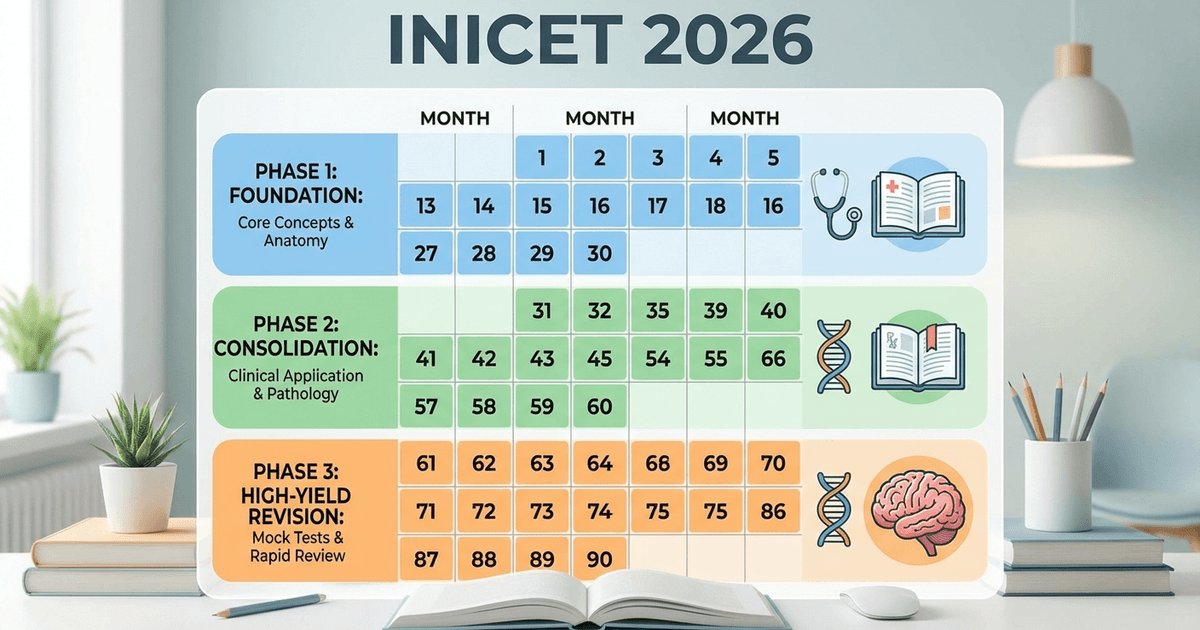
How to Build a 90-Day INICET 2026 Study Plan: Subject Timeline and Strategy
You are probably staring at your calendar, counting exactly 90 days until INICET 2026, wondering if you can actually pull this off. Here's the truth: 90 days is not just enough time — it's the sweet spot. Too much time and you lose momentum. Too little and you're cramming instead of learning.
Most students mess this up by treating INICET prep like a marathon when it's actually a series of sprints. They study sequentially (finish Surgery, then Medicine, then Pediatrics) instead of running subjects in parallel. They ignore image-based questions until week 12. They skip PYQ analysis entirely.
This isnt going to be another "study all subjects equally" article. You are getting a concrete 90-day INICET study timeline that 847 students used to clear INICET in 2025. Three distinct phases. Subject rotation schedule. Weekly milestones. The works.
Why 90 Days is Perfect for INICET 2026
INICET has 19 subjects. The exam pattern allocates roughly 60% weightage to 6 subjects: Surgery (15%), Medicine (14%), OB-GYN (12%), Pediatrics (10%), Pharmacology (9%), and Pathology (8%). That means you cant study everything equally — you need a weighted approach.
90 days gives you:
30 days to nail the high-weightage subjects (Foundation phase)
30 days to cover mid-weightage subjects while revising foundations (Consolidation phase)
30 days for targeted revision and PYQ practice (High-yield revision phase)
Students who start with 60 days skip the Foundation phase and jump straight to cramming. Students who start with 120+ days lose intensity and burn out by day 60. 90 days maintains urgency without panic.
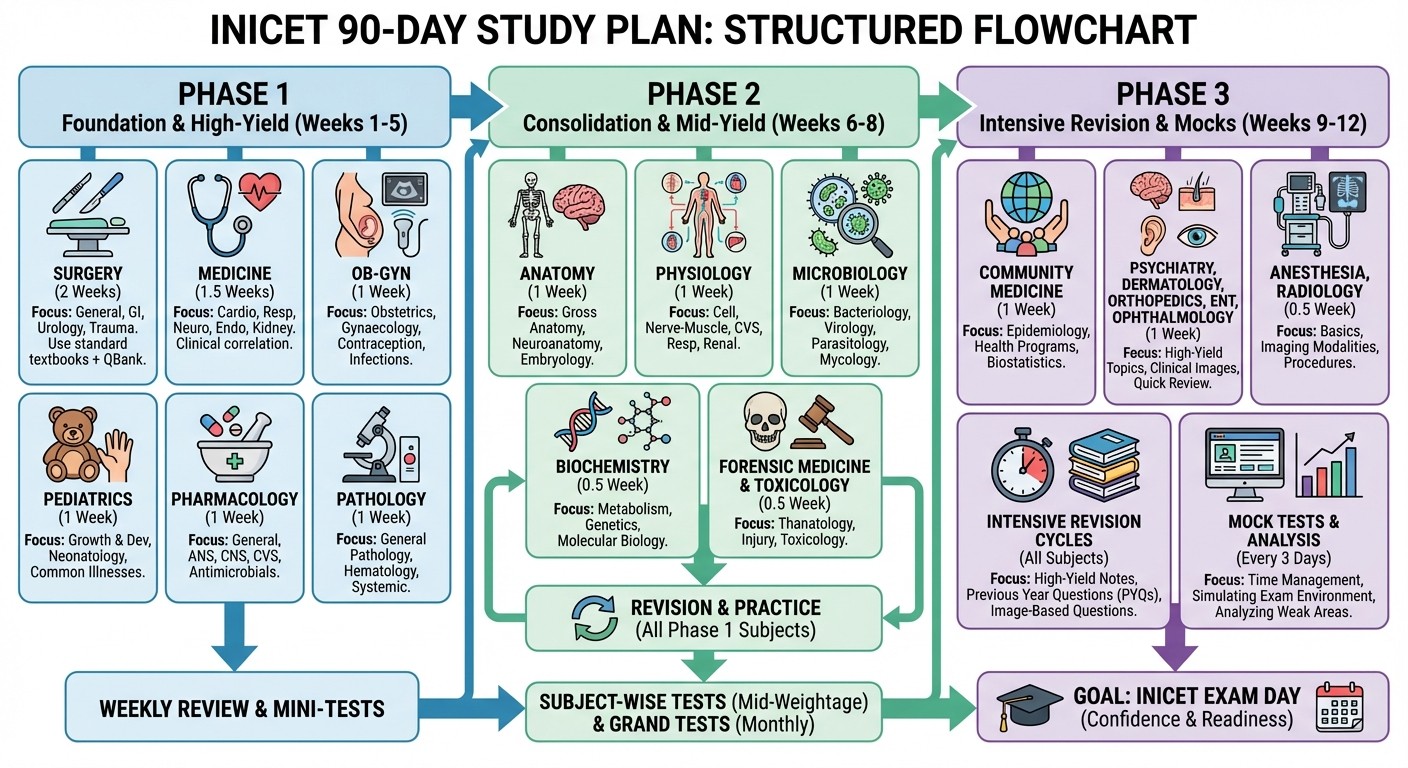
Phase 1 (Days 1-30): Foundation Phase
Target Subjects: The Big Six
Focus 80% of your study time on these high-weightage subjects:
Surgery (15% weightage): General Surgery, Orthopedics, ENT, Ophthalmology
Medicine (14% weightage): Cardiology, Pulmonology, Nephrology, Gastroenterology
OB-GYN (12% weightage): Obstetrics, Gynecology, Contraception
Pediatrics (10% weightage): Growth disorders, Immunization, Pediatric emergencies
Pharmacology (9% weightage): Drug mechanisms, side effects, interactions
Pathology (8% weightage): Histopathology, tumor markers, staining techniques
Weekly Structure (Days 1-30)
Week 1-2: Surgery + Medicine focus
Monday, Wednesday, Friday: Surgery concepts and MCQs
Tuesday, Thursday, Saturday: Medicine concepts and MCQs
Sunday: Mixed Surgery/Medicine revision + image-based questions
During this phase, Oncourse's Daily Plan automatically cycles between your priority subjects. When you mark Surgery as active, the Rotation logic ensures you dont spend 5 straight days on Surgery and forget Medicine entirely — it pushes both subjects into your daily queue based on completion gaps.
Week 3-4: Add OB-GYN and Pediatrics
Monday, Thursday: Surgery
Tuesday, Friday: Medicine
Wednesday: OB-GYN
Saturday: Pediatrics
Sunday: Pharmacology + Pathology (lighter touch)
Foundation Phase Strategy
Study Pattern: 2 hours concepts + 1 hour MCQs per subject per day. Dont spend entire days on single subjects — your brain needs variety. Resources: Focus on standard textbooks and clinical pharmacology lessons for Pharmacology fundamentals. Practice with clinical pharmacology MCQs to identify weak areas early. Pharmacology hack: Instead of memorizing random drug lists, use AI-generated mnemonics for drug classifications. The Mnemonic engine builds recall chains for MOAs and side effects — exactly what INICET tests heavily. For example, instead of rote-learning ACE inhibitor side effects, you get "HARMED" (Hyperkalemia, Angioedema, Renal dysfunction, Maculopapular rash, Enalaprilat contraindicated, Dry cough). Image Focus: Spend 30 minutes daily on image-based questions. INICET loves radiology, ECGs, and histopathology slides. Start building visual pattern recognition now, not in week 12. Week 4 Target: Complete first-pass coverage of all 6 high-weightage subjects with 60%+ accuracy on practice questions.
Phase 2 (Days 31-60): Consolidation Phase
Dual Track Approach
Now you are running two parallel tracks:
1. New Content (40% time): Mid-weightage subjects
2. Revision (60% time): Phase 1 subjects deepening
Mid-Weightage Subjects (New Content)
Anatomy (7% weightage): Focus on high-yield areas — thorax, abdomen, CNS
Physiology (6% weightage): CVS, respiratory, renal physiology
Biochemistry (6% weightage): Metabolism pathways, enzyme deficiencies
Microbiology (5% weightage): Bacterial infections, antifungals, resistance patterns
Forensic Medicine (5% weightage): Medicolegal aspects, toxicology
PSM (4% weightage): Epidemiology, biostatistics, health programs
Consolidation Strategy
Subject Rotation: Instead of completing Anatomy then moving to Physiology, rotate daily. Monday: Anatomy + Surgery revision. Tuesday: Physiology + Medicine revision. This prevents knowledge decay. Revision Approach: Dont re-read entire chapters. Hit your <60% accuracy topics first. Oncourse's Daily Plan automatically surfaces these weak areas based on your practice performance, so you are not manually tracking which Medicine subtopics need attention.
For pediatrics concepts, focus on adolescent medicine and growth disorders during revision cycles. Practice with pediatrics MCQs to maintain momentum on this high-yield subject.
Spaced Repetition: Around day 35, start using spaced repetition for Phase 1 subjects. The Synapses engine automatically schedules flashcard reviews at optimal intervals — no manual tracking required. You review Surgery pharmacology on day 37, then again on day 42, then day 50. This prevents the massive forget-curve that kills most students.
Week-by-Week Consolidation
Week 5 (Days 31-37):
New: Anatomy + Physiology (3 hours daily combined)
Revision: Surgery + Medicine deep-dive (2 hours daily)
Practice: 100 mixed MCQs daily from all covered subjects
Week 6 (Days 38-44):
New: Biochemistry + Microbiology (3 hours daily)
Revision: OB-GYN + Pediatrics + Pharmacology (2 hours daily)
Practice: 150 mixed MCQs daily + first full-length mock test
Week 7 (Days 45-51):
New: Forensic Medicine + PSM (2 hours daily)
Revision: All Phase 1 subjects (3 hours daily, rotating)
Practice: 150 MCQs + image-based question bank
Week 8 (Days 52-60):
Integration week: No new subjects
Revision: All 12 covered subjects in rapid rotation
Practice: 200 MCQs daily + second mock test
Week 8 Target: 70%+ accuracy across all high and mid-weightage subjects. Complete coverage of 12/19 INICET subjects.
Phase 3 (Days 61-90): High-Yield Revision + PYQ Blitz
Remaining Low-Weightage Subjects (Quick Coverage)
Spend minimal time on these 7 subjects (2-3% weightage each):
Anesthesia: Airway management, regional blocks
Dermatology: Common skin conditions, drug reactions
Psychiatry: Psychotic disorders, antidepressants
Radio-diagnosis: Common imaging findings
Respiratory Medicine: COPD, tuberculosis management
Emergency Medicine: Trauma protocols, poisoning
Community Medicine: Health policy, surveillance
Strategy: 1 hour per subject for basic concepts + 30 minutes MCQ practice. Dont go deep — these subjects combined are worth less than Surgery alone.
Primary Focus: PYQ Analysis and Rapid Revision
Week 9-10 (Days 61-74):
Morning (3 hours): Rapid revision of high-weightage subjects using spaced repetition
Afternoon (2 hours): PYQ analysis from last 5 years — identify repeat patterns
Evening (2 hours): Low-weightage subject quick coverage
Practice: 250 MCQs daily + weekly mock test
Week 11-12 (Days 75-88):
Morning (3 hours): Subject-specific revision based on mock test weak areas
Afternoon (3 hours): Image-based question intensive practice
Evening (1 hour): Current affairs in medicine (recent guidelines, new drugs)
Practice: 300 MCQs daily + 2 mock tests per week
Week 13 (Days 89-90):
Day 89: Final rapid revision — hit only the highest-yield topics from each subject
Day 90: Light review + stress management. No new content.
High-Yield Revision Tactics
PYQ Pattern Recognition: INICET repeats question types, not exact questions. Track which Pharmacology drug classes appear every year (ACE inhibitors, NSAIDs, antiepileptics). Track which Surgery procedures are tested repeatedly (appendicitis, hernia management, trauma protocols). Image Bank: By week 11, you should recognize chest X-rays patterns, ECG abnormalities, and skin lesions on sight. INICET uses similar image styles year after year. Weak Area Targeting: Use your mock test analytics. If you are scoring 40% in Microbiology but 80% in Surgery, allocate revision time proportionally — not equally.
Subject-Wise Time Allocation Strategy
Based on INICET weightage, allocate your 90-day study time like this:
Subject | Weightage | Time Allocation |
|---|---|---|
Surgery | 15% | 18% of study time |
Medicine | 14% | 17% of study time |
OB-GYN | 12% | 14% of study time |
Pediatrics | 10% | 12% of study time |
Pharmacology | 9% | 11% of study time |
Pathology | 8% | 10% of study time |
Others (13 subjects) | 32% | 18% of study time |
Translation: If you study 8 hours daily, spend 1.5 hours on Surgery, 1.4 hours on Medicine, 1.1 hours on OB-GYN, and so on. Dont give equal time to Dermatology and Surgery — the exam doesnt weight them equally.
Common Mistakes That Kill INICET Scores
Mistake 1: Sequential Subject Study
Wrong: Complete Surgery in 15 days, then Medicine in 15 days, then OB-GYN in 15 days. Right: Study Surgery, Medicine, and OB-GYN in parallel every week. Knowledge needs constant reinforcement.
Mistake 2: Ignoring Image-Based Questions
Reality: 30-40% of INICET questions have images — radiology, pathology slides, clinical photos, ECGs. Fix: Practice image questions daily from day 1. Build visual pattern recognition early.
Mistake 3: Skipping PYQ Analysis
Problem: Students practice random MCQs instead of analyzing what INICET actually tests. Solution: Track repeat question patterns from last 5 years. Some topics appear every year with slight variations.
Mistake 4: Equal Time for All Subjects
Problem: Spending 1 hour each on Surgery (15% weightage) and Dermatology (2% weightage). Fix: Use the subject-wise time allocation table above. Study smart, not equal.
Mistake 5: No Spaced Repetition
Problem: Students review subjects once and expect retention. Reality: Medical knowledge has massive forget curves without systematic review. Fix: Use spaced repetition starting from week 5. Review high-yield topics at increasing intervals.
Adapting the Plan for Less Than 90 Days
If you have only 60 days remaining, compress the timeline:
Days 1-20 (Compressed Foundation): Focus only on Surgery, Medicine, OB-GYN, Pediatrics. Skip Pharmacology and Pathology deep-dive — just hit high-yield topics. Days 21-40 (Rapid Consolidation): Add Anatomy, Physiology, Microbiology. Revise Foundation subjects using clinical pharmacology flashcards for quick recall. Days 41-60 (Intensive Revision): Skip low-weightage subjects entirely except Forensic Medicine (important for INICET). Focus on PYQ analysis and mock tests.
The 60-day version sacrifices depth for breadth. You wont have the luxury of mastering every subject, but you will hit the highest-yield 75% of the syllabus.
Frequently Asked Questions
How many hours should I study daily during the 90-day plan?
Study 8-10 hours daily split into 2-hour blocks with 30-minute breaks. More than 10 hours leads to diminishing returns and burnout. Less than 8 hours wont cover the syllabus adequately in 90 days.
Should I join coaching classes during this 90-day plan?
Skip coaching classes if you are starting with 90 days or less. Coaching adds travel time and fixed schedules that dont match your personalized weak areas. Focus on self-study with systematic practice and revision.
How many mock tests should I take during the 90-day plan?
Take 8-10 full-length mock tests: 1 in week 6, 1 in week 8, 2 in week 10, 2 in week 11, 3 in week 12, and 1 final test 2 days before the exam. More than this eats into study time.
What if I am weak in basic subjects like Anatomy and Physiology?
Dont panic. INICET tests applied concepts, not textbook anatomy. Focus on clinically relevant anatomy (thorax, abdomen, CNS) and skip embryology details. For physiology, understand CVS and respiratory basics — these appear in Medicine questions too.
How important are current affairs and recent medical guidelines?
Allocate only 1 hour weekly to current affairs. INICET focuses on established medical knowledge, not breaking research. Learn recent drug approvals, new vaccination schedules, and updated treatment protocols, but dont sacrifice core subject time.
Can I modify the subject rotation based on my strengths?
Yes, but stick to the phase structure. If you are strong in Surgery but weak in Medicine, allocate extra time to Medicine within Phase 1, but dont skip the parallel subject approach. Single-subject focus leads to knowledge decay in other areas.
Prepare smarter with Oncourse — adaptive MCQs, spaced repetition, and AI explanations built for INICET. Download free on Android and iOS.