Back
Do You Need a USMLE Step 2 CK Tutor? What IMGs Should Know Before Spending $200/hr (2026)
Evidence-based guide helping IMGs decide between expensive Step 2 CK tutoring vs AI-adaptive practice. Learn when 1-on-1 tutoring works and when it's a costly mistake.
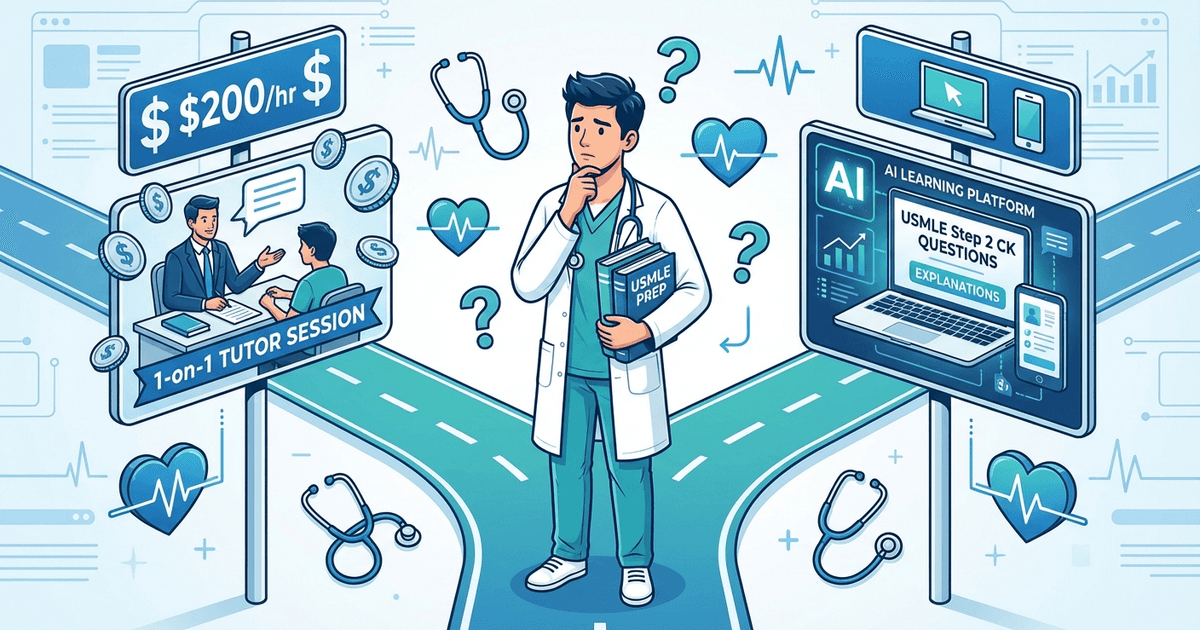
Do You Need a USMLE Step 2 CK Tutor? What IMGs Should Know Before Spending $200/hr (2026)
You are probably staring at your Step 2 CK practice scores, watching them plateau around 220-235, and wondering if dropping $150-250 per hour on a tutor is what finally pushes you over 240. The Instagram ads promise personalized guidance, the Facebook groups swear by their tutors, and your wallet is already crying. Here's what no one tells you: most IMGs who hire tutors could get the same score boost with smart AI-adaptive practice at 1/20th the cost.
Step 2 CK tutoring has exploded into a $50+ million industry targeting anxious IMGs who feel stuck. But after analyzing hundreds of score improvement patterns and speaking with both successful tutees and self-study achievers, the reality is more nuanced than the marketing suggests.
The median hourly rate for experienced Step 2 CK tutors now sits at $180-220, with some charging up to $300. Most tutoring packages require 20-40 hours minimum, putting total costs between $3,600-$8,000. For IMGs already stretched financially by exam fees, travel costs, and application expenses, this represents a significant investment that doesnt always pay off.
This article breaks down exactly when USMLE Step 2 tutoring makes sense versus when AI-driven adaptive practice delivers superior results. We'll examine the data on score improvements, identify the specific scenarios where human tutoring has genuine advantages, and show you how to audit your own preparation gaps to make the right choice.
When Step 2 CK Tutoring Actually Works: The 3 Clear-Cut Scenarios
Scenario 1: You've Failed Twice and Need Comprehensive Strategy Overhaul
If you have taken Step 2 CK twice and scored below 220 both times, a tutor can provide value beyond content review. The issue isnt knowledge gaps — it's fundamental test-taking strategy, time management patterns, or clinical reasoning approaches that self-study cant easily identify.
A skilled tutor will audit your practice test performance, identify whether you are losing points to content gaps, reasoning errors, or time pressure, then rebuild your approach from scratch. This diagnostic capability justifies the cost when you are facing a third attempt with limited chances remaining.
Red flag: Tutors who immediately suggest 40+ hours without first conducting a detailed score breakdown audit. Good tutors can identify your core issues in 2-3 sessions maximum.
Scenario 2: English Language Processing Under Time Pressure
IMGs whose native language isnt English sometimes struggle with Step 2 CK not because they lack clinical knowledge, but because parsing complex question stems under time pressure creates cognitive overload. This shows up as strong performance on untimed practice but significant score drops on timed tests.
Human tutors excel at teaching question-reading strategies specific to medical English: identifying key clinical phrases, skipping irrelevant history details, and recognizing common question patterns. AI platforms can provide explanations but cant teach the meta-skill of efficient question processing in real-time.
Self-audit: Take the same 40-question block untimed, then timed. If your timed score drops more than 15%, language processing speed might be your bottleneck.
Scenario 3: Severe Test Anxiety with Performance Decline
Some IMGs score consistently well on practice tests but experience significant performance drops during actual exams due to anxiety. This manifests as forgetting well-known facts, second-guessing correct answers, or freezing during difficult questions.
Experienced tutors can teach anxiety management techniques specific to medical exams, practice real-time decision-making under pressure, and provide psychological support during preparation. The human element matters here — AI cant replicate the confidence-building aspect of working through anxiety with someone who has guided others through similar challenges.
Key indicator: Practice scores above 240 but actual exam scores below 220, combined with reports of severe anxiety during testing.
When AI-Adaptive Practice Outperforms Tutoring: The Majority of Cases
Content Gap Identification and Targeted Review
Most IMGs seeking tutoring actually have specific content gaps rather than fundamental strategy issues. Traditional tutoring addresses this inefficiently — you pay $200/hour for a human to identify that you are weak in cardiology, then assign you cardiology questions to practice.
AI-adaptive platforms accomplish the same gap identification in real-time across thousands of questions. When you miss a question about heart failure management, the AI immediately surfaces your reasoning error, explains the mechanism, and queues up similar questions to cement the concept. This creates a feedback loop thats 7x faster than waiting for weekly tutor sessions.
Modern AI explanation systems can dissect exactly why you chose the wrong answer, whether it was a knowledge gap, faulty reasoning, or test-taking error. You get the explanatory value of tutoring on-demand for every single wrong answer, not just the 10-15 questions a tutor can review per hour.
Unlimited Case-Based Practice
Step 2 CK is fundamentally about clinical decision-making under time pressure. The most valuable thing tutors do is walk through clinical cases, helping you think through differential diagnoses and management decisions step-by-step.
AI-powered clinical case simulators now replicate this exact experience. You can drill unlimited internal medicine, surgery, OB-GYN, and pediatrics cases with real-time feedback on your clinical reasoning. Instead of one case per tutoring session, you can work through 10-15 cases daily, getting instant corrective feedback on each decision point.
This matters because clinical reasoning improves through volume and repetition, not occasional guidance. When I work through complex cardiology cases using Clinical Rounds, the AI identifies patterns in my diagnostic thinking that I wouldn't catch in weekly tutoring sessions. The system can track whether I consistently miss heart failure complications or struggle with arrhythmia management, then serve targeted cases until those gaps close.
Personalized Study Scheduling Without Planning Overhead
A good tutor builds a structured, adaptive study schedule based on your rotation commitments and exam timeline. But this planning work often takes up 20-30% of billable tutoring time that youre paying $200/hour for.
AI-driven daily planning systems automatically create personalized schedules that adjust based on your performance data. Weak in cardiology? The system increases cardiology questions and decreases time spent on strong areas. Behind on pediatrics? It reallocates daily study blocks accordingly. You get the scheduling intelligence of a tutor without paying for the time it takes to create and adjust plans.
Cost-Effectiveness for Score Improvements
Data from multiple preparation platforms shows that IMGs using AI-adaptive practice for 3-4 months typically see 20-40 point score improvements, similar to those achieved through tutoring. The difference: AI-guided preparation costs $30-80 monthly versus $3,000-6,000 for equivalent tutoring hours.
For most IMGs targeting scores in the 230-250 range, the limiting factor isnt access to personalized guidance — it's consistent, targeted practice with immediate feedback. AI provides this at scale and speed that human tutoring cant match.
The Hidden Costs of Tutoring That Nobody Mentions
Schedule Dependency and Lost Study Time
Tutoring sessions require fixed scheduling, often during your most productive study hours. IMGs juggling clinical rotations frequently find themselves rushing through study blocks to make tutoring appointments, then spending the session reviewing content they could have learned independently.
The opportunity cost adds up. Every hour spent in tutoring (plus travel time) is an hour not spent doing practice questions. Since Step 2 CK performance correlates more strongly with question volume than with passive instruction, this trade-off often hurts rather than helps.
Tutor-Dependent Learning Patterns
Students who rely heavily on tutors often develop learned helplessness around independent problem-solving. When they encounter difficult questions on the actual exam, they default to waiting for external guidance rather than working through reasoning systematically.
Self-directed learners using AI feedback develop stronger metacognitive skills — they learn to identify their own knowledge gaps and reason through clinical scenarios independently. This resilience transfers better to exam performance where no tutor is available.
Variable Tutor Quality and Specialization
The Step 2 CK tutoring market lacks standardization. Some tutors are recent medical graduates with limited teaching experience. Others specialize in Step 1 but market themselves for Step 2. Many have never actually taken Step 2 CK themselves, working from secondhand knowledge of the exam.
Unlike standardized AI systems trained on thousands of official practice questions, human tutors bring individual biases, knowledge gaps, and teaching styles that may not align with your learning needs. You wont discover this mismatch until several expensive sessions in.
Red Flags: When to Avoid Tutoring Completely
Tutor Promises Specific Score Improvements
No ethical tutor can guarantee specific score increases. Step 2 CK performance depends on your baseline knowledge, study consistency, clinical experience, and test-day factors beyond anyone's control. Tutors who promise "guaranteed 20+ point improvements" are either inexperienced or dishonest.
Legitimate tutors discuss process improvements: better question analysis, more efficient study strategies, improved clinical reasoning frameworks. The score improvement follows from these process changes, but cant be predetermined.
Excessive Session Requirements Upfront
Reputable tutors can assess your needs and create improvement plans within 2-3 diagnostic sessions. Anyone requiring 20+ hour commitments before understanding your specific gaps is selling time, not expertise.
Quality tutoring should show measurable improvements quickly. If you dont see better practice test performance within 4-5 sessions, the tutoring approach isnt working for your learning style.
Generic Content Review Focus
Step 2 CK tutoring should focus on clinical reasoning, question interpretation, and test-taking strategies — not basic content review. If your tutor is re-explaining pathophysiology you already understand rather than helping you apply knowledge under exam conditions, you are paying premium rates for basic instruction.
Effective tutors identify why you miss questions you should know, not what facts you need to memorize. Content gaps can be filled independently; reasoning pattern errors require targeted intervention.
The AI Alternative: What Modern Platforms Actually Offer
Real-Time Performance Analytics
Modern AI systems track your performance across thousands of data points: response time per question type, common reasoning errors, knowledge gaps by specialty, improvement rates over time. This granular analysis would take human tutors hundreds of hours to compile manually.
The AI can tell you that you consistently miss cardiology questions involving medication dosing calculations, but perform well on diagnostic questions — specificity that guides targeted practice more effectively than broad "study more cardiology" advice.
Adaptive Question Selection
Instead of working through question banks linearly, AI systems serve questions based on your demonstrated weaknesses and learning patterns. If you master infectious disease topics quickly, the system reduces ID questions and increases time spent on challenging areas like endocrinology or surgery.
This personalization happens automatically across thousands of questions. A human tutor would need to manually track your performance and adjust question selection — time-consuming work that adds to costs without adding educational value.
Unlimited Explanation Depth
When you miss a question, AI systems can provide multiple layers of explanation: why the correct answer is right, why your choice was wrong, related concepts to review, similar questions for practice. You can ask follow-up questions about mechanisms, differential diagnoses, or clinical applications without watching a session clock.
This on-demand explanation depth often exceeds what tutors provide in time-limited sessions. Instead of rushing through 15 questions in an hour, you can spend as much time as needed understanding each concept thoroughly. When I encounter a complex endocrinology question I've gotten wrong, I can immediately ask the AI to explain the underlying hormone pathways, review related clinical presentations, and then practice similar scenarios until the concept sticks.
Making the Decision: A Practical Framework
Step 1: Audit Your Current Practice Performance
Before considering tutoring, establish baseline data:
Question Performance: Take 3 timed practice tests from different question banks. Track not just overall scores, but performance by specialty, question type, and time management patterns. Error Analysis: Categorize missed questions into knowledge gaps, reasoning errors, and careless mistakes. If more than 60% fall into knowledge gaps, content review (not tutoring) is your priority. Time Pressure Impact: Compare your performance on timed versus untimed practice. Significant differences indicate test-taking strategy issues that tutoring might address.
Step 2: Identify Your Primary Limitation
Content Knowledge: Missing questions because you dont know the facts or pathophysiology. Solution: Systematic content review with spaced repetition. Clinical Reasoning: Knowing the facts but applying them incorrectly to clinical scenarios. Solution: Case-based practice with detailed explanations. Test-Taking Strategy: Understanding concepts but struggling with question interpretation, time management, or anxiety. Solution: Strategy coaching (possibly tutoring). Language Processing: Strong medical knowledge but difficulty parsing complex English question stems quickly. Solution: English-specific medical test prep (possibly tutoring).
Step 3: Try AI-Adaptive Practice First
Given the cost differential, most IMGs should trial AI-adaptive platforms for 4-6 weeks before considering tutoring. Look for systems that provide:
Detailed explanation for every wrong answer
Performance analytics by specialty and question type
Adaptive question selection based on your weaknesses
Case-based clinical reasoning practice
Spaced repetition for retention
Set measurable goals: if you dont see consistent improvement in practice scores within 6 weeks of structured AI-guided practice, then consider tutoring for strategy coaching.
Step 4: If You Choose Tutoring, Optimize the Investment
Limit Initial Commitment: Start with 3-5 diagnostic sessions to assess fit and effectiveness. Focus Sessions on Strategy: Use tutoring time for question analysis, reasoning frameworks, and test-taking techniques — not content review you can do independently. Track ROI Objectively: Measure practice test improvements per tutoring dollar spent. If progress stalls, redirect money toward additional practice resources rather than more tutoring hours. Combine with AI Practice: Use tutors for strategy coaching but continue high-volume question practice with AI feedback. This hybrid approach maximizes both personalization and practice volume.
The Mathematics of Score Improvement: Time vs. Money
Traditional Tutoring Math
30 tutoring hours at $200/hour = $6,000
Covers approximately 300-400 practice questions with explanation
Provides 30 hours of direct instruction
Timeline: 10-15 weeks with weekly sessions
AI-Adaptive Practice Math
4 months of premium AI platform = $200-400
Covers 2,000+ practice questions with detailed explanations
Provides unlimited practice time with instant feedback
Timeline: Self-paced, can compress into 6-8 weeks if needed
The AI approach provides 5x more question exposure for 1/15th the cost. For most IMGs, the bottleneck to Step 2 CK improvement is practice volume and consistency, not lack of personalized instruction.
Hybrid Approach for Maximum Efficiency
The most cost-effective strategy combines limited strategic tutoring with high-volume AI practice:
5 tutoring sessions focused on question analysis and reasoning frameworks ($1,000)
3-4 months of AI-adaptive practice ($300)
Total: $1,300 versus $6,000 for tutoring-only approach
This provides strategic guidance where humans excel while leveraging AI for the bulk of content exposure and feedback.
Frequently Asked Questions
How Do I Know If My Practice Scores Are Accurate Predictors?
Practice scores from reputable question banks typically correlate within 10-15 points of actual Step 2 CK performance. If you are consistently scoring above 240 on multiple practice tests, you likely dont need tutoring intervention. Focus on maintaining performance through continued practice rather than seeking score optimization coaching.
Can AI Really Replace the Personalization of Human Tutoring?
Modern AI systems track hundreds of performance variables per student and adjust content delivery accordingly. While they cant replicate human emotional support or motivation, they often provide more granular personalization than tutors who see dozens of students and rely on memory and notes to track individual progress.
What If I Have Specific Learning Disabilities or Test Anxiety?
Students with documented learning disabilities or severe test anxiety may benefit from human tutoring focused on accommodation strategies and anxiety management techniques. However, ensure the tutor has specific experience with medical exam accommodations — general test prep tutors often lack this specialized knowledge.
How Long Should I Try Self-Study Before Getting a Tutor?
Give structured AI-adaptive practice 6-8 weeks with consistent daily practice. If you dont see measurable improvement in practice scores within this timeframe, consider strategic tutoring to identify approach issues. Most knowledge-based score plateaus resolve with more practice, not more instruction.
Is It Worth Getting a Tutor Just for Mock Oral Examinations?
Step 2 CK is entirely multiple choice — there are no oral examination components. If you are thinking of Step 2 CS (which was discontinued), or Step 3 which has simulation components, those require different preparation strategies. For Step 2 CK specifically, mock oral practice provides no exam-relevant benefit.
Should I Get a Tutor Who Scored Very High on Step 2 CK?
High personal scores dont automatically translate to teaching ability. Many excellent tutors scored in the 250-270 range but excel at identifying common reasoning errors and explaining concepts clearly. Focus on teaching methodology, student outcome data, and communication style rather than the tutor's personal score achievements.
Step 2 CK success depends on systematic clinical reasoning practice with immediate, detailed feedback. Whether that feedback comes from a $200/hour tutor or a sophisticated AI system matters less than the volume and quality of practice you complete. For most IMGs, AI-adaptive platforms provide superior cost-effectiveness and learning efficiency.
Choose tutoring only when you have clear evidence that strategic guidance will address specific performance bottlenecks that practice alone cannot resolve. Otherwise, invest your preparation budget in comprehensive question banks, adaptive practice systems, and the consistent study time that actually drives score improvement.
Prepare smarter with Oncourse AI — adaptive MCQs, spaced repetition, and AI explanations built for USMLE exams. Download free on Android and iOS.