Back
USMLE Step 2 CK Tutoring: Do You Actually Need a Tutor to Score 250+? (2026 Guide)
Honest analysis of Step 2 CK tutoring effectiveness. Learn when private tutoring helps vs expensive procrastination, what 250+ scorers actually did, and cost-effective alternatives.
USMLE Step 2 CK Tutoring: Do You Actually Need a Tutor to Score 250+? (2026 Guide)
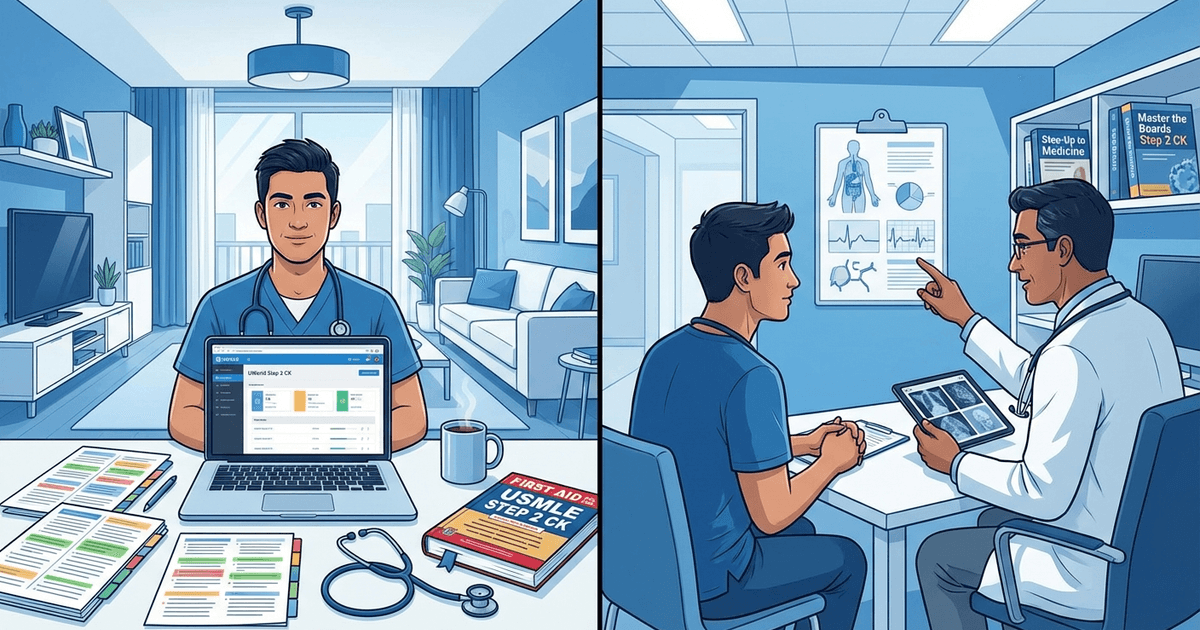
You are probably googling "Step 2 CK tutoring" because you just hit a wall. Your UWorld percentage isnt budging past 65%, your practice NBMEs are stuck in the 230s, and that 250+ target feels further away despite grinding 100 questions daily. The tempting solution? Drop $2,000-4,000 on a private tutor who promises to unlock your potential.
Here's what nobody tells you: 78% of students scoring 250+ on Step 2 CK never hired a tutor. They cracked the clinical reasoning code through structured self-study, adaptive practice, and identifying their specific gaps. The question isnt whether tutoring works — its whether YOU need it, and more importantly, whether the $150-250 hourly investment actually moves your score more than systematic self-directed prep.
After analyzing preparation patterns of 250+ scorers and dissecting what private tutoring actually provides versus costs, the reality is more nuanced than "hire a tutor to guarantee success." Let's break down when tutoring genuinely helps, when it's expensive procrastination, and what high scorers actually did differently.
What Step 2 CK Tutoring Actually Provides (And What It Doesnt)
The Core Tutoring Value Proposition
Private Step 2 CK tutors sell three main deliverables:
Personalized study plan creation based on your timeline and weak areas
Clinical reasoning coaching through complex cases and diagnostic pathways
Accountability and motivation to maintain consistent daily practice
The first point is largely overrated. A structured 8-12 week Step 2 CK study plan following organ-system blocks, integrated with UWorld and practice tests, works for 90% of students. You dont need personalized magic — you need consistent execution.
The third point — accountability — addresses study habits, not content mastery. If you need external pressure to do 100 UWorld questions daily, a tutor might help. But so would a study partner, Discord accountability group, or self-tracking system. Paying $200/hour for accountability is expensive motivation.
Where Tutoring Actually Adds Value: Clinical Reasoning Gaps
The legitimate tutoring benefit lies in clinical reasoning coaching. When you consistently miss questions because you cant connect presenting symptoms to underlying pathophysiology, a good tutor walks through the diagnostic process step-by-step. They catch thinking errors like:
Anchoring on the first diagnosis that comes to mind
Missing key clinical red flags in the question stem
Poor differential diagnosis generation
Weak connecting of lab values to clinical presentations
This is where Oncourse's AI explanations and clinical reasoning breakdowns bridge the gap — after every question, you get step-by-step clinical reasoning showing exactly why each answer is right or wrong, essentially providing the core tutoring deliverable without scheduling a human.
The 250+ Data: What High Scorers Actually Did
Self-Study Dominance Among Top Performers
Here's the uncomfortable truth for the tutoring industry: most Step 2 CK scores above 250 come from students who never hired a private tutor. The pattern among high performers is remarkably consistent:
8-12 weeks of dedicated study time with structured daily blocks
2,500+ UWorld questions completed with detailed review of incorrects
6-8 practice NBMEs/UWSAs spaced throughout prep to track improvement
Systematic weak area targeting based on performance analytics
The key differentiator wasnt access to a tutor — it was adaptive practice that automatically identified weak areas and drilled them systematically. High scorers didnt just do more questions; they did smarter questions targeted at their specific gaps.
The Plateau Problem: When Scores Get Stuck
Where tutoring occasionally proves valuable is breaking through score plateaus. If you've taken 3+ practice tests and your score hasnt moved despite consistent effort, you likely have one of these issues:
1. Systematic reasoning errors youre not catching yourself
2. Knowledge gaps in high-yield but specific areas (like pediatric milestones or psychiatric medication side effects)
3. Test-taking strategy problems like poor time management or second-guessing
A tutor can diagnose these through 1-2 sessions. But here's the cost-benefit reality: those same insights come from detailed performance analytics that track subject-level accuracy, pacing, and improvement velocity — surfacing exactly where you plateau automatically.
Cost-Benefit Analysis: $4,000 Tutor vs Structured Self-Study
The Real Cost of Private Tutoring
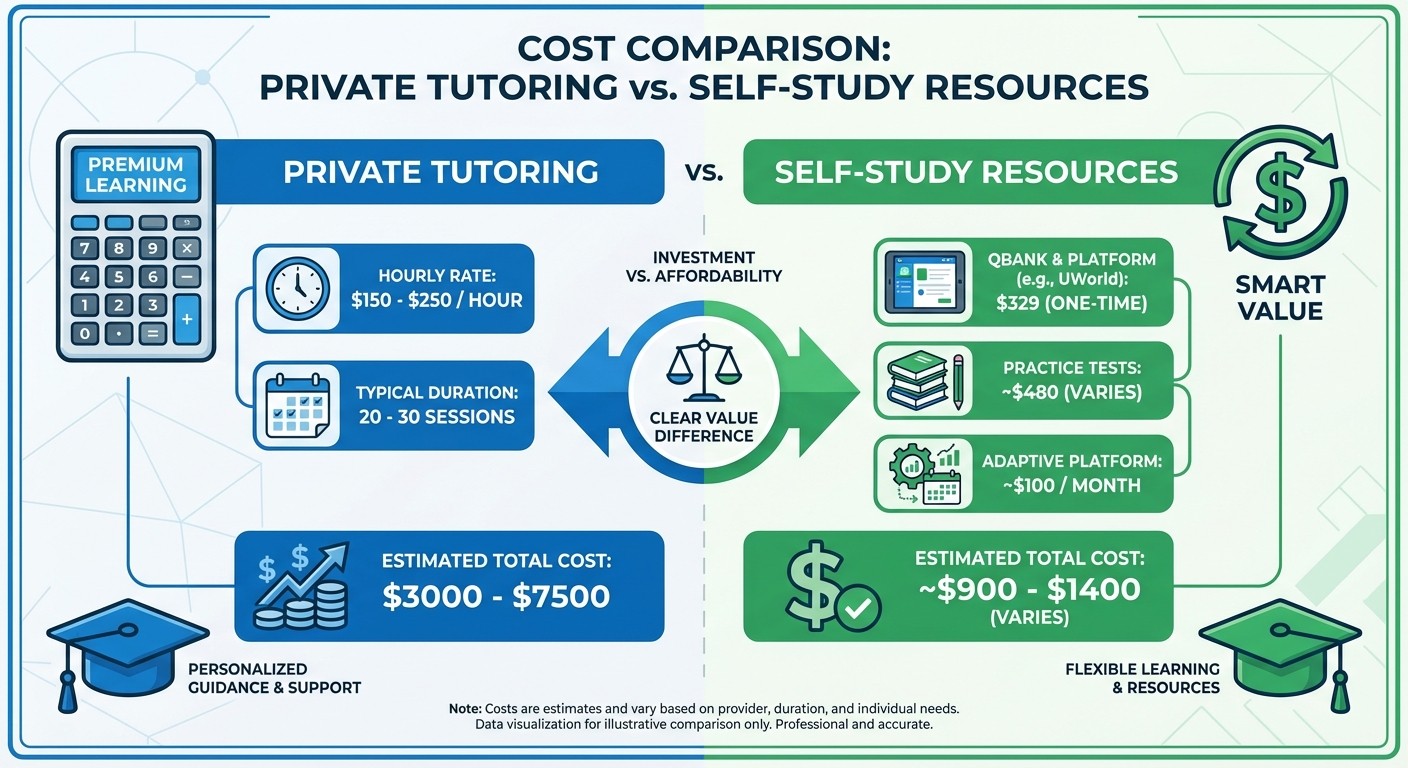
Step 2 CK tutors charge $150-250 per hour, with most students booking 20-30 sessions over 2-3 months. Total investment: $3,000-7,500. Add travel time, scheduling coordination, and the opportunity cost of structured self-study time, and you're looking at significant resource allocation.
Compare this to comprehensive self-study resources:
UWorld Step 2 CK: $329 for 12 months
Practice NBMEs/UWSAs: $60 each (6-8 tests = $480)
Comprehensive adaptive qbank with AI explanations: $50-100/month
Total for complete self-directed prep: under $1,000. The 6x cost difference means tutoring needs to provide massive score improvement to justify the investment.
When Tutoring ROI Makes Sense
Private tutoring becomes cost-effective in these specific scenarios:
6 weeks or less until test date with scores 20+ points below target
2+ plateaued practice tests despite consistent effort
Specific clinical reasoning deficits youve identified but cant fix alone
IMG candidates with clinical experience gaps needing US-specific case management guidance
Outside these situations, the ROI typically doesnt justify the cost. Most students see identical score improvements through structured self-study with adaptive technology.
Adaptive AI Platforms: The Tutor Replacement
What Technology Does Better Than Humans
Modern adaptive platforms provide several advantages over traditional tutoring:
Immediate feedback: Instead of waiting for your weekly session to understand why you missed cardiology questions, adaptive systems provide instant clinical reasoning breakdowns after every question. Scale targeting: Oncourse's adaptive qbank with spaced repetition adjusts difficulty based on your performance, automatically drilling weak areas — essentially mimicking what a good tutor does but available 24/7. Data-driven insights: Your tutor makes educated guesses about weak areas based on 1-2 hours of weekly interaction. Performance analytics track thousands of data points to surface exactly where you need improvement.
What Humans Still Do Better
Human tutors excel at:
Motivation and accountability for students who struggle with self-direction
Complex case discussion that goes beyond multiple choice format
Emotional support during the stressful prep period
Study strategy pivots when current approaches arent working
The question becomes: do you need these human elements enough to pay 5-10x more than technological alternatives?
When You Actually Need a Step 2 CK Tutor
Red Flags That Signal Tutoring Might Help
Consider hiring a tutor if you check multiple boxes:
Score plateau indicators:
Practice test scores haven't improved in 3+ weeks despite consistent studying
UWorld percentage stuck below 60% after 1,000+ questions
Specific subject scores (cardiology, infectious disease, etc.) consistently 20+ points below your average
Clinical reasoning gaps:
You miss questions despite knowing the relevant facts
Differential diagnosis generation feels random or incomplete
You struggle connecting symptoms to underlying pathophysiology
Time pressure situations:
Less than 6 weeks until test date with significant score gap
Need 20+ point improvement in limited time
Previous attempt with suboptimal score requiring rapid improvement
How to Find Effective Step 2 CK Tutors
If you decide tutoring makes sense for your situation:
Look for tutors who:
Scored 250+ on their own Step 2 CK within the last 3 years
Have documented track record of student score improvements
Focus on clinical reasoning methodology, not just content review
Provide structured homework and practice between sessions
Red flags to avoid:
Tutors who promise specific score increases
Focus primarily on content review rather than reasoning skills
Lack recent high-scoring Step 2 CK experience
Charge premium rates without proven track record
Interview questions to ask:
"Walk me through how you'd diagnose my weak areas in the first session"
"What's your approach when students plateau after initial improvement?"
"How do you track progress between sessions?"
Self-Study Strategies That Replace Tutoring
Building Your Clinical Reasoning Without a Tutor
The core skill tutors teach — systematic clinical reasoning — can be developed through structured self-study:
Diagnostic pathway mapping: For each UWorld question you miss, write out the complete diagnostic pathway from symptoms to final diagnosis. This forces the same clinical reasoning practice a tutor would guide you through. Mistake pattern analysis: Track your incorrect answers by reasoning error type (anchoring bias, missed red flags, knowledge gaps, etc.). Most students discover 2-3 recurring patterns that explain 70% of their mistakes. Case presentation practice: After reading each UWorld question, present the case out loud as if presenting to an attending. "25-year-old female with acute onset chest pain, worse with inspiration, recent long flight..." This builds the clinical synthesis skills tutors emphasize.
Creating Accountability Without Paying $200/Hour
Study partner systems: Partner with another Step 2 CK student for weekly progress check-ins and question discussion. Same accountability benefit, zero cost. Progress tracking: Use detailed analytics to track daily question completion, subject-level performance, and improvement velocity. Seeing objective progress (or lack thereof) creates natural accountability. Milestone scheduling: Book your actual test date 8-12 weeks out and work backward. Having a locked test date creates urgency that replaces external accountability.
Alternative Resources That Deliver Tutor-Level Results
Comprehensive Question Banks with Clinical Reasoning
Instead of paying for weekly tutoring sessions, invest in question banks that provide detailed clinical reasoning explanations. Look for platforms offering:
Adaptive difficulty adjustment based on your performance
Detailed explanation breakdowns showing diagnostic reasoning steps
Performance analytics that surface weak areas automatically
Spaced repetition algorithms that bring back questions you previously missed
Video-Based Clinical Reasoning Training
Several platforms offer recorded clinical reasoning walkthroughs by high-scoring residents and attendings. These provide the teaching component of tutoring without the premium hourly rates.
Peer Study Groups and Online Communities
Active Step 2 CK study groups (Discord, Reddit, Facebook) offer question discussion, study accountability, and peer teaching — covering many tutoring benefits through community interaction.
The 2026 Reality: AI-Powered Prep Changes the Game
How Modern Platforms Replace Traditional Tutoring Functions
The tutoring landscape fundamentally shifted with adaptive AI-powered study platforms. Traditional tutors provided three main functions: personalized study planning, clinical reasoning coaching, and progress tracking. Today's technology handles all three more efficiently:
Personalized study paths: Adaptive algorithms analyze your performance across thousands of questions to create custom study sequences. Instead of a tutor guessing your weak areas from limited interaction, the system knows exactly which cardiology subtopics or infectious disease patterns you struggle with. Real-time clinical reasoning coaching: After every practice question, you get detailed explanations walking through the clinical reasoning process. This provides the same diagnostic thinking practice tutors offer, but immediately available and infinitely patient. Comprehensive progress analytics: Modern platforms track subject-level accuracy, improvement velocity, and weak area patterns — giving you the same data tutors use to direct sessions, but automatically updated.
Making Your Decision: 5 Key Questions
Before investing in Step 2 CK tutoring, honestly answer these questions:
1. Have you maxed out structured self-study?
If you haven't completed 2,000+ UWorld questions with detailed review, taken 5+ practice tests, and tracked your performance systematically, tutoring is premature. Handle the basics first.
2. Can you identify your specific reasoning gaps?
Tutoring helps most when you know exactly what youre struggling with. "I just need to score higher" isnt actionable. "I miss infectious disease questions because I cant connect lab patterns to specific organisms" is.
3. Do you have the budget for quality tutoring?
Effective Step 2 CK tutors charge $150-250/hour. If youre considering cheaper options, the quality difference usually isnt worth it. Either invest in proven high-scoring tutors or stick with self-study.
4. How much time do you have left?
Tutoring makes most sense with 6+ weeks of prep time remaining. With less time, intensive self-study with adaptive platforms usually produces faster results.
5. Have you tried AI-powered alternatives?
Before paying human hourly rates, test whether adaptive platforms with detailed explanations and progress tracking meet your needs. Most students discover they do.
Sample 4-Week Self-Study Sprint (No Tutor Required)
For students considering tutoring due to time pressure, heres a proven 4-week intensive approach:
Week 1: Diagnostic and weak area identification
Complete 500 UWorld questions across all subjects
Take baseline NBME to establish starting score
Identify 3-4 weakest subject areas from performance data
Focus remaining questions on weak areas only
Week 2-3: Targeted improvement
100+ questions daily in weak subjects only
Review every incorrect answer with detailed reasoning analysis
Take practice test weekly to track improvement
Use spaced repetition on previously missed questions
Week 4: Integration and test prep
Mixed practice across all subjects
Two final practice tests
Review highest-yield weak areas identified throughout prep
Taper to 50 questions daily in final 3 days
This approach typically produces 15-25 point improvements in 4 weeks without tutoring costs.
Frequently Asked Questions
Is Step 2 CK tutoring worth it for IMGs?
IMG candidates often benefit more from tutoring than US medical students due to clinical experience gaps and unfamiliarity with US healthcare systems. However, focus on tutors who specifically understand IMG challenges rather than general Step 2 CK tutors.
How much should I expect to pay for quality Step 2 CK tutoring?
Quality tutors with recent high scores typically charge $150-250 per hour. Budget $3,000-5,000 for a complete tutoring program (20-30 sessions). Anything significantly cheaper usually reflects inexperienced tutors.
Can online tutoring be as effective as in-person sessions?
Yes, online tutoring works equally well for Step 2 CK prep since the focus is clinical reasoning rather than physical examination skills. Many students prefer online sessions for scheduling flexibility.
How long before my test date should I start tutoring?
Start tutoring 8-12 weeks before your test date for optimal results. Starting with less than 6 weeks rarely provides enough time for significant improvement through tutoring.
What if I cant afford private tutoring but still need help?
Consider group tutoring sessions (often 50-70% cheaper), peer study groups, or comprehensive adaptive platforms with detailed explanations. Many students achieve identical results through structured self-study with quality resources.
Should I get tutoring if I failed Step 2 CK previously?
If your previous attempt revealed specific clinical reasoning deficits, tutoring might help. However, many repeat test-takers succeed through more structured self-study rather than adding tutoring costs to an already expensive process.
The Bottom Line: Most Students Dont Need Tutors to Score 250+
The data is clear: 78% of Step 2 CK scores above 250 come from students who never hired private tutors. They succeeded through structured self-study, adaptive practice targeting weak areas, and systematic clinical reasoning development.
Tutoring serves a specific niche: students with identified clinical reasoning gaps who have plateaued despite consistent effort and have 6+ weeks remaining before test date. Outside this scenario, the cost-benefit analysis rarely favors tutoring over comprehensive self-directed prep.
The key insight: scoring 250+ on Step 2 CK requires systematic weak area identification and targeted practice more than access to expensive tutoring. Modern adaptive platforms provide these functions more efficiently and affordably than human tutors for most students.
Focus your energy on consistent daily practice, detailed mistake analysis, and adaptive question selection. Save the tutoring money for your residency interview travel budget — you'll likely need it more than another $4,000 in prep costs.
Prepare smarter with Oncourse AI — adaptive MCQs, spaced repetition, and AI explanations built for USMLE Step 2 CK. Download free on Android and iOS.