Back
NEET PG Pharmacology 2026: High-Yield Topics, Drug Classes, and MCQ Strategy
Master NEET PG pharmacology with this complete guide to high-yield topics, drug classification strategies, and MCQ techniques. Includes 4-week study plan and mechanism-based approach.
NEET PG Pharmacology 2026: High-Yield Topics, Drug Classes, and MCQ Strategy
You're staring at pharmacology and thinking "How do I memorize 500+ drugs without losing my mind?" Here's the reality: NEET PG pharmacology isnt about memorizing every drug. Its about understanding patterns, mechanisms, and clinical reasoning that repeat across 15-20% of your exam questions.
The numbers are clear. Pharmacology carries 30-35 questions in NEET PG. Thats 120-140 marks. Miss this section, and you're fighting for rank with one hand tied behind your back. But get the strategy right, and pharmacology becomes your scoring goldmine instead of your nightmare.
This guide breaks down exactly how to approach NEET PG pharmacology in 2026. No generic advice. No overwhelming lists. Just the mechanism-first strategy that works, the drug classes that matter, and the MCQ patterns you'll actually see.
Why Most Students Struggle with NEET PG Pharmacology
Most students approach pharmacology like a memorization marathon. They try to cram every drug name, every side effect, every contraindication. Then they wonder why they can't recall anything during the exam.
Here's what actually happens in those 3.5 hours: NEET PG doesnt test whether you know that "Drug X causes side effect Y." It tests whether you understand why Drug X causes that specific side effect based on its mechanism. Can you predict the adverse effect from the drug class? Can you reason through drug interactions? Can you pick the right drug for a clinical scenario?
The mechanism-first approach flips this completely. Instead of memorizing 500 individual facts, you learn 50 core mechanisms that explain everything else.
The Complete NEET PG Pharmacology Landscape
Let me break down what you're actually dealing with:
High-Yield Topic Distribution
System | Questions per Paper | Weightage | Must-Know Drug Classes |
|---|---|---|---|
Cardiovascular | 6-8 | 20-25% | ACE-I, ARBs, Beta-blockers, CCBs, Diuretics |
CNS | 5-7 | 18-22% | Antiepileptics, Antipsychotics, Antidepressants |
Antimicrobials | 4-6 | 15-18% | Beta-lactams, Macrolides, Fluoroquinolones |
Autonomic | 3-4 | 12-15% | Cholinergics, Anticholinergics, Sympathomimetics |
Endocrine | 3-4 | 10-12% | Insulin, Oral hypoglycemics, Thyroid drugs |
Respiratory | 2-3 | 8-10% | Bronchodilators, Corticosteroids |
Others | 4-5 | 15-18% | Chemotherapy, Toxicology, Miscellaneous |
Notice the pattern? Six systems account for 85% of pharmacology questions. Master these, and you've essentially cracked NEET PG pharmacology.
The Strategic Study Sequence: What to Learn First
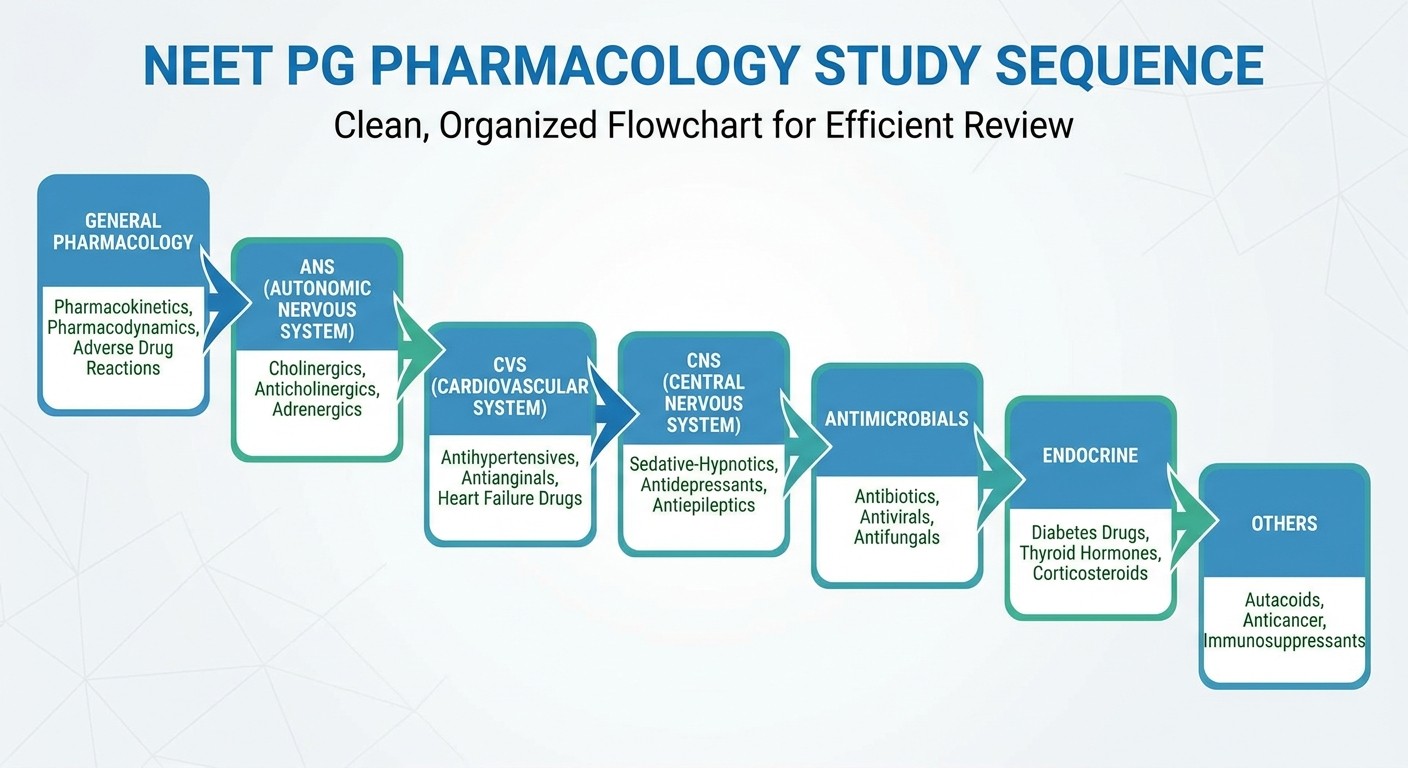
Dont study pharmacology randomly. There's a logical sequence that builds concepts layer by layer:
Phase 1: Foundation (Week 1)
General Pharmacology - This is non-negotiable. Pharmacokinetics, pharmacodynamics, drug interactions, and adverse drug reactions form the base for everything else.
Key concepts to master:
First-pass metabolism and bioavailability
Volume of distribution and half-life calculations
Dose-response curves and receptor theory
CYP450 substrates, inducers, and inhibitors
Types of drug antagonism
Autonomic Nervous System - ANS is the gateway to understanding most other drug classes. Beta-blockers, ACE inhibitors, and bronchodilators all make sense once you understand autonomic receptors.
Using Oncourse's Daily Plan feature, you can set up automatic rotation through general pharmacology and ANS topics, ensuring consistent coverage without overwhelming yourself. The algorithm prioritizes incomplete high-yield lessons, so you'll naturally focus on your weak areas first.
Phase 2: Core Systems (Week 2)
Cardiovascular Pharmacology - The highest-yield section. Focus on:
Antihypertensives (mechanism-based classification)
Heart failure drugs (guideline-based approach)
Antiarrhythmics (Vaughan-Williams classification)
Anticoagulants and antiplatelets
CNS Pharmacology - Second highest-yield. Prioritize:
Antiepileptics (mechanism and clinical use)
Psychiatric medications (receptor selectivity)
Anesthetics and analgesics
Phase 3: Clinical Applications (Week 3)
Antimicrobials - Heavy on clinical reasoning:
Beta-lactam mechanisms and resistance
Spectrum of activity patterns
Combination therapy principles
Endocrine Pharmacology - Integration-heavy topics:
Diabetes management algorithms
Thyroid disorder treatments
Corticosteroid uses and side effects
For detailed drug mechanisms and clinical applications, explore our comprehensive NEET PG antimicrobial pharmacology glossary, CNS pharmacology guide, and endocrine pharmacology reference.
Phase 4: Specialized Topics (Week 4)
Chemotherapy and Toxicology - Lower yield but specific:
Cancer drug mechanisms
Common poisonings and antidotes
Drug interactions in cancer therapy
How to Build Unbreakable Drug Class Tables
This is where most students waste hours creating pretty notes that dont stick. Here's the efficient way:
The 5-Column Framework
For every major drug class, create a table with exactly these columns:
1. Mechanism (the "why")
2. Clinical Uses (the "when")
3. Representative Drugs (the "what")
4. Major Side Effects (the "watch out for")
5. Key Interactions (the "dont combine with")
Example: ACE Inhibitors
Mechanism | Clinical Uses | Drugs | Side Effects | Interactions |
|---|---|---|---|---|
Block ACE → ↓ Ang II → vasodilation + ↓ aldosterone | HTN, HF, DM nephropathy, post-MI | Enalapril, Lisinopril, Ramipril | Dry cough (bradykinin), hyperkalemia, angioedema | K+ supplements, ARBs (↑ hyperkalemia risk) |
Notice how the mechanism explains the side effects? Thats the pattern recognition you need.
When reviewing these tables using Oncourse's spaced-repetition flashcards, focus on the mechanism-to-effect connections rather than rote memorization. The system tracks your response quality and automatically schedules harder cards more frequently.
Mastering the 4 Types of NEET PG Pharmacology MCQs
NEET PG pharmacology questions follow predictable patterns. Once you recognize them, your accuracy jumps dramatically.
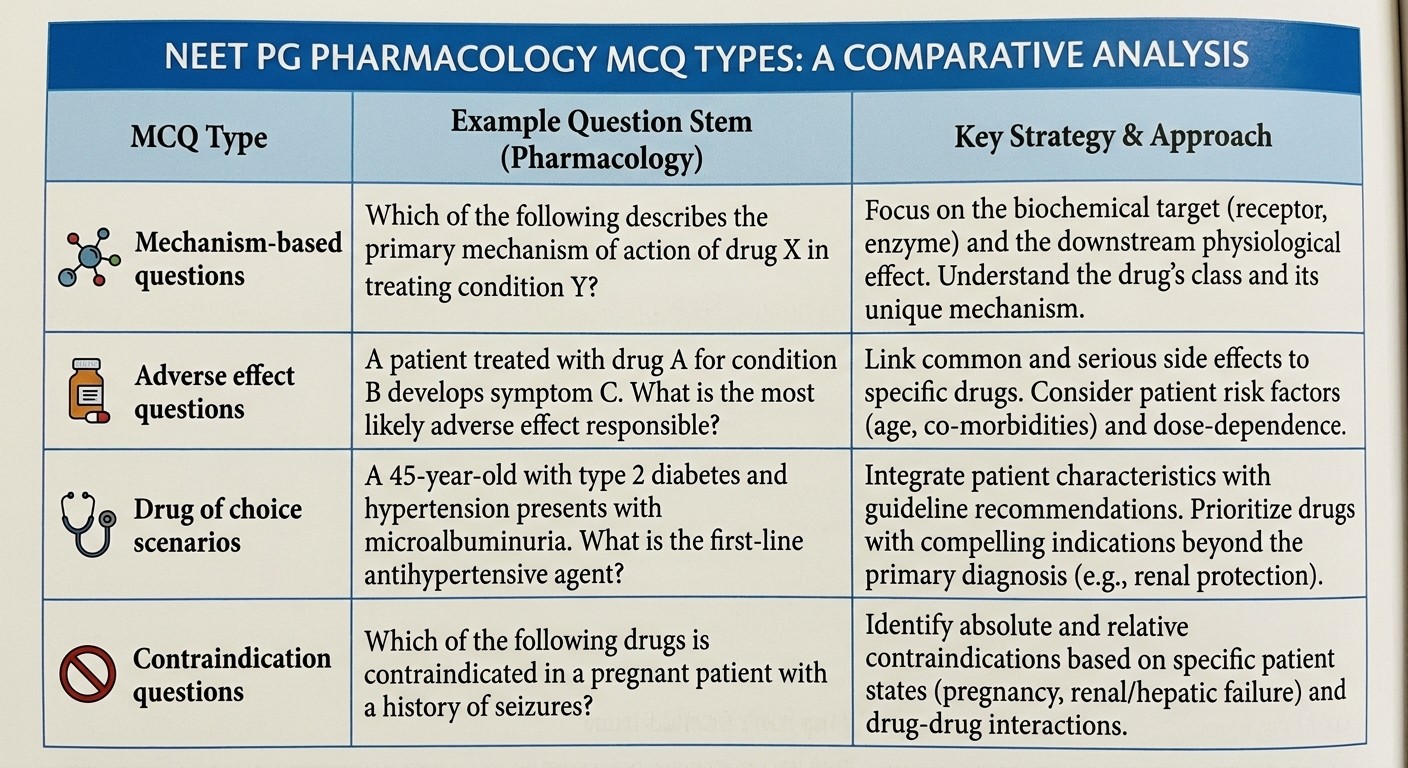
Type 1: Mechanism-Based Questions (40% of pharmacology MCQs)
Pattern: "Drug X works by..." Strategy: Connect the drug to its primary molecular target, then trace the downstream effects. Example approach: Metformin → AMPK activation → ↓ gluconeogenesis → ↓ glucose production
Type 2: Adverse Effect Recognition (25% of pharmacology MCQs)
Pattern: "Side effect X is caused by..." Strategy: Work backwards from the adverse effect to the mechanism. Example approach: ACE inhibitor cough → bradykinin accumulation → inflammatory mediators → cough reflex
Type 3: Clinical Scenario Questions (25% of pharmacology MCQs)
Pattern: Case description + "Best drug choice is..." Strategy: Identify the clinical condition, then match it to first-line therapy guidelines. Example approach: Post-MI patient → Beta-blocker (unless contraindicated) → check for asthma/COPD in stem
Type 4: Drug Interaction Questions (10% of pharmacology MCQs)
Pattern: "Patient on Drug A develops toxicity after adding Drug B..." Strategy: Focus on CYP450 interactions and additive toxicities.
For each wrong answer you encounter, use Oncourse's explanation-to-flashcard workflow. After reading Rezzy's AI explanation of why you missed the question, create targeted flashcards for the specific mechanism or interaction you missed. This builds a personalized weak-spot library.
The 4-Week NEET PG Pharmacology Sprint
Here's your week-by-week action plan for the final month:
Week 1: Foundation and Systems
Days 1-2: General pharmacology concepts + clinical pharmacology lessons
Days 3-4: ANS + cardiovascular drugs
Days 5-6: CNS pharmacology
Day 7: Practice 50 MCQs, identify weak drug classes
Week 2: Clinical Integration
Days 8-9: Antimicrobials + resistance patterns
Days 10-11: Endocrine drugs + diabetes management
Days 12-13: Respiratory + GI pharmacology
Day 14: Mixed MCQ practice (100 questions)
Week 3: Advanced Topics and Connections
Days 15-16: Chemotherapy basics + drug interactions
Days 17-18: Toxicology + antidotes
Days 19-20: Cross-system integration (drug effects across multiple organs)
Day 21: Weakness-targeted practice
Week 4: Consolidation and Speed
Days 22-24: Rapid review of all drug class tables
Days 25-27: High-speed MCQ practice (150+ questions daily)
Days 28: Final revision + cardiovascular pharmacology quick review
Throughout this sprint, leverage Oncourse's Synapses mnemonics for drug names and mechanisms that refuse to stick. The visual memory aids work particularly well for complex drug interaction patterns.
Common Pharmacology Mistakes That Kill Your Rank
Mistake 1: Ignoring Drug Classes for Individual Drugs
Wrong approach: "Atenolol causes bradycardia"
Right approach: "Beta-blockers cause bradycardia by blocking beta-1 receptors"
The second approach lets you handle questions about metoprolol, propranolol, or any other beta-blocker.
Mistake 2: Memorizing Guidelines Without Understanding
Many students memorize "ACE inhibitors are first-line for diabetic nephropathy" without understanding why. The mechanism (reducing intraglomerular pressure) explains both the benefit and the side effect profile.
Mistake 3: Studying Pharmacology in Isolation
Pharmacology connects to every clinical subject. A question about "drug choice for atrial fibrillation" isnt just pharmacology - its cardiology, internal medicine, and sometimes surgery rolled into one.
Mistake 4: Skipping Toxicology
Toxicology questions often have distinctive presentations and specific antidotes. These are high-yield because they're memorable and pattern-based.
How Memory Techniques Apply to Drug Names and Mechanisms
The key isnt to memorize more - its to memorize smarter.
Pattern Recognition for Drug Names
Most drug names follow conventions:
-olol = Beta-blockers (atenolol, metoprolol)
-pril = ACE inhibitors (enalapril, lisinopril)
-sartan = ARBs (losartan, valsartan)
-statin = HMG-CoA reductase inhibitors (atorvastatin, simvastatin)
Mechanism-Based Mnemonics
Instead of random memory tricks, create mnemonics that reinforce mechanisms:
ACE inhibitors: "ACE prevents Angiotensin Creation and Elimination" (captures both the mechanism and the contraindication in renal artery stenosis)
Visual Memory for Complex Pathways
For multi-step pathways like the renin-angiotensin system, create simple flow diagrams. The visual pattern helps more than text-heavy notes.
Practice these patterns using NEET PG pharmacology questions to reinforce both the name recognition and mechanism understanding simultaneously.
Integration with Other NEET PG Subjects
Pharmacology doesnt exist in isolation. Here's how it connects:
Medicine Integration
Diabetes: Know antidiabetic mechanisms for endocrinology questions
Hypertension: Understand antihypertensive choices for cardiology cases
Infections: Match antibiotic spectra to likely pathogens
Surgery Integration
Perioperative drugs: Anesthetics, muscle relaxants, reversal agents
Antibiotic prophylaxis: Match drug choice to surgical site
Pain management: Opioid mechanisms and side effects
Obstetrics Integration
Pregnancy categories: Teratogenic drugs and safe alternatives
Labor management: Oxytocin, prostaglandins, tocolytics
Hypertensive disorders: Safe antihypertensives in pregnancy
This integration approach naturally emerges when you use mechanism-first studying. The same receptor that matters for a cardiology question also applies to the obstetrics scenario.
Last-Week Revision Strategy
Your final week should be laser-focused:
Days -7 to -5: High-Yield Quick Review
Go through your drug class tables rapidly. Dont learn new concepts. Just reinforce existing patterns.
Days -4 to -2: MCQ Intensive
Practice 200+ MCQs daily with immediate review. Focus on question types you typically miss.
Day -1: Mental Consolidation
Review only your weakest 5-10 drug classes. Trust that everything else is already learned.
Frequently Asked Questions
How many times should I revise pharmacology for NEET PG?
Three complete revisions work for most students: first reading for understanding, second for pattern recognition, and third for speed. Quality beats quantity - better to do three focused revisions than five scattered ones.
Which pharmacology topics are absolutely high-yield for NEET PG?
Focus on cardiovascular drugs (ACE-I, beta-blockers, diuretics), CNS drugs (antiepileptics, antipsychotics), antimicrobials (beta-lactams, macrolides), and autonomic drugs. These six categories cover 70-75% of pharmacology questions.
How do I remember drug mechanisms without getting overwhelmed?
Use the mechanism-first approach. Learn the receptor or enzyme target first, then predict the effects. For example, knowing that beta-blockers block beta-1 receptors automatically tells you they cause bradycardia, reduce cardiac output, and help in heart failure.
Should I memorize all drug interactions for NEET PG?
Focus on CYP450-based interactions (strong inducers and inhibitors) and clinically significant combinations. Memorizing every possible interaction is neither practical nor necessary for NEET PG.
How much time should I dedicate to pharmacology daily?
During general preparation, 1-1.5 hours daily works well. In the final month, increase to 2-2.5 hours with emphasis on MCQ practice. Consistency matters more than marathon sessions.
Can I clear NEET PG pharmacology using only mnemonics?
Mnemonics help with recall, but mechanism understanding is crucial for NEET PG's application-based questions. Use mnemonics to remember drug names and major side effects, but always connect them to underlying mechanisms.
Conclusion
NEET PG pharmacology doesnt have to be your weakest link. With the right strategy - mechanism-first learning, systematic drug class organization, and targeted MCQ practice - it becomes a reliable scoring section.
The key insight? Stop trying to memorize everything. Start understanding patterns. When you know why drugs work the way they do, both the benefits and side effects become predictable. When effects are predictable, MCQs become solvable.
Your pharmacology performance directly impacts your rank. Make it count.
Prepare smarter with Oncourse AI — adaptive MCQs, spaced repetition, and AI explanations built for NEET PG. Download free on Android and iOS.