Back
Oncourse WIN: How a Daily Exam Readiness Score Turns Medical Exam Prep Into a Feedback Loop
Discover how Oncourse WIN transforms medical exam preparation through daily readiness feedback loops. Learn why tracking study hours fails and how adaptive planning, spaced repetition, and AI-powered insights create better NEET-PG, USMLE, and UKMLA prep outcomes.
Oncourse WIN: How a Daily Exam Readiness Score Turns Medical Exam Prep Into a Feedback Loop
You just finished 6 hours of studying. Pathology notes reviewed, pharmacology flashcards done, practice questions completed. But when someone asks "How ready are you for NEET-PG?" you pause. Ready based on what — the fact that you studied for 6 hours, or that you still cant explain why ACE inhibitors cause hyperkalemia?
Most medical students measure readiness by input metrics: hours studied, pages covered, videos watched. But readiness isn't about effort — it's about what you can recall, apply, and synthesize under exam pressure. The difference between studying and being exam-ready is feedback loops that show you exactly where you stand today and what to improve tomorrow.
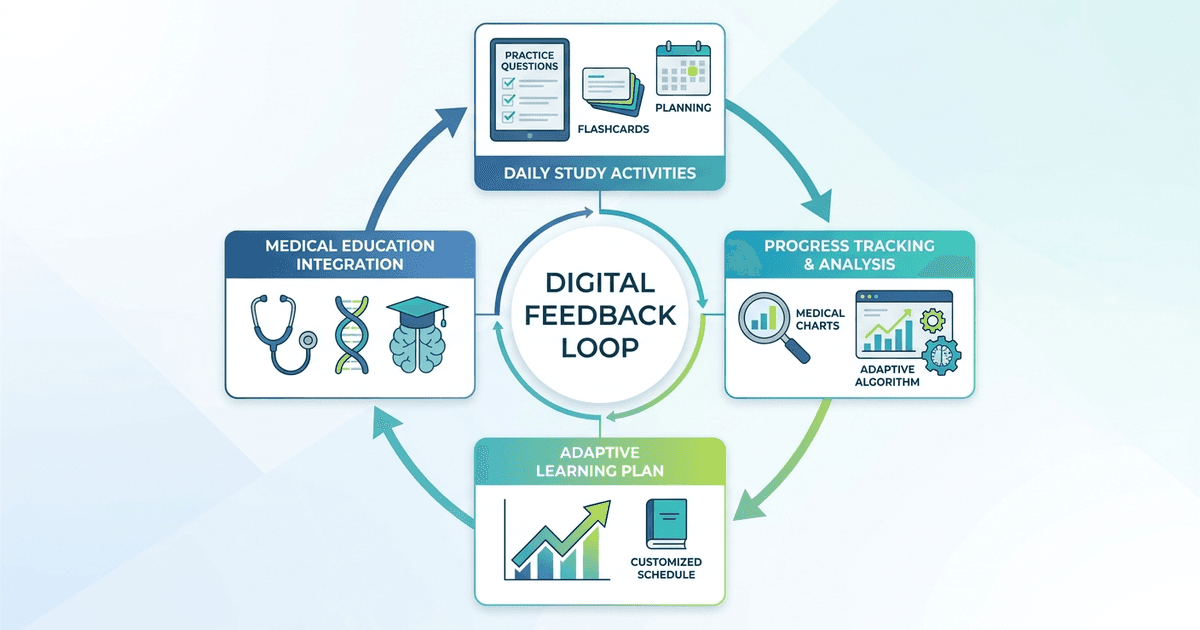
This is where Oncourse WIN transforms medical exam preparation. Instead of hoping your study hours translate to exam success, WIN creates a continuous readiness feedback loop that adapts to your actual performance patterns, identifies weak areas before they become problems, and optimizes every study session based on what you need most right now.
Why Hours Studied Is a Poor Proxy for Exam Readiness
The traditional medical exam prep approach treats studying like a linear equation: more hours = better scores. But your brain doesn't work that way. You might spend 3 hours reviewing cardiology and retain 90% of it, then spend the same time on nephrology and forget half within 48 hours.
Learning science shows us that true readiness emerges from three factors that hours studied can't capture:
Retrieval strength: How easily you can recall information when tested. This depends on active practice, not passive reading. A student who answers 100 questions correctly demonstrates higher retrieval strength than someone who highlighted 100 pages. Knowledge consolidation: How well concepts connect to create durable understanding. Isolated facts fade quickly; integrated knowledge networks last months. This happens through spaced repetition and interleaved practice, not cramming sessions. Performance calibration: How accurately you can judge your own competence. Overconfident students miss gaps in their knowledge; under-confident ones waste time on already-mastered topics. Calibration research shows this metacognitive awareness predicts exam performance better than study hours.
The problem with static study schedules is they ignore these dynamic factors. Your readiness changes every day based on what you practiced, what you forgot, and what new connections you made. A true readiness score adapts continuously.
The Feedback Loop Model: From Study to Readiness
Exam readiness isn't a destination — it's a continuous feedback loop where each study action generates data that informs the next decision. Here's how the complete cycle works:
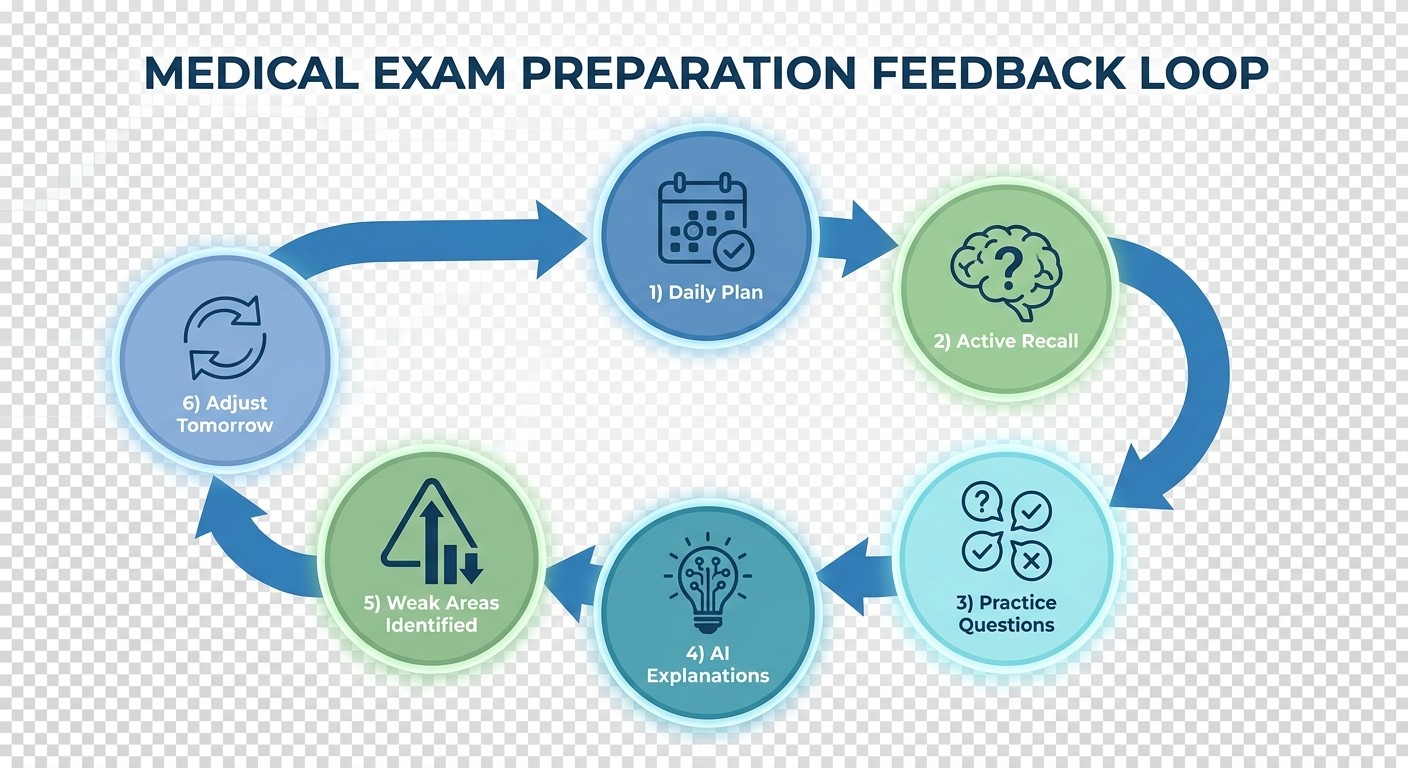
Plan → Execute → Measure → Adjust → Repeat
Daily Planning: Instead of asking "what should I study today?", an adaptive system uses your performance history to generate a personalized daily plan. Oncourse's adaptive daily planning considers your accuracy trends, spaced repetition schedule, and upcoming exam weightings to create today's optimal task list. Active Recall Practice: Every study session includes retrieval practice — answering questions, solving cases, or making concept connections rather than passive reading. Daily Synapses challenges turn this into quick concept-grouping exercises that reinforce connections between medical topics. Scored Performance: Each practice session generates accuracy data, response time metrics, and confidence ratings. This isn't just "right or wrong" — it's granular feedback about which specific subtopics within cardiology you're missing and how your performance trends over time. AI-Powered Explanations: Wrong answers generate targeted learning interventions. Instead of generic explanations, the system identifies your specific misconception and provides personalized clarification that addresses your exact gap. Weak Area Identification: Performance patterns reveal systematic gaps before they become problems. If you're consistently missing questions about diabetic emergencies but scoring well on diabetes management, the system flags this specific subtopic for focused review. Plan Optimization: Tomorrow's study plan automatically adjusts based on today's performance data. Topics where you showed improvement get longer intervals; subjects where you struggled get increased practice frequency.
How Daily Readiness Works for Different Exam Types
Medical exams vary significantly in format and content distribution, but the readiness feedback loop adapts to each:
NEET-PG Preparation
NEET-PG's 200 questions across 19 subjects in 3.5 hours demands broad coverage with deep clinical understanding. Daily readiness for NEET-PG focuses on:
High-yield topic prioritization: The system weights subjects by their typical question distribution (Medicine ~25%, Surgery ~20%, etc.)
Image recognition practice: Daily image-based question sets prepare you for NEET-PG's visual component
Speed optimization: Practice sessions gradually reduce time per question to build exam-day stamina
USMLE Step 1 & Step 2 CK
USMLE's integrated format requires connecting basic science concepts to clinical scenarios. The readiness loop emphasizes:
Cross-system connections: Daily practice includes questions that span multiple organ systems
Clinical reasoning chains: Each explanation shows the complete diagnostic thought process
Step-specific pacing: Different time allocations for Step 1 vs Step 2 CK question styles
UKMLA Preparation
UKMLA's Applied Knowledge Test focuses on clinical application and patient safety. Daily readiness adapts through:
Case-based scenarios: Priority given to multi-step clinical reasoning questions
Patient safety themes: Regular practice with medication errors, clinical governance, and risk management
UK-specific guidelines: Explanations reference NICE, GMC, and NHS protocols
Implementing the 15-45-60 Minute Readiness Sessions
One major advantage of the feedback loop approach is flexibility. Your readiness improves through consistent practice, regardless of session length:
15-Minute Sessions (Micro-Learning)
Perfect for busy clinical rotations or between lectures:
10 adaptive flashcard reviews targeting your weakest topics
5 quick Synapses concept connections to reinforce memory networks
Immediate weak area identification for tomorrow's focus
30-Minute Sessions (Core Practice)
The sweet spot for daily consistency:
15 minutes of targeted question practice (10-15 MCQs)
10 minutes reviewing AI explanations and noting patterns
5 minutes of spaced repetition flashcards based on yesterday's mistakes
45-Minute Sessions (Deep Dive)
For dedicated study periods:
25 minutes of mixed question practice across multiple subjects
15 minutes creating concept maps from explanation patterns
5 minutes planning tomorrow's focus areas based on today's performance gaps
60-Minute Sessions (Exam Simulation)
Weekly sessions that mimic real exam conditions:
40 minutes of timed, random question blocks
15 minutes analyzing performance patterns and calibrating confidence
5 minutes updating long-term weak area strategies
The key is consistency over intensity. A daily 30-minute readiness session builds more durable exam preparation than sporadic 4-hour cramming marathons.
Common Mistakes That Break the Feedback Loop
Even with access to adaptive systems, students often sabotage their readiness feedback loops through predictable mistakes:
Treating Accuracy as the Only Metric
A 75% accuracy score means different things depending on question difficulty and topic coverage. Students who chase high percentages often stick to easier questions, creating false confidence. True readiness requires attempting challenging questions and learning from mistakes.
Ignoring Spaced Repetition Signals
When the system schedules a pharmacology review for today, but you "feel like doing cardiology instead," you break the spacing algorithm. Successful students trust the data over their momentary preferences.
Skipping Explanation Reviews
Answering questions without studying explanations is like lifting weights without proper form — you're going through the motions without building strength. The explanation review is where learning actually happens.
Inconsistent Practice Patterns
Studying 4 hours on Sunday and skipping the next 3 days creates spaced repetition gaps that hurt retention. Daily 30-minute sessions outperform weekly 3.5-hour marathons for long-term retention.
Gaming the System
Some students repeat the same questions until they memorize answers, then celebrate their "improved" scores. This gives false readiness signals and wastes precious study time on pattern recognition instead of understanding.
The Science Behind Readiness Feedback Loops
Three key learning science principles make daily readiness feedback loops more effective than traditional study schedules:
The Testing Effect
Research consistently shows that active recall through testing strengthens memory more than passive review. Each question you answer — whether correct or incorrect — strengthens the neural pathways needed for exam-day retrieval.
Spaced Repetition Optimization
Your brain follows predictable forgetting curves for different types of information. Spaced repetition systems use your individual performance data to schedule reviews at optimal intervals — just before you would normally forget.
Metacognitive Calibration
Knowing what you know (and don't know) is crucial for exam success. Daily feedback loops improve calibration by providing objective performance data that corrects overconfidence and builds realistic self-assessment skills.
Frequently Asked Questions
How accurate are daily readiness scores compared to official practice tests?
Daily readiness scores track your learning trends and weak areas, not your exact exam score. They're designed to guide daily study decisions, not predict final performance. Use official practice tests from NBME for score predictions.
Can I trust the system if I disagree with its daily plan recommendations?
The algorithm considers hundreds of variables you cant track manually — accuracy trends, spacing intervals, topic weights, and retention patterns. Students who consistently follow system recommendations typically see better outcomes than those who override them based on feelings.
How long before I see improvements in my readiness metrics?
Most students notice accuracy improvements within 2-3 weeks of consistent practice. Long-term retention improvements (the real measure of readiness) become evident after 4-6 weeks of regular feedback loop participation.
Should I still do traditional studying alongside the readiness feedback loop?
The feedback loop works best when it becomes your primary study method. Use textbooks and videos to clarify concepts identified as weak areas, but let the adaptive system drive your overall study priorities and schedule.
What happens if I miss several days of practice?
The system adjusts automatically, prioritizing spaced repetition reviews that are overdue and gradually rebuilding your practice rhythm. Consistency matters more than perfection — restart immediately rather than trying to "catch up" with marathon sessions.
Is this approach suitable for all medical exams?
The feedback loop principle applies to any exam that tests recall and application of medical knowledge. The specific implementation adapts to different exam formats — NEET-PG, USMLE, UKMLA, INICET, and others each have optimized algorithms.
Transform Hours Studied Into Exam Readiness
The difference between studying and being exam-ready isn't effort — it's feedback loops that turn every practice session into data that improves tomorrow's performance. Traditional study schedules assume you're a static learner with predictable forgetting patterns. Reality shows that your readiness changes daily based on what you practiced, retained, and connected.
Oncourse WIN builds this readiness feedback loop into every study session. Your daily plan adapts to your actual performance patterns. Synapses concept challenges turn daily review into active recall practice. Scored questions and AI explanations create the measurement and adjustment data that keeps you progressing toward true exam readiness.
Instead of hoping your study hours translate to exam success, you'll know exactly where you stand today and what to improve tomorrow. That's the difference between studying and being ready.
Prepare smarter with Oncourse AI — adaptive MCQs, spaced repetition, and AI explanations built for medical exams. Download free on Android and iOS.