The Testing Effect: Why Practice Questions Beat Re-Reading for Medical Exam Retention (2026)
Discover why retrieval practice produces 2-3x better retention than re-reading. Learn the science behind active recall and how to implement testing effect strategies for NEET-PG, USMLE, and medical board exam success.
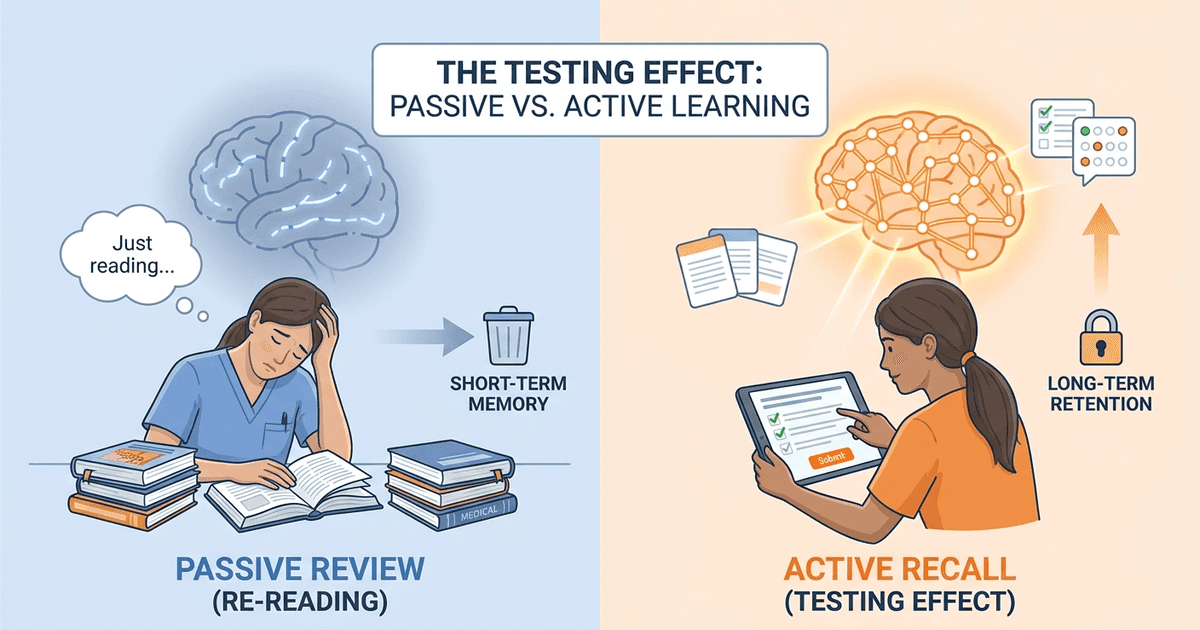
The Testing Effect: Why Practice Questions Beat Re-Reading for Medical Exam Retention (2026)
You are probably here because youve spent countless hours re-reading the same pathology chapter for the third time, highlighting every other sentence, and still cant recall half of it during practice tests. Sound familiar?
Heres the uncomfortable truth: re-reading is one of the least effective ways to learn medicine. Yet 83% of medical students still rely on it as their primary study method, according to recent learning behavior studies. Meanwhile, the students scoring in the 90th percentile? They spend 60% of their time answering practice questions, not re-reading notes.
This isnt opinion — its cognitive science. The testing effect, one of the most replicated findings in learning research, shows that retrieving information from memory produces 2-3x better long-term retention than re-reading the same material. Over 100+ studies confirm it works across every subject, from basic sciences to clinical reasoning.
For medical students grinding through NEET-PG, USMLE Steps, or any board exam, understanding why retrieval practice works better than passive review could be the difference between a pass and your target score.
What Is the Testing Effect? The Roediger & Karpicke Discovery
The testing effect refers to the finding that attempting to recall information from memory enhances learning better than repeatedly studying it. The landmark study came from cognitive psychologists Henry Roediger and Jeffrey Karpicke at Washington University in 2006.
Their experiment was elegantly simple. Students read prose passages (similar complexity to a medical textbook chapter) under three conditions:
Group 1: Read the passage four times (SSSS)
Group 2: Read once, then practice recalling it three times (STTT)
Group 3: Read twice, then practice recalling twice (SSTT)
The results shocked even the researchers:
After 1 week: The "testing" groups (STTT and SSTT) retained 50% more information than the "study-only" group (SSSS). Students who spent 75% of their time retrieving rather than re-reading dramatically outperformed those who kept re-reading. The kicker: Immediately after the study session, students thought they learned more from re-reading. They felt more confident about material they had reviewed multiple times. This illusion of fluency is why most students stick to ineffective methods — they confuse recognition with recall.
The Neuroscience: Why Your Brain Rewards Struggle
When you re-read a pharmacology chapter, the information flows smoothly from page to brain. It feels easy. Your brain interprets this fluency as mastery — but its wrong.
When you close the book and try to remember the mechanism of ACE inhibitors, your brain has to reconstruct that information from fragmented memory traces. This effortful retrieval process triggers several crucial mechanisms:
1. Retrieval-Induced Memory Consolidation
Each time you successfully recall information, you strengthen the neural pathways between concept nodes. Think of it like GPS navigation — the more you drive a route, the more permanent and automatic it becomes. Re-reading is like looking at the map repeatedly; retrieval practice is actually driving the route.
2. Desirable Difficulty
Psychologist Robert Bjork coined this term to describe how introducing controlled challenges during learning improves long-term retention. The mild struggle of recalling a drug mechanism from memory — rather than seeing it highlighted in your notes — creates what researchers call "desirable difficulty."
Your brain adapts by building more robust retrieval pathways. The Synapses flashcard engine in Oncourse AI leverages this principle — it surfaces due cards at optimal intervals using spaced repetition, forcing active recall when information is just beginning to fade.
3. Error-Driven Learning
Getting a question wrong and then receiving corrective feedback creates stronger memory traces than passively reading the right answer. The prediction error signal enhances memory encoding — which is why platforms like Oncourse AI provide instant AI explanations when you answer incorrectly, turning each mistake into a learning opportunity rather than passive review.
Active Recall vs Re-Reading: The Medical Student's Dilemma
Medical education presents unique challenges that make the testing effect even more critical:
Information Density
A single pathology textbook chapter contains 200+ discrete facts, mechanisms, and clinical correlations. Re-reading creates familiarity with this information landscape but doesnt guarantee you can navigate it during an exam.
Integration Requirements
Board exams test your ability to integrate knowledge across systems. A cardiology question might require pharmacology, pathophysiology, and clinical reasoning simultaneously. Only retrieval practice builds these cross-connections.
Time Pressure
NEET-PG gives you 63 seconds per question. USMLE Step 1 averages 90 seconds. You need instant recall, not the ability to find information in your notes.
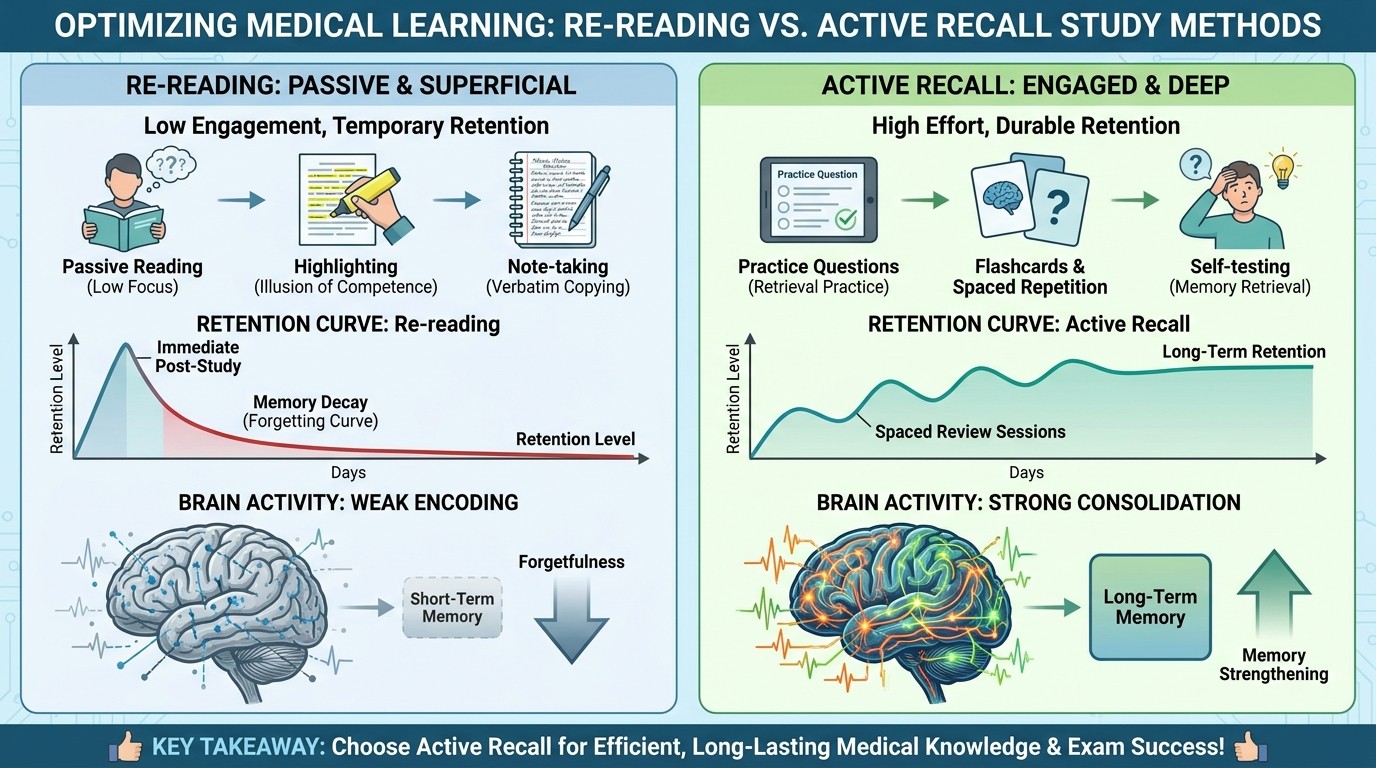
Why Medical Students Choose the Wrong Study Method
Despite overwhelming evidence favoring retrieval practice, most medical students still default to passive methods. Three factors drive this counterproductive choice:
The Fluency Illusion
Re-reading medical content creates a false sense of learning. When you see "myocardial infarction pathophysiology" for the fourth time, recognition feels automatic. Your brain mistakes this familiarity for understanding, leading to overconfidence before exams.
Students consistently overestimate their knowledge after re-reading and underestimate it after practice testing — even though testing produces superior learning outcomes.
Cognitive Load Misinterpretation
Retrieval practice feels harder than passive review because it IS harder. Your brain is working to reconstruct information rather than simply processing it. Medical students often interpret this mental effort as inefficiency rather than effectiveness.
The Probe Game in Oncourse AI cleverly addresses this by gamifying rapid-fire MCQ practice — the mild time pressure creates desirable difficulty while maintaining engagement through point systems and streaks.
Immediate vs Delayed Gratification
Re-reading provides immediate satisfaction — you can highlight, take notes, and feel productive. Retrieval practice involves frustration, wrong answers, and the discomfort of not knowing. Most students choose the path that feels better in the moment, not the one that works better long-term.
How to Implement Retrieval Practice in Your Medical Studies
The key is shifting from recognition-based review to recall-based practice. Here's how:
1. Question-First Learning
Instead of reading cardiology chapters and then doing questions, reverse the sequence. Start with practice MCQs on coronary artery disease, identify knowledge gaps, then target your reading to fill those gaps. This approach ensures youre learning what you actually need to recall, not just what feels comprehensive.
2. Spaced Retrieval Practice
Space your retrieval attempts across increasing intervals: same day, 3 days later, 1 week later, 2 weeks later. Each successful retrieval strengthens memory traces while unsuccessful attempts highlight areas needing reinforcement.
The Synapses system handles this automatically — after you mark a pharmacology flashcard as "known," it schedules the next review based on your historical performance and the forgetting curve. This takes the guesswork out of spaced repetition scheduling.
3. Mixed Practice Sessions
Instead of doing 50 straight cardiology questions, mix cardiology, pulmonology, and nephrology in the same session. This interleaving forces your brain to actively discriminate between similar concepts rather than pattern-matching within a single domain.
4. Explain-Back Retrieval
After answering a question correctly, close the explanation and teach it back to yourself out loud. This double retrieval — first answering the question, then explaining your reasoning — creates multiple retrieval pathways for the same information.
The Explanation Effect: Why Wrong Answers Accelerate Learning
Getting questions wrong isnt failure — its data. Each incorrect answer reveals a specific gap in your knowledge network. But heres where most question banks fail: they show you the right answer without helping you understand why you got it wrong.
Research on error-driven learning shows that mistakes followed by detailed explanations create stronger memory consolidation than getting questions right the first time. The prediction error signal enhances encoding of the correct information.
When you answer a question wrong in Oncourse AI, the Explanation Chat feature provides instant AI-powered explanations tailored to your specific error. Instead of generic textbook explanations, you get targeted feedback addressing your particular misconception — turning each wrong answer into a structured micro-learning moment.
Practice Question Formats: Which Builds Stronger Retrieval?
Not all question formats are equally effective for building retrieval strength:
Multiple Choice Questions (MCQs)
Pros: Match board exam format; allow recognition-aided recall
Cons: Can be answered through elimination without full knowledge
Effectiveness: High for familiar content, moderate for deep understanding
Short Answer Questions
Pros: Force complete recall without recognition cues
Cons: Time-intensive; dont match board exam format
Effectiveness: Very high for retention, moderate for exam preparation
Flashcard Recall
Pros: Pure retrieval without recognition aids; efficient for high-volume facts
Cons: Limited context; may not transfer to complex clinical scenarios
Effectiveness: Excellent for factual knowledge; combine with MCQ practice
Case-Based Questions
Pros: Integrate multiple knowledge domains; match clinical reasoning requirements
Cons: Complex to create; may overwhelm students with knowledge gaps
Effectiveness: Superior for clinical application; best for advanced learners
The optimal approach combines multiple formats. Use flashcards for rapid fact retrieval, MCQs for board exam preparation, and case discussions for clinical integration.
Common Retrieval Practice Mistakes Medical Students Make
Mistake 1: Passive Question Review
Reading questions and answers without attempting to answer first. This turns practice questions into fancy textbooks — you get recognition practice, not retrieval practice.
Fix: Cover the answer choices, read the stem, formulate your answer, then check.
Mistake 2: Immediate Answer Checking
Looking at explanations immediately after wrong answers without attempting to reason through them first.
Fix: After a wrong answer, spend 30 seconds trying to identify why before reading the explanation.
Mistake 3: Single-Pass Question Banks
Completing question banks once and never returning. The first pass identifies what you dont know; subsequent passes build retrieval strength.
Fix: Reset and repeat question banks, focusing on previously incorrect items.
Mistake 4: Subject Clustering
Doing 100 cardiology questions in a row creates pattern recognition, not retrieval practice.
Fix: Mix subjects within each study session to force active differentiation.
The Spacing Effect: When to Repeat Retrieval Practice
Timing your retrieval attempts correctly multiplies their effectiveness. The spacing effect shows that distributed practice beats massed practice for long-term retention.
Optimal Spacing Schedule for Medical Content:
Day 1: Initial learning
Day 3: First retrieval attempt
Day 7: Second retrieval attempt
Day 21: Third retrieval attempt
Day 60: Long-term maintenance
Research shows this schedule produces 90% retention after 6 months, compared to 20% retention from massed practice (cramming).
For rapid-fire review sessions, the Probe Game provides immediate spacing by cycling through mixed topics — you might see a cardiology question, then nephrology, then pharmacology, then back to cardiology. This micro-spacing prevents interference while maintaining engagement.
Building a Retrieval-First Study Schedule
Heres how to restructure your daily medical school routine around retrieval practice:
Morning Warm-Up (15 minutes)
Start with 5 minutes of Probe Game rapid-fire questions across all subjects. This primes your brain for active recall and identifies areas needing attention during formal study.
Core Study Session (2-3 hours)
Hour 1: New content reading (25%), mixed practice questions (75%)
Hour 2: Spaced retrieval on previous material using Synapses flashcards
Hour 3: Case-based questions integrating multiple subjects
Evening Review (30 minutes)
Attempt to recall key concepts from the day without notes. Identify gaps for tomorrow's focus.
This 80/20 split (80% retrieval practice, 20% new content reading) aligns with the testing effect research while maintaining forward progress through your curriculum.
Frequently Asked Questions
How many practice questions should I do daily for optimal retention?
Research suggests 50-100 mixed questions daily produces optimal learning curves for medical students. Quality matters more than quantity — focused practice on knowledge gaps beats random high-volume drilling.
Is it better to do questions before or after reading new material?
Both approaches work, but question-first learning is more efficient. Start with 10-15 questions on the topic, identify specific gaps, then read to fill those gaps. This targeted approach prevents passive reading of already-known material.
How long should I wait before repeating incorrectly answered questions?
Space incorrect questions at 3-day intervals initially, extending to 7 days, then 21 days as you achieve mastery. Immediate repetition creates recognition, not retrieval strength.
Can too much retrieval practice hurt my learning?
Retrieval practice has diminishing returns but no negative effects. The bigger risk is neglecting synthesis and clinical application. Balance factual retrieval with case-based reasoning.
Why do I feel like I learn less when doing practice questions compared to reading?
This is the fluency illusion. Re-reading feels more productive because information flows easily. Retrieval practice feels harder because your brain is working harder — thats exactly why it produces superior learning outcomes.
Should I focus on my weak subjects or strengthen my strong ones?
Both, but with different approaches. Use intensive retrieval practice to remediate weak subjects, and spaced maintenance retrieval to preserve strong subjects. The testing effect works for both scenarios.
The testing effect isnt just another study technique — its the fundamental way human memory works. Every time you retrieve information from memory, you strengthen the neural pathways that make future retrieval easier and more reliable.
For medical students preparing for high-stakes board exams, this research provides a clear directive: spend less time re-reading, more time recalling. Your brain will thank you, and your scores will show it.
Prepare smarter with Oncourse AI — adaptive MCQs, spaced repetition, and AI explanations built for medical board preparation. Download free on Android and iOS.