Back
USMLE Step 2 CK Study Plan 2026: Complete Week-by-Week Schedule, High-Yield Resources and Strategy for IMGs
Complete 16-week USMLE Step 2 CK study plan for IMGs with week-by-week schedule, high-yield resources, and proven strategies to bridge clinical knowledge gaps and excel in 2026.
USMLE Step 2 CK Study Plan 2026: Complete Week-by-Week Schedule, High-Yield Resources and Strategy for IMGs
You stare at your calendar and count backwards from your Step 2 CK test date. Sixteen weeks. Maybe twelve if you had to delay your original timeline. The weight hits you — this exam determines whether youll get residency interviews or spend another year watching your medical career stall.
As an IMG, you dont have the luxury of multiple practice runs that US graduates get through shelf exams. Your clinical exposure might be different from what Step 2 CK expects. But here's what thousands of successful IMGs have proven: a systematic, phase-based approach works better than cramming everything at once.
This isnt a generic study plan copied from American forums. Every week targets the specific challenges IMGs face — from bridging clinical knowledge gaps to mastering the US healthcare system's approach to patient management.
Understanding Step 2 CK Format Changes for 2026
Starting May 7, 2026, Step 2 CK moved to a new format that changes how you should practice. Instead of 8 blocks with 38-40 questions each, you now face 16 blocks with 18-20 questions per block.
New Format Details:
316 total questions (unchanged)
16 blocks of 30 minutes each
18-20 questions per block
9-hour exam day (unchanged)
No returning to previous blocks once submitted
This format mirrors NBMEs more closely, which actually helps IMGs since you'll practice with similar block structures throughout your prep. The shorter blocks mean less mental fatigue per section, but also less time to recover from difficult questions.
IMG-Specific Impact: The new format reduces the penalty for starting slowly in each block. Previously, struggling with the first 5-6 questions in an 8-block exam could derail your entire section. Now you reset every 30 minutes.
Determining Your Study Timeline: 8, 12, or 16 Weeks?
Your timeline depends on three factors: your Step 1 score, time since clinical rotations, and practice exam baseline.
8-Week Plan:
Step 1 score >240
Completed clinical rotations within 6 months
Baseline NBME >200
12-Week Plan (Most Common):
Step 1 score 220-240
Completed rotations within 1 year
Baseline NBME 180-200
16-Week Plan:
Step 1 score <220 or failed attempts
Completed rotations >1 year ago
Baseline NBME <180
This guide covers the comprehensive 16-week plan. If you need a shorter timeline, compress phases proportionally — spend 2-3 weeks on foundations instead of 4, but dont skip any phase entirely.
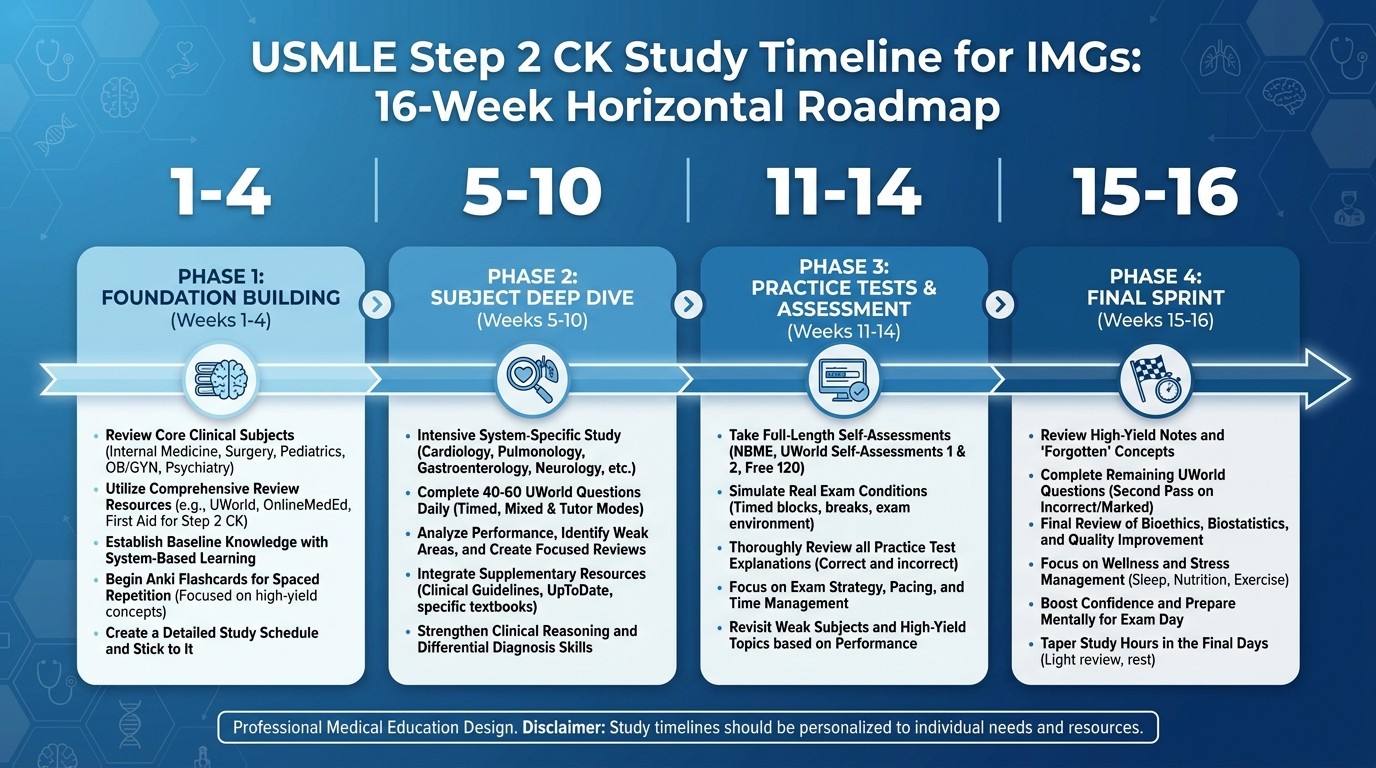
Phase 1: Foundation Building (Weeks 1-4)
Week 1: Assessment and Resource Setup
Goals: Establish baseline, set up resources, create study environment Daily Schedule (6-8 hours):
Take NBME 25 or 26 as baseline (untimed, then review)
Set up UWorld account and download offline content
Install Oncourse app and complete diagnostic assessment
Review Step 2 CK content outline from USMLE.org
Create Anki deck for high-yield facts
Key Tasks:
Score your baseline NBME honestly
Identify your weakest 3 subject areas
Set up Oncourse spaced repetition system for daily review
Download Step 2 CK tutorial for new exam format
The spaced repetition flashcards automatically schedule review of clinical vignette concepts, preventing you from wasting time re-reading material you already know. Your review queue adapts to Step 2 CK organ systems daily.
Week 2: Internal Medicine Deep Dive
Internal Medicine represents 40-50% of Step 2 CK questions. This week builds your foundation in the highest-yield specialty.
Daily Schedule:
Morning (3 hours): OnlineMedEd IM videos (2 topics daily)
Afternoon (2 hours): UWorld IM questions (40 questions)
Evening (2 hours): First Aid Step 2 CK reading
Night (30 minutes): Oncourse flashcards review
Priority Topics:
Acute coronary syndromes and heart failure
Diabetes management and complications
Pneumonia and respiratory infections
CKD and electrolyte disorders
GI bleeding and inflammatory conditions
Week 2 Targets:
Complete 280 UWorld questions
Review internal medicine cardiology lessons for US treatment protocols
Create disease-specific mnemonics using Synapses for complex diagnoses
Week 3: Surgery and Emergency Medicine
Daily Schedule:
Morning (2.5 hours): Surgical topics via OnlineMedEd
Afternoon (3 hours): UWorld Surgery/EM questions (50 questions)
Evening (1.5 hours): Pestana's Surgery Notes review
Night (1 hour): Emergency algorithms practice
High-Yield Surgery Topics:
Acute abdomen and appendicitis
Trauma management protocols
Post-operative complications
Breast and thyroid masses
Hernias and bowel obstruction
Emergency Medicine Focus:
Chest pain evaluation
Shortness of breath workups
Altered mental status
Trauma protocols
Toxicology basics
The adaptive question bank adjusts difficulty based on your surgery performance, helping you focus on weak areas without wasting time on mastered concepts.
Week 4: Obstetrics, Gynecology, and Pediatrics
Daily Structure:
Morning (3 hours): OB/GYN content review
Afternoon (2.5 hours): Pediatrics videos and reading
Evening (2 hours): Mixed practice questions (60 questions)
Night (30 minutes): High-yield fact review
OB/GYN Priorities:
Normal pregnancy management
Labor and delivery complications
Contraception counseling
Abnormal uterine bleeding
Sexually transmitted infections
Pediatrics Focus:
Well-child care and vaccines
Respiratory infections in children
Pediatric emergency presentations
Growth and development milestones
Child abuse recognition
Phase 1 Assessment: Take NBME 27 to measure progress. Target improvement of 20-30 points from baseline.
Phase 2: Subject Deep Dive and Pattern Recognition (Weeks 5-10)
Weeks 5-6: Advanced Internal Medicine
Move beyond basic concepts to complex multi-system cases that define high scorers.
Daily Schedule (8-9 hours):
Morning (3 hours): Advanced IM topics via AMBOSS library
Afternoon (3-4 hours): UWorld questions (70-80 daily)
Evening (2 hours): UpToDate reading for unclear concepts
Advanced Topics:
Rheumatology: SLE, RA, vasculitis patterns
Infectious Disease: HIV complications, resistant organisms
Hematology: Bleeding disorders, lymphomas
Endocrinology: Thyroid disorders, adrenal pathology
Nephrology: Glomerular diseases, acid-base
IMG-Specific Strategy: Many international curricula skip rheumatology and advanced ID. Use clinical rounds games to practice diagnostic reasoning for these US-heavy topics.
Weeks 7-8: Psychiatry and Ethics
Step 2 CK psychiatric content tests US-specific approaches to mental health that differ significantly from other countries.
Daily Focus:
Morning (2 hours): Psychiatry content (depression, anxiety, psychosis)
Midday (3 hours): Ethics and communication questions
Afternoon (2-3 hours): Mixed UWorld questions (60-70 daily)
Evening (1 hour): Medical ethics scenarios review
Psychiatry Essentials:
Depression screening and treatment algorithms
Anxiety disorders and panic attacks
Bipolar disorder management
Substance abuse protocols
Suicidal ideation assessment
Ethics Topics (High-Yield for IMGs):
Informed consent procedures
Confidentiality in different scenarios
End-of-life care decisions
Capacity vs competency determinations
Medical error disclosure
Weeks 9-10: Specialty Integration
Daily Approach:
Morning (3 hours): Weak subject reinforcement
Afternoon (4 hours): Timed UWorld blocks (80 questions)
Evening (1 hour): Cross-system integration practice
Focus on how different specialties interact. Step 2 CK loves questions where the primary problem is in one system but the management involves another.
Examples:
Cardiac patient needing surgery (cardiology + anesthesia)
Pregnant patient with medical conditions (OB + medicine)
Pediatric patient with surgical problem (surgery + pediatrics)
Performance Analytics Dashboard: Track weak areas by subject and question type to identify whether gaps are in diagnosis, management, or next-best-step questions. This helps prioritize your remaining study weeks.
Phase 3: Practice Tests and Assessment (Weeks 11-14)
Week 11: First NBME Battery
Take 2 NBMEs this week under timed conditions.
Schedule:
Monday: NBME 28 (timed, full-length)
Tuesday-Wednesday: Review every question, even correct ones
Thursday: NBME 29 (timed)
Friday-Saturday: Detailed review and remediation
Sunday: Rest day or light content review
Review Strategy:
Create spreadsheets tracking wrong answers by topic
Research every explanation using UpToDate
Add missed facts to flashcard system
Week 12: Weakness Remediation
Based on NBME results, dedicate this week to your worst-performing subjects. Structure:
Days 1-3: Intensive content review for weakest subject
Days 4-5: Targeted question practice in weak areas
Days 6-7: Mixed practice maintaining strong subjects
Common IMG Weak Areas:
Preventive Medicine: Screening guidelines, vaccination schedules
Quality Improvement: Patient safety, medical errors
Health Maintenance: Age-appropriate counseling
Legal/Ethical Issues: US healthcare system specifics
Week 13: UWSA and Free 120
Monday: UWorld Self Assessment 1 (UWSA1) Wednesday: UWorld Self Assessment 2 (UWSA2) Friday: NBME Free 120 questions Weekend: Comprehensive review of all three assessments Score Interpretation:
Target scores: UWSA >250, NBME >220 for comfortable pass
Red flags: Scores <200 on any assessment
Decision point: Scores consistently <210 may warrant test delay
Week 14: Final NBME and Strategy Refinement
Monday: NBME 30 (your final full-length assessment) Tuesday-Friday: Address any remaining knowledge gaps Weekend: Light review and test-taking strategy practice
By now, your question-solving approach should be automatic. Focus on timing, stress management, and maintaining accuracy under pressure.
Phase 4: Final Sprint (Weeks 15-16)
Week 15: High-Yield Review and Maintenance
No new content this week. Focus entirely on retention and fine-tuning. Daily Schedule (4-5 hours maximum):
Morning (2 hours): Review incorrect questions from recent NBMEs
Afternoon (2 hours): 40 mixed UWorld questions
Evening (1 hour): High-yield facts review
Maintenance Topics:
Drug side effects and contraindications
Lab value interpretation
ECG and imaging basics
Emergency protocols
Dosing calculations
Practice with Probe game for quick fact recall under time pressure — the timed clinical vignettes simulate real exam stress while keeping review engaging.
Week 16: Test Week Preparation
Monday-Wednesday: Light review only Thursday: Complete rest day Friday: Travel to test center if needed Weekend: Test day Final Week Rules:
No new topics or resources
Review only familiar, high-yield materials
Maintain normal sleep schedule
Avoid intensive studying 48 hours before exam
High-Yield Resources for IMGs: Ranked by Priority
Essential Resources (Must-Have)
1. Oncourse Platform
The only AI-powered platform specifically designed for clinical reasoning development. Features 100,000+ Step 2 CK questions with adaptive difficulty adjustment and personalized review schedules.
Key Features:
Rezzy AI tutor for clinical case discussion
Spaced repetition flashcards for 40,000+ high-yield facts
Performance analytics tracking weak subjects
Clinical games for pattern recognition
Free tier available with premium plans
2. UWorld Step 2 CK ($429/6 months)
The gold standard question bank with 3,400+ questions and detailed explanations.
3. OnlineMedEd ($349/year)
Best video platform for IMG foundation building. Covers US treatment protocols missing from international curricula.
4. AMBOSS Step 2 CK ($199/month)
Comprehensive qbank plus reference library for deep explanations.
Supplementary Resources
5. First Aid for Step 2 CK ($89)
Essential quick-reference guide, updated annually.
6. UpToDate (institutional access recommended)
For researching unclear concepts and current treatment guidelines.
7. NBME Self-Assessments ($60 each)
Take 4-5 NBMEs throughout your preparation for accurate score prediction.
IMG-Specific Considerations
Time Zone Strategy: Schedule your exam for times matching your peak performance hours from home country. Many IMGs perform better with morning slots (8 AM) to avoid afternoon fatigue. ECFMG Requirements: Ensure your medical school credentials are verified before scheduling Step 2 CK. Processing can take 2-3 months. Clinical Knowledge Gaps: IMGs often lack exposure to:
US preventive care guidelines
Health maintenance protocols
Medical-legal concepts
Quality improvement principles
Address these gaps early using dedicated resources rather than hoping UWorld covers everything.
Common IMG Mistakes and How to Avoid Them
Mistake 1: Starting Without Baseline Assessment
The Problem: Jumping into content review without knowing your starting level wastes precious study time. The Solution: Take NBME 25 or 26 within your first week. Score honestly and use results to customize your study plan.
Mistake 2: Over-Relying on Home Country Clinical Experience
The Problem: Assuming your clinical knowledge transfers directly to US practice standards. The Solution: Approach Step 2 CK as learning US medicine, not reviewing what you already know. Treatment algorithms, drug choices, and care protocols differ significantly between countries.
Mistake 3: Insufficient Ethics and Communication Practice
The Problem: International curricula rarely emphasize patient communication and medical ethics to US standards. The Solution: Dedicate 20% of your study time to ethics, preventive care, and communication questions. These are high-yield and commonly missed by IMGs.
Mistake 4: Cramming Before Practice Exams
The Problem: Taking NBMEs after intensive cramming sessions gives artificially inflated scores. The Solution: Space practice exams throughout your timeline and take them when you feel normal fatigue, not peak preparedness.
Mistake 5: Neglecting US Healthcare System Knowledge
The Problem: Step 2 CK tests understanding of insurance coverage, referral patterns, and healthcare delivery systems. The Solution: Study US healthcare organization, including Medicare/Medicaid basics, specialist referral indications, and cost-effectiveness principles.
Mistake 6: Inadequate Question Review
The Problem: Rushing through incorrect answers without understanding why other options were wrong. The Solution: Spend 2-3 minutes reviewing every question, including correct answers. Create detailed error logs by topic and question type.
Tracking Progress and Adjusting Your Plan
Score Milestones by Week
Use these benchmarks to assess whether youre on track:
Week | NBME Target | Adjustment Strategy |
|---|---|---|
4 | Baseline + 20-30 | Continue current pace |
8 | 200+ | Add content review if <200 |
11 | 215+ | Consider timeline extension if <200 |
|---|---|---|
13 | 230+ | Safe to proceed if >220 |
14 | 240+ | Target achieved if >235 |
Red Flag Indicators
Immediate Plan Revision Needed:
Declining NBME scores over time
Consistently scoring <60% in any major subject
Unable to complete timed blocks within time limits
Score plateau lasting >2 weeks
Course Corrections:
Weak Content Knowledge: Add 2 weeks of intensive review
Poor Test-Taking: Focus on question analysis and timing
Burnout Signs: Reduce daily hours, increase rest days
Plateau Effect: Switch primary question bank or add new resources
Final 2-Week Sprint Checklist
Week 15 Tasks
[ ] Complete final weakness remediation
[ ] Review all incorrect NBME questions from prior month
[ ] Maintain daily question practice (40-50 questions)
[ ] Organize test day logistics (ID, confirmation, travel)
[ ] Begin sleep schedule normalization
Week 16 Tasks
[ ] Review high-yield facts only
[ ] Complete test center visit if needed
[ ] Prepare test day materials
[ ] Avoid new topics completely
[ ] Maintain light exercise and normal routine
Test Day Strategy
Night Before:
Light review of familiar facts
Early bedtime (8+ hours sleep)
Prepare clothes and documents
Morning Of:
High-protein breakfast
Arrive 30 minutes early
Bring permitted snacks and drinks
Review positive self-talk strategies
During Exam:
Read questions completely before options
Eliminate clearly wrong answers first
Trust your preparation on difficult questions
Manage time: 90 seconds per question maximum
Mark difficult questions and return if time allows
Frequently Asked Questions
How long should IMGs study for Step 2 CK?
Most successful IMGs need 12-16 weeks of dedicated preparation. Those with recent US clinical experience or very strong Step 1 scores (>240) might complete preparation in 8 weeks, while those with significant time gaps or weaker foundations benefit from 16+ weeks.
What's the minimum passing score for Step 2 CK in 2026?
The passing score remains around 214, but competitive residency programs expect scores of 240+ for IMGs. Aim for >250 to be competitive in most specialties.
Should I take Step 2 CK before or after Step 1?
Take Step 1 first. Step 2 CK builds on basic science knowledge tested in Step 1, and the experience of taking a high-stakes USMLE exam is invaluable preparation.
How important is Step 2 CK for IMG match success?
Extremely important. Step 2 CK scores are weighted heavily in residency selection, often more than Step 1 for IMGs. A strong Step 2 CK score can offset weaknesses in other application areas.
Can I retake Step 2 CK if I fail?
Yes, but with limitations. You can attempt Step 2 CK up to 6 times total, with mandatory waiting periods between attempts. The stakes are high — plan thoroughly to pass on your first attempt.
What if my practice scores aren't improving?
If scores plateau for >2 weeks despite consistent effort, consider extending your timeline, changing primary resources, or seeking tutoring. Persistent plateaus often indicate fundamental knowledge gaps requiring different approaches.
Prepare smarter with Oncourse AI — adaptive MCQs, spaced repetition, and AI explanations built for USMLE success. Download free on Android and iOS.