Back
Active Recall vs Spaced Repetition for Medical Students: Which Study Method Wins for USMLE 2026?
Evidence-based comparison of active recall vs spaced repetition for USMLE Step 1 and Step 2 CK preparation. Learn when to use each method and how to combine them for maximum retention.
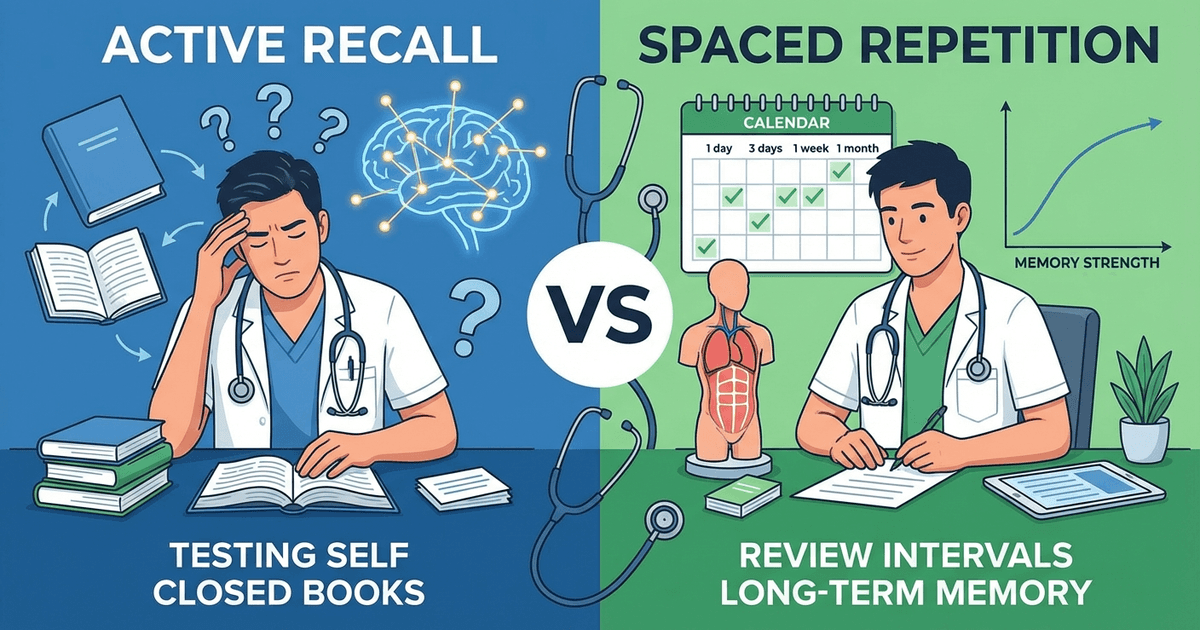
Active Recall vs Spaced Repetition for Medical Students: Which Study Method Wins for USMLE 2026?
You are probably scrolling through study method articles at 2 AM, wondering which technique will actually get you through USMLE Step 1. The internet loves pitting active recall against spaced repetition like theyre boxing opponents.
Heres the thing: that fight doesnt exist.
USMLE Step 1 has 280 questions. You have 8 hours to prove you can recall, apply, and synthesize years of medical knowledge under pressure. The students who consistently score 250+ dont pick sides between active recall and spaced repetition. They use both methods strategically, at the right moments, for the right reasons.
This isnt another surface-level "try both" article. Were diving into the cognitive science of how memory actually works, why each method targets different aspects of learning, and how to build a study system that leverages the strengths of both. By the end, youll know exactly when to test yourself (active recall) and when to schedule reviews (spaced repetition) — and why the combination is unstoppable.
What Active Recall Actually Does to Your Brain
Active recall isnt just "testing yourself." Its forced retrieval of information from memory without external cues. When you close your textbook and try to explain beta-blocker mechanisms from scratch, youre engaging the retrieval practice effect — one of the most robust findings in learning science.
Heres what happens neurologically: every time you strain to remember something, you strengthen the neural pathways to that information. The difficulty of retrieval is the point. When you struggle to recall the steps of glycolysis, then successfully retrieve them, you create stronger memory traces than if you had simply reread the pathway diagram.
Research by Roediger and Karpicke showed that students who spent time testing themselves (active recall) retained 50% more information after one week compared to students who spent the same time re-reading. For medical students, this translates to remembering drug mechanisms, pathophysiology chains, and clinical presentations weeks after your initial study session.
The Illusion of Knowing Problem
Medical school creates a dangerous trap: the illusion of knowing. You read about myocardial infarction pathophysiology, highlight key points, and feel confident. But can you actually explain the cascade from plaque rupture to troponin elevation without looking?
Active recall breaks this illusion ruthlessly. It exposes gaps in understanding that passive review methods miss. When you cant recall how ACE inhibitors reduce afterload, you know exactly what to focus on next. When youre reading Robbins for the third time and everything "looks familiar," you know nothing about your actual retrieval strength.
How Spaced Repetition Fights the Forgetting Curve
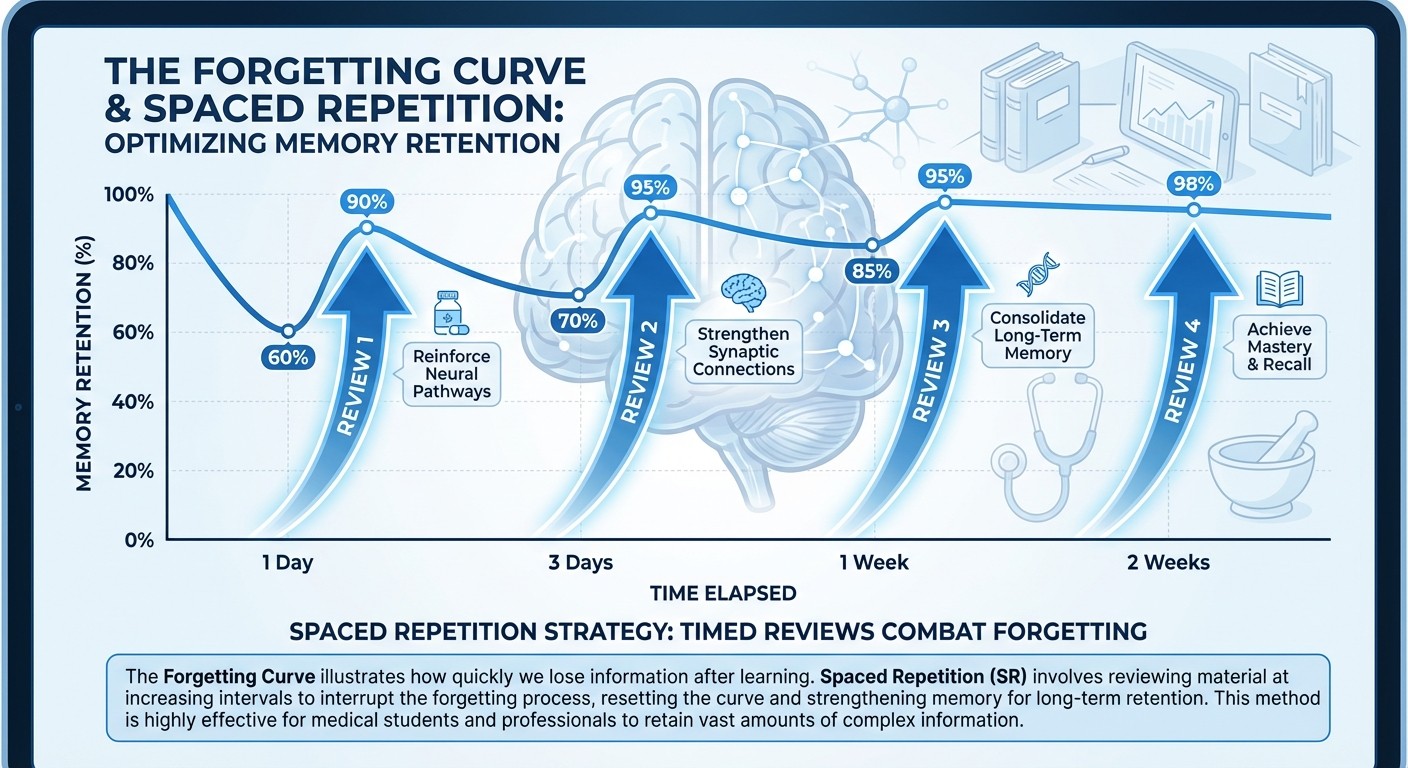
Spaced repetition attacks a different problem: the forgetting curve. Hermann Ebbinghaus discovered that we forget roughly 50% of new information within 24 hours, 70% within a week. For USMLE preparation, this means that pathology chapter you studied last month has largely evaporated unless youve reviewed it strategically.
Spaced repetition schedules reviews at increasing intervals — 1 day, 3 days, 1 week, 2 weeks, 1 month. Each successful recall pushes the next review further out. Each failed recall brings it back sooner. This isnt arbitrary timing; its optimized around the natural decay of memory traces.
The magic happens at the moment of near-forgetting. When you review material just as its about to fade from memory, you create the strongest possible reinforcement. Too early, and you waste time reviewing information you already remember. Too late, and you have to relearn from scratch.
Why Timing Matters More Than Volume
Most medical students understand spaced repetition in theory but mess up the execution. They create massive Anki decks with thousands of cards, then burn out trying to keep up with daily reviews. The key insight: spaced repetition isnt about doing more reviews. Its about doing them at the optimal moment for each piece of information.
A drug mechanism you understand deeply might need review every 3 weeks. A tricky enzyme pathway that you keep confusing might need review every 3 days. Effective spaced repetition personalizes the intervals based on your actual recall performance, not a one-size-fits-all schedule.
The Head-to-Head: When Each Method Wins
Active recall and spaced repetition excel in different scenarios. Understanding when to use each method can transform your USMLE preparation from scattered reviewing to strategic learning.
Active Recall Wins For: Initial Encoding and Deep Understanding
New material consolidation: When you finish reading about cardiac electrophysiology, active recall cements the information immediately. Close the textbook and explain the cardiac cycle from memory. Draw the action potential curve without reference. This initial retrieval session strengthens the memory traces while the information is still fresh. Identifying knowledge gaps: Active recall reveals exactly what you dont know. You might think you understand renal physiology until you try explaining the renin-angiotensin system from scratch. The moments where you struggle point to specific areas that need more attention. Building clinical reasoning: USMLE questions dont test isolated facts — they test your ability to connect concepts under pressure. Active recall practice with case-based scenarios builds this connection strength. When you practice recalling why a patient with chest pain, elevated troponins, and ST elevations needs immediate catheterization, youre building the clinical reasoning pathways that USMLE tests.
After studying beta-blockers, Probe Game fires rapid questions about mechanisms, indications, and contraindications — exactly the retrieval practice that research shows creates stronger memory traces than reviewing the same material multiple times.
Spaced Repetition Wins For: Long-term Retention and Maintenance
Preventing knowledge decay: Information you learned 3 months ago will fade without strategic review. Spaced repetition keeps high-yield concepts fresh throughout your entire preparation period. Your understanding of glycolysis from biochemistry block needs maintenance to be available during your medicine rotation. Efficient review scheduling: Instead of panic-reviewing everything before your exam, spaced repetition distributes the review burden across time. You maintain mastery of foundational concepts while learning new material. Automating retention: The best spaced repetition systems handle the scheduling automatically. You focus on learning; the system ensures you review material at optimal intervals. This removes the cognitive load of deciding what to review each day.
For USMLE Step 1 high-yield facts, Synapses automatically schedules reviews based on your individual recall performance. A concept you nail gets spaced further out; one you keep missing appears more frequently — exactly what the forgetting curve research prescribes.
The Science of Interleaving: Why Mixing Topics Beats Block Practice
Theres a third element that supercharges both active recall and spaced repetition: interleaving. This means mixing different topics during study sessions instead of focusing on one subject for hours.
Most medical students study in blocks — spend 3 hours on cardiology, then 3 hours on pulmonology. This feels efficient but creates weak retention. Research shows that interleaved practice (switching between cardiology, pulmonology, and nephrology questions within the same session) builds stronger long-term memory and better clinical reasoning.
Why? Clinical medicine is interleaved. A patient with shortness of breath could have cardiac, pulmonary, or renal pathology. USMLE questions deliberately mix these systems. When you practice retrieving information across multiple topics in the same session, you build the cognitive flexibility that high-stakes exams demand.
The Optimal Study Session Structure
1. Active recall phase (20 minutes): Test yourself on new material from todays reading
2. Spaced review phase (15 minutes): Review flashcards or concepts scheduled for today
3. Interleaved practice (25 minutes): Mix MCQs from different topics youve studied recently
4. Gap analysis (10 minutes): Note what you struggled with and plan targeted review
This 70-minute cycle hits all three evidence-based learning principles: retrieval practice, spaced repetition, and interleaving.
Why Passive Methods Fail Under Pressure
Medical students gravitate toward passive study methods because they feel productive. Reading textbooks, watching videos, and highlighting notes create the sensation of learning. The information feels familiar, which the brain interprets as mastery.
But familiarity isnt fluency. Recognition isnt recall. USMLE doesnt ask "Which of these looks familiar?" It asks "What is the most likely diagnosis?" under time pressure with distractors designed to confuse you.
Passive methods fail because they dont simulate exam conditions. When you read about heart failure management, the information is right there on the page. When you face a Step 1 question about heart failure, you must retrieve that information from memory while processing a complex clinical vignette. Thats an entirely different cognitive task.
Students who rely on passive review often experience "test shock" — the jarring realization that they cant access information they "know" when it matters. Active recall eliminates this shock by practicing retrieval under increasingly challenging conditions.
The Winner: Spaced Active Recall
The research is clear: active recall wins for encoding strength, spaced repetition wins for retention scheduling. But the real winner is their combination — spaced active recall.
This approach uses active recall techniques (testing, explaining, applying) distributed across time using spaced repetition intervals. Instead of passively reviewing flashcards, you actively test yourself on material at optimal intervals. Instead of cramming active recall sessions into marathon study days, you distribute retrieval practice across weeks and months.
The 3-2-1 Review Protocol
Heres a practical framework for combining both methods:
3 days after initial learning: Active recall session on new material
2 weeks later: Spaced review using practice questions or flashcards
1 month later: Mixed practice combining this topic with related concepts
This protocol ensures both strong initial encoding (through active recall) and long-term retention (through spaced repetition).
When you miss a concept during review, Rezzy bridges the gap immediately. Instead of passive re-reading, you can ask targeted questions like "Why does this mechanism matter for Step 1?" — turning the moment of confusion into active learning.
Building Your Evidence-Based Study System
Creating an effective study system requires more than knowing the techniques — you need practical implementation. Here's how to build a system that automatically incorporates both active recall and spaced repetition.
Week 1-4: Foundation Building with Active Recall
Start each new topic with active recall sessions. After reading about cardiovascular pharmacology:
1. Close your resources and list all beta-blockers from memory
2. Explain the mechanism of each drug without references
3. Create clinical scenarios where each drug would be appropriate
This initial retrieval practice creates strong memory traces while the information is fresh. Dont worry about perfection — the struggle to remember is what strengthens recall pathways.
Week 5-12: Integrated Spaced Review
Begin incorporating spaced repetition while continuing to learn new material. Your daily study should include:
New material learning (40% of time)
Scheduled spaced reviews (30% of time)
Mixed practice across topics (30% of time)
Week 13+: Maintenance and Application
Focus heavily on spaced reviews of all previously learned material while doing intensive question practice. The goal is maintaining mastery of foundational concepts while building exam-taking skills.
The key insight: dont wait until youve "finished" learning to start spaced repetition. Begin spacing material immediately after initial active recall sessions. This parallel approach ensures long-term retention while you continue learning new topics.
Common Implementation Mistakes (And How to Avoid Them)
Mistake 1: Confusing recognition with recall
Many students think they "know" material because it looks familiar during passive review. Test this by explaining concepts from scratch without references. If you cant teach it simply, you dont understand it well enough for exam conditions.
Mistake 2: Over-relying on someone elses spacing schedule
Generic flashcard decks use one-size-fits-all intervals that dont match your learning patterns. Effective spaced repetition adapts to your individual recall performance — concepts you struggle with appear more frequently, ones you master get spaced further apart.
Mistake 3: Avoiding difficult retrieval practice
The most valuable study sessions feel challenging. If youre consistently getting everything right during active recall practice, youre not pushing your retrieval strength. Embrace the difficulty — its building exam-ready memory traces.
Mistake 4: Separating learning and review
Many students try to "finish" learning before starting review cycles. This approach leads to massive forgetting. Instead, begin spaced repetition immediately after initial active recall sessions for each topic.
The Technology Solution: Automating Evidence-Based Learning
The biggest barrier to implementing spaced active recall isnt understanding the science — its the logistical complexity of managing hundreds of concepts across optimal review intervals while continuing to learn new material.
Modern AI-powered platforms solve this by automating the scheduling and personalizing the intervals. You focus on the learning; the technology ensures youre reviewing the right concepts at the right time using the most effective methods.
The combination of automated spaced reviews, gamified active recall practice, and AI-powered gap filling creates a complete evidence-based study system without the manual overhead of traditional methods.
Frequently Asked Questions
How much time should I spend on active recall vs spaced repetition daily?
Aim for a 60/40 split: 60% of your study time on active recall of new and recent material, 40% on spaced repetition of previously learned concepts. As you get closer to your exam, this ratio should shift toward more spaced repetition (maintaining old knowledge) and less new learning.
Can I use spaced repetition for clinical reasoning, or just facts?
Spaced repetition works excellently for clinical reasoning when you space case-based scenarios, not just isolated facts. Instead of reviewing "ACE inhibitors reduce preload," review complete cases: "63-year-old with CHF, current medications, next best step?" This spaces clinical decision-making practice.
How do I know if my active recall is working?
Track your retrieval success rate over time. If you can explain complex topics from memory after 48 hours without referencing materials, your active recall sessions are building strong memory traces. If you consistently struggle to recall recently "learned" material, increase the frequency and intensity of retrieval practice.
Should I abandon passive methods completely?
No — use passive methods strategically for initial exposure to new concepts and quick reference during active study. Read a physiology chapter to understand the basic framework, then immediately practice active recall to cement the information. Use passive review only for clarification during active sessions, not as primary learning method.
How long before USMLE should I start spaced repetition?
Begin spaced repetition immediately after your first active recall session of any topic — even if your exam is months away. The earlier you start spacing material, the less cramming youll need later. Students who begin spaced repetition in their first year maintain knowledge effortlessly through board exams.
What should I do when spaced repetition reveals major knowledge gaps?
When spaced review exposes forgotten material, dont just mark it for review — go back to active recall mode. Re-study the concept actively, then reset its spaced repetition interval to a shorter cycle. Major gaps indicate the material needs stronger initial encoding before effective spacing can begin.
---
The evidence is overwhelming: active recall builds strong memories, spaced repetition maintains them, and their combination creates the most effective study system for high-stakes medical exams. Students who master both methods dont just pass USMLE — they develop lifelong learning skills that serve them throughout their medical careers.
Prepare smarter with Oncourse AI — adaptive MCQs, spaced repetition, and AI explanations built for USMLE success. Download free on Android and iOS.