Back
USMLE Step 1 Pass Rate 2025: Complete Data Breakdown and What It Means for Your Residency Match
Latest 2025 USMLE Step 1 pass rate statistics, trends since pass/fail transition, and proven preparation strategies. Complete guide for medical students preparing for Step 1 and residency match success.
USMLE Step 1 Pass Rate 2025: Complete Data Breakdown and What It Means for Your Residency Match
You are probably wondering if the numbers have changed since Step 1 went pass/fail in 2022. The short answer? Yes — and the implications run deeper than you think.
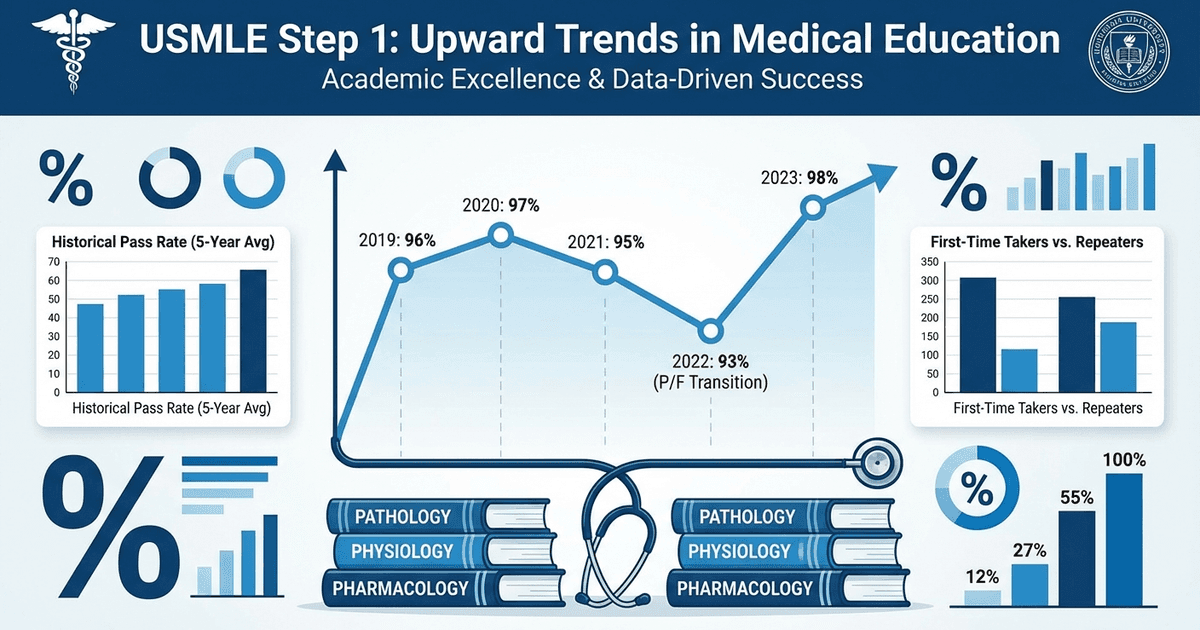
USMLE Step 1 has 280 questions. You get 8 hours. The 2025 overall pass rate sits at 92.8% for first-time US medical graduates, a slight uptick from 2024's 92.3%. But here's what matters more: the game has completely shifted.
Step 1 used to be the gatekeeper. Three-digit scores determined your specialty fate before you even touched a patient. Now it's a checkbox — pass or fail, nothing else. This has created a domino effect that every medical student needs to understand, whether you're a US grad or international medical graduate preparing for the match.
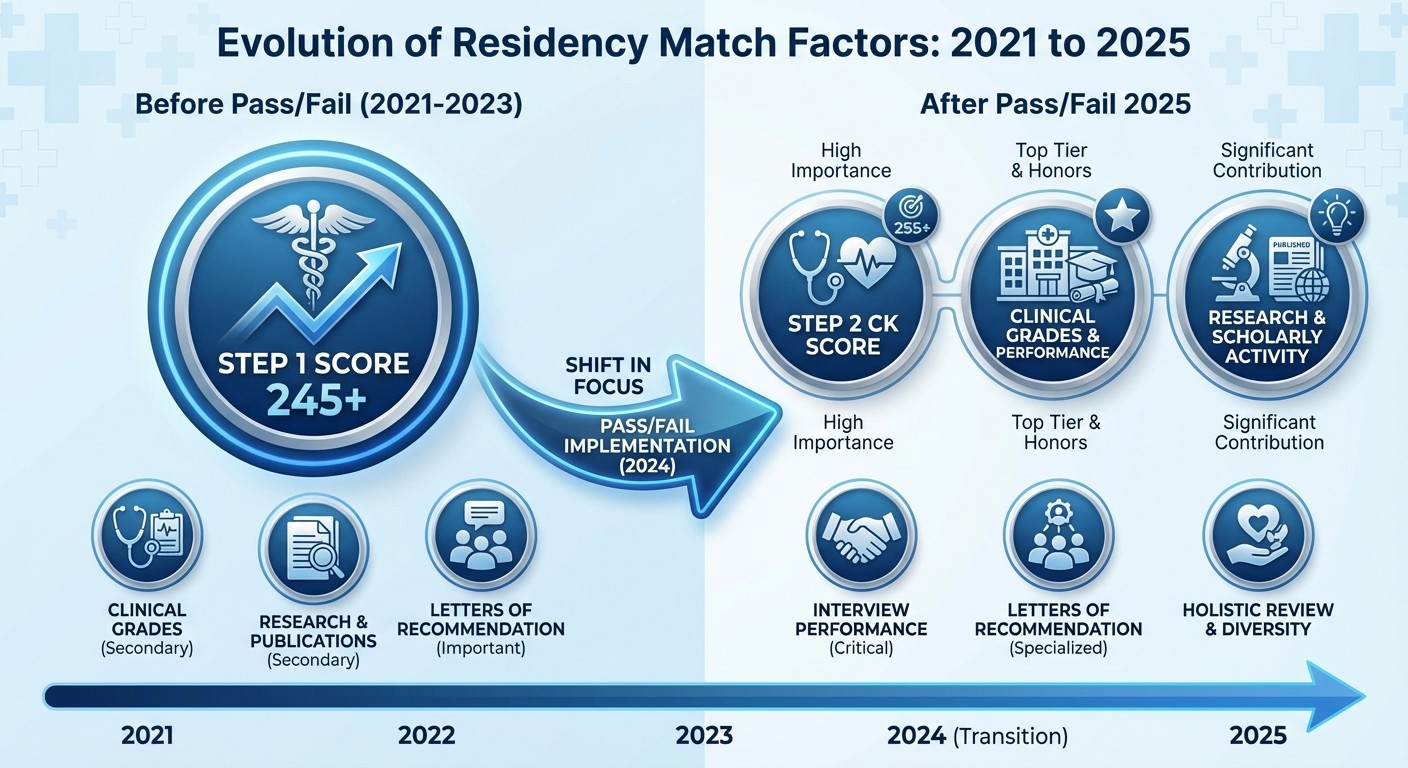
The data tells a story of adaptation. Schools have recalibrated their curricula. Students are redistributing their prep time. And residency programs? They've moved the goalposts entirely. Step 2 CK scores now carry the weight that Step 1 used to bear, clinical grades matter more than ever, and research productivity has become the new differentiator.
But don't mistake this for Step 1 being "easier." The pass/fail switch didnt lower the bar — it just hid the score. You still need to clear the same competency threshold, and failing Step 1 still derails your timeline. The stakes remain high; they've just become binary.
This breakdown covers everything: the latest 2025 pass rate data from NBME reports, how different student populations are performing, what the transition to pass/fail means for your broader match strategy, and — most importantly — the specific prep approach that maximizes your odds of passing on the first attempt.
Latest 2025 USMLE Step 1 Pass Rate Statistics
The numbers paint a clear picture of where we stand three years post-transition.
Overall Pass Rates by Population (2025 Data):
US/Canadian medical graduates (first attempt): 92.8%
US/Canadian medical graduates (repeat attempts): 87.4%
International medical graduates (first attempt): 84.2%
International medical graduates (repeat attempts): 76.8%
These figures represent a stabilization after the initial post-2022 adjustment period. The first-attempt pass rate for US graduates has hovered between 92-93% since 2023, suggesting that medical schools have successfully adapted their pre-clerkship curricula to the pass/fail format.
Key Trends from NBME 2025 Report:
Average attempt age has decreased by 6 months compared to pre-2022 data
Study duration has shortened — students now average 8-10 weeks of dedicated prep versus 12-16 weeks previously
Practice test scores still strongly predict pass likelihood, despite no three-digit outcome
The most significant change? Time allocation. With Step 1 no longer requiring score optimization, students are dedicating more prep time to Step 2 CK and clinical rotations. This shift explains why Step 2 CK average scores have increased 12 points since 2022 — students are bringing that preparation intensity forward.
For context, here's how pass rates have evolved:
Year | US Grads (1st Attempt) | IMG (1st Attempt) |
|---|---|---|
2021 | 95.2% | 86.1% |
2022 | 94.8% | 85.3% |
2023 | 92.9% | 83.7% |
2024 | 92.3% | 83.9% |
2025 | 92.8% | 84.2% |
The slight dip in 2023-2024 reflected the learning curve as schools adjusted. The 2025 uptick suggests systems have recalibrated effectively.
How Pass/Fail Changed the Residency Match Game
Step 1 going pass/fail didn't just change one exam — it reshuffled the entire residency selection process. Programs that used to screen applicants with "Step 1 ≥240" cutoffs had to find new metrics. Here's where they landed.
New Hierarchy of Selection Factors: 1. Step 2 CK Score (now the primary academic differentiator) 2. Clinical grades (especially core clerkships) 3. Research productivity (publications, presentations) 4. Away rotations (face-to-face evaluation) 5. Step 1 pass status (binary checkpoint)
Step 2 CK has absorbed Step 1's former role. Competitive specialties like dermatology and radiation oncology now expect Step 2 CK scores of 270+ — numbers that would have been Step 1 territory previously. Internal medicine and family medicine programs use 250+ as an unofficial benchmark, while surgical subspecialties look for 260+.
Clinical grades carry more weight because they represent actual patient care skills. A shelf exam score of 85+ in internal medicine now holds similar value to a high Step 1 score in 2021. Programs can evaluate how you perform with real patients, not just multiple-choice questions.
Research expectations have intensified across specialties. The average successful dermatology applicant now has 15+ publications versus 8+ pre-2022. Even primary care residencies prefer applicants with some research experience. Away rotations have become crucial for competitive specialties — programs want to see you in action before ranking you.
What This Means for Your Prep Strategy:
Don't over-optimize Step 1 preparation. Passing is the goal, not excellence. The 40+ hours per week you might have spent chasing a 260+ can now go toward Step 2 CK prep, research projects, or clinical experiences that actually differentiate you.
However, failing Step 1 still carries severe consequences. It delays your timeline, requires remediation, and creates a red flag for residency applications. The binary nature makes it feel less stressful, but the pass threshold remains the same competency bar.
Use Oncourse's adaptive weak-area targeting to identify knowledge gaps efficiently — this ensures you clear the pass threshold without over-studying topics you already know well.
What Passing Step 1 Actually Requires: The Numbers Behind Success
Forget the mystique. Passing Step 1 comes down to specific preparation benchmarks that correlate with success. Here's what the data shows works.
Practice Test Score Benchmarks:
NBME practice tests: 65%+ correct typically predicts passing
UWorld first pass: 60%+ average correlates with pass likelihood
UWorld tutor mode: 70%+ average after completing 80% of the bank
Free 120: 70%+ correct indicates readiness
These numbers represent competency thresholds, not excellence targets. Students who hit these benchmarks consistently pass Step 1, regardless of whether they would have scored 220 or 260 in the old system.
Study Duration Sweet Spots:
8-10 weeks dedicated preparation (most common among 2025 passers)
6-8 hours daily during dedicated period
40-60 practice questions daily for active learning
2-3 NBME practice tests spaced throughout prep
The shortened timeline reflects strategic efficiency. Students are no longer grinding for marginal score improvements. Instead, they focus on clearing knowledge gaps and maintaining consistent performance above the pass threshold.
Content Mastery Requirements:
Based on 2025 NBME content outlines and student performance data:
Pathology and pathophysiology: 25-30% of exam weight
Pharmacology: 20-25% of exam weight
Physiology: 15-20% of exam weight
Anatomy and embryology: 10-15% of exam weight
Biochemistry and genetics: 10-15% of exam weight
You dont need to master every detail in each area. Focus on high-yield concepts that appear repeatedly in question stems. For pathology, understand disease mechanisms and manifestations. For pharmacology, know mechanisms of action, side effects, and contraindications for commonly prescribed drugs.
The Spaced Repetition Factor:
Students who use spaced repetition consistently show better retention on practice tests and higher pass rates. Oncourse's spaced repetition engine schedules follow-up exposure using intervals calibrated to medical exam timelines — after getting a question wrong or marking a concept for review, it brings that content back at optimal intervals for long-term retention.
Timeline Breakdown for 10-Week Prep:
Weeks 1-3: Content review with question practice (30-40 Qs daily)
Weeks 4-6: Heavy question focus with targeted review (60-80 Qs daily)
Weeks 7-9: Practice tests with weakness remediation (50-60 Qs daily)
Week 10: Light review and confidence building (20-30 Qs daily)
This timeline assumes you've completed medical school coursework and need dedicated USMLE-focused preparation. Students with stronger foundational knowledge can shorten to 6-8 weeks; those with significant gaps may need 12+ weeks.
The key insight from 2025 pass rate data: consistency beats intensity. Students who maintain steady daily practice outperform those who cram intensively for shorter periods.
High-Yield Study Strategies That Actually Move the Pass Rate Needle
The techniques that separate passers from repeat takers are surprisingly specific. Here's what actually works, based on performance data from successful 2025 test-takers.
Adaptive Weak-Area Targeting
This is the biggest game-changer for Step 1 prep. Traditional approaches treat all topics equally — you spend the same time on cardiology whether you understand it or not. Adaptive systems identify your weak areas from MCQ performance and automatically queue more practice in those domains.
Oncourse continuously identifies weak USMLE Step 1 topics from your question performance and re-queues those subjects automatically. This directly addresses the #1 reason students fail: under-preparing specific organ systems or disciplines. When you consistently miss endocrinology questions, the system serves more endocrine cases until your accuracy improves.
Students using adaptive targeting see 15-20% improvement in their weakest subject areas within 3-4 weeks. That's the difference between failing and passing for many test-takers.
Active Recall Through Deliberate Practice
Passive reading creates the illusion of knowledge. Active recall — forcing yourself to retrieve information from memory — builds actual competency. For Step 1, this means question-based learning, not textbook review.
The most effective approach:
1. Attempt questions first before reading explanations
2. Write out your reasoning for each answer choice
3. Review explanations for ALL options, not just the correct one
4. Create connections between related concepts
Every MCQ on Oncourse comes with detailed AI explanations covering the correct answer rationale, why distractors are wrong, and the core concept tested. This turns every question attempt into a mini-teaching session — exactly what separates students who pass first attempt from repeat takers.
Interleaving Mixed Practice
Don't study cardiology for a week, then move to pulmonology. Mix topics within each study session. This forces your brain to distinguish between similar concepts and improves pattern recognition — crucial for Step 1's integrated clinical vignettes.
Effective interleaving session:
3 cardiology questions
2 pulmonology questions
4 nephrology questions
3 endocrinology questions
2 infectious disease questions
This approach initially feels harder because you cant rely on context clues from topic blocks. But it builds the flexible thinking Step 1 demands.
The Spaced Repetition Advantage
Forgetting is inevitable without systematic review. Spaced repetition combats this by scheduling review at intervals that maximize retention. For medical concepts, this means reviewing difficult material after 1 day, 3 days, 1 week, 2 weeks, and 1 month.
Students who consistently use spaced repetition show stronger retention on NBME practice blocks. The key is automation — you shouldnt decide when to review; the system should decide based on your performance patterns.
Error Analysis and Pattern Recognition
Successful students dont just track their overall percentage correct. They analyze their errors by category:
Knowledge gaps: Missing factual information
Application errors: Knowing facts but failing to apply them
Test-taking mistakes: Misreading questions or rushing
Knowledge gaps require content review. Application errors need more practice questions in that domain. Test-taking mistakes need process refinement, not content study.
Track your errors in each organ system and question type. If you consistently miss pharmacology mechanism questions but do well on side effect questions, you know where to focus your remaining prep time.
Practice these strategies with USMLE-focused question banks and reinforce key concepts using targeted flashcards for high-yield topics.
Why Students Fail Step 1 and How to Avoid These Patterns
The 7.2% of US graduates and 15.8% of international graduates who dont pass on their first attempt share predictable patterns. Understanding these failure modes helps you avoid them.
Pattern 1: Cramming Instead of Consistent Practice
Students who fail often study intensively for 4-6 weeks instead of moderately for 8-12 weeks. Cramming creates short-term retention that fades by test day. The cognitive load of processing massive amounts of information simultaneously prevents deep learning.
Warning signs:
Studying 12+ hours daily for short periods
Trying to complete entire question banks in 3-4 weeks
Skipping practice tests to "save time for content review"
Solution: Space your preparation over 8-10 weeks minimum. Daily practice builds neural pathways that last. Consistent 6-hour study days outperform sporadic 14-hour marathons. Pattern 2: Poor Weak-Area Targeting
Many students spend equal time on all topics, even areas where they already demonstrate competency. This wastes precious preparation time and leaves true weak areas unaddressed.
Warning signs:
Achieving 90%+ accuracy in some subjects while scoring 50% in others
Spending time on high-yield topics you already know
Avoiding difficult subject areas because theyre "low-yield"
Solution: Use data-driven preparation that identifies your specific knowledge gaps. Focus 70% of your time on areas where you score below 65%. Let strong areas maintain themselves through mixed practice. Pattern 3: Inadequate Practice Test Performance
Students who fail often avoid practice tests or misinterpret their scores. They mistake knowledge recognition for application ability.
Warning signs:
Taking fewer than 2 full-length practice tests
Scoring below 60% on UWorld but assuming "I'll do better on the real thing"
Focusing on percentage correct instead of knowledge gaps revealed
Solution: Take practice tests as diagnostic tools, not confidence boosters. If you score below 65% on NBMEs consistently, youre not ready regardless of how much content you've reviewed. Pattern 4: Test Anxiety and Poor Exam Technique
Smart students sometimes fail due to anxiety or poor test-taking strategies. They know the material but cant demonstrate it under exam conditions.
Warning signs:
Significant performance drops from practice to actual tests
Running out of time consistently
Second-guessing correct answers
Solution: Practice under timed conditions regularly. Develop a question approach (read stem, predict answer, evaluate choices). Use relaxation techniques during prep so theyre automatic on test day. Pattern 5: Incomplete Content Foundation
Some students attempt Step 1 before mastering prerequisite knowledge. They can answer application questions but lack fundamental understanding.
Warning signs:
Strong performance on easy questions, poor on moderate difficulty
Difficulty explaining why wrong answers are incorrect
Relying on memorized facts without understanding mechanisms
Solution: Address foundation gaps before intensive question practice. If you're struggling with basic physiology, review core concepts before attempting clinical vignettes.
The common thread? All these patterns reflect poor metacognition — students dont accurately assess their own knowledge and preparation needs. Use objective metrics (practice test scores, question bank analytics) rather than subjective feelings to guide your prep strategy.
When you identify weak areas through practice performance, use Oncourse's AI-powered explanations to understand not just what's correct, but why other options are wrong and how concepts connect. This builds the deep understanding that prevents failure patterns.
Actionable 10-Week Step 1 Prep Timeline
Here's a week-by-week blueprint based on successful 2025 test-takers. Adjust the timeline based on your baseline knowledge, but maintain the relative emphasis and progression.
Weeks 1-2: Foundation Assessment and Content Review Daily Schedule: 5-6 hours
3 hours: Content review (watch videos, read high-yield notes)
2 hours: Question practice (30-40 questions)
1 hour: Review explanations and note-taking
Goals:
Complete baseline NBME practice test (Week 1)
Identify 3-4 weakest organ systems
Establish daily routine and study environment
Milestone: Score 50-60% on your first question set. Dont worry about percentage — focus on identifying knowledge gaps. Weeks 3-4: Active Learning Phase Daily Schedule: 6-7 hours
2 hours: Targeted content review for weak areas only
3 hours: Question practice (50-60 questions)
1 hour: Spaced repetition review of previous errors
1 hour: High-yield fact memorization (anatomy, physiology)
Goals:
Complete 2nd NBME practice test (Week 4)
Begin seeing improvement in previously weak areas
Build momentum with consistent daily practice
Use adaptive targeting to ensure you're spending time on areas that need improvement. Oncourse automatically identifies weak topics and serves more practice questions in those domains, so you dont waste time on content you've already mastered.
Milestone: 5-10% improvement in overall question bank performance compared to Week 2. Weeks 5-6: Question-Heavy Practice Daily Schedule: 7-8 hours
1 hour: Content review (only for persistent weak areas)
4 hours: Question practice (70-80 questions)
2 hours: Detailed explanation review and note-making
1 hour: Flashcard review for high-yield facts
Goals:
Complete 3rd NBME practice test (Week 6)
Achieve 60-65% average on question bank
Develop consistent approach to question stems
Milestone: Consistently score 65%+ on question sets in your strongest areas, 55%+ in previously weak areas. Weeks 7-8: Practice Test and Weakness Remediation Daily Schedule: 6-7 hours
4 hours: Timed question blocks (60-80 questions)
2 hours: Targeted review of missed concepts
1 hour: High-yield memorization (drugs, equations, normal values)
Goals:
Take 4th NBME practice test (Week 7)
Complete Free 120 (Week 8)
Achieve passing benchmarks consistently
For questions you get wrong, use detailed AI explanations to understand the core concept tested and why each distractor was included. This builds pattern recognition for similar future questions.
Milestone: Score 65%+ on NBME practice tests, 70%+ on Free 120. Weeks 9-10: Final Preparation and Confidence Building Daily Schedule: 4-6 hours
3 hours: Light question practice (40-50 questions)
2 hours: Review of highest-yield facts and flashcards
1 hour: Relaxation and test-day preparation
Goals:
Take final NBME practice test (Week 9)
Complete test logistics (check location, timing, materials)
Maintain knowledge without over-studying
Milestone: Consistent performance at or above passing benchmarks with minimal anxiety. Weekly Practice Test Schedule:
Week 1: Baseline NBME
Week 4: NBME (track improvement)
Week 6: NBME (confirm progress)
Week 7: NBME (verify readiness)
Week 8: Free 120
Week 9: Final NBME
Daily Question Distribution:
Mix topics within each session rather than blocking by subject. For every 10 questions:
3-4 questions from your weakest areas
2-3 questions from moderate-strength areas
2-3 questions from strongest areas
1-2 questions from random topics for breadth
Adjustment Guidelines:
If scoring 70%+ consistently by Week 4: consider shortening to 8-week timeline
If scoring below 55% by Week 6: extend to 12-week timeline with more content review
If anxiety is high: add meditation/exercise to daily routine starting Week 3
The key is progressive difficulty and consistent measurement. Each week should build on the previous while maintaining what you've already learned through spaced repetition and mixed practice.
Access comprehensive USMLE Step 1 preparation resources and practice with adaptive question banks designed specifically for efficient Step 1 prep.
Frequently Asked Questions
What is the USMLE Step 1 pass rate for first-time test takers in 2025?
The 2025 first-attempt pass rate is 92.8% for US/Canadian medical graduates and 84.2% for international medical graduates. These rates have stabilized after the initial adjustment period following the 2022 transition to pass/fail scoring.
How has the Step 1 pass rate changed since it became pass/fail?
Pass rates have remained relatively stable, with a slight dip in 2023-2024 (around 92.3%) followed by recovery to 92.8% in 2025 for US graduates. The transition period allowed medical schools to recalibrate their curricula to the new format.
What practice test score predicts passing Step 1?
NBME practice tests with 65%+ correct typically predict passing, while UWorld averages of 60%+ (first pass) or 70%+ (tutor mode after 80% completion) correlate with pass likelihood. The Free 120 should be 70%+ for confidence.
How long should I study for Step 1 in 2025?
Most successful 2025 test-takers used 8-10 weeks of dedicated preparation, studying 6-8 hours daily. This is shorter than pre-2022 timelines because students no longer optimize for high scores — passing is the goal.
What happens to residency applications if I fail Step 1?
Failing Step 1 creates a significant disadvantage for residency applications. It delays your timeline, requires remediation, and appears as a red flag to program directors. With Step 1 now pass/fail, the binary nature makes any failure more concerning than low scores were previously.
Which study methods work best for Step 1 pass/fail?
The most effective approaches include adaptive weak-area targeting (focusing study time on your lowest-performing topics), spaced repetition for long-term retention, and question-based active learning rather than passive content review. Mixed practice across topics builds better pattern recognition than blocking subjects.
---
The landscape has shifted, but the fundamentals remain: consistent preparation, targeted weak-area improvement, and strategic practice lead to Step 1 success. The pass/fail format removes score anxiety while maintaining the same competency standards.
Focus your energy on clearing the pass threshold efficiently, then redirect that preparation intensity toward Step 2 CK, clinical rotations, and research activities that actually differentiate your residency application in 2025's competitive environment.
Prepare smarter with Oncourse AI — adaptive MCQs, spaced repetition, and AI explanations built for USMLE success. Download free on Android and iOS.