How AI Adaptive Question Banks Know What to Drill Next — And Why It Matters for USMLE Step 1
Discover how adaptive question banks use AI to identify weak areas and personalize USMLE Step 1 practice. Learn the science behind intelligent question selection and why it matters for exam success.
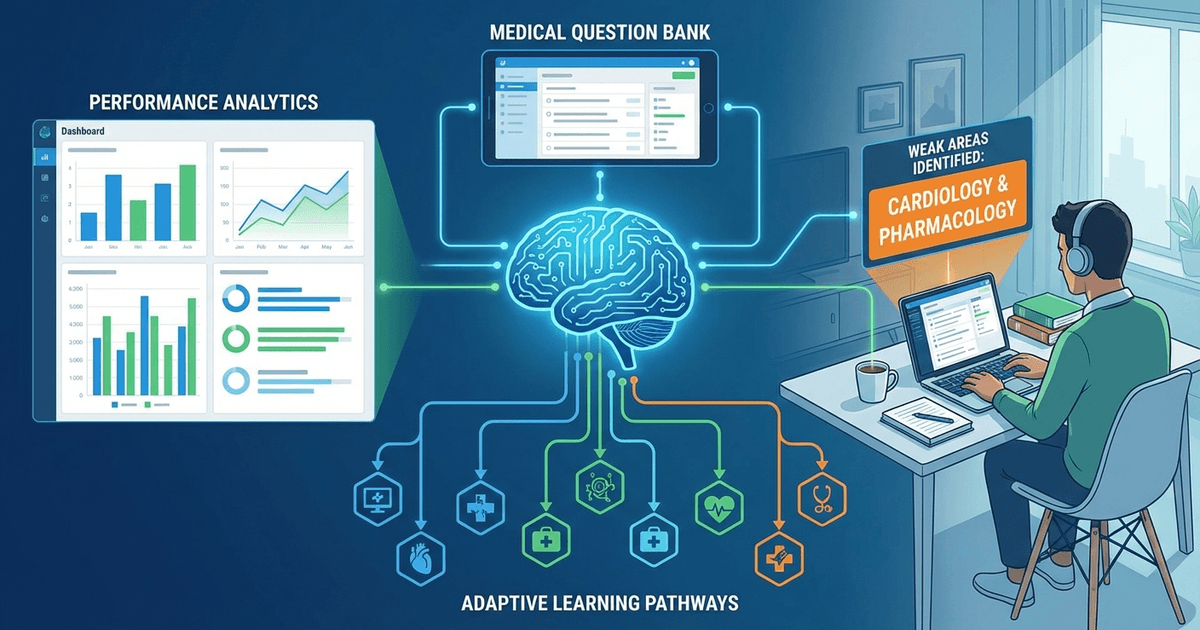
How AI Adaptive Question Banks Know What to Drill Next — And Why It Matters for USMLE Step 1
You probably know the feeling. You just finished 40 USMLE Step 1 questions, got 32 right, and now you're staring at the screen wondering what to tackle next. Do you hit Cardiology again? Dive into those Pharmacology weak spots? Or just press "random mix" and hope for the best?
Here's what most students dont realize: that decision — what question to see next — might be the difference between a 240 and a 260. While you're manually guessing your weak areas, adaptive question banks are doing the math in real-time, tracking every click, every wrong answer, every pattern in your performance.
Static question banks serve you questions in order. Adaptive ones serve you the exact question your brain needs to see next. The difference isnt just convenience — it's backed by decades of cognitive science on how memory actually works.
What Makes a Question Bank "Adaptive"
An adaptive question bank isnt just shuffling a deck of MCQs. It's running continuous calculations on your performance data, identifying knowledge gaps, and serving questions based on where you need the most practice.
The algorithm tracks three key metrics:
Accuracy per topic — Your percentage in Cardiology vs Endocrinology vs Pharmacology
Time patterns — Which concepts take you longest to answer
Forgetting curves — How quickly you lose information you previously knew
Every time you answer a question, the system updates your profile. Got a Biochemistry pathway wrong? The algorithm notes it. Nailed three Cardiology questions in a row? It adjusts your confidence score for that topic.
But the real intelligence comes in the next step: deciding what question to serve you based on all that data.
The Science Behind Intelligent Question Selection
Adaptive systems use principles from learning science that most students have never heard of — but work incredibly well for long-term retention.
Desirable Difficulty
Your brain learns best when challenged at exactly the right level. Too easy and you dont form strong memories. Too hard and you give up. Adaptive algorithms find that sweet spot by serving questions that are 65-75% challenging based on your current ability.
For USMLE Step 1, this means if you're crushing Cardiology but struggling with Renal, the system will serve you harder Cardiology questions and foundational Renal ones. You stay in the learning zone for both topics instead of getting bored or overwhelmed.
Spaced Repetition Optimization
The forgetting curve shows we lose 50% of new information within an hour unless we review it. Adaptive question banks time your reviews based on how well you knew the material initially.
Miss a question about ACE inhibitors? You'll see another ACE inhibitor question tomorrow. Get it right the second time? The next one comes in 3 days. Get that one right? A week later. The intervals expand based on your demonstrated retention, maximizing efficiency.
Oncourse's adaptive question engine tracks this timing automatically, so students spend more time on concepts they're actually forgetting rather than reviewing what they already know cold.
Interleaving for Transfer
Static question banks often group questions by topic — all Cardiology, then all Pulmonology. But research shows mixing topics forces your brain to actively recall the correct approach for each question, leading to better transfer on the actual exam.
Adaptive systems create intelligent mixes based on your weak areas. If you're strong in Cardiology but weak in Pulmonology, you might see 2 Pulm questions, 1 Cardio, 3 Pulm, 1 Cardio — keeping you sharp on your strengths while drilling your gaps.
How Adaptive Algorithms Identify Your Weak Spots
The magic happens in the data analysis. Every question attempt creates multiple data points the algorithm uses to build your knowledge map.
Pattern Recognition in Wrong Answers
A single wrong answer might be a careless mistake. But patterns reveal systematic gaps. Miss 3 questions about diabetes management? The system flags endocrinology as needing work. Miss questions about ACE inhibitors, beta blockers, and diuretics? It identifies a pharmacology pattern, not just cardiovascular.
Advanced algorithms look for correlations between topics too. Students who struggle with cardiac embryology often need extra work on vascular development. The system connects these dots and adjusts accordingly.
Time-to-Answer Analysis
How long you spend on questions reveals confidence levels. Quick right answers suggest solid knowledge. Long right answers might indicate lucky guessing. Long wrong answers often show conceptual confusion that needs targeted review.
Oncourse's performance analytics dashboard shows these patterns at a granular level — students can see exactly where they stand in each subject and system, while the algorithm uses this data to auto-adjust future question selection.
Confidence Calibration
Some students are overconfident (guess wrong but feel certain). Others are underconfident (know more than they think). Adaptive systems learn your confidence patterns and adjust question difficulty accordingly.
If you consistently mark questions as "uncertain" but get them right, the algorithm serves you harder questions in that topic. If you mark them "certain" but get them wrong, it focuses on foundational concepts.
The Real-World Impact on USMLE Step 1 Performance
Students using adaptive question banks typically see faster score improvements compared to static systems. Here's why:
Focused Practice Time
Instead of wasting time on concepts you already know, you spend 80% of your study time on actual weak areas. A student strong in basic sciences but weak in clinical applications will see mostly clinical vignettes. Someone who knows facts but struggles with application will get more multi-step reasoning questions.
This targeted approach cuts study time significantly. Why review 100 cardiology questions when the algorithm can identify that you specifically need work on 12 concepts?
Reduced Forgetting
By timing reviews based on your forgetting curve, adaptive systems help you retain information longer with fewer total reviews. You're not cramming the same facts repeatedly — you're reinforcing them at exactly the moment your brain needs the reminder.
Better Transfer to Exam Conditions
USMLE Step 1 questions integrate across systems and require applying knowledge in novel contexts. Adaptive systems prepare you for this by creating question mixes that mirror the exam's integrative approach.
Instead of studying systems in isolation, you practice switching between Pathology, Pharmacology, and Physiology within the same session — exactly what the real exam demands.
How Daily Study Plans Leverage Adaptive Intelligence
The most advanced adaptive systems dont just pick individual questions — they structure your entire study schedule around your performance data.
Dynamic Planning
Traditional study schedules are static: "Week 1: Cardiology, Week 2: Pulmonology." Adaptive plans evolve daily based on your progress. Had trouble with Immunology yesterday? Today's plan front-loads those concepts before moving to scheduled content.
Oncourse's daily study plan integration means students get a coherent, progressive path rather than fragmented practice sessions. If yesterday revealed weak spots in Pharmacology, today's plan prioritizes those questions while maintaining review cycles for stronger topics.
Balanced Practice
Pure adaptive algorithms sometimes over-focus on weak areas, creating gaps in strong subjects. Smart daily plans maintain balance — ensuring you stay sharp on your strengths while systematically addressing weaknesses.
This prevents the common problem where students drill weak areas so intensively they forget previously mastered material by exam day.
Progress Tracking
Adaptive daily plans show measurable progress over time. Instead of wondering "am I improving?", you see concrete evidence: accuracy trends, response time improvements, and knowledge map visualizations showing gaps closing week by week.
Why Static Question Banks Fall Short
Traditional question banks serve questions in predetermined order or random shuffle. This creates several problems:
Inefficient Time Use
You waste hours on topics you already know while neglecting concepts you dont understand. A student who's solid on basic anatomy might spend 30% of their time on anatomy questions when they should focus on clinical correlations.
Poor Retention
Without spaced repetition timing, you forget reviewed material by exam day. Static systems dont know when you last saw a concept or how well you retained it, leading to suboptimal review scheduling.
One-Size-Fits-All Approach
Every student gets the same question sequence regardless of their background, strengths, or exam date. A student with strong basic science knowledge gets the same mix as someone who needs foundational review.
Limited Feedback
Static systems show overall percentages but dont identify specific patterns or provide actionable insights about where to focus next.
Getting the Most from Adaptive Question Banks
To maximize adaptive systems, follow these strategies:
Answer Honestly
Mark confidence levels accurately. The algorithm needs honest feedback to calibrate difficulty appropriately. Gaming the system by marking everything "certain" breaks the adaptive logic.
Review Explanations Thoroughly
Adaptive algorithms work best when they understand not just whether you got a question right, but why you got it wrong. Reading explanations and understanding your mistakes provides better data for future question selection.
Trust the Algorithm
Resist the urge to manually override topic selection. The system has data on thousands of similar students and optimizes based on proven learning science. Let it guide your practice instead of second-guessing the recommendations.
Use Performance Analytics
Check your dashboard regularly to understand patterns in your performance. Are you consistently weak in certain systems? Do you make more mistakes in the afternoon? Use this insight to adjust your study schedule and approach.
Choosing an Adaptive Question Bank for Step 1
When evaluating adaptive question banks, look for these features:
Granular Tracking
The system should track performance at the subtopic level, not just broad subjects. "Cardiology: 70%" isnt helpful. "Heart failure pathophysiology: 45%, Arrhythmia management: 85%" gives actionable insight.
Transparent Algorithms
Good adaptive systems show you why they're recommending certain questions. "Based on your performance in Renal physiology" is better than black box recommendations.
Integration Across Study Tools
The most effective systems integrate adaptive questioning with flashcards, daily plans, and progress tracking. Your question bank performance should inform your entire study strategy, not exist in isolation.
Regular Updates
Adaptive algorithms improve with more data. Choose platforms that regularly update their algorithms based on student performance patterns and exam changes.
The Future of Adaptive Learning in Medical Education
Adaptive question banks are just the beginning. Future systems will integrate real-time biometric data, learning style analysis, and predictive modeling to create even more personalized study experiences.
We're moving toward AI tutors that understand not just what you dont know, but how you learn best, when you're most focused, and how to time interventions for maximum retention.
For current Step 1 students, the advantage is clear: adaptive systems provide more focused, efficient, and effective preparation than static alternatives.
Frequently Asked Questions
How long does it take for adaptive algorithms to learn my patterns?
Most adaptive systems start personalizing after 50-100 questions, with meaningful adaptation beginning around 200-300 questions. Full optimization typically occurs after 2-3 weeks of consistent use.
Can I still choose specific topics to practice?
Yes, most adaptive systems allow manual topic selection while maintaining intelligent question ordering within your chosen focus area. This gives you control over broad study goals while optimizing specific practice sessions.
Do adaptive question banks work for students with limited time?
Adaptive systems are especially valuable for time-constrained students because they maximize efficiency by focusing on actual weak areas rather than random practice.
Will adaptive systems prepare me for the integrated nature of Step 1?
Advanced adaptive algorithms specifically create integrated question mixes that mirror Step 1's cross-system approach, often providing better preparation than topic-by-topic static systems.
How do I know if the adaptive algorithm is working?
Look for improving accuracy scores over time and decreasing time-to-answer on previously difficult topics. Good adaptive systems also provide visualization of your knowledge gaps closing over time.
Can adaptive systems help with test anxiety?
By ensuring you practice at appropriate difficulty levels and providing confidence in your actual knowledge areas, adaptive systems can reduce anxiety by giving you realistic assessment of your preparedness.
Prepare smarter with Oncourse AI — adaptive MCQs, spaced repetition, and AI explanations built for USMLE Step 1. Download free on Android and iOS.