Zoonotic Diseases Indian Medical PG Practice Questions and MCQs
Practice Indian Medical PG questions for Zoonotic Diseases. These multiple choice questions (MCQs) cover important concepts and help you prepare for your exams.
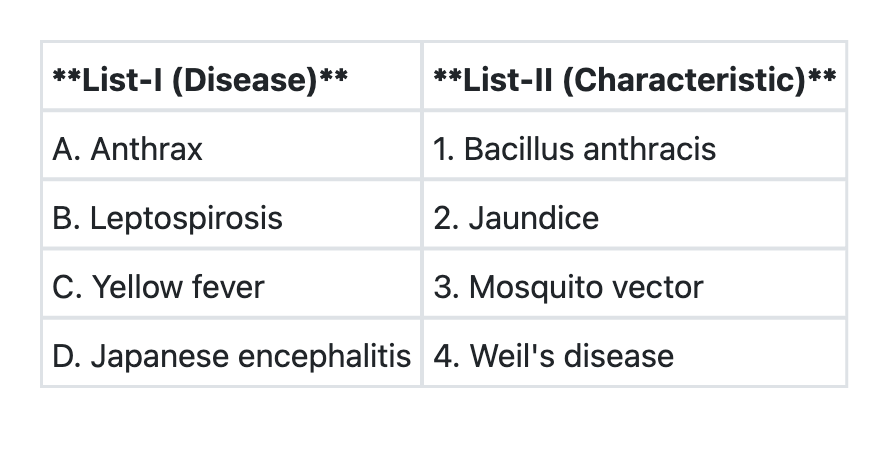
Zoonotic Diseases Indian Medical PG Question 1: Match List-I with List-II and select the correct answer using the code given below the Lists:
- A. A→1 B→4 C→2 D→3
- B. A→1 B→2 C→4 D→3 (Correct Answer)
- C. A→4 B→3 C→2 D→1
- D. A→1 B→2 C→3 D→4
Zoonotic Diseases Explanation: ***A→1 B→2 C→4 D→3***
- This option correctly matches each disease with its primary characteristic: **Anthrax** is caused by *Bacillus anthracis*, **Leptospirosis** is known as **Weil's disease** (in its severe form), **Yellow fever** causes **jaundice** (hence the name "yellow"), and **Japanese encephalitis** is transmitted by **mosquito vector** (Culex species).
- All pairings are medically accurate and represent the most distinctive features of each disease.
*A→1 B→4 C→2 D→3*
- While it correctly links **Anthrax** to *Bacillus anthracis* and **Japanese encephalitis** to **mosquito vector**, it makes critical errors with the middle two diseases.
- **B→4** incorrectly pairs **Leptospirosis** with **jaundice** - while jaundice can occur in severe leptospirosis, this is not its defining characteristic or eponym (that would be Weil's disease).
- **C→2** incorrectly pairs **Yellow fever** with **Weil's disease** - these are completely unrelated; Yellow fever is a flavivirus infection characterized by jaundice, not Weil's disease (which is leptospirosis).
*A→4 B→3 C→2 D→1*
- This option contains multiple fundamental errors in disease-characteristic matching.
- **A→4** incorrectly pairs **Anthrax** with **jaundice** - Anthrax typically presents with cutaneous lesions (eschar), pulmonary, or GI symptoms, not jaundice.
- **B→3** incorrectly pairs **Leptospirosis** with **mosquito vector** - Leptospirosis is transmitted through contact with water/soil contaminated with infected animal urine, not by mosquitoes.
- The other pairings are also incorrect, making this option entirely wrong.
*A→1 B→2 C→3 D→4*
- This option correctly links **Anthrax** to *Bacillus anthracis* and **Leptospirosis** to **Weil's disease**, but makes errors in the last two pairings.
- **C→3** incorrectly pairs **Yellow fever** with **mosquito vector** - while Yellow fever IS transmitted by mosquitoes (Aedes aegypti), this ignores that option 3 should go with Japanese encephalitis, and Yellow fever's most distinctive feature is jaundice (option 4).
- **D→4** incorrectly pairs **Japanese encephalitis** with **jaundice** - JE is a neurological infection without jaundice as a primary feature.
Zoonotic Diseases Indian Medical PG Question 2: A person has presented with history of dog-bite on the uncovered surface of his right leg. There is a minor abrasion without bleeding. Consider the following statements about management :
1. The bite should be taken as a category I contact with suspect animal
2. The bite requires local treatment of the wound
3. The person requires immediate vaccination
4. The person requires immediate administration of rabies immunoglobulin Which of the above statements are correct ?
- A. 2 and 3 only (Correct Answer)
- B. 1 and 2
- C. 2, 3 and 4
- D. 3 and 4 only
Zoonotic Diseases Explanation: ***2 and 3 only***
- A minor abrasion without bleeding falls under **Category II exposure** per WHO guidelines, requiring **local wound treatment** and **immediate vaccination**.
- **Category II exposures** are defined as nibbling of uncovered skin, minor abrasions without bleeding, or scratches without bleeding.
*1 and 2*
- The bite described (minor abrasion without bleeding) is classified as **Category II exposure** by WHO, not Category I.
- **Category I contact** involves touching or feeding an animal, or licks on intact skin, requiring **no post-exposure prophylaxis** as there is no breach of skin integrity.
*2, 3 and 4*
- While local wound treatment and vaccination are correct for Category II exposure, **rabies immunoglobulin (RIG)** is not indicated for Category II.
- RIG is reserved for **Category III exposures**, which involve single or multiple transdermal bites or scratches, contamination of mucous membranes with saliva, or licks on broken skin.
*3 and 4 only*
- Immediate vaccination is correct, but **rabies immunoglobulin** is not necessary for a minor abrasion without bleeding (Category II exposure).
- Administration of RIG is only indicated after **Category III exposures** due to the higher risk of rabies transmission.
Zoonotic Diseases Indian Medical PG Question 3: A man with chills, fever, and headache is thought to have "atypical" pneumonia. History reveals that he raises chickens, and that approximately 2 weeks ago he lost a large number of them to an undiagnosed disease. Which of the following is the most likely diagnosis of this man's condition?
- A. Leptospirosis
- B. Relapsing fever
- C. Anthrax
- D. Ornithosis (Correct Answer)
Zoonotic Diseases Explanation: ***Ornithosis***
- The patient's symptoms of **chills, fever, headache, and atypical pneumonia**, combined with a history of **raising chickens** that recently died from an undiagnosed disease, are highly suggestive of ornithosis (also known as **psittacosis** or **parrot fever**). [2], [3]
- This zoonotic infection is caused by **Chlamydophila psittaci** and is transmitted to humans through inhalation of contaminated aerosols from infected birds (poultry, parrots, pigeons). [2]
*Leptospirosis*
- **Leptospirosis** is typically associated with exposure to **contaminated water or soil** with animal urine, not direct contact with sick poultry.
- While it can cause fever and headache, it often presents with **jaundice, renal failure, and hemorrhagic manifestations**, which are not mentioned here.
*Relapsing fever*
- **Relapsing fever** is characterized by **recurrent episodes of fever** separated by afebrile periods, caused by **Borrelia** species transmitted by lice or ticks.
- The clinical presentation does not align with the typical course or epidemiological link to sick chickens.
*Anthrax*
- **Inhalational anthrax** can cause severe respiratory symptoms and fever but is primarily associated with exposure to **Bacillus anthracis spores**, often from infected livestock (cattle, sheep) or bioweapon exposure. [1]
- The rapid death of a large number of chickens and the patient's "atypical pneumonia" do not fit the typical presentation or common transmission routes of anthrax. [1]
Zoonotic Diseases Indian Medical PG Question 4: Which of the following is classified as a Category A bioterrorism agent?
- A. Clostridium perfringens
- B. NIPAH virus
- C. Bacillus anthracis (Correct Answer)
- D. Coxiella burnetii
Zoonotic Diseases Explanation: ***Bacillus anthracis***
- **Anthrax**, caused by *Bacillus anthracis*, is a prime example of a Category A bioterrorism agent due to its high mortality, ease of dissemination, and potential for major public health impact.
- Category A agents pose the **greatest threat** to public health and national security.
*Clostridium perfringens*
- *Clostridium perfringens* is classified as a **Category B bioterrorism agent**.
- While it causes **gas gangrene** and food poisoning with moderate severity, it lacks the **high transmissibility** and widespread impact characteristic of Category A agents.
*NIPAH virus*
- **Nipah virus** is classified as a Category C priority pathogen.
- It has the potential for high morbidity and mortality, but its **epidemiological characteristics** (e.g., lower transmissibility than Category A agents) preclude its inclusion in Category A.
*Coxiella burnetii*
- *Coxiella burnetii*, the causative agent of **Q fever**, is classified as a Category B bioterrorism agent.
- Category B agents are moderately easy to disseminate and can cause **moderate morbidity** and low mortality, which is less severe than Category A agents.
Zoonotic Diseases Indian Medical PG Question 5: Most sensitive test for detecting microfilariae?
- A. Membrane filtration technique (Correct Answer)
- B. Diethylcarbamazine (DEC) challenge test
- C. Fluorescence-based immunoassay
- D. Thick blood smear
Zoonotic Diseases Explanation: ***Membrane filtration technique***
- The **membrane filtration technique** is considered the most sensitive test for detecting **microfilariae** because it concentrates microfilariae from a larger volume of blood (typically 1 mL or more) onto a filter membrane, increasing detection rates, especially in low-parasite density infections.
- This method physically traps the microfilariae, allowing for microscopic examination of the concentrated sample after staining, which enhances visualization.
*Diethylcarbamazine (DEC) challenge test*
- The **DEC challenge test** uses **diethylcarbamazine** to provoke the release of microfilariae into the peripheral blood, especially in cases of occult filariasis or when microfilaria numbers are low.
- While it can be useful in certain diagnostic situations, it is **less sensitive** than membrane filtration for directly detecting circulating microfilariae and carries the risk of inducing severe adverse reactions due to rapid parasite killing.
*Fluorescence-based immunoassay*
- **Fluorescence-based immunoassays** detect **antigens** or **antibodies** related to filarial infection, providing evidence of exposure or active infection.
- While valuable for diagnosis, especially in antibody detection for chronic or occult infections, they do not directly detect live microfilariae and thus are not the most sensitive method for *detecting microfilariae themselves*.
*Thick blood smear*
- A **thick blood smear** is a common and quick method for detecting microfilariae by examining a drop of blood for their presence.
- However, it is **less sensitive** than the membrane filtration technique, particularly in persons with low microfilaremia, as it examines a much smaller volume of blood.
More Zoonotic Diseases Indian Medical PG questions available in the OnCourse app. Practice MCQs, flashcards, and get detailed explanations.