
Cardiac imaging modalities — MCQs

A 57-year-old man presents to his family physician for a routine exam. He feels well and reports no new complaints since his visit last year. Last year, he had a colonoscopy which showed no polyps, a low dose chest computerized tomography (CT) scan that showed no masses, and routine labs which showed a fasting glucose of 93 mg/dL. He is relatively sedentary and has a body mass index (BMI) of 24 kg/m^2. He has a history of using methamphetamines, alcohol (4-5 drinks per day since age 30), and tobacco (1 pack per day since age 18), but he joined Alcoholics Anonymous and has been in recovery, not using any of these for the past 7 years. Which of the following is indicated at this time?
A 41-year-old man presents to his primary care provider because of chest pain with activity for the past 6 months. Past medical history is significant for appendectomy at age 12 and hypertension, and diabetes mellitus type 2 that is poorly controlled. He takes metformin and lisinopril but admits that he is bad at remembering to take them everyday. His father had a heart attack at 41 and 2 stents were placed in his heart. His mother is healthy. He drinks alcohol occasionally and smokes a half of a pack of cigarettes a day. He is a sales executive and describes his work as stressful. Today, the blood pressure is 142/85 and the body mass index (BMI) is 28.5 kg/m2. A coronary angiogram shows > 75% narrowing of the left anterior descending coronary artery. Which of the following is most significant in this patient?
A 54-year-old woman is diagnosed with locally-advanced invasive ductal carcinoma of the breast. She undergoes surgical resection, radiation therapy, and is now being started on adjunctive chemotherapy with cyclophosphamide and doxorubicin. The patient is scheduled for follow up by her primary care provider. Which of the following tests should be performed regularly to monitor her current treatment regimen?
In a patient with acute myocardial ischemia, which of the following cardiovascular structures is at greatest risk of damage?
A 79-year-old woman with type 2 diabetes mellitus and hypertension undergoes 99mTc cardiac scintigraphy for the evaluation of a 3-month history of retrosternal chest tightness on exertion. The patient's symptoms are reproduced following the administration of dipyridamole. A repeat ECG shows new ST depression and T wave inversion in leads V5 and V6. Which of the following is the most likely underlying mechanism of this patient's signs and symptoms during the procedure?
A 58-year-old man presents to the emergency department for evaluation of intermittent chest pain over the past 6 months. His history reveals that he has had moderate exertional dyspnea and 2 episodes of syncope while working at his factory job. These episodes of syncope were witnessed by others and lasted roughly 30 seconds. The patient states that he did not have any seizure activity. His vital signs include: blood pressure 121/89 mm Hg, heart rate 89/min, temperature 37.0°C (98.6°F), and respiratory rate 16/min. Physical examination reveals a crescendo-decrescendo systolic murmur in the right second intercostal area. An electrocardiogram is performed, which shows left ventricular hypertrophy. Which of the following is the best next step for this patient?
A 62-year-old man with a past medical history of previous myocardial infarction, angina, hypertension, hyperlipidemia, diabetes mellitus, peripheral vascular disease, and below knee amputation has developed new chest pain. His medication includes insulin, hydrochlorothiazide, lisinopril, metoprolol, daily aspirin, atorvastatin, and nitroglycerin as needed. His vitals include: blood pressure 135/87 mm Hg, pulse 52/min, and respirations 17/min. Coronary arteriography shows a reduced ejection fraction, a 65% stenosis of the left anterior descending artery, and a 75% stenosis of the left circumflex artery. Which of the following is the recommended treatment for the patient?
A 69-year-old man is scheduled to undergo radical retropubic prostatectomy for prostate cancer in 2 weeks. He had a myocardial infarction at the age of 54 years. He has a history of GERD, unstable angina, hyperlipidemia, and severe osteoarthritis in the left hip. He is unable to climb up stairs or walk fast because of pain in his left hip. He had smoked one pack of cigarettes daily for 30 years but quit 25 years ago. He drinks one glass of wine daily. Current medications include aspirin, metoprolol, lisinopril, rosuvastatin, omeprazole, and ibuprofen as needed. His temperature is 36.4°C (97.5°F), pulse is 90/min, and blood pressure is 136/88 mm Hg. Physical examination shows no abnormalities. A 12-lead ECG shows Q waves and inverted T waves in leads II, III, and aVF. His B-type natriuretic protein is 84 pg/mL (N < 125). Which of the following is the most appropriate next step in management to assess this patient's perioperative cardiac risk?
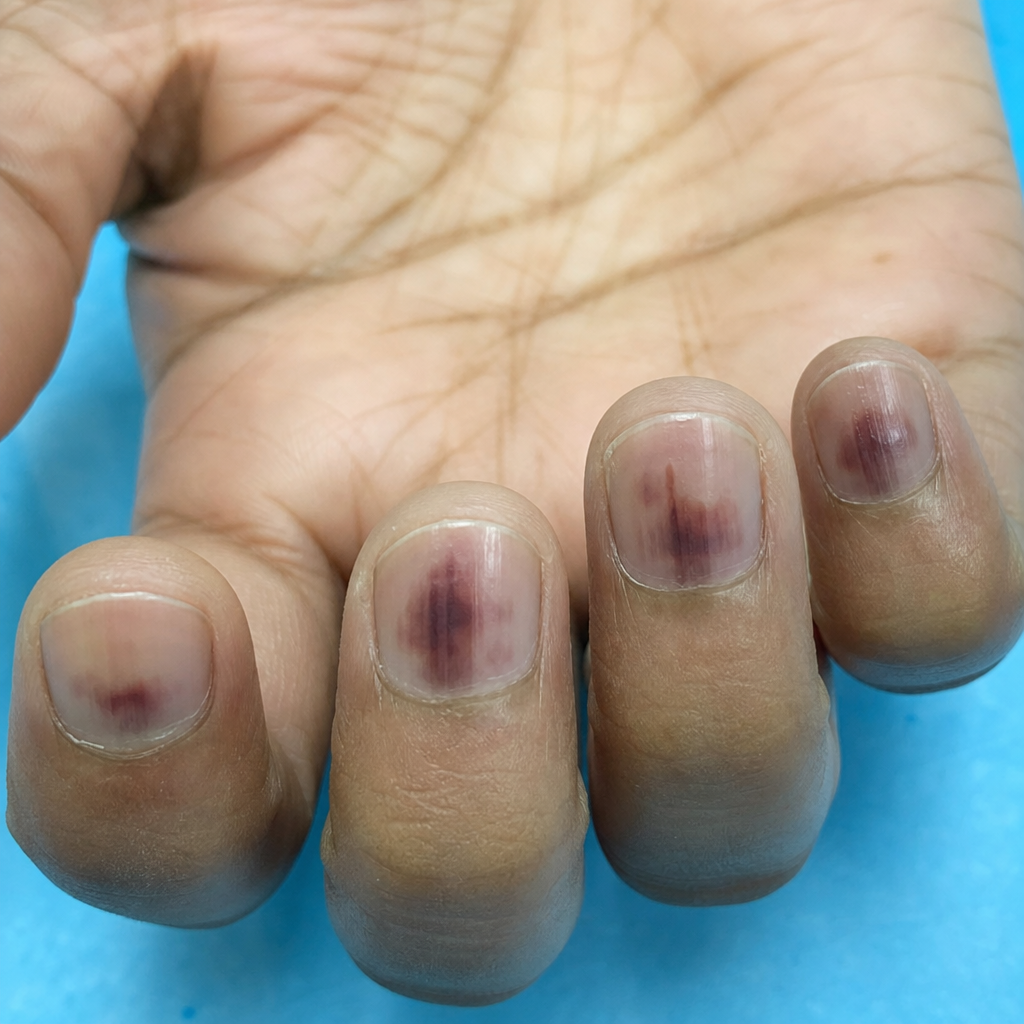
A 35-year-old woman with a medical history significant for asthma, hypertension, and occasional IV drug use comes to the emergency department with fever. On physical exam, there are findings depicted in figure A, for which the patient cannot account. What test will be most helpful to establish the diagnosis?
A 75-year-old man comes to the physician because of a 4-month history of progressive shortness of breath and chest pressure with exertion. Cardiac examination shows a crescendo-decrescendo systolic murmur that is heard best in the second right intercostal space. Radial pulses are decreased and delayed bilaterally. Transesophageal echocardiography shows hypertrophy of the left ventricle and a thick, calcified aortic valve. The area of the left ventricular outflow tract is 30.6 mm2. Using continuous-wave Doppler measurements, the left ventricular outflow tract velocity is 1.0 m/s, and the peak aortic valve velocity is 3.0 m/s. Which of the following values most closely represents the area of the stenotic aortic valve?
Want unlimited practice?
Get full access to all questions, explanations, and performance tracking.
Scan to download app