
Kidneys and suprarenal glands — MCQs

A 19-year-old man presents to the emergency department after a motor vehicle accident. The patient reports left shoulder pain that worsens with deep inspiration. Medical history is significant for a recent diagnosis of infectious mononucleosis. His temperature is 99°F (37.2°C), blood pressure is 80/55 mmHg, pulse is 115/min, and respiratory rate is 22/min. On physical exam, there is abdominal guarding, abdominal tenderness in the left upper quadrant, and rebound tenderness. The patient’s mucous membranes are dry and skin turgor is reduced. Which of the following most likely represents the acute changes in renal plasma flow (RPF) and glomerular filtration rate (GFR) in this patient?
A 20-year-old man is brought to the emergency room for evaluation of a back injury sustained while at work. A CT scan of the lumbar spine shows an incidental 2-cm mass adjacent to the inferior vena cava. Histologic examination of a biopsy specimen of the mass shows clusters of chromaffin cells. This mass is most likely to secrete which of the following substances?
A 45-year-old female is undergoing renal transplantation for management of chronic renal failure secondary to glomerulonephritis. The transplant surgeon placed the donor kidney in the recipient and anastomosed the donor renal artery to the recipient's external iliac artery as well as the donor ureter to the recipient's bladder. After removing the clamps on the external iliac artery, the recipient's blood is allowed to perfuse the transplanted kidney. Within 3 minutes, the surgeon notes that the kidney does not appear to be sufficiently perfused. Upon further investigation, an inflammatory reaction is noted that led to clotting off of the donor renal artery, preventing blood flow to the transplanted organ. Which of the following best describes the pathophysiology of this complication?
An 11-year-old girl is brought to the office by her mother due to complaint of intermittent and severe periumbilical pain for 1 day. She does not have any significant past medical history. She provides a history of a recent school trip to the suburbs. On physical examination, there is a mild tenderness around the umbilicus without any distension or discharge. There is no rebound tenderness. Bowel sounds are normal. An abdominal imaging shows enlarged mesenteric lymph nodes, and she is diagnosed with mesenteric lymphadenitis. However, incidentally, a mass of tissue was seen joining the inferior pole of both kidneys as shown in the image. Which of the following best describes this renal anomaly?
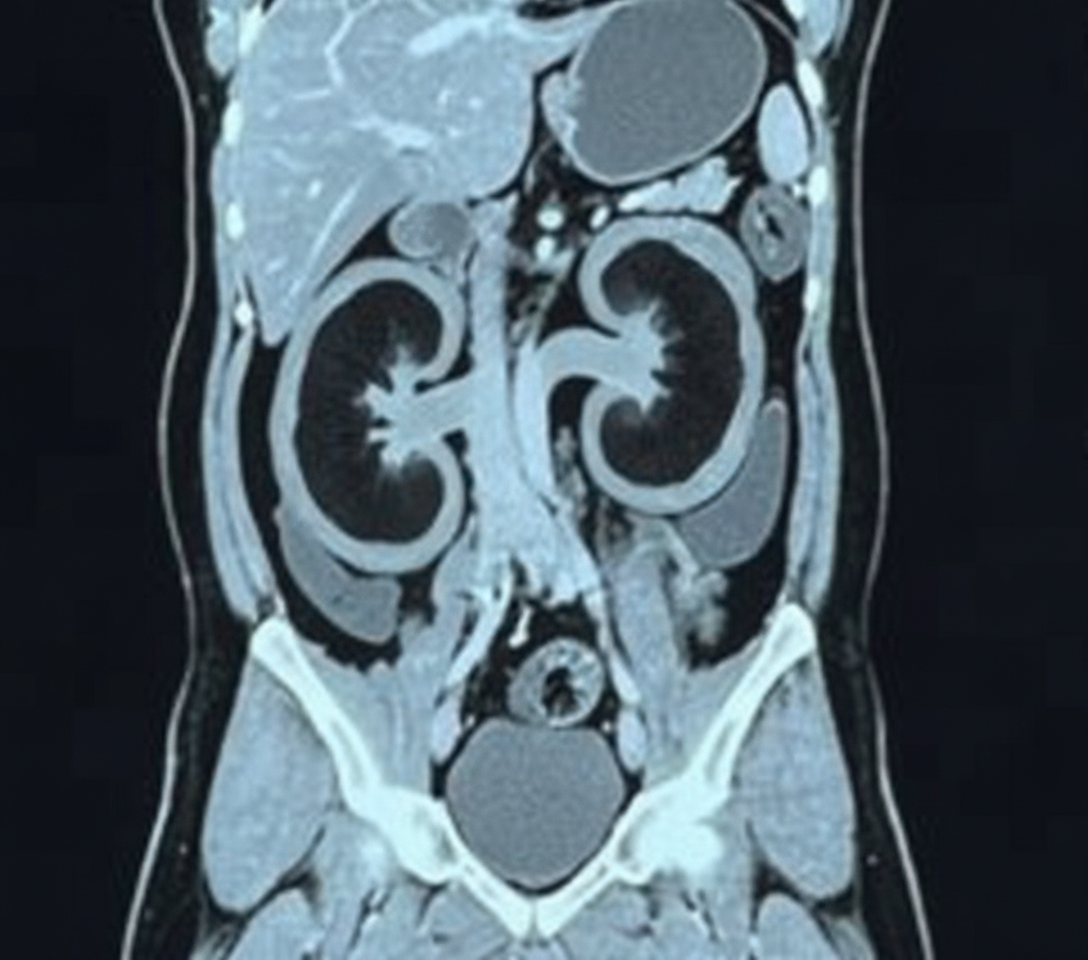
A 37-year-old woman presents to the Emergency Department after 8 hours of left sided flank pain that radiates to her groin and pelvic pain while urinating. Her medical history is relevant for multiple episodes of urinary tract infections, some requiring hospitalization, and intravenous antibiotics. In the hospital, her blood pressure is 125/83 mm Hg, pulse of 88/min, a respiratory rate of 28/min, and a body temperature of 36.5°C (97.7°F). On physical examination, she has left costovertebral tenderness and lower abdominal pain. Laboratory studies include a negative pregnancy test, mild azotemia, and a urinary dipstick that is positive for blood. Which of the following initial tests would be most useful in the diagnosis of this case?
A 2-day-old infant dies of severe respiratory distress following a gestation complicated by persistent oligohydramnios. Upon examination at autopsy, the left kidney is noted to selectively lack cortical and medullary collecting ducts. From which of the following embryological structures do the cortical and medullary collecting ducts arise?
A 42-year-old man comes to the physician for a health maintenance examination. He has had generalized fatigue and muscle aches since his previous visit 6 months ago. He has hypertension and gastroesophageal reflux disease. Current medications include amlodipine and omeprazole. His temperature is 37.1°C (98.1°F), pulse is 88/min and blood pressure is 156/102 mm Hg. Physical examination shows no abnormalities. Serum studies show: Na+ 143 mEq/L K+ 2.3 mEq/L Cl- 100 mEq/L HCO3- 31 mEq/L Urea nitrogen 14 mg/dL Creatinine 1 mg/dL His blood pressure medication is discontinued. One week later his plasma aldosterone concentration is 35 ng/dL (N=3.6 - 24.0 ng/dL) and plasma renin activity is 0.4 ng/mL/h (N=0.3 to 4.2 ng/mL/h). An oral sodium loading test over 3 days fails to reduce aldosterone. A contrast-enhanced CT scan of the abdomen and pelvis shows a 3-cm, homogenous, right-sided adrenal mass with rapid contrast washout. He is counseled about his treatment options and chooses to pursue surgery. Which of the following is the most appropriate next step in management?
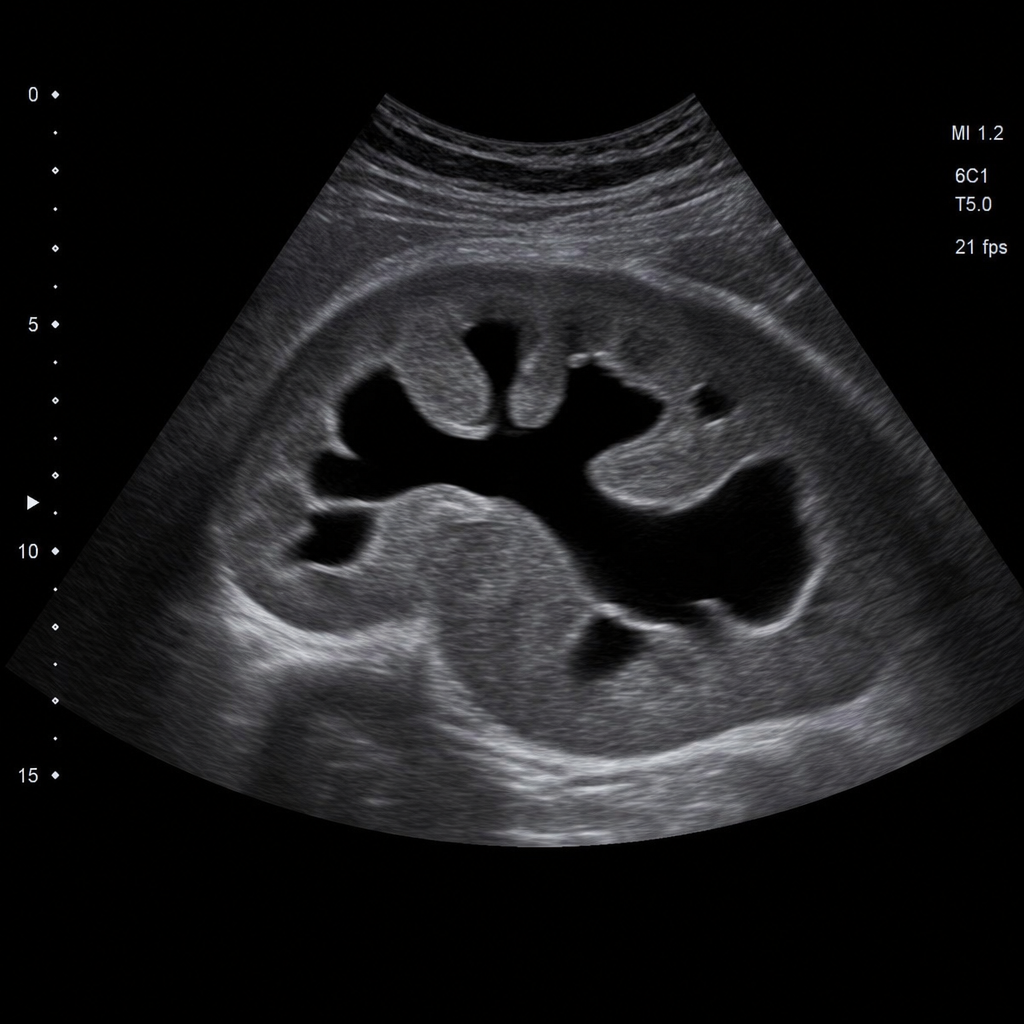
An 87-year-old man comes to the physician because of progressive involuntary urine dribbling over the past two years. He has to use the restroom more frequently than he used to and feels like he cannot fully empty his bladder. Physical examination shows a palpable suprapubic mass. An ultrasound image of the left kidney is shown. Which of the following is the most likely explanation of this patient's imaging findings?
A researcher is investigating the blood supply of the adrenal gland. While performing an autopsy on a patient who died from unrelated causes, he identifies a vessel that supplies oxygenated blood to the inferior aspect of the right adrenal gland. Which of the following vessels most likely gave rise to the vessel in question?
A 63-year-old man comes to the physician because of a 1-month history of difficulty swallowing, low-grade fever, and weight loss. He has smoked one pack of cigarettes daily for 30 years. An esophagogastroduodenoscopy shows an esophageal mass just distal to the upper esophageal sphincter. Histological examination confirms the diagnosis of locally invasive squamous cell carcinoma. A surgical resection is planned. Which of the following structures is at greatest risk for injury during this procedure?
Want unlimited practice?
Get full access to all questions, explanations, and performance tracking.
Scan to download app