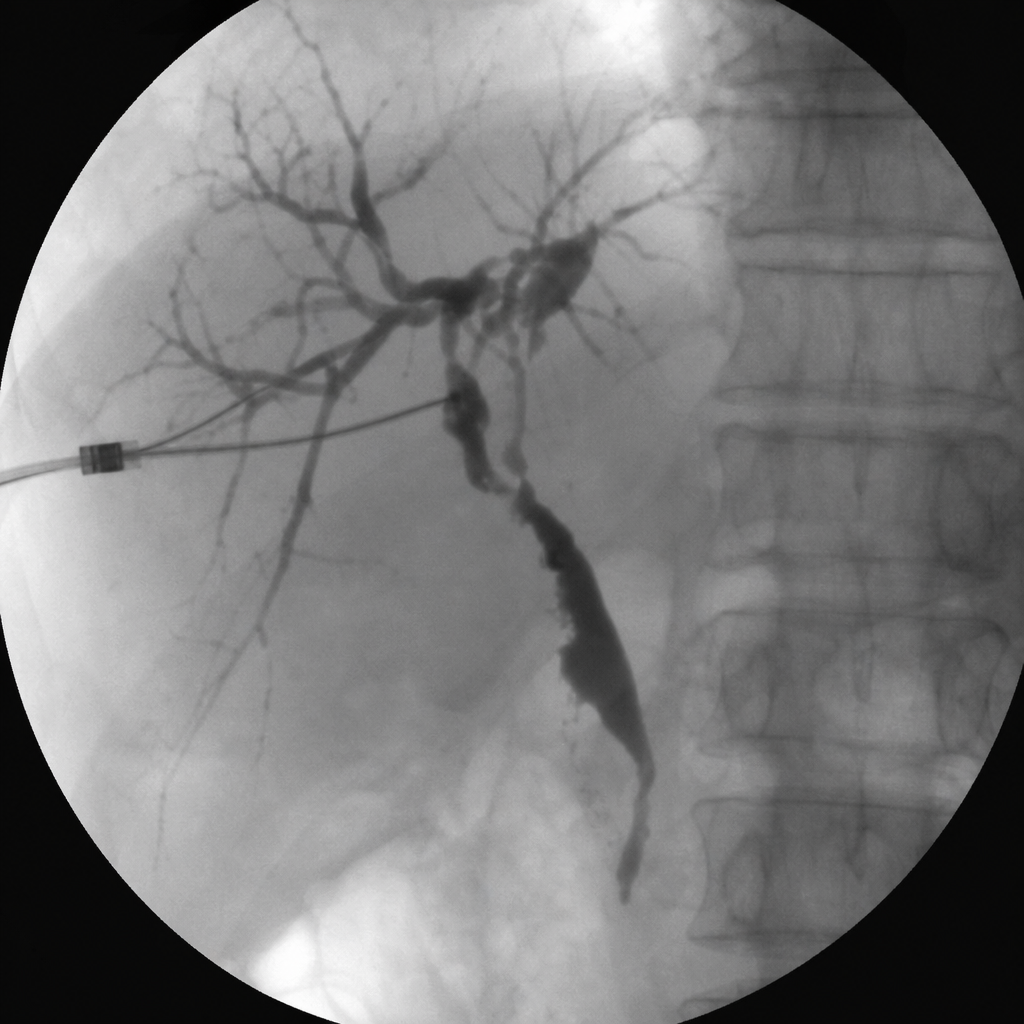
A 30-year-old female presents with sterile pyuria. The radiograph below is provided. What is the most likely diagnosis?

A patient presents with abdominal distension. Based on the X-ray, which of the following bowel loops are dilated?

Identify the condition based on the non-contrast CT scan of a patient given below.

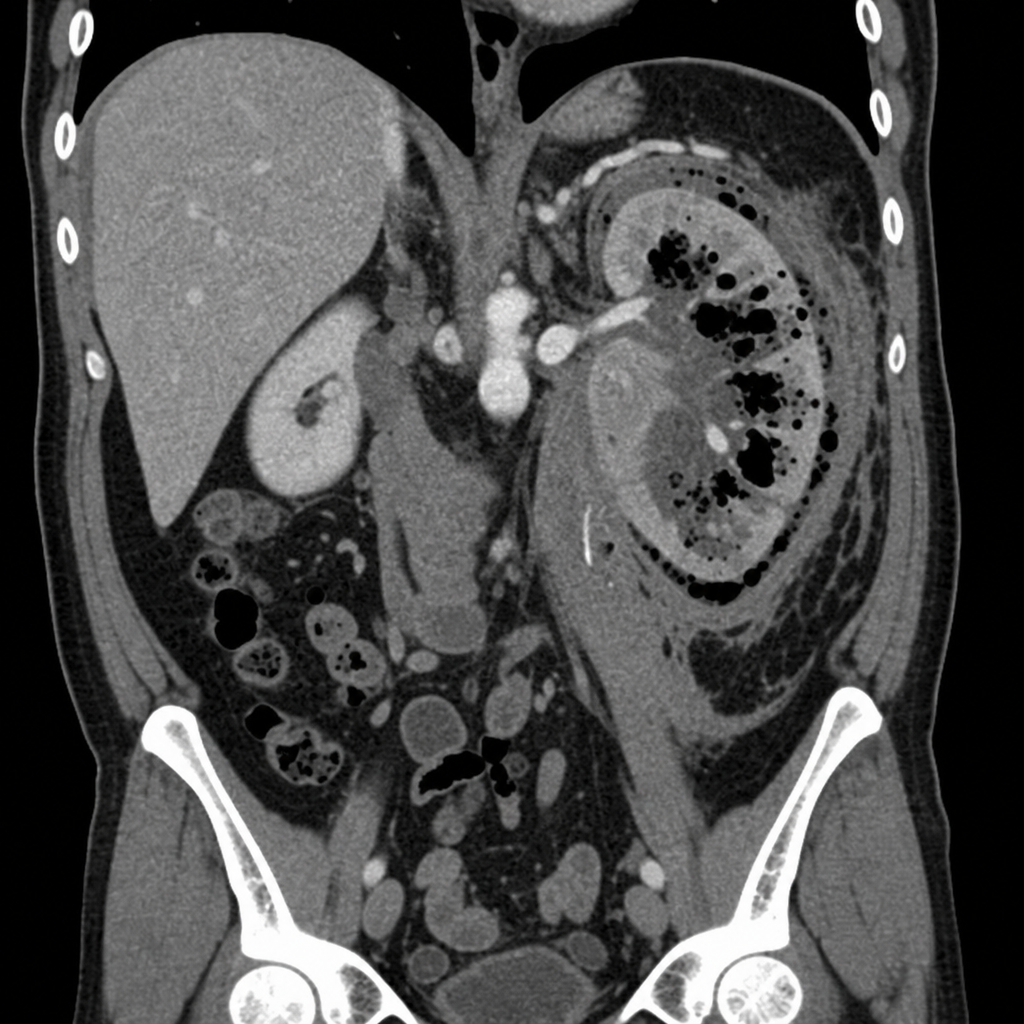
A 45-year-old patient presented with vague abdominal pain. On USG, he was found to have a renal cyst of Bosniak class III. CECT was done, as shown below. What imaging modality is shown?

One of the following is characterised by RIM sign?
The best investigation for air in the peritoneal cavity is:
In which of the following conditions is the lead pipe appearance of the colon seen on a barium enema?
In which of the following conditions is air under both sides of diaphragm visualized -
Gas absent from intestine (gasless abdomen) on x-ray is seen in which condition?
What is the characteristic feature of hepatocellular carcinoma on triphasic CT?
Explanation: ***Putty Kidney*** - The image visible in the question shows a **caseous calcification** of the renal parenchyma, which is characteristic of a "putty kidney," a late manifestation of **renal tuberculosis**. - **Sterile pyuria** is commonly associated with renal tuberculosis, where Mycobacterium tuberculosis infection leads to chronic inflammation and granuloma formation in the kidney, eventually resulting in caseous necrosis and calcification. *Psoas Calcification* - This typically refers to calcification within the **psoas muscle**, which would appear as a linear or amorphous calcification along the path of the muscle, an appearance not consistent with the image. - While psoas abscesses can calcify, they would not manifest as widespread renal parenchymal calcification and are not specifically linked to sterile pyuria in this manner. *Staghorn Calculus* - A **staghorn calculus** is a large, branched kidney stone that fills all or part of the renal pelvis and calyces, resembling the antlers of a stag. - While these stones are composed of mineral salts and would be radiopaque, their morphology is distinctly different from the diffuse, caseous calcification seen in the image. *Nephrocalcinosis* - **Nephrocalcinosis** is a condition characterized by diffuse microcalcifications throughout the renal parenchyma, usually affecting the tubules. - The calcifications in the provided image appear more nodular and clustered, consistent with late-stage tuberculous caseous necrosis, rather than the fine, diffuse pattern of nephrocalcinosis.
Explanation: ***Jejunum*** - The image shows dilated small bowel loops with prominent **valvulae conniventes** (also known as plicae circulares), which are characteristic of the jejunum. - These folds are typically closely spaced and extend across the entire lumen, giving a "coiled spring" or "stack of coins" appearance on plain radiographs when dilated. *Duodenum* - While the duodenum is part of the small bowel, it is the most proximal segment and typically not as diffusely involved in generalized small bowel dilation as the jejunum and ileum unless the obstruction is very high. - The valvulae conniventes in the duodenum are less prominent and more sparsely distributed compared to the jejunum. *Transverse colon* - The transverse colon is part of the large intestine and would show **haustra**, which are sacculations that do not extend across the entire lumen and are typically more widely spaced than valvulae conniventes. - The dilated loops in the image clearly show mucosal folds that span the entire width of the bowel. *Ileum* - The ileum also has valvulae conniventes, but they are less prominent and more sparsely distributed than in the jejunum. - In cases of small bowel obstruction or dilation, the jejunum characteristically shows more distinct and closely packed valvulae conniventes, making it the most identifiable segment in this image.
Explanation: ***Hydatid cyst*** - The image distinctly shows a **large, well-defined cyst with internal septations**, consistent with the daughter cysts and collapsed membranes within a hydatid cyst (the "**water lily sign**"). - The thick, often calcified wall surrounding the lesion is a characteristic feature often seen in **Echinococcus granulosa** infection. *Hepatocellular carcinoma* - **Hepatocellular carcinoma (HCC)** typically appears as a **solid, enhancing mass** (especially on contrast-enhanced CT) and does not usually present with clearly defined internal septations or "water lily" sign on non-contrast imaging. - While HCC can show necrosis, it does not form the characteristic cystic structure seen here. *Liver abscess* - A **liver abscess** would typically appear as a ill-defined, fluid-filled lesion that may have a rim of enhancement on contrast CT, but it generally lacks the **distinct internal septations** or daughter cysts characteristic of a hydatid cyst. - Abscesses are often associated with signs of infection like fever and elevated inflammatory markers. *Fibronodular hyperplasia* - **Focal nodular hyperplasia (FNH)** is a benign liver lesion characterized by a central scar and is typically **isodense or slightly hypodense** to the liver parenchyma on non-contrast CT. - It does not present as a cystic lesion with internal daughter cysts or calcified walls.
Explanation: ***CT scan*** - The image provided is an **axial view** showing internal organs with different densities, characteristic of a **Computed Tomography (CT) scan**. - A CT scan uses X-rays and computer processing to create detailed cross-sectional images of the body. *Contrast Dye study* - A contrast dye study typically refers to the **administration of a contrast agent** to enhance visibility of structures in imaging, it is not an imaging modality itself but an adjunct. - While a CECT (Contrast-Enhanced CT) was mentioned in the clinical scenario, "Contrast Dye study" alone doesn't describe the image type. *Angiography* - **Angiography** is a specialized imaging technique used to visualize blood vessels, typically involving the injection of contrast media. - The image provided shows **parenchymal structures** like the liver and kidneys, not just blood vessels, making angiography an unlikely description. *X-ray* - A general **X-ray** (radiograph) produces a 2D projection of internal structures and does not provide the detailed cross-sectional view seen in this image. - X-rays are typically less sensitive for soft tissue differentiation compared to a CT scan.
Explanation: ***Hydronephrosis (Gross)*** - The **RIM sign** refers to the visualization of a thick, echogenic rim of compressed renal parenchyma surrounding a dilated collecting system, a characteristic finding in gross hydronephrosis on imaging. - This sign indicates significant **urine outflow obstruction**, leading to the accumulation of urine and subsequent dilation of the renal pelvis and calyces. *Polycystic kidney* - Characterized by the presence of numerous **cysts of varying sizes** throughout the renal parenchyma, which are typically anechoic (fluid-filled) structures. - Does not typically present with a "RIM sign" as the primary imaging feature; instead, the parenchyma is replaced by cysts. *Chronic pyelonephritis* - Involves scarring and focal or diffuse cortical thinning of the kidney, often with blunted calyces, a finding known as **clubbing of calyces**. - The imaging features are primarily related to **cortical atrophy** and scarring, not a distinct RIM sign around a dilated system. *Hypernephroma* - Also known as **renal cell carcinoma**, it presents as a solid, often heterogeneous mass within the kidney, which can be vascular. - Imaging focuses on identifying the mass, its vascularity, and any local or distant spread, not a "RIM sign."
Explanation: ***X-ray*** - An **X-ray**, particularly an erect chest X-ray or an erect abdominal X-ray, is the **most sensitive and readily available investigation** to detect **free air under the diaphragm** (pneumoperitoneum). - This free air, indicating a perforated viscus, appears as a **Crescent-shaped lucency** shadowing the diaphragm. *USG* - While ultrasound can sometimes detect free air, it is **less sensitive and specific** than X-ray for this purpose, especially in early or small perforations. - Its utility is more in detecting other intra-abdominal pathologies like fluid collections or organomegaly. *Laparoscopy* - **Laparoscopy** is a **surgical procedure** that allows direct visualization of the peritoneal cavity. - While it can definitively identify free air and its source, it is an **invasive procedure** and not the primary diagnostic investigation for suspected pneumoperitoneum. *Laparotomy* - **Laparotomy** is an **open surgical procedure** involving a large incision to access the abdominal cavity. - It is used for definitive diagnosis and treatment, but it is **highly invasive** and not a diagnostic investigation in the initial workup for air in the peritoneal cavity.
Explanation: **Ulcerative colitis** - The **"lead pipe" appearance** on a barium enema is indicative of **loss of haustra**, foreshortening, and rigidity of the colon due to chronic inflammation and fibrosis, which are characteristic features of extensive ulcerative colitis. - This appearance reflects a smooth, tube-like colon without the normal sacculations, resulting from **mucosal damage** and subsequent scarring. *Amoebiasis* - While amoebiasis can cause colonic inflammation, it typically presents with **flask-shaped ulcers** and sometimes strictures on barium enema, not a diffuse loss of haustra leading to a "lead pipe" appearance. - The disease is more commonly associated with changes like **filling defects** or **segmental narrowing** rather than overall colonic rigidity. *Tuberculosis of the colon* - Tuberculosis of the colon often causes **strictures**, ulcerations, and sometimes **hypertrophic lesions**, particularly affecting the ileocecal region. - It does not typically result in the widespread mucosal damage and loss of haustra seen in the "lead pipe" appearance of ulcerative colitis, but rather **focal deformities**. *Crohn's involvement of the colon* - Crohn's disease is characterized by a **"cobblestoned" appearance** due to deep ulcerations and transmural inflammation, skip lesions, and **fistulae**. - While it can cause strictures and bowel wall thickening, the diffuse loss of haustra leading to the "lead pipe" sign is more specific to **ulcerative colitis**, which primarily affects the mucosa.
Explanation: ***Perforation of duodenal ulcer*** - A perforated duodenal ulcer is the **most classic and common cause** of pneumoperitoneum (free air under the diaphragm). - Perforation creates a communication between the gastrointestinal tract and the peritoneal cavity, allowing **free air to escape into the abdomen**. - This free air, being less dense than surrounding tissues, rises and collects **bilaterally under the diaphragm**, creating the classic **"football sign"** or crescents of air on upright chest X-ray. - Duodenal ulcer perforation is the **most frequently tested** cause of this radiological finding in medical examinations. *Perforated Meckel's diverticulum* - A perforated Meckel's diverticulum would also allow **intraluminal gas to escape into the peritoneal cavity**, causing pneumoperitoneum. - However, this is a **much rarer condition** compared to duodenal ulcer perforation. - Meckel's diverticulum perforation occurs in only 10-30% of symptomatic cases, making it less common than duodenal ulcer perforation. - While technically correct that it would show free air, duodenal ulcer perforation is the **primary answer** due to its higher frequency. *Uterine rupture following illegal abortion* - Uterine rupture would primarily involve **blood and uterine contents** spilling into the peritoneal cavity, rather than free air. - While instrumentation during illegal abortion could potentially introduce air, significant **bilateral subdiaphragmatic free air** is not a typical or diagnostically significant finding. - The hallmark findings would be **hemoperitoneum and pelvic fluid collections**, not pneumoperitoneum. *All of the options* - This option is incorrect because uterine rupture (as explained above) typically does not cause diagnostically significant pneumoperitoneum. - While both GI perforations can cause free air, only duodenal ulcer perforation is the **classic and most common** cause being tested here.
Explanation: ***Acute pancreatitis*** - In **severe acute pancreatitis**, a **gasless or relatively gasless abdomen** may be seen due to profound **ileus** with fluid accumulation displacing intestinal gas. - The marked inflammatory process can lead to complete loss of intestinal motility and fluid sequestration (third-spacing), resulting in minimal visible bowel gas on X-ray. - **Note**: Classic signs include **sentinel loop sign** (dilated jejunal loop) or **colon cut-off sign**, but in severe cases with massive ascites or fluid collections, a gasless pattern may occur. *Ulcerative colitis* - Typically presents with **dilated loops of large bowel** with visible gas and **toxic megacolon** in severe cases. - Inflammatory changes cause bowel wall thickening, but gas is usually **present and often increased**. *Intussusception* - May show a **target sign** or **meniscus sign** on imaging, with bowel loops dilated proximal to the obstruction. - Gas is typically **present** within the bowel or proximal to the invagination, not absent from the entire abdomen. *Necrotizing enterocolitis* - Characterized by **pneumatosis intestinalis** (gas in the bowel wall) and **portal venous gas**, features directly contradicting a gasless abdomen. - Shows dilated loops with gas and evidence of bowel wall necrosis - **gas is prominently present**.
Explanation: ***Arterial enhancement with washout*** - **Hepatocellular carcinoma (HCC)** classically demonstrates **hyperenhancement** in the arterial phase due to its unique blood supply primarily from the **hepatic artery**. - This is followed by a characteristic **rapid "washout"** of contrast in the portal venous or delayed phases, as the tumor lacks normal portal venous supply and functional bile ducts. *No enhancement* - Lack of enhancement would suggest a **necrotic lesion** or a **benign cyst** rather than a primary malignant tumor like HCC. - This feature is not typical for a viable HCC on a triphasic CT scan. *Delayed enhancement* - **Delayed enhancement** is more typical of **fibrotic lesions** or some benign hepatic masses like **hemangiomas**, which continue to fill in with contrast over time. - It does not show the typical rapid arterial hyperenhancement and washout pattern of HCC. *Progressive enhancement* - **Progressive enhancement** is characteristic of entities like **hepatic hemangiomas**, which show gradual, often nodular, enhancement that follows the blood pool on delayed phases. - This pattern is distinct from the rapid arterial enhancement and subsequent washout seen in HCC.
Imaging of Liver
Practice Questions
Biliary Tract Imaging
Practice Questions
Pancreatic Imaging
Practice Questions
Spleen and Lymphatic System
Practice Questions
Gastrointestinal Tract Imaging
Practice Questions
Renal and Urinary Tract Imaging
Practice Questions
Adrenal Imaging
Practice Questions
Female Pelvic Imaging
Practice Questions
Male Pelvic Imaging
Practice Questions
Abdominal Trauma Imaging
Practice Questions
Acute Abdomen Imaging
Practice Questions
Imaging of Peritoneal Cavity and Retroperitoneum
Practice Questions
Get full access to all questions, explanations, and performance tracking.
Start For Free