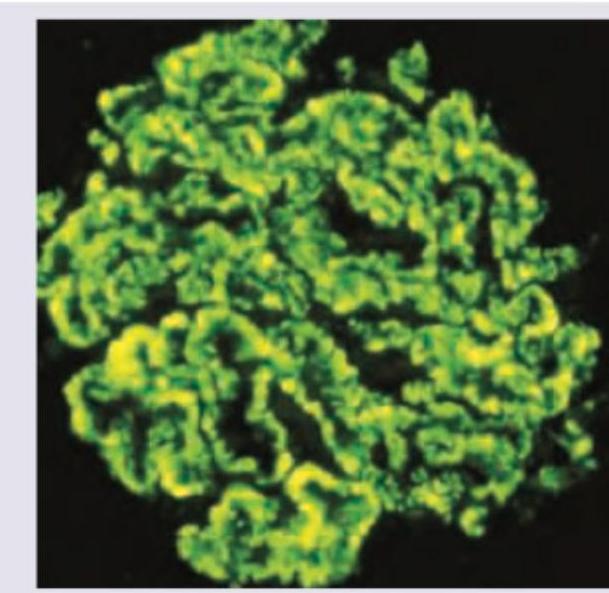
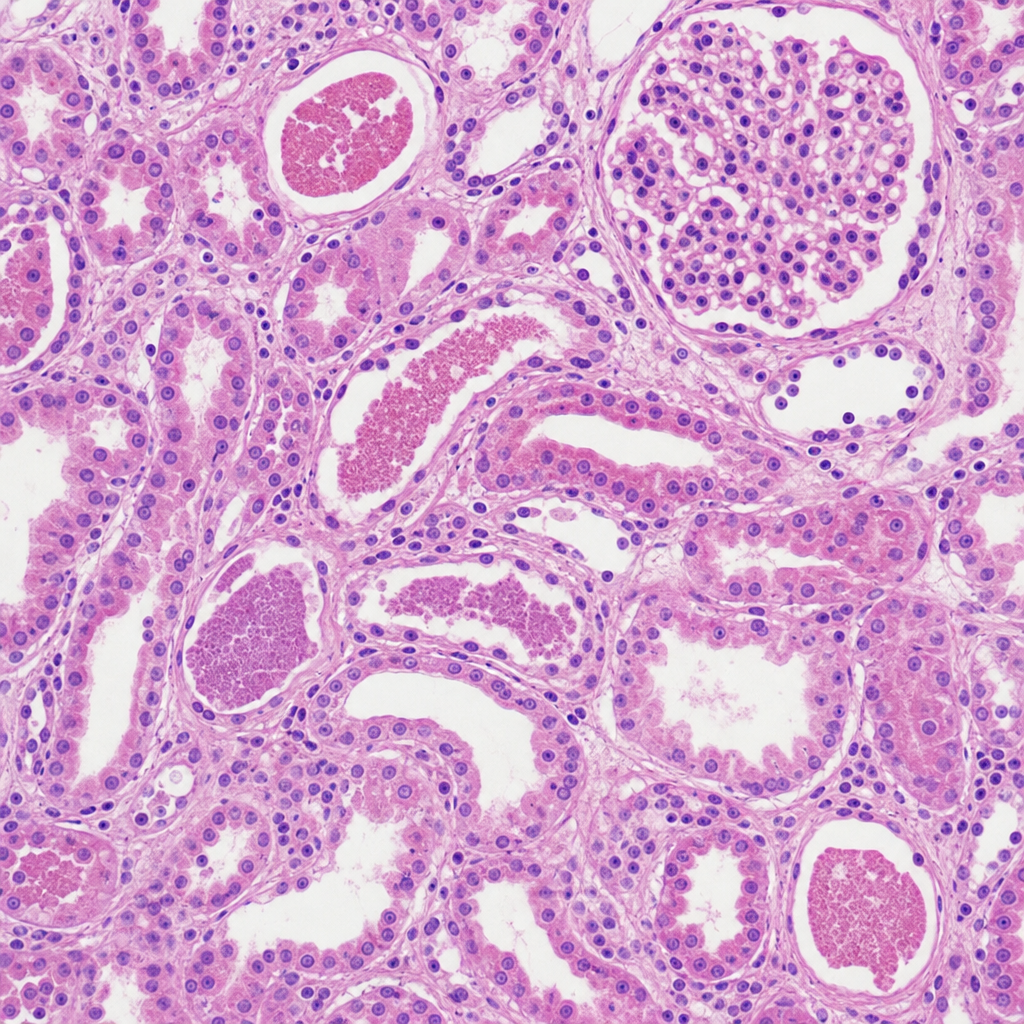
Minimal change disease is caused by which of the following?
Most unlikely cause of acute tubular necrosis amongst the following is?
A 19-year-old woman presents with swelling of her eyelids, abdomen, and ankles. She has pitting edema in her legs where her socks elastic was. A chest X-ray reveals bilateral pleural effusions, and urine protein electrophoresis shows 4+ proteinuria. A percutaneous kidney biopsy confirms the diagnosis of minimal change nephrotic syndrome. What is the most likely mechanism of soft tissue edema in this patient?
An 8-year-old boy presents with headaches, dizziness, and malaise. He was seen for a severe sore throat 2 weeks ago. Physical examination reveals facial edema. The blood pressure is 180/110 mm Hg. A 24-hour urine collection demonstrates oliguria, and urinalysis shows hematuria. What finding on microscopic urinalysis indicates that hematuria in the patient is caused by a renal process, rather than bleeding from another site in the urinary tract?
Which of the following is NOT true about Alport syndrome?
Which type of glomerulonephritis is characterized by crescent formation?
Which of the following is NOT seen in SLE nephropathy?
Necrotizing papillitis may be seen in all of the following conditions except?
A 15-year-old male presents with hematuria. He has previous diagnoses of deafness and corneal dystrophy. Urinalysis shows 1+ protein, no ketones, no glucose, 1+ blood, and no leukocytes. A renal biopsy reveals tubular epithelial foam cells by light microscopy. By electron microscopy, the glomerular basement membrane shows areas of attenuation, with splitting and lamination of the lamina densa in other thickened areas. What is the most probable diagnosis?
Which carcinoma is most commonly associated with metastasis to the Inferior Vena Cava (IVC)?
Explanation: **Explanation:** Minimal Change Disease (MCD) is the most common cause of nephrotic syndrome in children [1, 2], but it can also occur in adults, often secondary to specific triggers. The underlying pathophysiology involves **T-cell dysfunction** leading to the production of a "glomerular permeability factor" (like IL-13 or angiopoietin-like protein 4). This factor causes the **effacement of podocyte foot processes** [1, 3], resulting in massive proteinuria. While most cases are idiopathic, secondary MCD can be induced by various drugs and systemic conditions: 1. **IFN-α (Interferon-alpha):** Frequently associated with the development of MCD and Focal Segmental Glomerulosclerosis (FSGS) through direct podocyte injury or immune modulation. 2. **NSAIDs and Antibiotics:** **Rifampicin** and NSAIDs are well-documented triggers for MCD, often presenting concurrently with Acute Interstitial Nephritis (AIN). 3. **Gold Salts and Penicillamine:** While more classically associated with Membranous Nephropathy, these agents are also recognized causes of MCD in some patients. 4. **Lithium and Pamidronate:** Other high-yield drugs associated with podocyte injury. **Clinical Pearls for NEET-PG:** * **Light Microscopy:** Glomeruli appear completely **normal** (hence "Minimal Change") [3]. * **Electron Microscopy (Gold Standard):** Shows characteristic **effacement (fusion) of podocyte foot processes** [1, 3]. * **Immunofluorescence:** Negative (no immune complex deposits) [1]. * **Associated Malignancy:** **Hodgkin Lymphoma** is the most common systemic malignancy associated with MCD. * **Treatment:** Highly responsive to **Corticosteroids** (Steroid-sensitive) [1, 3]. **References:** [1] Kumar V, Abbas AK, et al.. Robbins and Cotran Pathologic Basis of Disease. 9th ed. The Kidney, pp. 927-928. [2] Kumar V, Abbas AK, et al.. Robbins and Cotran Pathologic Basis of Disease. 9th ed. The Kidney, pp. 919-921. [3] Kumar V, Abbas AK, et al.. Robbins and Cotran Pathologic Basis of Disease. 9th ed. The Kidney, pp. 922-923.
Explanation: Acute Tubular Necrosis (ATN) is the most common cause of acute kidney injury (AKI). It results from either **ischemic** or **nephrotoxic** injury to the renal tubular epithelial cells [2, 3]. **Why Rupture of Aortic Aneurysm is the correct (unlikely) answer:** While a ruptured aortic aneurysm causes massive hemorrhage and hypotension, it typically leads to **acute cortical necrosis** rather than ATN. Acute cortical necrosis is a more severe, irreversible form of renal injury characterized by ischemic destruction of both the tubules and the glomeruli, usually seen in catastrophic systemic events like abruptio placentae or massive exsanguination. **Analysis of Incorrect Options:** * **Severe Bacterial Infection (Sepsis):** This is a leading cause of ATN. It induces systemic vasodilation and intrarenal hemodynamic changes, leading to decreased renal perfusion and ischemic ATN [1]. * **Massive Burn:** Burns lead to severe hypovolemia (fluid loss) and potential hemoglobinuria, both of which are classic triggers for ischemic and pigment-induced ATN. * **Severe Crush Injury:** This causes **Rhabdomyolysis**. The release of massive amounts of myoglobin is directly toxic to the tubules and forms obstructing casts, a classic cause of nephrotoxic ATN [3]. **High-Yield Clinical Pearls for NEET-PG:** * **Morphology:** The most sensitive parts of the nephron to ischemia are the **Proximal Convoluted Tubule (PCT)** and the **Thick Ascending Limb (TAL)** [3]. * **Urinary Findings:** Look for **"Muddy brown" granular casts** in the urine sediment. * **Key Distinction:** Ischemic ATN shows "patchy" tubular necrosis, whereas Toxic ATN (e.g., Mercury, Ethylene glycol) often shows "extensive/diffuse" necrosis, particularly in the PCT [3]. **References:** [1] Cross SS. Underwood's Pathology: A Clinical Approach. 6th ed. (Basic Pathology) introduces the student to key general principles of pathology, both as a medical science and as a clinical activity with a vital role in patient care. Part 2 (Disease Mechanisms) provides fundamental knowledge about the cellular and molecular processes involved in diseases, providing the rationale for their treatment. Part 3 (Systematic Pathology) deals in detail with specific diseases, with emphasis on the clinically important aspects., pp. 149-150. [2] Kumar V, Abbas AK, et al.. Robbins and Cotran Pathologic Basis of Disease. 9th ed. The Kidney, p. 933. [3] Kumar V, Abbas AK, et al.. Robbins and Cotran Pathologic Basis of Disease. 9th ed. The Kidney, pp. 933-934.
Explanation: ### Explanation The patient presents with classic features of **Nephrotic Syndrome** (Minimal Change Disease), characterized by massive proteinuria (4+), generalized edema (anasarca), and pleural effusions. **Why the correct answer is right:** The primary mechanism of edema in nephrotic syndrome is **decreased intravascular oncotic pressure** [1]. 1. **Proteinuria:** Damage to the glomerular filtration barrier (podocyte effacement) leads to massive loss of albumin in the urine [2]. 2. **Hypoalbuminemia:** As the liver cannot compensate for the urinary loss, serum albumin levels drop [1]. 3. **Starling Forces:** Albumin is the main determinant of plasma colloid oncotic pressure, which keeps fluid inside the vessels. When this pressure decreases, the opposing hydrostatic pressure forces fluid out of the capillaries into the interstitial soft tissues, resulting in pitting edema and effusions [1], [2]. **Why the incorrect options are wrong:** * **A. Active hyperemia:** This refers to an active process where arteriolar dilation increases blood flow to a tissue (e.g., during inflammation or exercise). It causes redness and heat, not generalized pitting edema. * **B. Chronic passive congestion:** This is a "back-up" of blood due to impaired venous outflow (e.g., in Congestive Heart Failure) [2]. While it causes edema, the mechanism is increased hydrostatic pressure, not decreased oncotic pressure [2]. * **D. Hyperalbuminemia:** This would increase oncotic pressure and draw fluid *into* the vessels, preventing edema. Nephrotic syndrome is characterized by **hypo**albuminemia. **NEET-PG High-Yield Pearls:** * **Minimal Change Disease (MCD):** Most common cause of nephrotic syndrome in children; characterized by the effacement of podocyte foot processes on Electron Microscopy (EM). * **Edema Sequence:** In nephrotic syndrome, edema typically appears first in areas with low tissue pressure, such as the **periorbital region** (puffy eyelids). * **Secondary Hyperaldosteronism:** The drop in intravascular volume (due to fluid shift) activates the RAAS pathway, leading to sodium and water retention, which further exacerbates the edema [2]. **References:** [1] Cross SS. Underwood's Pathology: A Clinical Approach. 6th ed. (Basic Pathology) introduces the student to key general principles of pathology, both as a medical science and as a clinical activity with a vital role in patient care. Part 2 (Disease Mechanisms) provides fundamental knowledge about the cellular and molecular processes involved in diseases, providing the rationale for their treatment. Part 3 (Systematic Pathology) deals in detail with specific diseases, with emphasis on the clinically important aspects., pp. 126-127. [2] Kumar V, Abbas AK, et al.. Robbins and Cotran Pathologic Basis of Disease. 9th ed. Hemodynamic Disorders, Thromboembolic Disease, and Shock, pp. 124-126.
Explanation: **Explanation:** The clinical presentation of an 8-year-old boy with a recent sore throat, hypertension, edema, and hematuria is classic for **Post-Streptococcal Glomerulonephritis (PSGN)**, a type of nephritic syndrome. [1] **1. Why Red Blood Cell (RBC) Casts are correct:** RBC casts are the hallmark of **glomerular bleeding**. They form when red blood cells enter the renal tubule lumen and become trapped in a matrix of **Tamm-Horsfall protein** (secreted by the thick ascending limb). Because these casts can only form within the renal tubules, their presence in the urine sediment definitively localizes the source of hematuria to the **renal parenchyma** (specifically the glomeruli) rather than the lower urinary tract (ureters, bladder, or urethra). [1] **2. Why other options are incorrect:** * **Blood clots:** These are typically absent in glomerular disease. Their presence suggests **post-renal bleeding** (e.g., stones, tumors, or trauma in the bladder or ureters), as the urokinase in the nephron usually prevents clot formation in glomerular bleeding. [1] * **Hemoglobin crystals:** These are not a standard finding in nephritic syndrome and do not localize the site of bleeding. * **Phagocytosed hemoglobin:** While macrophages may ingest hemoglobin, this is a non-specific finding and does not differentiate between upper and lower urinary tract sources. **Clinical Pearls for NEET-PG:** * **Dysmorphic RBCs:** Along with RBC casts, the presence of acanthocytes (mickey-mouse shaped RBCs) on phase-contrast microscopy is highly suggestive of glomerular origin. * **PSGN Triad:** Hematuria (cola-colored urine), hypertension, and periorbital edema following a Group A Strep infection (1–3 weeks post-pharyngitis or 3–6 weeks post-impetigo). [1] * **Low C3:** Complement levels are characteristically low in the acute phase of PSGN. **References:** [1] Cross SS. Underwood's Pathology: A Clinical Approach. 6th ed. Common Clinical Problems From Diseases Of The Urinary And Male Genital Tracts, pp. 520-521.
Explanation: **Explanation:** Alport syndrome is a hereditary nephritis caused by mutations in the genes encoding the **Type IV collagen** alpha chains (specifically $\alpha3$, $\alpha4$, and $\alpha5$), which are essential components of the glomerular basement membrane (GBM), cochlea, and lens [1]. **Why Option B is the correct answer:** The most common inheritance pattern of Alport syndrome is **X-linked dominant (85% of cases)**, due to mutations in the *COL4A5* gene [1]. While autosomal recessive and rare autosomal dominant forms exist, the syndrome is classically defined by its X-linked nature. Therefore, stating it is primarily "Autosomal dominant" is incorrect in the context of this "Except" type question. **Analysis of other options:** * **Option A (X-linked):** This is the most common mode of inheritance (85%), making it a true statement [1]. * **Option C (Nerve deafness):** Sensorineural hearing loss (nerve deafness) is a classic extra-renal manifestation, typically manifesting in late childhood or adolescence [1]. * **Option D (Glomerulonephritis):** The disease presents as hereditary glomerulonephritis, characterized by hematuria progressing to chronic renal failure [1]. **High-Yield Clinical Pearls for NEET-PG:** * **Electron Microscopy (Gold Standard):** Shows characteristic **"Basket-weave appearance"** due to irregular thinning and thickening of the GBM with splitting of the lamina densa. * **Clinical Triad:** 1. Hereditary Nephritis (Hematuria), 2. Sensorineural Deafness, 3. Ocular defects (e.g., **Anterior Lenticonus**—pathognomonic). * **Molecular Defect:** Mutation in Type IV collagen (The "4" in Alport reminds you of Type IV collagen). * **Goodpasture Syndrome Connection:** Patients with Alport syndrome who receive a kidney transplant may develop anti-GBM antibodies against the "missing" collagen antigens in the graft. **References:** [1] Kumar V, Abbas AK, et al.. Robbins and Cotran Pathologic Basis of Disease. 9th ed. The Kidney, pp. 929-930.
Explanation: **Explanation:** **Rapidly Progressive Glomerulonephritis (RPGN)** is the correct answer because it is clinically defined by a rapid decline in renal function and histologically characterized by the presence of **crescents** in most glomeruli (usually >50%) [1]. **Pathophysiology of Crescent Formation:** Crescents are formed by the proliferation of **parietal epithelial cells** of Bowman’s capsule and the infiltration of monocytes/macrophages [1]. This process is triggered by severe glomerular capillary wall injury, which allows plasma proteins (like fibrin) to leak into Bowman’s space. Fibrin acts as the primary stimulus for this cellular proliferation [1]. **Analysis of Incorrect Options:** * **Acute Glomerulonephritis (e.g., PSGN):** Characterized by hypercellularity due to endothelial and mesangial cell proliferation and neutrophil infiltration ("starry sky" appearance on IF), but crescents are rare unless the disease is exceptionally severe [5]. * **Membranous Glomerulonephritis:** Characterized by diffuse thickening of the glomerular capillary wall due to subepithelial deposits, showing a "spike and dome" pattern. It does not typically involve crescent formation. * **Membranoproliferative Glomerulonephritis (MPGN):** Characterized by a "tram-track" appearance due to basement membrane splitting. While it involves mesangial proliferation, it is not a primary crescentic disease [3]. **NEET-PG High-Yield Pearls:** * **Classification of RPGN:** * **Type I:** Anti-GBM disease (e.g., Goodpasture syndrome); Linear IF [4]. * **Type II:** Immune-complex mediated (e.g., SLE, PSGN); Granular IF. * **Type III:** Pauci-immune (e.g., Wegener’s/GPA, Microscopic polyangiitis); Negative IF, associated with ANCA [2]. * **Key Histology:** Fibrin is the most important component within the crescent [1]. * **Clinical Sign:** RPGN often presents as "Nephritic Syndrome" progressing to acute renal failure within weeks [4]. **References:** [1] Cross SS. Underwood's Pathology: A Clinical Approach. 6th ed. Common Clinical Problems From Diseases Of The Urinary And Male Genital Tracts, pp. 528-529. [2] Kumar V, Abbas AK, et al.. Robbins and Cotran Pathologic Basis of Disease. 9th ed. The Kidney, pp. 917-918. [3] Kumar V, Abbas AK, et al.. Robbins and Cotran Pathologic Basis of Disease. 9th ed. The Kidney, pp. 925-926. [4] Cross SS. Underwood's Pathology: A Clinical Approach. 6th ed. Common Clinical Problems From Diseases Of The Urinary And Male Genital Tracts, pp. 537-538. [5] Kumar V, Abbas AK, et al.. Robbins and Cotran Pathologic Basis of Disease. 9th ed. The Kidney, pp. 916-917.
Explanation: **Explanation:** The correct answer is **Lipoid nephrosis** (Option A). Systemic Lupus Erythematosus (SLE) is a multisystem autoimmune disease characterized by the deposition of immune complexes in the glomeruli [3]. The WHO/ISN classification of Lupus Nephritis (LN) categorizes these patterns based on the site and extent of immune deposition. **Why Lipoid Nephrosis is the correct answer:** Lipoid nephrosis, also known as **Minimal Change Disease (MCD)**, is characterized by the effacement of podocyte foot processes without immune complex deposition [1]. It is typically a primary cause of nephrotic syndrome in children and is **not** a recognized feature or class of Lupus Nephritis [1][2]. **Analysis of other options (ISN/RPS Classification of Lupus Nephritis):** * **Class III: Focal Glomerulonephritis (Option B):** Involves less than 50% of glomeruli [4]. It presents with hematuria and proteinuria. * **Class IV: Diffuse Glomerulonephritis (Option C):** The **most common and most severe** form, involving more than 50% of glomeruli [4]. It typically shows "wire-loop" lesions on light microscopy [4]. * **Class V: Membranous Glomerulonephritis (Option D):** Characterized by subepithelial immune deposits and diffuse thickening of the glomerular capillary wall, leading to nephrotic-range proteinuria [2][3]. **High-Yield Clinical Pearls for NEET-PG:** * **Most Common Class:** Class IV (Diffuse Proliferative LN) [4]. * **Best Prognosis:** Class I (Minimal Mesangial LN). * **Worst Prognosis:** Class IV [4]. * **Wire-loop lesions:** Characteristic of Class IV (due to massive subendothelial deposits) [4]. * **Full House Pattern:** Immunofluorescence showing positivity for IgG, IgA, IgM, C3, and C1q is highly suggestive of SLE [3]. * **Hematoxylin Bodies (LE bodies):** The only pathognomonic finding for SLE in the kidney. **References:** [1] Kumar V, Abbas AK, et al.. Robbins and Cotran Pathologic Basis of Disease. 9th ed. The Kidney, pp. 927-928. [2] Kumar V, Abbas AK, et al.. Robbins and Cotran Pathologic Basis of Disease. 9th ed. The Kidney, pp. 919-921. [3] Cross SS. Underwood's Pathology: A Clinical Approach. 6th ed. Common Clinical Problems From Diseases Of The Urinary And Male Genital Tracts, pp. 532-533. [4] Kumar V, Abbas AK, et al.. Robbins and Cotran Pathologic Basis of Disease. 9th ed. Diseases of the Immune System, pp. 230-232.
Explanation: ### Explanation **Necrotizing Papillitis** (Renal Papillary Necrosis) is a form of nephropathy involving ischemic necrosis of the renal papillae [1]. The renal papillae are particularly vulnerable to ischemia because they are located at the distal end of the renal blood supply (the vasa recta), which operates in a relatively hypoxic environment. #### Why Tuberculous Pyelonephritis is the Correct Answer: While **Tuberculosis (TB)** of the kidney causes extensive tissue destruction, it typically results in **caseous necrosis** and "putty kidney" rather than the specific clinical entity of necrotizing papillitis. In TB, the destruction is chronic and granulomatous, often leading to cavitation and strictures, whereas necrotizing papillitis is characterized by acute or subacute ischemic infarction of the papillae. #### Analysis of Other Options (Causes of Papillary Necrosis): The mnemonic **"POSTCARDS"** is often used to remember the causes, with the most common being: * **Diabetes Mellitus (Option C):** The most common cause [1], [3]. It involves a combination of ischemia (due to diabetic microangiopathy) and increased susceptibility to infection (acute pyelonephritis). * **Analgesic Nephropathy (Option D):** Chronic use of Phenacetin or Aspirin inhibits vasodilatory prostaglandins, leading to chronic ischemia of the vasa recta [4]. * **Sickle Cell Disease/Trait (Option A):** Sickling of RBCs in the hypoxic, hypertonic medulla causes microthrombosis and infarction of the papillae [2]. * **Obstructive Uropathy:** Increased intratubular pressure compromises blood flow to the papillae [1], [3]. #### NEET-PG High-Yield Pearls: * **Clinical Presentation:** Often presents with gross hematuria, flank pain (due to sloughed papillae obstructing the ureter), and features of UTI [1]. * **Radiology:** The **"Ring Shadow"** sign on intravenous pyelogram (IVP) is characteristic, representing the sloughed necrotic papilla surrounded by contrast. * **Most common cause overall:** Diabetes Mellitus [1]. * **Most common cause in children:** Dehydration or Sickle Cell Disease. **References:** [1] Cross SS. Underwood's Pathology: A Clinical Approach. 6th ed. Common Clinical Problems From Diseases Of The Urinary And Male Genital Tracts, pp. 543-544. [2] Kumar V, Abbas AK, et al.. Robbins and Cotran Pathologic Basis of Disease. 9th ed. The Kidney, pp. 948-949. [3] Kumar V, Abbas AK, et al.. Robbins and Cotran Pathologic Basis of Disease. 9th ed. The Kidney, p. 937. [4] Kumar V, Abbas AK, et al.. Robbins and Cotran Pathologic Basis of Disease. 9th ed. The Kidney, pp. 934-935.
Explanation: **Explanation:** The correct diagnosis is **Alport Syndrome**. This is a hereditary nephritis caused by mutations in the genes encoding the **α-chains of Type IV collagen** (most commonly *COL4A5*, X-linked). Type IV collagen is a crucial structural component of the glomerular basement membrane (GBM), the cochlea, and the lens of the eye. * **Why it is correct:** The clinical triad of **hereditary nephritis (hematuria), sensorineural deafness, and ocular defects** (like corneal dystrophy or anterior lenticonus) is classic for Alport syndrome [1]. The pathognomonic Electron Microscopy (EM) finding is a **"basket-weave" appearance**, characterized by irregular thickening and thinning of the GBM with **splitting and lamination of the lamina densa** [1]. The presence of **foam cells** (lipid-laden interstitial macrophages) in the tubules is a common, though non-specific, Light Microscopy finding. **Incorrect Options:** * **Acute Tubular Necrosis (ATN):** Presents with acute renal failure and "muddy brown" granular casts; it lacks the genetic triad and basement membrane splitting. * **Berger’s Disease (IgA Nephropathy):** The most common cause of gross hematuria; however, it is characterized by **mesangial IgA deposits** on immunofluorescence, not GBM splitting or deafness. * **Membranous Glomerulonephritis:** Presents primarily with nephrotic syndrome [2]. EM shows subepithelial "spikes" and uniform thickening of the GBM, not lamination [2]. **NEET-PG High-Yield Pearls:** * **Inheritance:** 80% are X-linked dominant [1]. * **EM Finding:** "Basket-weave appearance" (Splitting of lamina densa). * **Ocular Sign:** Anterior lenticonus is highly specific. * **Benign Familial Hematuria (Thin Basement Membrane Disease):** A related differential where the GBM is only thinned (no splitting) and systemic symptoms are absent [1]. **References:** [1] Kumar V, Abbas AK, et al.. Robbins and Cotran Pathologic Basis of Disease. 9th ed. The Kidney, pp. 929-930. [2] Cross SS. Underwood's Pathology: A Clinical Approach. 6th ed. Common Clinical Problems From Diseases Of The Urinary And Male Genital Tracts, pp. 531-532.
Explanation: **Renal Cell Carcinoma (RCC)**, specifically the clear cell subtype, is uniquely characterized by its tendency for **venous invasion** [1]. Unlike most carcinomas that spread primarily via lymphatics, RCC has a high propensity to invade the renal vein. From there, it can extend as a "tumor thrombus" into the **Inferior Vena Cava (IVC)** and may even reach the right atrium of the heart [1]. This hematogenous spread is a hallmark of RCC and is a critical factor in surgical staging and planning. **Analysis of Incorrect Options:** * **Small cell carcinoma of the lung:** While highly aggressive and prone to early hematogenous spread, it typically metastasizes to the brain, liver, and bones. It may cause Superior Vena Cava (SVC) syndrome via external compression, but direct endovascular extension into the IVC is not characteristic. * **Gastric adenocarcinoma:** Primarily spreads via lymphatics (e.g., Virchow’s node) or via the portal venous system to the liver. It does not typically show intraluminal extension into the IVC. * **Papillary carcinoma of the thyroid:** This is an indolent tumor that spreads predominantly via the lymphatic system to cervical lymph nodes. Hematogenous spread is rare compared to follicular thyroid carcinoma. **High-Yield Clinical Pearls for NEET-PG:** * **Triad of RCC:** Hematuria (most common), flank pain, and a palpable abdominal mass (seen in <10% of cases). * **Paraneoplastic Syndromes:** RCC is known as the "Internist's Tumor" because it produces various hormones (EPO leading to polycythemia, PTHrP leading to hypercalcemia, and Renin leading to hypertension). * **Stauffer Syndrome:** Reversible hepatic dysfunction (elevated LFTs) in the absence of liver metastases, associated with RCC. * **Left-sided Varicocele:** Occurs if the tumor obstructs the left renal vein, blocking the drainage of the left testicular vein. **References:** [1] Kumar V, Abbas AK, et al.. Robbins and Cotran Pathologic Basis of Disease. 9th ed. The Kidney, pp. 959-961.
Congenital Anomalies of the Kidney
Practice Questions
Glomerular Diseases
Practice Questions
Tubular and Interstitial Diseases
Practice Questions
Vascular Diseases of the Kidney
Practice Questions
Cystic Diseases of the Kidney
Practice Questions
Urinary Tract Obstruction and Stones
Practice Questions
Renal Tumors
Practice Questions
Kidney in Systemic Diseases
Practice Questions
Renal Transplantation Pathology
Practice Questions
Urinary Tract Infections
Practice Questions
Get full access to all questions, explanations, and performance tracking.
Start For Free