Characteristic of acute Glomerulonephritis is?
A 7-year-old boy presented with generalized edema. Urine examination revealed marked albuminuria. Serum biochemical examinations showed hypoalbuminemia with hyperlipidemia. Kidney biopsy was undertaken. On light microscopic examination, the kidney appeared normal. Electron microscopic examination is most likely to reveal:
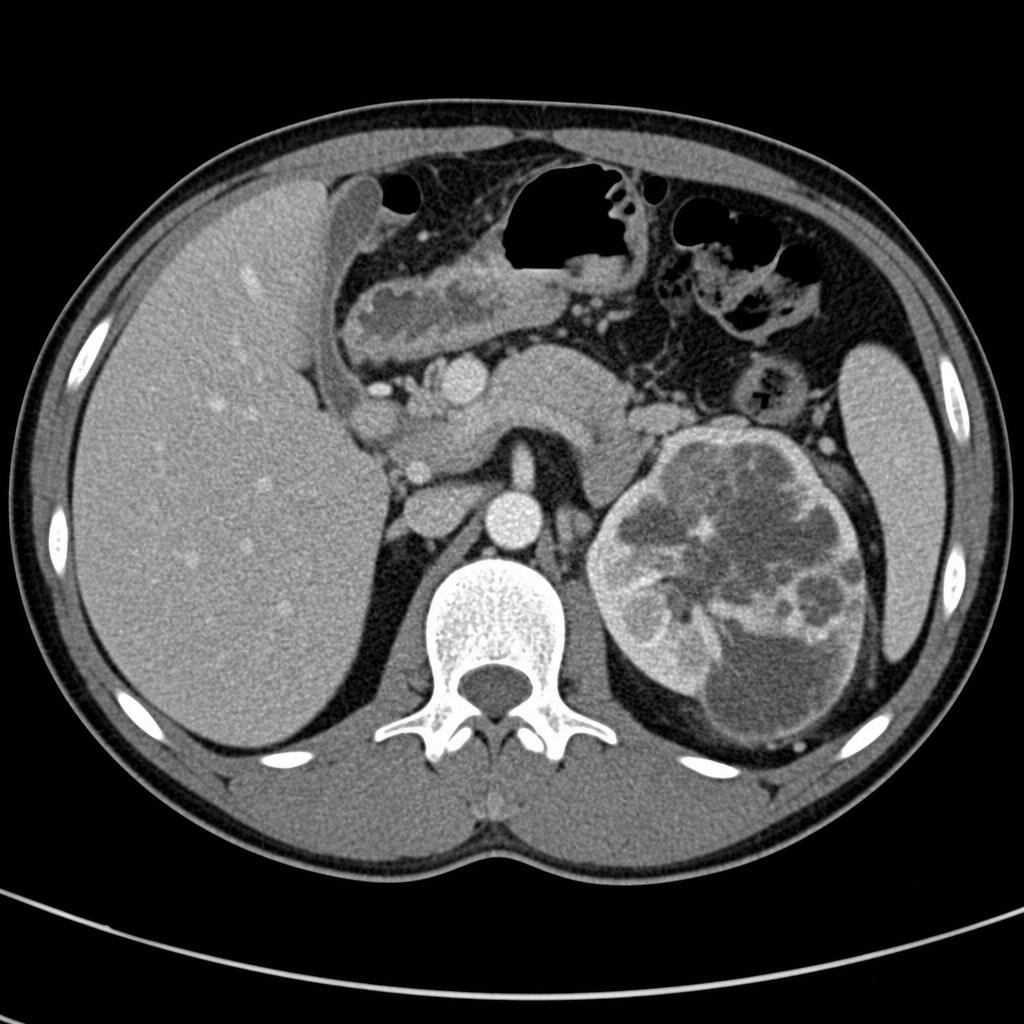
Wilms tumor occurs in:
Post streptococcal glomerulonephritis causes -
All are true about minimal change disease (Minimal Change GN) except –
In a case of glomerulonephritis (GN), C3 is normal in all the following except?
Bellini duct cancer is seen in which of the following?
Loss of foot processes seen on electron microscopy of renal biopsy is a classical feature in which of the following?
Renal biopsy shows 'spike and dome' appearance on silver methenamine stain. Immunofluorescence shows granular IgG deposits. Diagnosis?
Feature NOT seen in acute rejection of transplanted kidney?
Explanation: ***RBC cast*** - The presence of **red blood cell casts** in urine is the **hallmark** of glomerulonephritis, indicating glomerular inflammation and hemorrhage [1]. - These casts are formed when red blood cells enter the renal tubules and are molded within the **protein matrix** of the tubule. *Hemoglobinuria* - **Hemoglobinuria** refers to free hemoglobin in the urine, often seen in conditions involving **intravascular hemolysis**, not directly indicative of glomerular damage [2]. - While red blood cells may be present in glomerulonephritis resulting in gross or microscopic hematuria, free hemoglobin in urine is distinct from the presence of red blood cells or RBC casts [2]. *Hyaline cast* - **Hyaline casts** are composed primarily of Tamm-Horsfall protein and can be seen in **healthy individuals**, especially after exercise, or in conditions like dehydration. - Their presence is **non-specific** and does not point directly to acute glomerulonephritis. *Broad cast* - **Broad casts** (or "waxy casts") are larger than typical casts and are associated with **end-stage renal disease** and chronic kidney failure, indicating severely dilated and hypertrophied tubules. - They are not characteristic of the acute inflammation seen in acute glomerulonephritis. **References:** [1] Kumar V, Abbas AK, et al.. Robbins and Cotran Pathologic Basis of Disease. 9th ed. The Kidney, pp. 915-916. [2] Kumar V, Abbas AK, et al.. Robbins and Cotran Pathologic Basis of Disease. 9th ed. Red Blood Cell and Bleeding Disorders, pp. 639-640.
Explanation: ***Fusion of foot processes of the glomerular epithelial cells*** - This finding, also known as **effacement of podocyte foot processes**, is the characteristic electron microscopic feature of **minimal change disease (MCD)** [1]. - MCD is the most common cause of **nephrotic syndrome** in children, presenting with generalized edema, marked albuminuria, hypoalbuminemia, and hyperlipidemia, with a normal appearance on light microscopy [1]. *Deposition of electron dense material in the basement membrane* - This suggests diseases like **membranous nephropathy** or **post-infectious glomerulonephritis**, which typically involve immune complex deposition. - These conditions usually show abnormalities on **light microscopy** (e.g., thickened capillary loops in membranous nephropathy) and differ clinically [1]. *Rarefaction of glomerular basement membrane* - **Rarefaction** or thinning of the glomerular basement membrane is associated with conditions like **Alport syndrome** or **thin basement membrane disease**. - These are typically associated with **hematuria**, which is not mentioned as a primary symptom in this case, and often have a genetic component. *Thin basement membrane* - A **thin basement membrane** is the hallmark of **thin basement membrane disease** (also known as benign familial hematuria). - This condition primarily presents with **microscopic hematuria** and does not typically cause the complete nephrotic syndrome found in this child [1]. **References:** [1] Kumar V, Abbas AK, et al.. Robbins and Cotran Pathologic Basis of Disease. 9th ed. The Kidney, pp. 919-923.
Explanation: ***Kidney*** - **Wilms tumor** (also known as nephroblastoma) is a **malignant tumor** that originates in the **kidney** and affects primarily children [1]. - It arises from **embryonic renal blastema** and is the most common kidney cancer in children [2]. *Bronchus* - The bronchus is part of the respiratory system, and while tumors can occur here (e.g., **bronchogenic carcinoma**), Wilms tumor does not originate in the bronchus. - Tumors in the bronchus are primarily seen in adults and are often associated with smoking. *Liver* - The liver is a common site for childhood tumors, such as **hepatoblastoma**, but it is not the origin of Wilms tumor [1]. - Hepatic tumors have different cellular origins and clinical presentations compared to renal tumors. *Stomach* - Tumors of the stomach in children are rare and typically involve conditions like **lymphoma** or **sarcoma**, not Wilms tumor. - The stomach is an organ of the digestive system with distinct developmental origins from the kidney. **References:** [1] Cross SS. Underwood's Pathology: A Clinical Approach. 6th ed. (Basic Pathology) introduces the student to key general principles of pathology, both as a medical science and as a clinical activity with a vital role in patient care. Part 2 (Disease Mechanisms) provides fundamental knowledge about the cellular and molecular processes involved in diseases, providing the rationale for their treatment. Part 3 (Systematic Pathology) deals in detail with specific diseases, with emphasis on the clinically important aspects., pp. 211-212. [2] Kumar V, Abbas AK, et al.. Robbins and Cotran Pathologic Basis of Disease. 9th ed. Diseases of Infancy and Childhood, pp. 487-490.
Explanation: ***Nephritic syndrome*** - **Post-streptococcal glomerulonephritis (PSGN)** is a classic cause of **nephritic syndrome** [2], characterized by **glomerular inflammation** [1]. - Key features of nephritic syndrome include **hematuria**, **oliguria**, **hypertension**, and mild proteinuria with edema [2]. *Primary Nephrotic syndrome* - **Nephrotic syndrome** is defined by massive **proteinuria** (>3.5g/day), **hypoalbuminemia**, **edema**, and **hyperlipidemia** [2]. - PSGN typically presents with **microscopic or gross hematuria** and only moderate proteinuria, not the heavy proteinuria characteristic of nephrotic syndrome [2]. *Chronic renal failure* - While severe or recurrent cases of PSGN can eventually lead to **chronic kidney disease (CKD)** [3], it is not the immediate or primary presentation. - PSGN typically presents as an **acute** glomerulonephritis [1]. *Secondary Nephrotic syndrome* - **Secondary nephrotic syndrome** refers to nephrotic syndrome caused by systemic diseases (e.g., diabetes, lupus). - PSGN is an inflammatory condition primarily affecting the glomeruli, leading to nephritic features rather than dominant nephrotic range proteinuria [2]. **References:** [1] Kumar V, Abbas AK, et al.. Robbins and Cotran Pathologic Basis of Disease. 9th ed. The Kidney, pp. 914-915. [2] Kumar V, Abbas AK, et al.. Robbins and Cotran Pathologic Basis of Disease. 9th ed. The Kidney, p. 915. [3] Kumar V, Abbas AK, et al.. Robbins and Cotran Pathologic Basis of Disease. 9th ed. The Kidney, pp. 916-917.
Explanation: ***IgG deposition in mesangium*** - **Minimal Change Disease (MCD)** is characterized by the absence of significant immune complex deposition in the glomeruli [1]. - The hallmark of MCD on immunofluorescence is typically **negative or minimal staining for immunoglobulins (like IgG)** and complement components [1]. *Common in age group 2–9 years* - **Minimal Change Disease** is the most common cause of **nephrotic syndrome** in children, particularly in the 2-9 year age range [1]. - It accounts for approximately 80% of nephrotic syndrome cases in this pediatric population. *Selective proteinuria* - MCD causes damage to the **glomerular basement membrane's charge barrier**, leading to the loss of only smaller proteins like **albumin** [2]. - This results in **selective proteinuria**, where larger proteins like globulins are retained [2]. *Responds to steroids* - MCD is well-known for its excellent response to **corticosteroid therapy**, with the majority of patients achieving complete remission [1],[2]. - This characteristic responsiveness is a key diagnostic and therapeutic feature of the disease [2]. **References:** [1] Kumar V, Abbas AK, et al.. Robbins and Cotran Pathologic Basis of Disease. 9th ed. The Kidney, pp. 927-928. [2] Kumar V, Abbas AK, et al.. Robbins and Cotran Pathologic Basis of Disease. 9th ed. The Kidney, pp. 922-923.
Explanation: ***Diffuse lupus nephritis*** - This condition is characterized by **immune complex deposition** in the glomeruli [2], leading to activation of the **classical complement pathway** and consumption of C3, resulting in low C3 levels. [3] - Patients with diffuse lupus nephritis often present with **systemic lupus erythematosus (SLE)** symptoms, and **hypocomplementemia** is a hallmark. [3] *Goodpasture's syndrome* - This is an **autoimmune disease** targeting the **glomerular basement membrane (GBM)** and lung alveolar basement membranes. [1] - It involves **anti-GBM antibodies** directly, rather than widespread immune complex formation and complement consumption, so C3 levels are typically normal. [1] *IgA nephropathy* - Characterized by the deposition of **IgA immune complexes** in the glomeruli. [2] - While there is immune activity, C3 levels are generally **normal** because the alternative complement pathway, which primarily involves C3, is not extensively activated or consumed. *HSP* - **Henoch-Schönlein Purpura (HSP)** is a form of **IgA vasculitis** that can affect the kidneys, causing a glomerulonephritis similar to IgA nephropathy. - Similar to IgA nephropathy, C3 levels are usually **normal** in HSP-associated glomerulonephritis as the primary immune mechanism does not typically involve significant C3 consumption. **References:** [1] Kumar V, Abbas AK, et al.. Robbins and Cotran Pathologic Basis of Disease. 9th ed. The Kidney, p. 915. [2] Kumar V, Abbas AK, et al.. Robbins and Cotran Pathologic Basis of Disease. 9th ed. The Kidney, p. 911. [3] Kumar V, Abbas AK, et al.. Robbins and Cotran Pathologic Basis of Disease. 9th ed. The Kidney, pp. 910-911.
Explanation: ***Kidney*** - Bellini duct carcinoma is a **rare and aggressive subtype of renal cell carcinoma (RCC)**, originating from the collecting ducts of Bellini in the kidney. [1] - It accounts for a very small percentage of all RCCs and is characterized by a **poor prognosis**. *Liver* - The liver is affected by primary cancers like **hepatocellular carcinoma** and **cholangiocarcinoma**, or by metastatic disease, none of which arise from Bellini ducts. - Bellini ducts are structures **exclusive to the kidney**, not found in the liver. *Spleen* - Primary cancers of the spleen are **extremely rare**, with most malignant lesions being **lymphomas** or metastases. [2] - The spleen is a **lymphoid organ** and does not contain Bellini ducts. *Heart* - Primary cardiac tumors are uncommon, with the majority being **benign myxomas**. Malignant tumors include **sarcomas**. - The heart's anatomy is distinct and **does not contain any structures analogous to Bellini ducts**. **References:** [1] Kumar V, Abbas AK, et al.. Robbins and Cotran Pathologic Basis of Disease. 9th ed. The Kidney, pp. 959-961. [2] Kumar V, Abbas AK, et al.. Robbins and Cotran Pathologic Basis of Disease. 9th ed. Diseases of White Blood Cells, Lymph Nodes, Spleen, and Thymus, pp. 605-606.
Explanation: ***Minimal change disease*** - **Loss of foot processes** (podocyte effacement) is the hallmark ultrastructural finding in **minimal change disease** on electron microscopy [1]. - This effacement of podocyte foot processes leads to increased permeability of the **glomerular filtration barrier** to albumin, causing **nephrotic syndrome** [1], [2]. *IgA nephropathy* - Characterized by **IgA immune complex deposition** in the **mesangium** on immunofluorescence. - Electron microscopy typically shows **mesangial immune deposits**, not primarily foot process effacement. *Membranous nephropathy* - Identified by the presence of **subepithelial immune deposits** and **thickening of the glomerular basement membrane** (GBM) [3]. - On electron microscopy, these deposits are visible, often with overlying **spikes** of GBM material separating them. *Rapidly progressive glomerulonephritis* - Defined by the rapid loss of renal function and the presence of **crescents** in more than 50% of glomeruli on light microscopy [2]. - While there may be secondary podocyte changes due to severe inflammation, **foot process effacement** is not its primary diagnostic feature. **References:** [1] Kumar V, Abbas AK, et al.. Robbins and Cotran Pathologic Basis of Disease. 9th ed. The Kidney, pp. 927-928. [2] Cross SS. Underwood's Pathology: A Clinical Approach. 6th ed. Common Clinical Problems From Diseases Of The Urinary And Male Genital Tracts, pp. 527-528. [3] Cross SS. Underwood's Pathology: A Clinical Approach. 6th ed. Common Clinical Problems From Diseases Of The Urinary And Male Genital Tracts, pp. 532-533.
Explanation: ***Membranous nephropathy*** - The characteristic **'spike and dome' appearance** on silver methenamine stain is due to new basement membrane material laid down between subepithelial deposits, a hallmark of membranous nephropathy [1], [2]. - **Granular IgG deposits** on immunofluorescence reflect the immune complex deposition in the subepithelial space, leading to nephrotic syndrome [1]. *FSGS* - Characterized by **focal (some glomeruli) and segmental (part of glomeruli) scarring** on light microscopy, without the 'spike and dome' pattern [3]. - Immunofluorescence typically shows **negative or non-specific staining** for IgG, unlike the prominent granular deposits seen in membranous nephropathy [3]. *MPGN* - Exhibits a **'tram track' appearance** on light microscopy due to mesangial cell interposition and GBM splitting, not 'spike and dome' [4]. - Immunofluorescence can show IgG and C3 deposits, but the pattern and location are different from membranous nephropathy [4]. *Minimal change* - Light microscopy is often normal, and **electron microscopy** is required to identify **effacement of podocyte foot processes**, which is the primary pathology. - **Immunofluorescence is typically negative** as there are no immune complex deposits, distinguishing it from membranous nephropathy. **References:** [1] Kumar V, Abbas AK, et al.. Robbins and Cotran Pathologic Basis of Disease. 9th ed. The Kidney, p. 921. [2] Cross SS. Underwood's Pathology: A Clinical Approach. 6th ed. Common Clinical Problems From Diseases Of The Urinary And Male Genital Tracts, pp. 531-532. [3] Cross SS. Underwood's Pathology: A Clinical Approach. 6th ed. Common Clinical Problems From Diseases Of The Urinary And Male Genital Tracts, pp. 530-531. [4] Kumar V, Abbas AK, et al.. Robbins and Cotran Pathologic Basis of Disease. 9th ed. The Kidney, pp. 925-926.
Explanation: ***Wire-loop lesions*** - **Wire-loop lesions** are characteristic histological findings of diffuse proliferative glomerulonephritis, typically seen in **lupus nephritis (Class III or IV)** [3], and are not associated with acute kidney transplant rejection. - These lesions represent pronounced subendothelial immune complex deposition, leading to thickening and stiffness of the capillary walls [4]. *Tubulitis* - **Tubulitis**, defined as inflammatory cells (lymphocytes) infiltrating the tubular epithelium, is a **hallmark pathological feature of acute T-cell mediated rejection** in kidney allografts [1]. - Its presence indicates a significant immunologic attack on the renal tubules. *Endothelialitis* - **Endothelialitis**, or inflammation of the endothelial cells lining renal vessels, especially venules and arteries, is another key histological feature of **acute rejection**, particularly severe forms of T-cell mediated and antibody-mediated rejection [2], [1]. - It often correlates with the severity of rejection and can lead to vascular damage. *Interstitial infiltrate* - A prominent **interstitial infiltrate**, primarily composed of lymphocytes, macrophages, and plasma cells, is a fundamental characteristic of **acute cellular rejection** in transplanted kidneys [1]. - This inflammatory infiltrate surrounds the tubules and small vessels, indicating an immune attack on the allograft. **References:** [1] Kumar V, Abbas AK, et al.. Robbins and Cotran Pathologic Basis of Disease. 9th ed. Diseases of the Immune System, pp. 241-242. [2] Cross SS. Underwood's Pathology: A Clinical Approach. 6th ed. Common Clinical Problems From Diseases Of The Urinary And Male Genital Tracts, pp. 546-549. [3] Kumar V, Abbas AK, et al.. Robbins and Cotran Pathologic Basis of Disease. 9th ed. Diseases of the Immune System, pp. 230-232. [4] Cross SS. Underwood's Pathology: A Clinical Approach. 6th ed. Common Clinical Problems From Diseases Of The Urinary And Male Genital Tracts, pp. 528-529.
Congenital Anomalies of the Kidney
Practice Questions
Glomerular Diseases
Practice Questions
Tubular and Interstitial Diseases
Practice Questions
Vascular Diseases of the Kidney
Practice Questions
Cystic Diseases of the Kidney
Practice Questions
Urinary Tract Obstruction and Stones
Practice Questions
Renal Tumors
Practice Questions
Kidney in Systemic Diseases
Practice Questions
Renal Transplantation Pathology
Practice Questions
Urinary Tract Infections
Practice Questions
Get full access to all questions, explanations, and performance tracking.
Start For Free