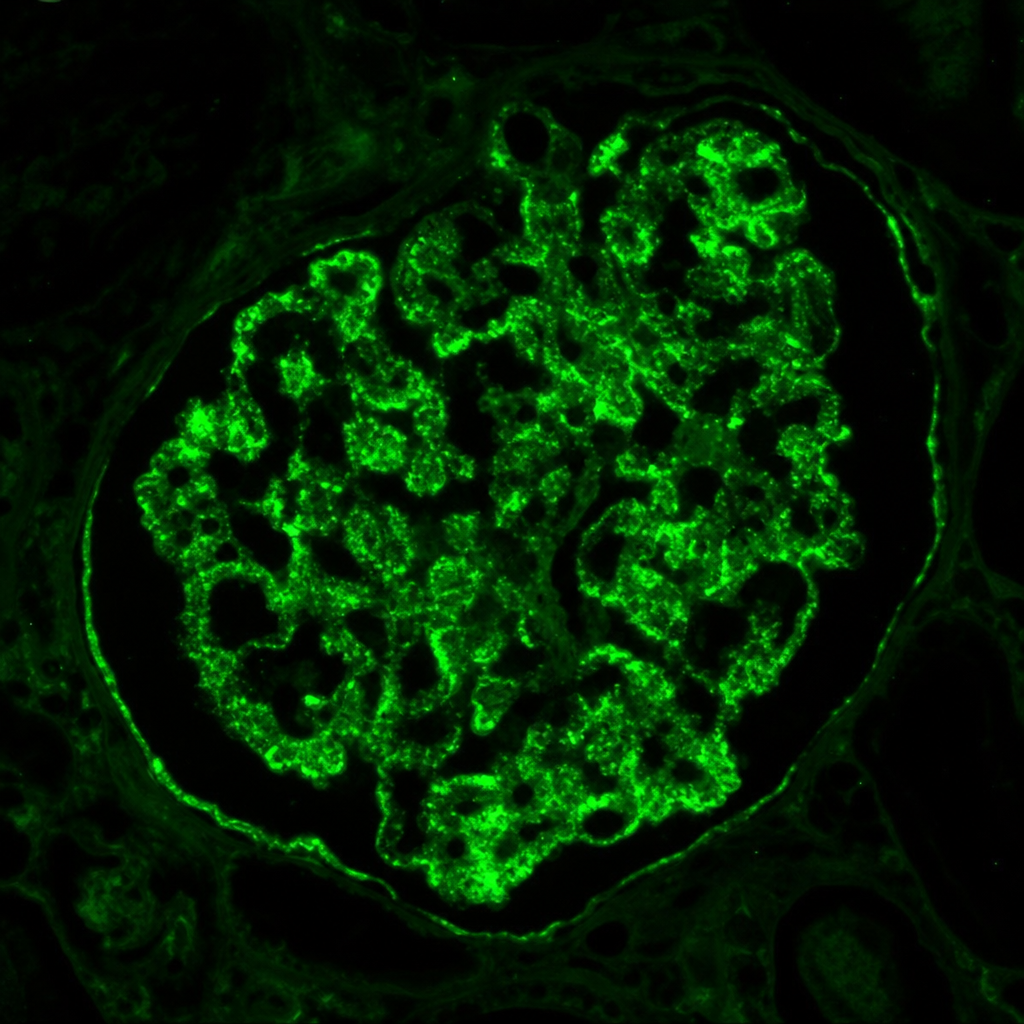
A kidney biopsy under electron microscopy shows subepithelial 'spike' formation. Which immunofluorescence pattern would confirm membranous nephropathy?
Crescent forming glomerulonephritis is:-
The Finnish type of congenital nephrotic syndrome occurs due to gene mutation affecting the following protein –
In minimal change disease following is not seen -
A diagnosed case of SLE has renal biopsy finding suggestive of mesangial proliferative nephropathy. It belongs to which class of lupus nephritis:
A 5-year-old child suffering from nephrotic syndrome is responding well to steroid therapy. What would be the most likely finding on light microscopy?
In minimal change disease, which of the following is seen?
The main mechanism of proteinuria in minimal change disease is
Class IV lupus nephritis is:
Investigation of choice for confirming Henoch Schönlein Purpura is
Explanation: ***Granular IgG along GBM*** - **Membranous nephropathy** is characterized by the immune complexes forming **subepithelial deposits** along the glomerular basement membrane (GBM) [1], [2]. - These deposits appear as **granular IgG** (and often C3) on immunofluorescence, corresponding to the "spike" formation seen on electron microscopy [1]. *Linear IgG along GBM* - This pattern is characteristic of **Goodpasture syndrome** (anti-GBM disease), where antibodies directly bind to the GBM in a uniform, linear fashion [3], [4]. - The electron microscopy findings in Goodpasture syndrome do not show subepithelial "spike" formation but rather a normal or thickened GBM. *Mesangial IgA deposits* - This is the hallmark of **IgA nephropathy** (Berger's disease), where IgA immune complexes accumulate predominantly in the mesangium [2]. - IgA nephropathy would not typically present with subepithelial "spike" formation on electron microscopy. *C3 deposits only* - While C3 can be present in membranous nephropathy, finding "C3 deposits only" without significant IgG or other immunoglobulins suggests conditions like **C3 glomerulopathy** or dense deposit disease. - These conditions have distinct electron microscopy findings and a different pathogenesis compared to membranous nephropathy. **References:** [1] Kumar V, Abbas AK, et al.. Robbins and Cotran Pathologic Basis of Disease. 9th ed. The Kidney, p. 921. [2] Kumar V, Abbas AK, et al.. Robbins and Cotran Pathologic Basis of Disease. 9th ed. The Kidney, p. 911. [3] Kumar V, Abbas AK, et al.. Robbins and Cotran Pathologic Basis of Disease. 9th ed. The Kidney, p. 909. [4] Cross SS. Underwood's Pathology: A Clinical Approach. 6th ed. Common Clinical Problems From Diseases Of The Urinary And Male Genital Tracts, pp. 526-527.
Explanation: ***RPGN*** - **Rapidly progressive glomerulonephritis (RPGN)** is a clinical syndrome characterized by a rapid decline in **renal function** over weeks to months, often due to severe glomerular injury. - The hallmark **histological feature** of RPGN is the formation of **crescents** in more than 50% of the glomeruli, which are proliferations of parietal epithelial cells and infiltrating macrophages [1]. *MCN* - **Minimal change nephropathy (MCN)** is characterized by **diffuse effacement of podocyte foot processes** on electron microscopy, with normal findings on light microscopy. - It typically presents as **nephrotic syndrome** and does not involve crescent formation. *MPGN* - **Membranoproliferative glomerulonephritis (MPGN)** involves thickening of the glomerular basement membrane with a "tram-track" appearance and mesangial proliferation [2]. - While MPGN can occasionally have focal crescents in some cases, **crescent formation is not a defining or characteristic feature** of MPGN [2]. - MPGN typically presents with nephritic-nephrotic syndrome. *All of the options* - This option is incorrect because only RPGN is characterized by **crescent formation** as a defining feature. - MCN does not involve crescents, and MPGN does not characteristically present with extensive crescent formation, thus invalidating this choice. **References:** [1] Cross SS. Underwood's Pathology: A Clinical Approach. 6th ed. Common Clinical Problems From Diseases Of The Urinary And Male Genital Tracts, pp. 528-529. [2] Kumar V, Abbas AK, et al.. Robbins and Cotran Pathologic Basis of Disease. 9th ed. The Kidney, pp. 925-926.
Explanation: The Finnish type of congenital nephrotic syndrome occurs due to gene mutation affecting the following protein – ***Nephrin*** * The **Finnish type congenital nephrotic syndrome (CNF)** is specifically caused by mutations in the *NPHS1* gene, which codes for the protein **nephrin**. * **Nephrin** is a crucial component of the **slit diaphragm** in podocytes, essential for maintaining the glomerular filtration barrier and preventing protein loss [1]. *Alpha–actinin* * **Alpha-actinin** is a protein that anchors actin filaments to various membrane structures, including the podocyte cytoskeleton. * Mutations in genes encoding alpha-actinin (e.g., *ACTN4*) are associated with some forms of **focal segmental glomerulosclerosis (FSGS)**, but not specifically the Finnish type CNF [1]. *CD2 activated protein* * **CD2-associated protein (CD2AP)** is another important podocyte protein involved in anchoring the slit diaphragm to the actin cytoskeleton [1]. * Mutations in the *CD2AP* gene can cause some forms of **steroid-resistant nephrotic syndrome** and FSGS, but not the Finnish type CNF. *Podocin* * **Podocin** is a lipid raft-associated protein in podocytes, encoded by the *NPHS2* gene, crucial for stabilizing nephrin and forming the slit diaphragm [1]. * Mutations in *NPHS2* (leading to podocin dysfunction) are a common cause of **steroid-resistant nephrotic syndrome** in childhood, but not the Finnish type congenital nephrotic syndrome. **References:** [1] Kumar V, Abbas AK, et al.. Robbins and Cotran Pathologic Basis of Disease. 9th ed. The Kidney, pp. 923-924.
Explanation: ***Normal electron microscopic appearance*** - In **minimal change disease**, electron microscopy characteristically shows **effacement of podocyte foot processes**, which is not a normal appearance [1]. - This effacement is the underlying cause for the increased permeability of the glomerular filtration barrier leading to proteinuria. *Light microscopy normal* - **Minimal change disease** is named for the fact that the **glomeruli appear normal** or nearly normal on light microscopy [1]. - No significant inflammatory changes, cellular proliferation, or basement membrane thickening are typically visible [1]. *Good response to steroids* - **Minimal change disease** is known for its **excellent response to corticosteroids**, with remission of proteinuria in most cases [1]. - This distinguishes it from many other causes of nephrotic syndrome, which often have a poorer response to steroids. *Massive proteinuria* - **Massive proteinuria** (typically >3.5 g/24 hours in adults) is a **hallmark characteristic** of nephrotic syndrome, of which minimal change disease is a primary cause [1]. - The loss of large amounts of protein in the urine leads to symptoms like edema and hypoalbuminemia [1]. **References:** [1] Kumar V, Abbas AK, et al.. Robbins and Cotran Pathologic Basis of Disease. 9th ed. The Kidney, pp. 921-923, 927-928.
Explanation: ***Class II*** - **Mesangial proliferative lupus nephritis (Class II)** is characterized by mesangial hypercellularity and/or mesangial matrix expansion with mesangial immune deposits. - While it can be associated with proteinuria, it generally has a **better prognosis** and less severe clinical manifestations compared to more advanced classes of lupus nephritis. *Class IV* - **Class IV lupus nephritis (diffuse lupus nephritis)** is the most common and severe form, characterized by extensive immune deposits and inflammation in the glomerular capillaries [1]. - This class typically presents with significant proteinuria, hematuria, renal insufficiency, and often requires **aggressive immunosuppressive therapy** [1]. *Class III* - **Class III lupus nephritis (focal lupus nephritis)** involves proliferative lesions affecting less than 50% of glomeruli, with immune deposits primarily in the subendothelial space [1]. - It often manifests with proteinuria and hematuria, and can progress to more severe forms if not adequately treated [1]. *Class I* - **Class I lupus nephritis (minimal mesangial lupus nephritis)** is characterized by normal glomeruli on light microscopy but with mesangial immune deposits on immunohistochemistry or electron microscopy [1]. - It is typically associated with **minimal or no clinical symptoms** and a very good prognosis, rarely leading to significant renal dysfunction. **References:** [1] Kumar V, Abbas AK, et al.. Robbins and Cotran Pathologic Basis of Disease. 9th ed. Diseases of the Immune System, pp. 230-232.
Explanation: ***No finding*** - The most common cause of nephrotic syndrome in children is **minimal change disease (MCD)**. Histologically, MCD is characterized by **normal-appearing glomeruli** on light microscopy, hence "no finding." [1] - The characteristic changes in MCD, such as **effacement of podocyte foot processes**, are only visible on **electron microscopy**, not light microscopy. [1] *Fusion of foot process* - This change, more accurately described as **effacement (flattening and merging) of podocyte foot processes**, is the **hallmark lesion of minimal change disease**. [1] - However, this finding is detectable only with **electron microscopy**, not with light microscopy. [1] *Basement membrane thickening* - **Thickening of the glomerular basement membrane (GBM)** is characteristic of diseases like **membranous nephropathy** [1] or **diabetic nephropathy**. - These conditions typically present differently and are less common causes of nephrotic syndrome in children, especially those responding well to steroids. [1] *Hypercellular glomeruli* - **Glomerular hypercellularity** suggests proliferative glomerulonephritis, such as post-streptococcal glomerulonephritis or IgA nephropathy. [1] - These conditions usually do not cause nephrotic syndrome as their primary presentation and are not characterized by good response to steroid therapy in children. [1] **References:** [1] Kumar V, Abbas AK, et al.. Robbins and Cotran Pathologic Basis of Disease. 9th ed. The Kidney, pp. 919-928.
Explanation: ***No immunodeposits*** - Minimal change disease (MCD) is characterized by the **absence of immune complex deposition** in the glomeruli [1]. - This lack of immunodeposits is a key diagnostic feature, distinguishing it from other types of glomerulonephritis [1]. *Immunodeposits in blood vessels* - Immunodeposits in blood vessels are typically associated with **vasculitic conditions**, such as ANCA-associated vasculitis or cryoglobulinemic vasculitis. - This finding is not characteristic of minimal change disease, which primarily affects the podocytes of the glomeruli. *Immunodeposits in mesangium* - Mesangial immunodeposits are characteristic of conditions like **IgA nephropathy** or **membranoproliferative glomerulonephritis** [1]. - These conditions involve immune complex deposition within the mesangial matrix, which is absent in minimal change disease [1]. *Immunodeposits in glomerulus* - While "glomerulus" is a broad term, the absence of **immune complex deposition** within the glomerulus (including capillary loops, mesangium, and subepithelial/subendothelial spaces) is precisely what defines minimal change disease [1]. - The primary abnormality in MCD is **podocyte foot process effacement**, not immune complex deposition [1]. **References:** [1] Kumar V, Abbas AK, et al.. Robbins and Cotran Pathologic Basis of Disease. 9th ed. The Kidney, pp. 927-928.
Explanation: ***Loss of negative charge on membrane*** [1] - The primary defect in **minimal change disease** is a loss of the **negative charge** on the glomerular basement membrane (GBM) and podocytes. - This loss of negative charge allows for the increased filtration of negatively charged proteins, particularly **albumin**, leading to severe proteinuria [1]. *Increase in pore size* - While increased pore size can contribute to proteinuria (e.g., in some forms of glomerulonephritis), it is **not the primary or defining mechanism** in minimal change disease [1]. - The loss of **anionic charge** is the more specific and significant factor for albuminuria in MCD. *Decreased circulation* - **Decreased circulation** (e.g., hypoperfusion) would typically lead to **acute kidney injury** or prerenal azotemia rather than isolated proteinuria and nephrotic syndrome. - This mechanism does not explain the selective albuminuria characteristic of minimal change disease. *Loss of cells* - While some glomerular disorders involve **loss of specific cell types**, such as podocytes in focal segmental glomerulosclerosis (FSGS), minimal change disease is characterized by **foot process effacement** without a significant loss of cells [1]. - The podocytes remain largely intact, but their structural and functional integrity is compromised [1]. **References:** [1] Kumar V, Abbas AK, et al.. Robbins and Cotran Pathologic Basis of Disease. 9th ed. The Kidney, pp. 905-907, 922-923, 927-928.
Explanation: ***Diffuse lupus nephritis*** - This is the most **severe** and common form of lupus nephritis, characterized by **widespread inflammation** and proliferation affecting more than 50% of glomeruli [1]. - Patients typically present with **nephrotic-range proteinuria**, **hematuria**, and significant **renal impairment** [1]. *Proliferative lupus nephritis* - This is a general term describing **increased cellularity** within the glomeruli. - While Class IV (diffuse) lupus nephritis is a proliferative form, "proliferative lupus nephritis" alone is not a specific class in the ISN/RPS classification system without further qualification (e.g., focal or diffuse). *Mesangial lupus nephritis* - This refers to Classes I and II, characterized by **mesangial immune deposits** and/or mild mesangial hypercellularity. - It is typically a **milder form** with a better prognosis, unlike the severe presentation of Class IV [1]. *Membranous lupus nephritis* - This corresponds to Class V lupus nephritis, distinguished by **subepithelial immune deposits** and thickening of the glomerular basement membrane. - Patients often present with **nephrotic syndrome** but typically have less severe inflammation or cellular proliferation compared to Class IV. **References:** [1] Kumar V, Abbas AK, et al.. Robbins and Cotran Pathologic Basis of Disease. 9th ed. Diseases of the Immune System, pp. 230-232.
Explanation: ***Renal Biopsy*** - **Biopsy (renal or skin)** showing **IgA deposition** is the **confirmatory investigation** for Henoch-Schönlein Purpura (HSP) when histological confirmation is needed [1]. - **Renal biopsy** demonstrates characteristic **IgA-dominant immune deposits** in the mesangium and glomerular capillaries, along with **mesangial proliferation** [1]. - While HSP is primarily a **clinical diagnosis** based on palpable purpura, age < 20 years, abdominal pain, and renal involvement, biopsy provides **definitive confirmation** in atypical presentations or when diagnosis is uncertain. - Immunofluorescence showing **IgA deposition** is the pathognomonic finding [1]. *Serum IgA levels* - Serum IgA levels may be elevated in approximately **50% of HSP cases**, but this is **neither sensitive nor specific**. - **Normal serum IgA does NOT exclude HSP**, making it unreliable as a confirmatory test. - Elevated IgA can occur in many other conditions (IgA nephropathy without vasculitis, liver disease, infections). - Provides only supportive evidence, not confirmation. *CRP levels* - **C-reactive protein (CRP)** is a **non-specific inflammatory marker** that may be elevated in HSP. - Cannot distinguish HSP from other inflammatory or infectious conditions. - Has no role in confirming the diagnosis. *DTPA* - **DTPA scan** assesses **renal perfusion and function** but does not provide diagnostic information about the underlying pathology. - Cannot detect the characteristic **IgA-mediated vasculitis** of HSP. - Not useful for confirming the diagnosis. **References:** [1] Cross SS. Underwood's Pathology: A Clinical Approach. 6th ed. Common Clinical Problems From Diseases Of The Urinary And Male Genital Tracts, pp. 526-527.
Congenital Anomalies of the Kidney
Practice Questions
Glomerular Diseases
Practice Questions
Tubular and Interstitial Diseases
Practice Questions
Vascular Diseases of the Kidney
Practice Questions
Cystic Diseases of the Kidney
Practice Questions
Urinary Tract Obstruction and Stones
Practice Questions
Renal Tumors
Practice Questions
Kidney in Systemic Diseases
Practice Questions
Renal Transplantation Pathology
Practice Questions
Urinary Tract Infections
Practice Questions
Get full access to all questions, explanations, and performance tracking.
Start For Free