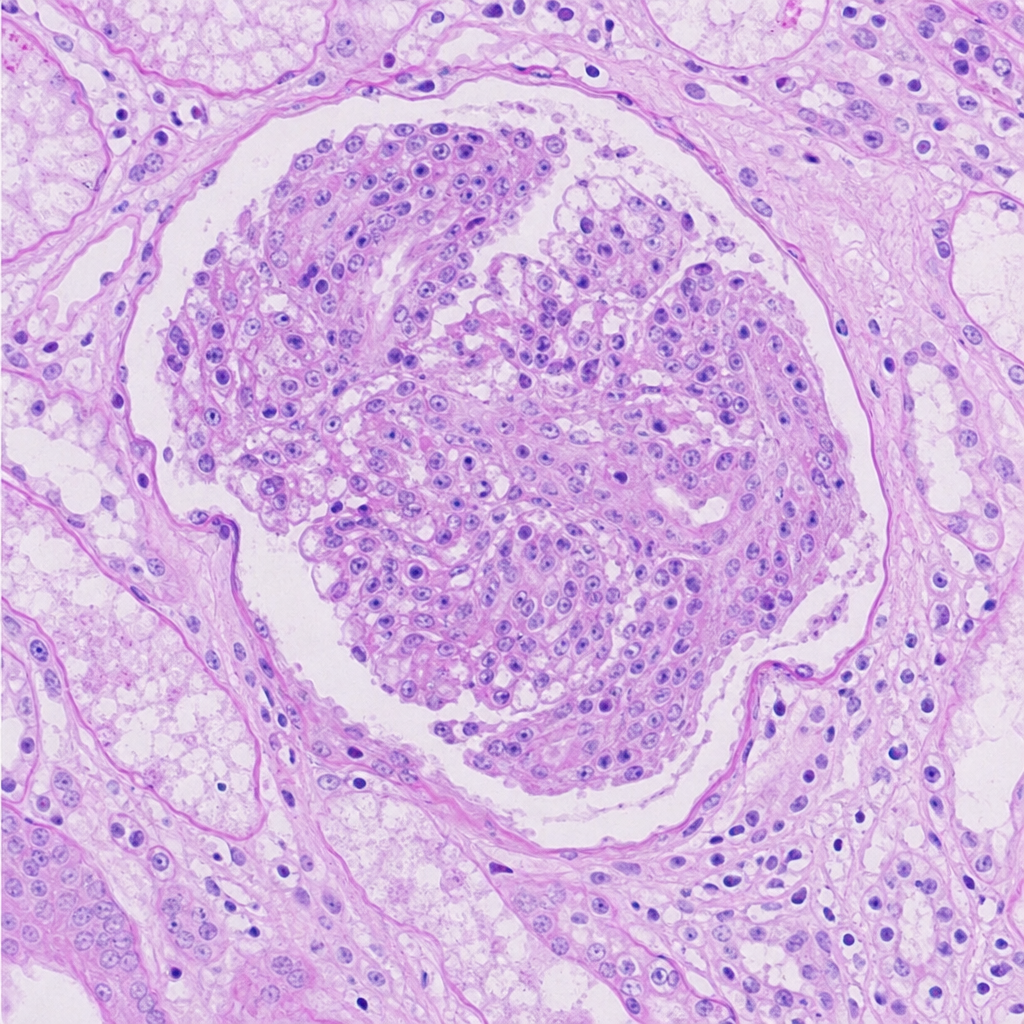
Glomerular basement membrane showing "tram-track" appearance is seen in which of the following conditions?
A 55-year-old obese woman complains of declining visual acuity. Funduscopic examination shows peripheral retinal microaneurysms. Urinalysis reveals 3+ proteinuria and 3+ glucosuria. Serum albumin is 3 g/dL, and serum cholesterol is 350 mg/dL. Which of the following mechanisms best explains these clinicopathologic findings?
What is the inheritance pattern of Alport syndrome?
Presence of which of the following in the urine is diagnostic of glomerular injury?
Goodpasture's disease is characterized by all of the following except:
Which of the following conditions is characterized by occasional breaks in the glomerular basement membrane and subepithelial deposits visible on electron microscopy?
What is true about acute post-infective glomerulonephritis?
At autopsy, a patient who had died with acute anuria and uremia is found to have ischemic necrosis of the cortex of both kidneys with relative sparing of the medulla. These pathological findings are MOST likely related to which of the following underlying conditions?
Pigmented "muddy brown" granular casts are characteristic of which of the following conditions?
Wire loop lesions are often characteristic for which class of lupus nephritis?
Explanation: **Explanation:** The "tram-track" or "double-contour" appearance of the glomerular basement membrane (GBM) is the hallmark histological feature of **Membranoproliferative Glomerulonephritis (MPGN) Type 1** [1]. **Why Option A is correct:** In MPGN Type 1, the deposition of immune complexes in the subendothelial space triggers the proliferation of mesangial cells [2]. These mesangial cells extend their cytoplasmic processes into the capillary loop, interposing themselves between the endothelial cell and the original basement membrane [2]. This "mesangial interposition" results in the synthesis of a new layer of basement membrane material [3], creating two parallel lines (the original and the new) that resemble railroad tracks on Silver (PAS) or Jones stain [1]. **Why the other options are incorrect:** * **B. Membranous Nephropathy:** Characterized by subepithelial deposits resulting in a "spike and dome" appearance on silver stain, not tram-tracking. * **C. Focal Segmental Glomerulosclerosis (FSGS):** Shows segmental sclerosis (obliteration of capillary loops by hyaline and collagen) in some, but not all, glomeruli. * **D. Minimal-Change Disease:** Glomeruli appear normal under light microscopy; the characteristic finding is the effacement of podocyte foot processes visible only on electron microscopy. **NEET-PG High-Yield Pearls:** * **MPGN Type 1:** Associated with Chronic Hepatitis C, SLE, and Cryoglobulinemia. It shows low C3 and C4 levels [1]. * **MPGN Type 2 (Dense Deposit Disease):** Characterized by "ribbon-like" intramembranous deposits [1]. It is associated with **C3 Nephritic Factor** and low C3 levels (normal C4). * **Stain of Choice:** Periodic Acid-Schiff (PAS) or Methenamine Silver stain is used to visualize the tram-track appearance. **References:** [1] Kumar V, Abbas AK, et al.. Robbins and Cotran Pathologic Basis of Disease. 9th ed. The Kidney, pp. 926-927. [2] Kumar V, Abbas AK, et al.. Robbins and Cotran Pathologic Basis of Disease. 9th ed. The Kidney, pp. 925-926. [3] Kumar V, Abbas AK, et al.. Robbins and Cotran Pathologic Basis of Disease. 9th ed. The Kidney, pp. 907-908.
Explanation: ### **Explanation** The clinical presentation describes a classic case of **Type 2 Diabetes Mellitus (T2DM)** with secondary **Diabetic Nephropathy** and **Retinopathy**. The patient exhibits the metabolic syndrome triad (obesity, hypercholesterolemia) along with target organ damage: * **Retinopathy:** Microaneurysms (earliest sign). * **Nephropathy:** Heavy proteinuria (3+) and hypoalbuminemia (3 g/dL), suggesting Nephrotic-range proteinuria [2]. * **Glucosuria:** Resulting from hyperglycemia exceeding the renal threshold. #### **Why Option A is Correct?** The hallmark of **Type 2 Diabetes Mellitus** is **peripheral insulin resistance**, primarily in skeletal muscle, liver, and adipose tissue [1]. This resistance leads to compensatory hyperinsulinemia initially, followed by relative insulin deficiency. Chronic hyperglycemia results in the formation of **Advanced Glycation End-products (AGEs)**, which cause hyaline arteriolosclerosis and thickening of the glomerular basement membrane (Kimmelstiel-Wilson nodules), leading to the renal and retinal findings observed [3], [4]. #### **Why Other Options are Incorrect?** * **Option B:** Increased peripheral insulin uptake would lead to hypoglycemia, not the hyperglycemia required to cause glucosuria and microvascular complications. * **Option C:** While "impaired" insulin secretion occurs in later stages of T2DM, the primary and initiating pathophysiologic mechanism in an obese patient is **resistance**, not just irregular secretion [1]. #### **High-Yield NEET-PG Pearls** * **Earliest Renal Change:** Hyperfiltration (increased GFR). * **Earliest Clinical Sign:** Microalbuminuria (30–300 mg/day). * **Pathognomonic Lesion:** **Kimmelstiel-Wilson (KW) nodules** (Nodular Glomerulosclerosis) [4]. * **Most Common Lesion:** Diffuse Glomerulosclerosis. * **Retinopathy:** Diabetic retinopathy is the leading cause of blindness in adults; microaneurysms occur due to pericyte loss. **References:** [1] Kumar V, Abbas AK, et al.. Robbins and Cotran Pathologic Basis of Disease. 9th ed. The Endocrine System, pp. 1114-1115. [2] Kumar V, Abbas AK, et al.. Robbins and Cotran Pathologic Basis of Disease. 9th ed. The Endocrine System, p. 1121. [3] Kumar V, Abbas AK, et al.. Robbins and Cotran Pathologic Basis of Disease. 9th ed. The Endocrine System, pp. 1118-1119. [4] Kumar V, Abbas AK, et al.. Robbins and Cotran Pathologic Basis of Disease. 9th ed. The Endocrine System, pp. 1121-1122.
Explanation: **Explanation:** **1. Why X-linked Dominant is Correct:** Alport syndrome is a genetic disorder caused by mutations in the genes encoding **Type IV collagen**, a critical component of the glomerular basement membrane (GBM), cochlea, and lens [1]. Approximately **80% of cases** are inherited in an **X-linked dominant** fashion due to mutations in the **COL4A5** gene [1]. Because it is dominant, both hemizygous males and heterozygous females can manifest the disease, though males typically present with more severe renal failure due to the lack of a second X chromosome. **2. Why Other Options are Incorrect:** * **Autosomal Recessive (AR):** This accounts for about 15% of cases (mutations in *COL4A3* or *COL4A4*). While it exists, it is not the most common inheritance pattern. * **Autosomal Dominant (AD):** This is the rarest form (approx. 5%) and usually presents with a slower progression to end-stage renal disease (ESRD). * **X-linked Recessive:** This is incorrect because females with a single mutated *COL4A5* gene frequently show clinical symptoms (like hematuria), which defines the pattern as dominant rather than recessive. **3. NEET-PG High-Yield Clinical Pearls:** * **Classic Triad:** Hereditary nephritis (hematuria/ESRD), Sensorineural deafness, and Ocular defects (e.g., **Anterior Lenticonus**—pathognomonic). * **Electron Microscopy (EM):** Shows characteristic **"Basket-weave appearance"** due to irregular thinning and thickening of the GBM with splitting of the lamina densa [1]. * **Molecular Defect:** Defective assembly of Type IV collagen ̡3, ̡4, and ̡5 chains [1]. * **Diagnosis:** Often suspected in a child with persistent hematuria and a family history of early-onset renal failure and hearing loss [1]. **References:** [1] Kumar V, Abbas AK, et al.. Robbins and Cotran Pathologic Basis of Disease. 9th ed. The Kidney, pp. 929-930.
Explanation: **Explanation:** The presence of **dysmorphic RBCs** (acanthocytes) in the urine is a hallmark of **glomerular bleeding**. When red blood cells pass through the damaged glomerular basement membrane (GBM) and travel through the varying osmotic gradients of the renal tubules, they undergo mechanical and chemical stress. This results in distorted shapes, blebs, and uneven membranes. * **Why Option B is correct:** While various thresholds exist, the presence of **>20% dysmorphic RBCs** (or specifically >5% acanthocytes/G1 cells) is highly specific and diagnostic for a glomerular source of hematuria (e.g., Glomerulonephritis [1]). * **Why Option A is incorrect:** Bright red cells (monomorphic RBCs) typically indicate **non-glomerular bleeding** from the lower urinary tract (ureters, bladder, or urethra), such as stones, trauma, or malignancy. * **Why Option C is incorrect:** The quantity of RBCs (100 RBCs/HPF) indicates significant hematuria but does not localize the site of injury. Both glomerular and post-glomerular conditions can cause high RBC counts. * **Why Option D is incorrect:** Beta-2 microglobulin is a marker used to assess **tubular function**. Elevated levels in urine indicate tubular injury or dysfunction, not necessarily glomerular basement membrane damage. **High-Yield Clinical Pearls for NEET-PG:** 1. **RBC Casts:** These are the most specific indicators of glomerular hematuria [1]. 2. **Acanthocytes:** Specifically, "mickey mouse" shaped RBCs are the most predictive type of dysmorphic cell for glomerulonephritis. 3. **Proteinuria:** Glomerular injury is often associated with significant proteinuria (>3.5g/day in nephrotic range), whereas isolated hematuria without protein often points to a lower tract cause [1]. **References:** [1] Cross SS. Underwood's Pathology: A Clinical Approach. 6th ed. Common Clinical Problems From Diseases Of The Urinary And Male Genital Tracts, pp. 520-532.
Explanation: ### Explanation **Goodpasture’s Disease** is a specific type of anti-glomerular basement membrane (anti-GBM) disease characterized by the triad of glomerulonephritis, pulmonary hemorrhage, and anti-GBM antibodies [1]. **Why Option B is the Correct Answer (The "Except"):** Leukocytoclastic vasculitis (LCV) is a small-vessel vasculitis typically mediated by immune complex deposition (Type III hypersensitivity) or ANCA-associated processes [4]. **Goodpasture’s disease is NOT a systemic vasculitis.** It is a tissue-specific autoimmune disease caused by Type II hypersensitivity. While it affects the capillaries of the kidneys and lungs, it does not involve the systemic small vessels of the skin or other organs that define LCV. **Analysis of Incorrect Options:** * **Option A (Glomerulonephritis):** This is a hallmark feature. Patients typically present with Rapidly Progressive Glomerulonephritis (RPGN) Type I, characterized by "crescents" on light microscopy [1]. * **Option C (Antibodies to basement membrane):** The pathogenesis involves IgG antibodies directed against the **non-collagenous (NC1) domain of the α3 chain of Type IV collagen** [3]. * **Option D (Diffuse alveolar hemorrhage):** Since the α3 chain of Type IV collagen is also present in alveolar capillaries, these antibodies cause pulmonary hemorrhage, leading to hemoptysis [1]. **High-Yield Clinical Pearls for NEET-PG:** * **Immunofluorescence (IF):** Shows a characteristic **linear** pattern of IgG deposition along the GBM [2], [3] (unlike the "granular" pattern seen in immune-complex diseases). * **Genetics:** Strongly associated with **HLA-DRB1*15:01** and **DR4** [1]. * **Demographics:** Typically shows a bimodal distribution (young men in their 20s and older women in their 60s). * **Treatment:** Plasmapheresis (to remove circulating antibodies) combined with corticosteroids and cyclophosphamide [1]. **References:** [1] Cross SS. Underwood's Pathology: A Clinical Approach. 6th ed. Common Clinical Problems From Diseases Of The Urinary And Male Genital Tracts, pp. 537-538. [2] Kumar V, Abbas AK, et al.. Robbins and Cotran Pathologic Basis of Disease. 9th ed. The Kidney, p. 909. [3] Cross SS. Underwood's Pathology: A Clinical Approach. 6th ed. Common Clinical Problems From Diseases Of The Urinary And Male Genital Tracts, pp. 526-527. [4] Kumar V, Abbas AK, et al.. Robbins and Cotran Pathologic Basis of Disease. 9th ed. The Kidney, pp. 917-918.
Explanation: **Explanation:** The correct answer is **Membranous Glomerulonephritis (MGN)**. MGN is a common cause of nephrotic syndrome in adults, characterized by the diffuse thickening of the glomerular basement membrane (GBM) due to the accumulation of subepithelial immune complexes [2],[3]. 1. **Why MGN is correct:** On electron microscopy (EM), MGN classically shows **subepithelial deposits** (located between the podocytes and the GBM) [3]. As the basement membrane grows around these deposits to incorporate them, it creates the characteristic "spike and dome" appearance seen on silver stains [1]. Occasional breaks or irregularities in the GBM occur as the membrane undergoes remodeling and thickening in response to these deposits [2]. 2. **Why other options are incorrect:** * **Focal Segmental Glomerulosclerosis (FSGS):** Characterized by segmental scarring of some glomeruli. EM shows effacement of podocyte foot processes but lacks subepithelial deposits [4]. * **Rapidly Progressive Glomerulonephritis (RPGN):** Defined by the formation of "crescents" in Bowman’s space. While GBM breaks are a hallmark of Type I (Anti-GBM) and Type III (Pauci-immune) RPGN, they do not typically feature subepithelial deposits. * **Minimal Change Disease (MCD):** Shows normal glomeruli under light microscopy. EM reveals diffuse effacement of foot processes but **no** deposits or GBM thickening [4]. **High-Yield Clinical Pearls for NEET-PG:** * **Immunofluorescence (IF):** MGN shows a characteristic **granular** IgG and C3 pattern along the GBM [1]. * **Primary MGN:** Strongly associated with antibodies against the **Phospholipase A2 Receptor (PLA2R)**. * **Secondary MGN:** Associated with HBV, SLE (Class V), gold/penicillamine, and occult malignancies (colon/lung). * **Silver Stain:** Used to visualize the "spikes" on light microscopy [1]. **References:** [1] Kumar V, Abbas AK, et al.. Robbins and Cotran Pathologic Basis of Disease. 9th ed. The Kidney, p. 921. [2] Cross SS. Underwood's Pathology: A Clinical Approach. 6th ed. Common Clinical Problems From Diseases Of The Urinary And Male Genital Tracts, pp. 529-530. [3] Kumar V, Abbas AK, et al.. Robbins and Cotran Pathologic Basis of Disease. 9th ed. The Kidney, pp. 919-921. [4] Kumar V, Abbas AK, et al.. Robbins and Cotran Pathologic Basis of Disease. 9th ed. The Kidney, pp. 927-928.
Explanation: ### Explanation: Acute Post-Infective Glomerulonephritis (PSGN) **Correct Answer: D. Deposition of IgA** *Note: While the classic description of PSGN involves IgG and C3, recent literature and specific variants (especially in adults and diabetics) frequently show **IgA-dominant post-infectious glomerulonephritis**. [1] In the context of this specific question, IgA deposition is a recognized immunofluorescence finding in the "staphylococcal" variant of post-infectious GN.* #### Why the options are evaluated: * **Subepithelial deposits (Option B):** This is a hallmark of PSGN. On Electron Microscopy (EM), these are classically described as **"subepithelial humps."** [1], [4] * **Granular deposits of IgG (Option C):** Immunofluorescence (IF) typically shows a **"starry sky"** or "lumpy-bumpy" appearance due to granular deposits of **IgG and C3** along the GBM and mesangium. [1] * **Crescent formation (Option A):** While crescents can occur in severe cases of PSGN (indicating Rapidly Progressive Glomerulonephritis), they are not the defining or most common feature. [3] #### Clinical Pearls for NEET-PG: 1. **Etiology:** Most commonly follows a Group A Beta-hemolytic Streptococcal infection (Nephritogenic strains like Type 12). [2] 2. **Latent Period:** 1–3 weeks after pharyngitis; 3–6 weeks after skin infection (impetigo). [2] 3. **Serology:** Low C3 levels are characteristic (returns to normal in 6–8 weeks). ASO titers are elevated in post-pharyngeal cases. 4. **Light Microscopy:** Diffuse proliferative glomerulonephritis with hypercellularity (neutrophils and monocytes). [3] 5. **Prognosis:** Excellent in children (>95% recover); more guarded in adults who may progress to chronic renal failure. **High-Yield Summary:** * **IF:** Starry sky (IgG + C3). [1] * **EM:** Subepithelial humps. [1] * **LM:** Hypercellular glomeruli ("Exudative"). [1], [3] **References:** [1] Kumar V, Abbas AK, et al.. Robbins and Cotran Pathologic Basis of Disease. 9th ed. The Kidney, p. 915. [2] Kumar V, Abbas AK, et al.. Robbins and Cotran Pathologic Basis of Disease. 9th ed. The Kidney, pp. 914-915. [3] Kumar V, Abbas AK, et al.. Robbins and Cotran Pathologic Basis of Disease. 9th ed. The Kidney, pp. 915-916. [4] Kumar V, Abbas AK, et al.. Robbins and Cotran Pathologic Basis of Disease. 9th ed. The Kidney, pp. 910-911.
Explanation: The clinical presentation of acute anuria and uremia, combined with the pathological finding of bilateral ischemic necrosis of the renal cortex (sparing the medulla), is the classic description of **Acute Cortical Necrosis (ACN)** [2]. ### 1. Why the Correct Answer is Right **Disseminated Intravascular Coagulation (DIC)** is the most common underlying mechanism for ACN [1]. The pathogenesis involves widespread microthrombi formation in the interlobular and afferent arterioles, leading to irreversible ischemic infarction of the renal cortex [2]. The medulla is relatively spared because its blood supply (vasa recta) is less susceptible to the vasospasm and microthrombosis that affect the cortical vessels. This condition is frequently associated with **obstetric emergencies** (e.g., Abruptio placentae, septic abortion) and **septic shock** [2]. ### 2. Why Incorrect Options are Wrong * **Multiple Myeloma:** Typically causes "Myeloma Kidney" (cast nephropathy) or AL amyloidosis. It presents with chronic renal failure rather than acute cortical infarction. * **Polycystic Kidney Disease:** This is a genetic structural disorder characterized by multiple expanding cysts that destroy the parenchyma over decades, not acute ischemic necrosis. * **Pyelonephritis:** This is an inflammatory/infectious process. While severe cases can lead to papillary necrosis or perinephric abscesses, it does not cause diffuse, bilateral cortical necrosis. ### 3. High-Yield Pearls for NEET-PG * **ACN vs. ATN:** Unlike Acute Tubular Necrosis (ATN), where the basement membrane is intact and recovery is possible, ACN involves **permanent** destruction of the architecture, leading to irreversible renal failure. * **Classic Association:** If the question mentions "obstetric complication" + "anuria," always think of Acute Cortical Necrosis [2]. * **Radiology:** On CT, ACN may show a "rim sign" (enhancement of the subcapsular area due to collateral circulation). **References:** [1] Kumar V, Abbas AK, et al.. Robbins and Cotran Pathologic Basis of Disease. 9th ed. Red Blood Cell and Bleeding Disorders, pp. 671-672. [2] Kumar V, Abbas AK, et al.. Robbins and Cotran Pathologic Basis of Disease. 9th ed. The Kidney, pp. 948-949.
Explanation: ### Explanation **Correct Option: B. Ischemic or nephrotoxic acute tubular necrosis (ATN)** The hallmark of **Acute Tubular Necrosis (ATN)** is the sloughing of necrotic tubular epithelial cells into the tubular lumen [1]. These dead cells, along with Tamm-Horsfall protein and cellular debris, aggregate to form **pigmented "muddy brown" granular casts**. * In **Ischemic ATN**, the damage is patchy and primarily affects the straight portion of the proximal tubule and the thick ascending limb [1]. * In **Nephrotoxic ATN** (caused by drugs like aminoglycosides or contrast), the damage is more extensive in the proximal convoluted tubules [1]. The "muddy brown" appearance is due to the breakdown of hemoglobin/myoglobin or simply the dense accumulation of necrotic cellular debris. **Why other options are incorrect:** * **A. Prerenal acute renal failure:** This is caused by decreased renal perfusion (e.g., dehydration). The tubules remain intact; therefore, the sediment is typically "bland" or may show **Hyaline casts** (formed from solidified protein). * **C. Postrenal acute renal failure:** This results from urinary tract obstruction. The sediment is usually unremarkable unless there is a secondary infection (Pyuria/WBC casts) or stones (Crystals). * **D. Chronic renal failure:** This is characterized by **Broad, waxy casts**, which represent dilated, atrophic tubules with low flow. **High-Yield Clinical Pearls for NEET-PG:** * **RBC Casts:** Pathognomonic for Glomerulonephritis (e.g., PSGN). * **WBC Casts:** Characteristic of Acute Pyelonephritis or Tubulointerstitial Nephritis. * **Fatty Casts ("Maltese Cross"):** Seen in Nephrotic Syndrome. * **Eosinophiluria:** Highly suggestive of Acute Interstitial Nephritis (AIN). * **ATN Phases:** Initiation → Maintenance (Oliguric) → Recovery (Polyuric). Hypokalemia is a common risk during the recovery phase. **References:** [1] Kumar V, Abbas AK, et al.. Robbins and Cotran Pathologic Basis of Disease. 9th ed. The Kidney, pp. 933-934.
Explanation: **Explanation:** **Diffuse Proliferative Glomerulonephritis (Class IV)** is the most common and severe form of lupus nephritis [1]. The hallmark **"wire loop lesion"** occurs due to massive **subendothelial immune complex deposits** (DNA-anti-DNA complexes) [1]. These deposits cause circumferential thickening of the glomerular capillary wall, making it appear rigid and thickened like a wire under light microscopy [1]. This class involves >50% of glomeruli and is associated with the worst prognosis if untreated [1]. **Analysis of Incorrect Options:** * **Class II (Mesangial Proliferative):** Characterized by mild clinical symptoms and immune complexes restricted to the **mesangium** only. Capillary loops remain thin. * **Class III (Focal Proliferative):** Similar to Class IV but involves **<50% of glomeruli** [1]. While wire loops can occasionally be seen, they are the defining characteristic of the more extensive Class IV. * **Class IV (Membranous):** Characterized by **subepithelial deposits** (not subendothelial). It presents with nephrotic syndrome and shows uniform "spikes and domes" on silver stain, rather than wire loops. **High-Yield Clinical Pearls for NEET-PG:** * **Most common and most severe form:** Class IV (DPGN) [1]. * **Most common cause of death in SLE:** Renal failure (specifically Class IV). * **Immunofluorescence:** Shows a **"Full House" pattern** (IgG, IgA, IgM, C3, and C1q positivity). * **Electron Microscopy (EM):** Subendothelial deposits are the key to wire loops; "Fingerprint" patterns may also be seen. * **Lab Correlation:** Class IV is associated with high anti-dsDNA titers and low serum complement (C3, C4) levels. **References:** [1] Kumar V, Abbas AK, et al.. Robbins and Cotran Pathologic Basis of Disease. 9th ed. Diseases of the Immune System, p. 232.
Congenital Anomalies of the Kidney
Practice Questions
Glomerular Diseases
Practice Questions
Tubular and Interstitial Diseases
Practice Questions
Vascular Diseases of the Kidney
Practice Questions
Cystic Diseases of the Kidney
Practice Questions
Urinary Tract Obstruction and Stones
Practice Questions
Renal Tumors
Practice Questions
Kidney in Systemic Diseases
Practice Questions
Renal Transplantation Pathology
Practice Questions
Urinary Tract Infections
Practice Questions
Get full access to all questions, explanations, and performance tracking.
Start For Free