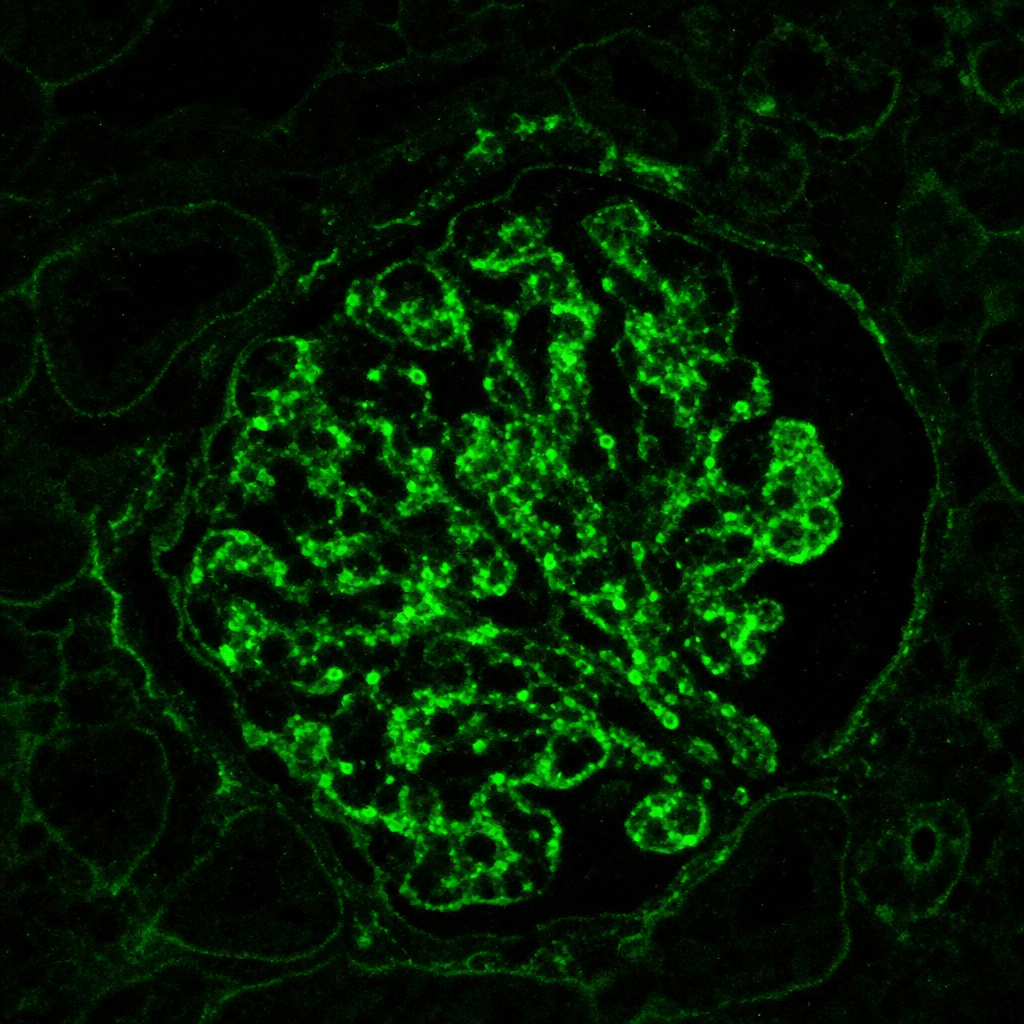
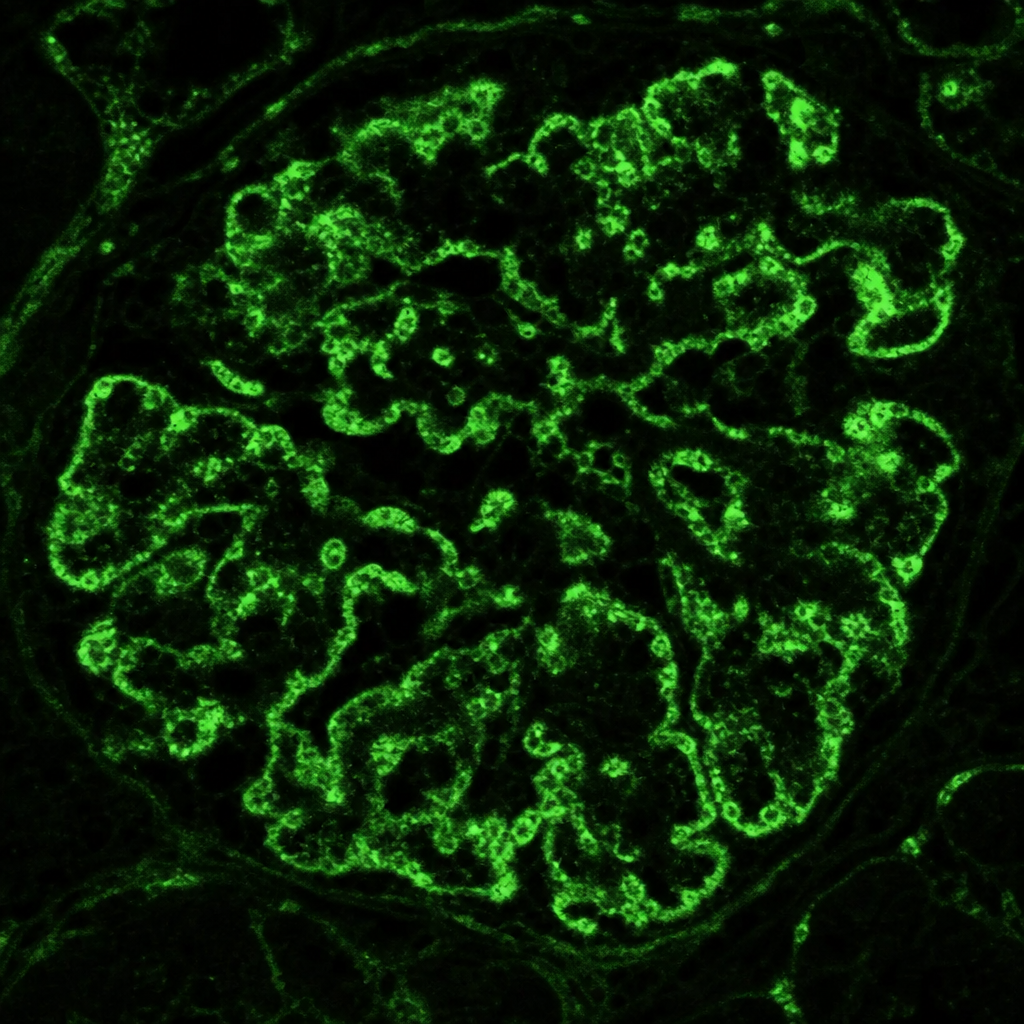
A 45-year-old man presents with hematuria. Renal biopsy demonstrates a focal necrotizing glomerulitis with crescent formation. The patient has a history of intermittent hemoptysis and intermittent chest pain of moderate intensity. A previous chest x-ray had demonstrated multiple opacities, some of which were cavitated. The patient also has chronic cold-like nasal symptoms. Which of the following is the most likely diagnosis?
Which of the following statements about Xanthogranulomatous pyelonephritis is not true?
Which of the following is a characteristic histological finding in Alport syndrome?
The important light microscopical features in Alport syndrome are all, EXCEPT:
A 45-year-old male with a history of recurrent ureteric calculi presented with fever. Following right-sided nephrectomy, gross and histological views were obtained. What is your diagnosis?

Which condition is characterized by effacement of the foot processes of the podocytes?
Post-streptococcal glomerulonephritis (PSGN) is associated with which of the following?
Post-infective glomerulonephritis typically presents as:
SUPAR is a blood marker for which of the following conditions?
Which protein defect causes Finnish nephrotic syndrome?
Explanation: ### Explanation The clinical presentation describes a classic triad of upper respiratory tract, lower respiratory tract, and renal involvement, which is the hallmark of **Granulomatosis with Polyangiitis (GPA)**, formerly known as **Wegener’s Granulomatosis** [1]. **1. Why Wegener’s Granulomatosis is Correct:** * **Upper Respiratory Tract:** Chronic "cold-like" nasal symptoms (often manifesting as sinusitis or saddle-nose deformity) [1]. * **Lower Respiratory Tract:** Hemoptysis and chest pain with imaging showing **cavitary nodules/opacities** [5]. * **Renal Involvement:** Focal necrotizing glomerulitis with **crescents** (Rapidly Progressive Glomerulonephritis - RPGN) [2], [4]. * **Pathology:** It is a small-vessel vasculitis characterized by necrotizing granulomas and is strongly associated with **c-ANCA (PR3-ANCA)** [1], [3]. **2. Why the Other Options are Incorrect:** * **A. Aspergillosis:** While it can cause cavitary lung lesions (fungal ball), it does not typically cause necrotizing glomerulitis or chronic upper airway symptoms in an immunocompetent host. * **B. Polyarteritis Nodosa (PAN):** PAN is a medium-vessel vasculitis. While it involves the kidney (causing microaneurysms and hypertension), it characteristically **spares the lungs** [1], [5]. * **C. Renal Cell Carcinoma (RCC):** While RCC can cause hematuria and lung metastases ("cannonball" lesions), it would not explain the necrotizing glomerulitis or the chronic upper respiratory symptoms. **3. High-Yield Clinical Pearls for NEET-PG:** * **The Triad:** Upper RT + Lower RT + Kidneys = GPA [4]. * **Serology:** c-ANCA (anti-proteinase 3) is highly specific (>90%) [1], [3]. * **Biopsy:** Look for "geographic necrosis" and palisading granulomas. * **Treatment:** Cyclophosphamide and Corticosteroids (Rituximab is an alternative). * **Differential:** Goodpasture Syndrome also presents with lung-renal symptoms but **lacks upper airway involvement** and shows linear IgG deposits on immunofluorescence [2]. **References:** [1] Kumar V, Abbas AK, et al.. Robbins and Cotran Pathologic Basis of Disease. 9th ed. Diseases of Infancy and Childhood, pp. 519-520. [2] Kumar V, Abbas AK, et al.. Robbins and Cotran Pathologic Basis of Disease. 9th ed. The Kidney, pp. 931-933. [3] Kumar V, Abbas AK, et al.. Robbins and Cotran Pathologic Basis of Disease. 9th ed. The Kidney, pp. 917-918. [4] Cross SS. Underwood's Pathology: A Clinical Approach. 6th ed. Common Clinical Problems From Diseases Of The Urinary And Male Genital Tracts, pp. 536-537. [5] Kumar V, Abbas AK, et al.. Robbins and Cotran Pathologic Basis of Disease. 9th ed. Diseases of Infancy and Childhood, pp. 518-519.
Explanation: **Xanthogranulomatous Pyelonephritis (XGP)** is a chronic, destructive form of pyelonephritis characterized by the replacement of renal parenchyma with granulomatous tissue. ### **Explanation of the Correct Answer** **Option B (Associated with tuberculosis) is NOT true.** XGP is primarily associated with **chronic urinary tract infections (UTIs)** caused by urea-splitting organisms, most commonly ***Proteus mirabilis*** and ***Escherichia coli*** [1]. It is not caused by *Mycobacterium tuberculosis*. While both conditions involve granulomatous inflammation, XGP is a response to chronic bacterial infection and urinary obstruction (often by staghorn calculi), whereas renal TB presents with caseating necrosis and different histopathological markers. ### **Analysis of Other Options** * **Option A (Foam cells are seen):** This is a hallmark feature. XGP is characterized by an accumulation of **lipid-laden macrophages (xanthoma cells)**, which give the tissue its characteristic "foamy" appearance [1]. * **Option C (Yellow nodules are seen):** Macroscopically, XGP presents as large, orange-yellow nodules that can mimic Renal Cell Carcinoma (RCC) [1]. This yellow color is due to the high lipid content within the foam cells. * **Option D (Giant cells may be seen):** Histology typically shows a mixture of plasma cells, lymphocytes, neutrophils, and **multinucleated giant cells** as part of the chronic inflammatory infiltrate [1]. ### **High-Yield Clinical Pearls for NEET-PG** * **The "Great Mimicker":** XGP is often mistaken for Renal Cell Carcinoma (RCC) on imaging due to its mass-like appearance [1]. * **The "Bear Paw" Sign:** On CT scan, the cross-sectional appearance of dilated calyces and thinned cortex resembles a bear's paw. * **Association:** Strongly linked with **Staghorn calculi** (struvite stones) and chronic obstruction [1]. * **Michaelis-Gutmann bodies:** These are NOT seen in XGP; they are the hallmark of **Malakoplakia**, another chronic inflammatory renal condition. **References:** [1] Kumar V, Abbas AK, et al.. Robbins and Cotran Pathologic Basis of Disease. 9th ed. The Kidney, pp. 939-940.
Explanation: **Explanation:** **Alport Syndrome** is a hereditary nephritis caused by mutations in the genes encoding the **α-chains of Type IV collagen** (most commonly *COL4A5*). Type IV collagen is a structural cornerstone of the Glomerular Basement Membrane (GBM) [1]. 1. **Why Option C is Correct:** The hallmark of Alport syndrome under electron microscopy (EM) is the **irregular thickening and thinning** of the GBM with **lamination** (splitting) of the lamina densa. This creates a classic **"basket-weave" appearance**. While both thinning and thickening occur, the progressive, irregular thickening and splitting are the diagnostic pathological features that distinguish it from Thin Basement Membrane Disease [1]. 2. **Why Other Options are Incorrect:** * **Option A & B:** While "foam cells" (lipid-laden macrophages) can be seen in the interstitium in Alport syndrome, they are a **non-specific** reactive finding to proteinuria and are not the primary diagnostic histological characteristic of the disease. They are not typically found in the tubular epithelial cells. * **Option D:** Although thinning of the GBM is seen in the *early* stages of Alport syndrome, it is the defining feature of **Thin Basement Membrane Disease (Benign Familial Hematuria)** [1]. In Alport syndrome, the pathology progresses to the characteristic thickened, split membrane. **High-Yield Clinical Pearls for NEET-PG:** * **Inheritance:** Most commonly **X-linked Dominant** [1]. * **Clinical Triad:** Hereditary nephritis (hematuria/ESRD), **Sensorineural deafness**, and Ocular defects (**Anterior Lenticonus**) [1]. * **Diagnosis:** EM is the gold standard ("Basket-weave" appearance). Immunofluorescence shows a lack of staining for Type IV collagen α-chains [1]. * **Differential:** Always distinguish from Thin Basement Membrane Lesion, which presents with isolated hematuria but lacks deafness and the "basket-weave" GBM [1]. **References:** [1] Kumar V, Abbas AK, et al.. Robbins and Cotran Pathologic Basis of Disease. 9th ed. The Kidney, pp. 929-930.
Explanation: Alport Syndrome is a hereditary nephritis caused by mutations in the **COL4A3, COL4A4, or COL4A5** genes, leading to defective Type IV collagen synthesis. This primarily affects the basement membranes of the kidney, eye, and cochlea [1]. **Why "Tubular Hypertrophy" is the correct answer:** In Alport syndrome, the chronic progression of the disease leads to **tubular atrophy**, not hypertrophy [1]. As the glomeruli become sclerosed and interstitial fibrosis sets in, the associated tubules undergo degenerative changes, leading to wasting and atrophy [1]. **Analysis of Incorrect Options:** * **Glomerular changes:** Early light microscopy may be normal, but as the disease progresses, it typically shows focal segmental glomerulosclerosis (FSGS) or global sclerosis [1]. * **Segmental proliferative:** Some cases exhibit focal or diffuse mesangial proliferation or segmental proliferative glomerulonephritis before progressing to sclerosis. * **Interstitial fibrosis:** This is a hallmark of chronic renal involvement in Alport syndrome [1]. A classic light microscopic finding is the presence of **interstitial foam cells** (lipid-laden macrophages), which result from the malabsorption of tubular lipids. **High-Yield Clinical Pearls for NEET-PG:** * **Inheritance:** Most common is **X-linked Dominant** (85%). * **Electron Microscopy (Gold Standard):** Shows characteristic **"Basket-weave appearance"** due to irregular thickening, thinning, and splitting of the Glomerular Basement Membrane (GBM). * **Clinical Triad:** 1. Hereditary Nephritis (Hematuria/ESRD), 2. Sensorineural hearing loss, 3. Ocular defects (Anterior Lenticonus is pathognomonic). * **Diagnosis:** Skin biopsy can sometimes be used for diagnosis (staining for the alpha-5 chain of Type IV collagen) [1]. **References:** [1] Kumar V, Abbas AK, et al.. Robbins and Cotran Pathologic Basis of Disease. 9th ed. The Kidney, pp. 929-930.
Explanation: ***Chronic pyelonephritis with hydronephrosis*** - History of **recurrent ureteric calculi** leads to chronic **obstruction** causing **hydronephrosis** and subsequent chronic pyelonephritis with characteristic **thyroidization** pattern. - Gross findings show **dilated renal pelvis and calyces** with **cortical thinning**, while histology reveals **colloid-like tubular casts**, **periglomerular fibrosis**, and **chronic lymphocytic infiltrate**. *Renal cell carcinoma* - Typically presents as a **solid mass** with **clear cell** or **papillary architecture**, not as dilated collecting system with inflammatory changes. - Usually shows **hemorrhage** and **necrosis** on gross examination, lacking the **hydronephrotic** changes seen with obstruction. *Autosomal dominant polycystic kidney disease* - Characterized by **multiple large cysts** throughout both kidneys with **enlarged kidney size**, not unilateral involvement with calculi history. - Family history is usually positive and presents with **bilateral** involvement and **hypertension**, without the inflammatory thyroidization pattern. *Cystic dysplastic kidney* - A **developmental anomaly** presenting in **neonates/infants** with **primitive ducts** and **cartilage formation** on histology. - Not associated with **calculi** or **infection**, and shows **dysplastic tissue** rather than inflammatory changes and thyroidization.
Explanation: **Explanation:** **Minimal Change Disease (MCD)** is the most common cause of nephrotic syndrome in children [1]. The hallmark of this condition is the **diffuse effacement (flattening/fusion) of the foot processes of podocytes**, which is visible only under **Electron Microscopy (EM)** [2]. Under Light Microscopy, the glomeruli appear normal (hence "minimal change"), and Immunofluorescence is typically negative [1]. The underlying pathophysiology involves T-cell-mediated cytokine production that damages the glomerular polyanion charge, leading to selective proteinuria (mainly albumin) [2]. **Analysis of Incorrect Options:** * **B. Focal Segmental Glomerulosclerosis (FSGS):** While FSGS also shows podocyte effacement, its defining feature is segmental scarring (sclerosis) of some glomeruli visible on Light Microscopy [4]. In the context of "characteristic" findings for exams, MCD is the classic answer for isolated foot process effacement [1]. * **C. Acute Glomerulonephritis (PSGN):** This is a nephritic syndrome characterized by hypercellularity of the glomeruli and subepithelial "humps" (immune complexes) on EM, rather than primary podocyte effacement. * **D. Membranous Nephropathy:** This is characterized by diffuse thickening of the glomerular basement membrane (GBM) due to subepithelial deposits, creating a "spike and dome" appearance on silver stains [3]. **High-Yield Pearls for NEET-PG:** * **MCD Treatment:** Highly responsive to **Corticosteroids** (Steroid-sensitive) [2]. * **Associated Condition:** Hodgkin Lymphoma (in adults). * **Proteinuria Type:** Highly selective (Albuminuria) [2]. * **EM is the Gold Standard:** Necessary for diagnosis because Light Microscopy and Immunofluorescence are unremarkable [2]. **References:** [1] Kumar V, Abbas AK, et al.. Robbins and Cotran Pathologic Basis of Disease. 9th ed. The Kidney, pp. 927-928. [2] Kumar V, Abbas AK, et al.. Robbins and Cotran Pathologic Basis of Disease. 9th ed. The Kidney, pp. 922-923. [3] Kumar V, Abbas AK, et al.. Robbins and Cotran Pathologic Basis of Disease. 9th ed. The Kidney, pp. 919-921. [4] Cross SS. Underwood's Pathology: A Clinical Approach. 6th ed. Common Clinical Problems From Diseases Of The Urinary And Male Genital Tracts, pp. 530-531.
Explanation: Post-streptococcal glomerulonephritis (PSGN) is a classic example of a **Type III hypersensitivity reaction** occurring 1–4 weeks after a Group A Beta-hemolytic Streptococcal infection (pharyngitis or impetigo) [1]. * **Subepithelial immune deposits (Option A):** On electron microscopy, PSGN is characterized by large, electron-dense **"subepithelial humps"** [1]. These represent the deposition of immune complexes (IgG, IgM, and C3) between the epithelial cells (podocytes) and the glomerular basement membrane. * **Nephritis and Acute Renal Failure (Option B):** PSGN typically presents as an **Acute Nephritic Syndrome** [1]. Clinical features include hematuria (cola-colored urine), hypertension, and periorbital edema. In severe cases, the inflammatory process significantly reduces the Glomerular Filtration Rate (GFR), leading to oliguria and acute renal failure. * **Low Complement Levels (Option C):** The pathogenesis involves the activation of the **alternative complement pathway**. This leads to the consumption of serum complement proteins, resulting in **low C3 levels**. Notably, C4 levels usually remain normal. Since all individual statements are hallmark features of the disease, **Option D (All of the above)** is the correct answer. **High-Yield Clinical Pearls for NEET-PG:** * **Light Microscopy:** Shows "Starry sky" or "Lumpy-bumpy" appearance on Immunofluorescence (C3 and IgG) [1]. * **Serology:** Elevated ASO titers (common after pharyngitis) or Anti-DNase B (more sensitive after skin infections/impetigo). * **Prognosis:** Excellent in children (95% recover completely); however, adults have a higher risk of progressing to Chronic Kidney Disease (CKD) or RPGN [1]. * **Complement Recovery:** C3 levels typically return to normal within 6–8 weeks. If they remain low, consider Membranoproliferative Glomerulonephritis (MPGN). **References:** [1] Kumar V, Abbas AK, et al.. Robbins and Cotran Pathologic Basis of Disease. 9th ed. The Kidney, pp. 910-917.
Explanation: **Explanation:** **Post-Infectious Glomerulonephritis (PSGN)** is the classic prototype of **Nephritic Syndrome** [1]. It typically occurs 1–3 weeks after a Group A Beta-hemolytic Streptococcal infection (pharyngitis or impetigo). The underlying mechanism is a **Type III Hypersensitivity reaction**, where immune complexes (containing the SpeB antigen) deposit in the subepithelial space, leading to the characteristic "lumpy-bumpy" appearance on immunofluorescence and "subepithelial humps" on electron microscopy [1], [4]. **Why Nephritic Syndrome is correct:** Nephritic syndrome is characterized by an inflammatory rupture of the glomerular capillaries [3]. This leads to the classic clinical triad: 1. **Hematuria:** Often described as "cola-colored" or "smoky" urine due to RBC casts [3]. 2. **Hypertension and Edema:** Resulting from salt and water retention [3]. 3. **Azotemia:** Decreased GFR leading to oliguria and rising creatinine [3]. **Why other options are incorrect:** * **Acute Renal Failure (ARF):** While PSGN can cause a transient decline in renal function, it rarely progresses to full-blown ARF or Rapidly Progressive Glomerulonephritis (RPGN) in children. * **Nephrotic Syndrome:** This is characterized by massive proteinuria (>3.5g/day), hypoalbuminemia, and hyperlipidemia (e.g., Minimal Change Disease) [2]. PSGN involves "sub-nephrotic" range proteinuria. * **Asymptomatic Hematuria:** This is more characteristic of IgA Nephropathy (Berger’s disease) or Alport Syndrome, where there is persistent or recurrent hematuria without the full systemic inflammatory features of PSGN. **High-Yield Pearls for NEET-PG:** * **Serology:** Low C3 levels are hallmark; C4 is usually normal. ASO titers are elevated in post-pharyngeal cases, while Anti-DNase B is more sensitive for post-skin infections. * **Morphology:** Light microscopy shows a "starry sky" or "garland" pattern of granular deposits [4]. * **Prognosis:** Excellent in children (>95% recover); more likely to progress to chronic renal failure in adults. **References:** [1] Kumar V, Abbas AK, et al.. Robbins and Cotran Pathologic Basis of Disease. 9th ed. The Kidney, p. 915. [2] Cross SS. Underwood's Pathology: A Clinical Approach. 6th ed. Common Clinical Problems From Diseases Of The Urinary And Male Genital Tracts, pp. 527-528. [3] Kumar V, Abbas AK, et al.. Robbins and Cotran Pathologic Basis of Disease. 9th ed. The Kidney, pp. 918-919. [4] Kumar V, Abbas AK, et al.. Robbins and Cotran Pathologic Basis of Disease. 9th ed. The Kidney, pp. 915-916.
Explanation: **suPAR (Soluble Urokinase Plasminogen Activator Receptor)** is a circulating protein that has emerged as a key biomarker and potential pathogenic factor for **Focal Segmental Glomerulosclerosis (FSGS)**, particularly the primary (idiopathic) form. 1. **Why FSGS is correct:** Research indicates that high levels of suPAR in the blood bind to and activate **$\beta$3 integrins** on the surface of podocytes. This activation leads to podocyte foot process effacement, detachment, and subsequent proteinuria. It is especially useful in clinical practice to differentiate primary FSGS from other causes [1] and to predict the risk of recurrence after kidney transplantation. 2. **Why other options are incorrect:** * **Minimal Change Disease (MCD):** While MCD also involves podocyte injury, it is primarily considered a T-cell mediated cytokine disorder [2]. suPAR levels are typically not elevated in MCD, making it a useful marker to distinguish FSGS from MCD. * **Membranous Nephropathy (MN):** The hallmark biomarker for primary MN is the **PLA2R (Phospholipase A2 Receptor) antibody** [3]. suPAR does not play a role in the pathogenesis of the subepithelial deposits seen in MN. **High-Yield Pearls for NEET-PG:** * **FSGS Hallmark:** Light microscopy shows segmental sclerosis in some (focal) glomeruli [1]. * **Electron Microscopy:** Shows global effacement of podocyte foot processes (similar to MCD, but with structural scarring) [2]. * **Genetic Association:** Mutations in the **APOL1 gene** (common in African lineage) are strongly associated with increased susceptibility to FSGS [2]. * **Other Markers:** While suPAR is a circulating factor, **CD80 (B7-1)** is another molecule studied in podocyte injury pathways. **References:** [1] Cross SS. Underwood's Pathology: A Clinical Approach. 6th ed. Common Clinical Problems From Diseases Of The Urinary And Male Genital Tracts, pp. 530-531. [2] Kumar V, Abbas AK, et al.. Robbins and Cotran Pathologic Basis of Disease. 9th ed. The Kidney, pp. 922-928. [3] Kumar V, Abbas AK, et al.. Robbins and Cotran Pathologic Basis of Disease. 9th ed. The Kidney, pp. 921-922.
Explanation: **Explanation:** **Congenital Nephrotic Syndrome of the Finnish type (CNF)** is an autosomal recessive disorder characterized by massive proteinuria starting in utero or shortly after birth. 1. **Why Nephrin is correct:** The primary defect in Finnish nephrotic syndrome is a mutation in the **NPHS1 gene**, which encodes the protein **Nephrin**. Nephrin is a key transmembrane glycoprotein located in the **slit diaphragm** between podocyte foot processes [1]. It acts as a structural scaffold and signaling molecule; its absence leads to the collapse of the filtration barrier, resulting in profound albuminuria and a characteristic "microcystic" dilation of the proximal tubules. 2. **Why the other options are incorrect:** * **Podocin (Option B):** Mutations in the **NPHS2 gene** encoding Podocin cause **Steroid-Resistant Nephrotic Syndrome (SRNS)**, typically presenting as focal segmental glomerulosclerosis (FSGS) in childhood [1]. * **Alpha-actinin-4 (Option C):** Mutations in the **ACTN4 gene** are associated with autosomal dominant forms of **FSGS** [1]. It is an actin-binding protein that maintains the podocyte cytoskeleton. * **CD2-associated protein (Option D):** CD2AP interacts with nephrin and podocin; mutations are rare but can lead to inherited forms of FSGS. **High-Yield Clinical Pearls for NEET-PG:** * **Gene Mnemonic:** **N**ephrin = **N**PHS**1** (Finnish); **P**odocin = **N**PHS**2** (SRNS/FSGS). * **Clinical Marker:** Elevated **Alpha-fetoprotein (AFP)** in maternal serum or amniotic fluid is a diagnostic clue for Finnish nephrotic syndrome. * **Morphology:** Light microscopy shows **microcystic dilation** of proximal convoluted tubules. * **Treatment:** These patients do not respond to steroids; the definitive treatment is bilateral nephrectomy followed by renal transplantation. **References:** [1] Kumar V, Abbas AK, et al.. Robbins and Cotran Pathologic Basis of Disease. 9th ed. The Kidney, pp. 905-907, 923-924.
Congenital Anomalies of the Kidney
Practice Questions
Glomerular Diseases
Practice Questions
Tubular and Interstitial Diseases
Practice Questions
Vascular Diseases of the Kidney
Practice Questions
Cystic Diseases of the Kidney
Practice Questions
Urinary Tract Obstruction and Stones
Practice Questions
Renal Tumors
Practice Questions
Kidney in Systemic Diseases
Practice Questions
Renal Transplantation Pathology
Practice Questions
Urinary Tract Infections
Practice Questions
Get full access to all questions, explanations, and performance tracking.
Start For Free