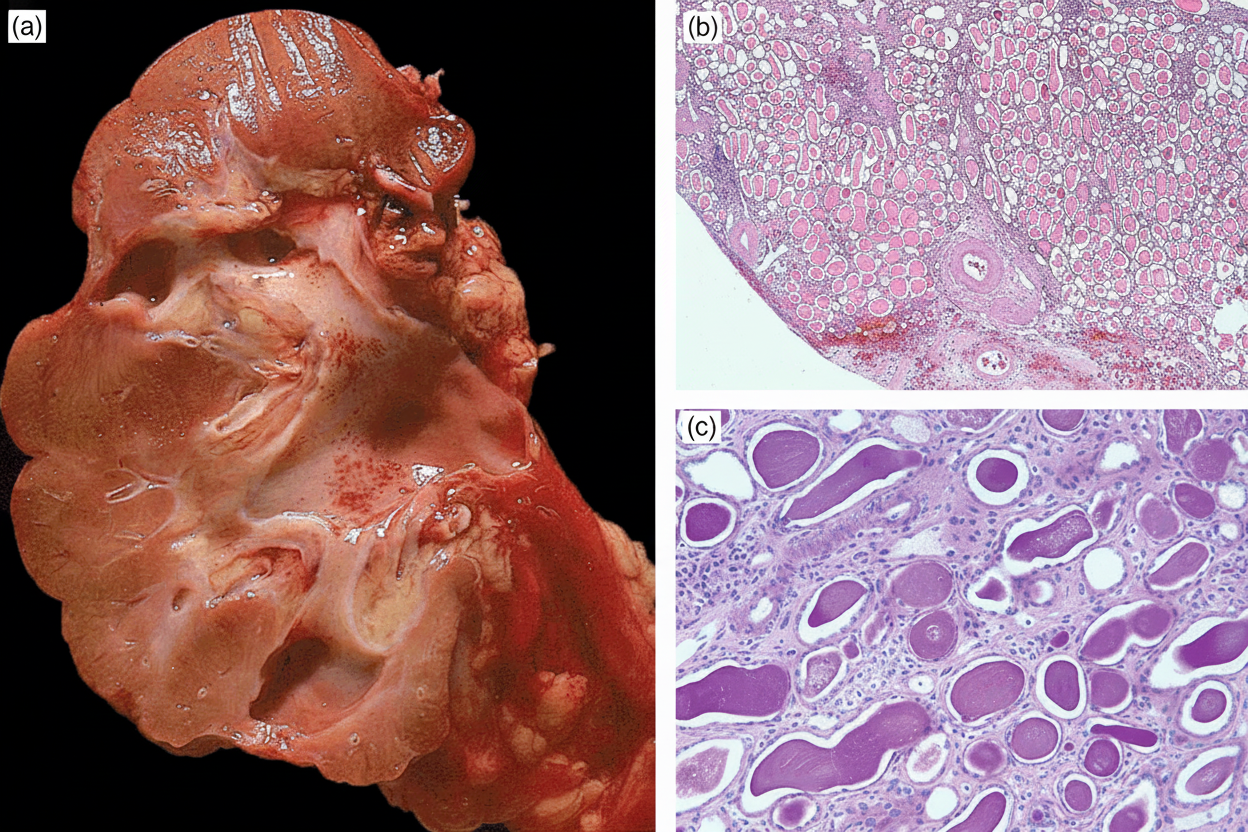
Glomerulosclerosis is a characteristic feature of which of the following conditions?
Effacement of foot processes is pathognomic of which disease?
The NPHP1 gene encodes which of the following proteins?
Goodpasture syndrome is characterized by which of the following?
Which genetic alteration is associated with the chromophobe variant of renal cell carcinoma?
Lipid casts are seen in which of the following conditions?
What is the characteristic feature of kidneys in diabetes mellitus?
Pulmonary hypoplasia with urinary problems is associated with which of the following conditions?
Which of the following genes is associated with the Xp11 translocation variant of renal cell carcinoma?
Bi-Hogg-Dube syndrome is associated with an increased risk of malignancy in which of the following organs?
Explanation: **Explanation:** **Glomerulosclerosis** refers to the scarring or hardening of the glomeruli. While several conditions can lead to glomerular scarring, it is the hallmark pathological feature of **Diabetic Nephropathy** [1]. **1. Why Diabetes Mellitus is Correct:** In Diabetes, chronic hyperglycemia leads to the formation of **Advanced Glycation End-products (AGEs)** and hemodynamic changes (hyperfiltration) [2]. This results in: * **Diffuse Glomerulosclerosis:** The most common pattern, characterized by a generalized increase in mesangial matrix and thickening of the GBM [3]. * **Nodular Glomerulosclerosis (Kimmelstiel-Wilson lesions):** Pathognomonic for diabetes, these are ovoid, laminated hyaline masses in the periphery of the glomerulus [3]. **2. Why other options are incorrect:** * **Hypertension:** Typically leads to **Hyaline Arteriolosclerosis** (thickening of arteriolar walls) [5]. While it can cause "Benign Nephrosclerosis," the term *Glomerulosclerosis* is more specifically associated with the metabolic damage of diabetes in a classic exam context. * **Acute Glomerulonephritis (AGN):** Characterized by **hypercellularity** (proliferation of endothelial/mesangial cells and leucocytic infiltration), not sclerosis. * **Nephrotic Syndrome:** This is a clinical complex, not a single pathology. While some causes (like FSGS) involve sclerosis, others (like Minimal Change Disease) show no light microscopic changes [4]. **High-Yield Clinical Pearls for NEET-PG:** * **Kimmelstiel-Wilson (KW) nodules** are PAS-positive [3]. * The earliest clinical sign of diabetic nephropathy is **Microalbuminuria** (30–300 mg/day). * **Fibrin caps** and **Capsular drops** are other characteristic histological features of Diabetic Nephropathy. * Diabetes is the most common cause of End-Stage Renal Disease (ESRD) worldwide. **References:** [1] Kumar V, Abbas AK, et al.. Robbins and Cotran Pathologic Basis of Disease. 9th ed. The Endocrine System, p. 1121. [2] Kumar V, Abbas AK, et al.. Robbins and Cotran Pathologic Basis of Disease. 9th ed. The Endocrine System, pp. 1119-1121. [3] Kumar V, Abbas AK, et al.. Robbins and Cotran Pathologic Basis of Disease. 9th ed. The Endocrine System, pp. 1121-1122. [4] Kumar V, Abbas AK, et al.. Robbins and Cotran Pathologic Basis of Disease. 9th ed. The Kidney, pp. 907-908. [5] Kumar V, Abbas AK, et al.. Robbins and Cotran Pathologic Basis of Disease. 9th ed. Diseases of Infancy and Childhood, pp. 498-499.
Explanation: ### Explanation **Correct Answer: A. Minimal Change Disease (MCD)** The hallmark of Minimal Change Disease is the **diffuse effacement (fusion) of podocyte foot processes**, visible only under **Electron Microscopy (EM)** [1]. Under Light Microscopy, the glomeruli appear normal (hence "minimal change"), and Immunofluorescence is typically negative [1]. The underlying pathophysiology involves T-cell-mediated cytokine release, which damages the anionic charge of the glomerular basement membrane (GBM), leading to selective proteinuria (primarily albuminuria) [2]. While foot process effacement occurs in other nephrotic syndromes, it is the **defining and pathognomonic ultrastructural feature** required to diagnose MCD in a clinical setting of nephrotic syndrome [1]. **Why other options are incorrect:** * **B. Steroid-resistant GN:** This is a clinical description, not a specific pathological entity. While many cases of Focal Segmental Glomerulosclerosis (FSGS) are steroid-resistant and show foot process effacement, the effacement is often focal rather than the global, uniform effacement seen in MCD [1]. * **C. Membranous Glomerulonephritis:** The characteristic feature is the thickening of the GBM due to **subepithelial immune complex deposits** ("Spike and Dome" appearance on silver stain), not isolated foot process effacement [3]. * **D. IgA Nephropathy:** This is a nephritic syndrome characterized by **mesangial hypercellularity** and IgA-dominant immune deposits in the mesangium [3]. **High-Yield Clinical Pearls for NEET-PG:** * **Most common cause** of nephrotic syndrome in children [1]. * **Clinical Presentation:** Sudden onset of massive edema; highly responsive to **Corticosteroids** (Prednisolone) [2]. * **EM Findings:** Loss of polyanionic charge, foot process effacement, and vacuolization of podocytes [2]. * **Associated with:** Hodgkin Lymphoma and NSAID use in adults. **References:** [1] Kumar V, Abbas AK, et al.. Robbins and Cotran Pathologic Basis of Disease. 9th ed. The Kidney, pp. 927-928. [2] Kumar V, Abbas AK, et al.. Robbins and Cotran Pathologic Basis of Disease. 9th ed. The Kidney, pp. 922-923. [3] Kumar V, Abbas AK, et al.. Robbins and Cotran Pathologic Basis of Disease. 9th ed. The Kidney, pp. 919-921.
Explanation: **Explanation:** The correct answer is **Nephrocystin**. The **NPHP1 gene** encodes the protein **Nephrocystin-1**, which is localized to the primary cilia, basal bodies, and tight junctions of renal tubular epithelial cells. Mutations in this gene are the most common cause of **Nephronophthisis (NPHP)**, an autosomal recessive tubulointerstitial cystic kidney disease. NPHP is a "ciliopathy" that leads to tubular atrophy, interstitial fibrosis, and eventual progression to end-stage renal disease (ESRD) in children and adolescents [1]. **Analysis of Incorrect Options:** * **Fibrocystin (Option A):** Encoded by the **PKHD1** gene [1]. Mutations lead to **Autosomal Recessive Polycystic Kidney Disease (ARPKD)**, characterized by fibrocystin deficiency in the primary cilia [1]. * **Polycystin (Option B):** Encoded by **PKD1** (Polycystin-1) and **PKD2** (Polycystin-2). Mutations in these genes cause **Autosomal Dominant Polycystic Kidney Disease (ADPKD)**. * **Podocin (Option D):** Encoded by the **NPHS2** gene. It is a key component of the glomerular slit diaphragm; mutations lead to steroid-resistant **Nephrotic Syndrome** (specifically FSGS). **High-Yield Clinical Pearls for NEET-PG:** * **Nephronophthisis (NPHP):** Unlike ADPKD, the kidneys in NPHP are typically **small to normal-sized** (shrunken) with cysts located primarily at the **corticomedullary junction** [1]. * **Senior-Løken Syndrome:** A high-yield association where NPHP occurs alongside **Retinitis Pigmentosa**. * **Triad of NPHP:** Polyuria/polydipsia (due to concentrating defects), growth retardation, and progressive renal failure [1]. **References:** [1] Kumar V, Abbas AK, et al.. Robbins and Cotran Pathologic Basis of Disease. 9th ed. The Kidney, pp. 952-954.
Explanation: **Explanation:** **Goodpasture Syndrome (GPS)** is a specific autoimmune disease characterized by the presence of **circulating anti-GBM antibodies**. These antibodies are directed against the non-collagenous domain (NC1) of the **α3 chain of Type IV collagen** [1]. This is the defining pathogenic feature of the disease, making **Option A** the most specific characteristic. * **Why Option A is correct:** The anti-GBM antibodies bind to the basement membranes of both the renal glomeruli and pulmonary alveoli [1]. On immunofluorescence, this results in a classic **linear IgG deposition** along the glomerular basement membrane [2]. * **Why Option B is incorrect:** While crescents are seen in Goodpasture Syndrome (it is a classic cause of Rapidly Progressive Glomerulonephritis - RPGN Type I), crescents are a *morphological* finding common to many diseases (e.g., GPA, SLE, IgA Nephropathy) and are not unique to GPS [1]. * **Why Option C is incorrect:** Pulmonary hemorrhage is a clinical manifestation of the "Goodpasture Antigen" attacking alveolar membranes [1]. However, the syndrome is defined by the *antibody* itself; pulmonary involvement without the antibody is simply called "pulmonary-renal syndrome." * **Why Option D is incorrect:** Diffuse alveolar damage (DAD) is the pathological hallmark of ARDS, not the primary pathology of Goodpasture Syndrome, which typically shows intra-alveolar hemorrhage and hemosiderin-laden macrophages. **High-Yield Clinical Pearls for NEET-PG:** * **Immunofluorescence:** Linear pattern (Pathognomonic) [2]. * **HLA Association:** Strongly associated with **HLA-DRB1** [1]. * **Clinical Triad:** Glomerulonephritis, Pulmonary Hemorrhage, and Anti-GBM antibodies [1]. * **Treatment:** Plasmapheresis (to remove circulating antibodies) + Corticosteroids/Cyclophosphamide [1]. * **Demographics:** Typically affects young males (pulmonary symptoms often precede renal symptoms) [1]. **References:** [1] Cross SS. Underwood's Pathology: A Clinical Approach. 6th ed. Common Clinical Problems From Diseases Of The Urinary And Male Genital Tracts, pp. 526-538. [2] Kumar V, Abbas AK, et al.. Robbins and Cotran Pathologic Basis of Disease. 9th ed. The Kidney, p. 909.
Explanation: ### Explanation **Chromophobe Renal Cell Carcinoma (RCC)** is a distinct subtype of renal cancer derived from the intercalated cells of the collecting ducts [1]. Its genetic profile is characterized by **extreme hypodiploidy** rather than specific gene mutations [1]. #### 1. Why Option D is Correct The hallmark of Chromophobe RCC is the **loss of entire chromosomes (monosomy)** [1]. The most frequent losses involve chromosomes **1, 2, 6, 10, 13, 17, 21, and Y**. Among these, the loss of chromosome 1 and the Y chromosome (in males) are classic diagnostic markers. This widespread chromosomal loss helps differentiate it from other RCC subtypes. #### 2. Why Other Options are Incorrect * **Options A & C (VHL gene / 3p deletions):** These are the genetic signatures of **Clear Cell RCC** (the most common subtype). The *VHL* gene is located on the short arm of chromosome 3 (3p25). * **Option B (Trisomy 7 and 17):** These are characteristic of **Papillary RCC**. Unlike Chromophobe RCC (which loses chromosomes), Papillary RCC is defined by the *gain* of chromosomes (trisomies/polysomies). #### 3. NEET-PG High-Yield Pearls * **Morphology:** Look for "plant-like" cells with prominent cell membranes, perinuclear halos, and "raisinoid" (wrinkled) nuclei [1]. * **Staining:** Chromophobe RCC shows diffuse cytoplasmic positivity with **Hale’s Colloidal Iron stain** (unlike other subtypes). * **Prognosis:** It generally carries a better prognosis compared to Clear Cell RCC [1]. * **Birt-Hogg-Dubé Syndrome:** This hereditary condition is specifically associated with an increased risk of Chromophobe RCC and oncocytomas. **References:** [1] Kumar V, Abbas AK, et al.. Robbins and Cotran Pathologic Basis of Disease. 9th ed. The Kidney, p. 959.
Explanation: **Explanation:** **Lipid casts** (and oval fat bodies) are a hallmark finding in **Nephrotic Syndrome** [1]. The underlying mechanism involves massive proteinuria, which triggers the liver to increase lipoprotein synthesis (hyperlipidemia). These lipids leak through the damaged glomerular basement membrane (lipiduria). When renal tubular epithelial cells (RTECs) endocytose these filtered lipids, they become "oval fat bodies." When these cells or free lipids are trapped within a matrix of Tamm-Horsfall protein in the distal tubules, they form lipid casts [2]. Under polarized microscopy, these show a characteristic **"Maltese Cross" appearance** due to the presence of cholesterol esters [2]. **Analysis of Incorrect Options:** * **Acute Tubular Necrosis (ATN):** Characterized by **"Muddy brown" granular casts** or epithelial cell casts resulting from the sloughing of necrotic tubular cells. * **Cytomegalic Inclusion Disease:** Typically shows characteristic large intranuclear inclusions (**"Owl’s eye" appearance**) within tubular cells, which may be seen in urine sediment as exfoliated cells, but not as lipid casts. **High-Yield Clinical Pearls for NEET-PG:** * **Hyaline casts:** Seen in dehydration or normal exercise (non-specific). * **Red Blood Cell (RBC) casts:** Pathognomonic for **Glomerulonephritis** (Nephritic syndrome). * **White Blood Cell (WBC) casts:** Indicative of **Pyelonephritis** or Tubulointerstitial nephritis. * **Waxy/Broad casts:** Suggestive of **Chronic Renal Failure** (due to stasis in dilated, atrophic tubules). * **Fatty casts + Maltese Cross = Nephrotic Syndrome.** **References:** [1] Cross SS. Underwood's Pathology: A Clinical Approach. 6th ed. Common Clinical Problems From Diseases Of The Urinary And Male Genital Tracts, pp. 527-528. [2] Cross SS. Underwood's Pathology: A Clinical Approach. 6th ed. Common Clinical Problems From Diseases Of The Urinary And Male Genital Tracts, pp. 531-532.
Explanation: ### Explanation **Correct Answer: A. Nodular glomerulosclerosis (Kimmelstiel-Wilson lesions)** **Why it is correct:** Nodular glomerulosclerosis, or **Kimmelstiel-Wilson (KW) lesions**, is the most specific and pathognomonic histological feature of Diabetic Nephropathy [1]. These are ovoid, laminated, hyaline (PAS-positive) nodules located in the periphery of the glomerular tuft within the mesangial matrix [1]. They result from long-standing non-enzymatic glycosylation of proteins and increased mesangial matrix production [2]. **Analysis of Incorrect Options:** * **B. Fibrin cap:** While seen in diabetes, it is a non-specific hyaline accumulation on the surface of glomerular capillaries. It is also found in other glomerular diseases and is not as characteristic as KW lesions. * **C. Papillary necrosis:** This is a complication of diabetes (often triggered by infection/analgesics), but it is not a primary glomerular feature. It is also seen in sickle cell disease and chronic pyelonephritis. * **D. Diffuse glomerulosclerosis:** This is actually the **most common** lesion in diabetic nephropathy, characterized by widespread thickening of the GBM and mesangial expansion [1]. However, it is not as "characteristic" or pathognomonic as the nodular form (KW lesion). **High-Yield Clinical Pearls for NEET-PG:** * **Earliest Change:** Thickening of the Glomerular Basement Membrane (GBM) [2]. * **Most Common Lesion:** Diffuse glomerulosclerosis [1]. * **Most Specific/Pathognomonic Lesion:** Nodular glomerulosclerosis (KW lesions) [1]. * **Armanni-Ebstein Lesions:** Glycosuria-induced glycogen deposits in the distal convoluted tubules (highly specific for DM). * **Clinical Marker:** Microalbuminuria (30–300 mg/day) is the first clinical sign of diabetic nephropathy [2]. **References:** [1] Kumar V, Abbas AK, et al.. Robbins and Cotran Pathologic Basis of Disease. 9th ed. The Endocrine System, pp. 1121-1122. [2] Kumar V, Abbas AK, et al.. Robbins and Cotran Pathologic Basis of Disease. 9th ed. The Endocrine System, p. 1121.
Explanation: **Explanation:** **Potter Syndrome** (or Potter Sequence) is the correct answer. The underlying pathophysiology is **oligohydramnios** (low amniotic fluid). In the fetus, amniotic fluid is primarily composed of fetal urine. Therefore, any severe **urinary tract abnormality**—such as bilateral renal agenesis (most common), polycystic kidney disease, or obstructive uropathy—leads to a lack of urine production. [1] Amniotic fluid is essential for lung development; it distends the airways and provides the necessary pressure for alveolar growth. Its absence leads to **Pulmonary Hypoplasia**, which is the most common cause of death in these neonates. The lack of fluid also causes physical compression of the fetus, resulting in "Potter Facies" (flattened nose, recessed chin, low-set ears) and limb deformities. [1] **Analysis of Incorrect Options:** * **Mobius Syndrome:** A rare neurological condition characterized by congenital facial paralysis and inability to abduct the eyes (CN VI and VII palsy). It does not involve renal or pulmonary pathology. * **Patau Syndrome (Trisomy 13):** Characterized by midline defects like holoprosencephaly, cleft lip/palate, polydactyly, and microphthalmia. While renal cysts can occur, it is not primarily defined by the pulmonary-renal sequence. * **WAGR Syndrome:** A deletion syndrome (11p13) involving **W**ilms tumor, **A**niridia, **G**enitourinary anomalies, and mental **R**etardation. While it involves the kidneys, it does not typically present with the oligohydramnios-induced pulmonary hypoplasia seen in Potter sequence. [2] **High-Yield Clinical Pearls for NEET-PG:** * **Mnemonic for Potter Sequence (POTTER):** **P**ulmonary hypoplasia, **O**ligohydramnios, **T**wisted face (Potter facies), **T**wisted skin, **E**xtremity defects, **R**enal failure. * The most common cause of Potter sequence is **Bilateral Renal Agenesis**. * In the context of "Pulmonary-Renal Syndromes" in adults, think of **Goodpasture Syndrome** or **GPA (Wegener's)**; however, in a neonatal/fetal context, always think of **Potter Syndrome**. **References:** [1] Kumar V, Abbas AK, et al.. Robbins and Cotran Pathologic Basis of Disease. 9th ed. Diseases of Infancy and Childhood, pp. 460-462. [2] Cross SS. Underwood's Pathology: A Clinical Approach. 6th ed. (Basic Pathology) introduces the student to key general principles of pathology, both as a medical science and as a clinical activity with a vital role in patient care. Part 2 (Disease Mechanisms) provides fundamental knowledge about the cellular and molecular processes involved in diseases, providing the rationale for their treatment. Part 3 (Systematic Pathology) deals in detail with specific diseases, with emphasis on the clinically important aspects., pp. 94-95.
Explanation: **Explanation:** **Xp11 translocation renal cell carcinoma (RCC)** is a distinct subtype of renal cancer recognized in the WHO classification. It is characterized by chromosomal translocations involving the **Xp11.2 locus** [1]. * **Why TFE3 is correct:** The molecular hallmark of this entity is the fusion of the **TFE3 gene** (located at Xp11.2) with various partner genes (most commonly *ASPSCR1* or *PRCC*). This translocation leads to the overexpression of the TFE3 protein, which can be detected via **nuclear immunohistochemistry (IHC)**—the diagnostic gold standard. Clinically, this variant is unique because it primarily affects **children and young adults**, though it can occur in older patients. **Analysis of Incorrect Options:** * **VHL (Von Hippel-Lindau):** Associated with **Clear Cell RCC** (the most common subtype). Deletion or mutation of the VHL gene on chromosome 3p leads to HIF-1̱ accumulation. * **MET:** Associated with **Hereditary Papillary RCC** (Type 1) [2]. It is a proto-oncogene encoding a tyrosine kinase receptor for hepatocyte growth factor [2]. * **TSC1 (Tuberous Sclerosis Complex 1):** Mutations in *TSC1* (Hamartin) or *TSC2* (Tuberin) are associated with **Angiomyolipomas** [3] and occasionally specific eosinophilic variants of RCC, but not Xp11 translocations. **High-Yield Clinical Pearls for NEET-PG:** * **Morphology:** Often shows a papillary architecture with "clear cells" and prominent **psammoma bodies**. * **Demographics:** It is the most common RCC in the pediatric population. * **Prognosis:** Generally presents at an advanced stage but has a more indolent course in children compared to adults. * **Key IHC Marker:** Strong nuclear positivity for **TFE3**. **References:** [1] Kumar V, Abbas AK, et al.. Robbins and Cotran Pathologic Basis of Disease. 9th ed. The Kidney, p. 959. [2] Kumar V, Abbas AK, et al.. Robbins and Cotran Pathologic Basis of Disease. 9th ed. The Kidney, pp. 958-959. [3] Kumar V, Abbas AK, et al.. Robbins and Cotran Pathologic Basis of Disease. 9th ed. The Kidney, pp. 957-958.
Explanation: **Explanation:** **Birt-Hogg-Dubé (BHD) Syndrome** is an autosomal dominant genodermatosis caused by a germline mutation in the **FLCN gene** (encoding the protein **Folliculin**), located on chromosome 17p11.2. **Why Kidney is correct:** The hallmark of BHD is the development of multiple, bilateral **Renal Cell Carcinomas (RCC)**. The most characteristic histological subtype associated with BHD is **Chromophobe RCC** or **Oncocytic Hybrid Tumors** (a hybrid of chromophobe RCC and oncocytoma) [1]. However, clear cell and papillary variants can also occur. **Why other options are incorrect:** * **Stomach:** While some hereditary syndromes like Lynch syndrome or Hereditary Diffuse Gastric Cancer (CDH1) involve the stomach, BHD does not have a recognized association with gastric malignancy. * **Lung:** BHD is strongly associated with the lung, but primarily with **benign** manifestations like **pulmonary cysts** and **spontaneous pneumothorax** (due to ruptured blebs), rather than primary lung malignancy. * **Ovaries:** Ovarian cancers are linked to BRCA1/2 or Lynch syndrome, but there is no established link with the FLCN mutation. **Clinical Pearls for NEET-PG:** 1. **Triad of BHD:** * **Cutaneous:** Benign hair follicle tumors (Fibrofolliculomas, Trichodiscomas, and Acrochordons). * **Pulmonary:** Basal lung cysts and spontaneous pneumothorax. * **Renal:** Multiple/bilateral renal tumors (most commonly Chromophobe RCC) [1]. 2. **High-Yield Association:** If a question mentions "Hybrid Oncocytic Tumors," always think of Birt-Hogg-Dubé Syndrome. 3. **Genetics:** FLCN gene mutation (Folliculin) is the definitive molecular marker. **References:** [1] Kumar V, Abbas AK, et al.. Robbins and Cotran Pathologic Basis of Disease. 9th ed. The Kidney, pp. 958-959.
Congenital Anomalies of the Kidney
Practice Questions
Glomerular Diseases
Practice Questions
Tubular and Interstitial Diseases
Practice Questions
Vascular Diseases of the Kidney
Practice Questions
Cystic Diseases of the Kidney
Practice Questions
Urinary Tract Obstruction and Stones
Practice Questions
Renal Tumors
Practice Questions
Kidney in Systemic Diseases
Practice Questions
Renal Transplantation Pathology
Practice Questions
Urinary Tract Infections
Practice Questions
Get full access to all questions, explanations, and performance tracking.
Start For Free