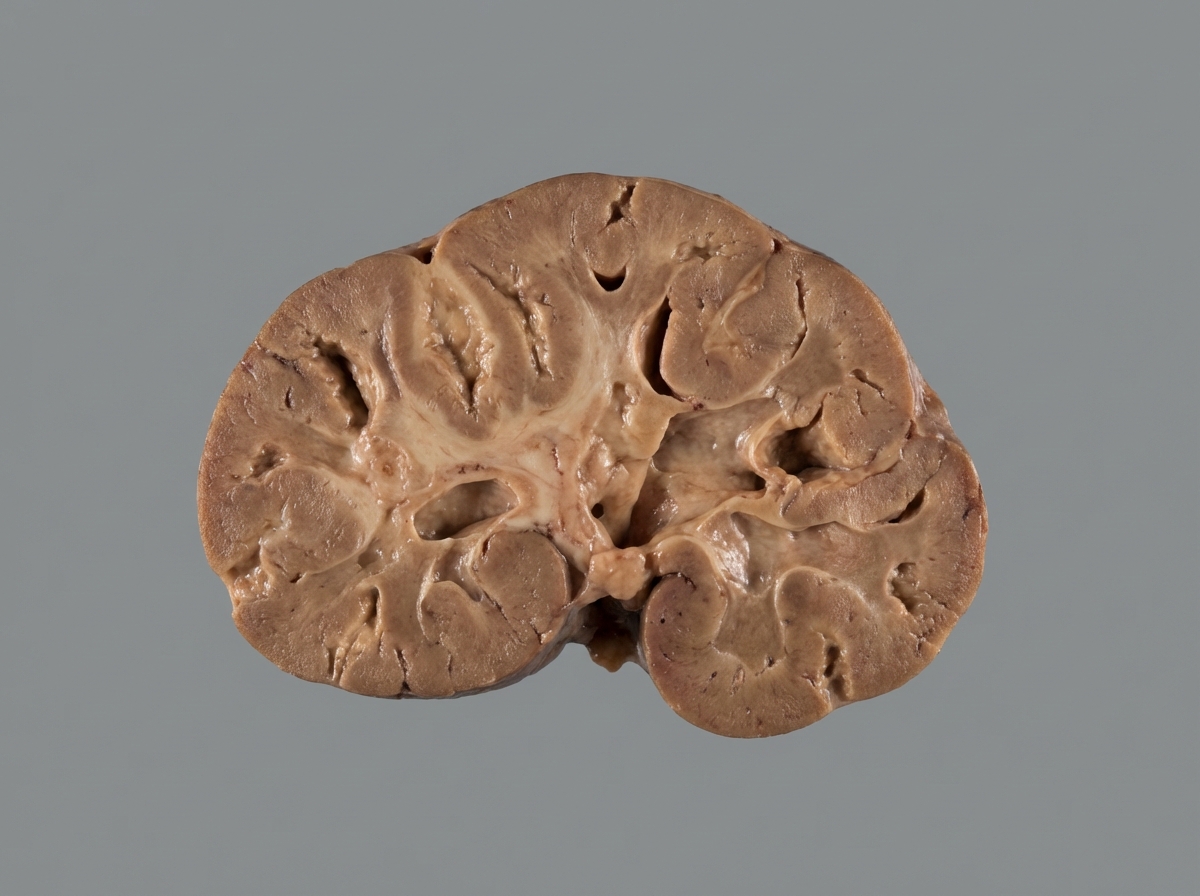
Urine analysis of a patient with hematuria and glomerulonephrosis shows:
Necrotizing papillitis is a feature in all of the following conditions except?
Which chromosome is associated with Autosomal Dominant Polycystic Kidney Disease (ADPKD)?
Which of the following is associated with Renal Papillary Necrosis?
Which of the following is true about minimal change disease?
Mercury primarily affects which part of the kidney?
Which of the following sequelae occurs in Schistosomiasis of the bladder?
A 58-year-old diabetic patient presents with hypertension and frothiness in the urine, with evidence of proteinuria. Renal biopsy demonstrated characteristic lesions of diabetic nephropathy. Which of the following is the most likely diagnosis?
Autosomal recessive polycystic kidney disease is characterized by the altered expression of:
Which of the following is associated with anti-glomerular basement membrane antibody?
Explanation: The key to answering this question lies in distinguishing between **Glomerular** and **Non-glomerular (Urological)** causes of hematuria. [2] ### **Explanation of the Correct Answer** The term **Glomerulonephrosis** (often used interchangeably with Nephrosis) refers to non-inflammatory glomerular disease. However, the presence of **Isomorphic red cells** (RBCs that are uniform in size and shape) typically indicates a **post-glomerular** or **urological** source of bleeding (e.g., stones, tumors, or infections). *Note on Question Context:* In many standard pathology exams, if a patient has hematuria but the RBCs are isomorphic, the bleeding source is likely the urinary tract (ureters, bladder, or urethra) rather than the glomerular filtration barrier itself. ### **Analysis of Incorrect Options** * **B. Red cell casts:** These are the hallmark of **Glomerulonephritis** (nephritic syndrome). Their presence proves that the RBCs originated in the renal tubules, having been trapped in Tamm-Horsfall protein. [1], [3] * **C. WBC casts:** These indicate renal inflammation or infection, most commonly **Acute Pyelonephritis** or Acute Interstitial Nephritis. [1] * **D. Hyaline casts:** These are non-specific and can be seen in normal concentrated urine, dehydration, or after vigorous exercise. They do not indicate hematuria. [1] ### **NEET-PG High-Yield Pearls** * **Dysmorphic RBCs (Acanthocytes):** These are the most sensitive markers for **Glomerular hematuria**. They occur because RBCs get distorted as they squeeze through the damaged glomerular basement membrane. * **Mnemonic for Casts:** * **RBC Casts:** Glomerulonephritis. [1], [3] * **WBC Casts:** Pyelonephritis. [1] * **Fatty Casts ("Maltese Cross"):** Nephrotic Syndrome. * **Broad/Waxy Casts:** Chronic Renal Failure (End-stage renal disease). * **Muddy Brown/Granular Casts:** Acute Tubular Necrosis (ATN). [1] **References:** [1] Cross SS. Underwood's Pathology: A Clinical Approach. 6th ed. Common Clinical Problems From Diseases Of The Urinary And Male Genital Tracts, pp. 520-521. [2] Cross SS. Underwood's Pathology: A Clinical Approach. 6th ed. Common Clinical Problems From Diseases Of The Urinary And Male Genital Tracts, pp. 527-528. [3] Kumar V, Abbas AK, et al.. Robbins and Cotran Pathologic Basis of Disease. 9th ed. Diseases of the Immune System, pp. 230-232.
Explanation: **Explanation:** **Necrotizing Papillitis (Renal Papillary Necrosis)** is a clinicopathologic entity characterized by ischemic necrosis of the renal papillae. The correct answer is **Tuberculous pyelonephritis** because, while tuberculosis causes "caseous necrosis" and can lead to papillary destruction through cavitation, it is not classically categorized under the specific vascular/ischemic syndrome of "Necrotizing Papillitis." **Why the other options are incorrect (Causes of Papillary Necrosis):** The mnemonic **"POSTCARD"** is often used to remember the causes, with the most common being: * **Diabetes Mellitus (Option C):** The most common cause [2]. It involves a combination of ischemia (due to diabetic microangiopathy) and increased susceptibility to infection. * **Analgesic Nephropathy (Option D):** Chronic ingestion of phenacetin or aspirin leads to direct toxicity and inhibition of vasodilatory prostaglandins, causing ischemic necrosis. * **Sickle Cell Disease/Trait (Option A):** Sickling of RBCs in the relatively hypoxic and hypertonic medulla leads to microvascular occlusion and infarction of the papillae [1]. * **Acute Pyelonephritis/Obstruction:** Severe infection or urinary tract obstruction can increase intrarenal pressure, compromising blood flow to the papillae [2]. **NEET-PG High-Yield Pearls:** * **Clinical Presentation:** Patients often present with hematuria, flank pain (due to sloughed papillae obstructing the ureter), and features of a UTI. * **Radiology:** The "Ring Sign" on intravenous pyelography (IVP) is characteristic, representing the radiopaque contrast encircling the sloughed necrotic papilla. * **Pathology:** Grossly, the papillae appear grey-white to yellow [2]. Microscopically, there is coagulative necrosis with preserved outlines of tubules (in non-infected cases). * **Key Distinction:** In Diabetes, all papillae are usually at the same stage of necrosis, whereas in Analgesic Nephropathy, they may be at different stages. **References:** [1] Kumar V, Abbas AK, et al.. Robbins and Cotran Pathologic Basis of Disease. 9th ed. The Kidney, pp. 948-949. [2] Cross SS. Underwood's Pathology: A Clinical Approach. 6th ed. Common Clinical Problems From Diseases Of The Urinary And Male Genital Tracts, pp. 543-544.
Explanation: **Explanation:** **Autosomal Dominant Polycystic Kidney Disease (ADPKD)** is the most common inherited cystic kidney disease [1]. It is characterized by the progressive formation of bilateral renal cysts that eventually lead to end-stage renal disease (ESRD). **1. Why Option C is Correct:** ADPKD is genetically heterogeneous, caused by mutations in two primary genes: * **PKD1 Gene (85% of cases):** Located on **Chromosome 16p13.3**. It encodes the protein **Polycystin-1**. This form is typically more severe, with an earlier onset of renal failure (mean age ~54 years). * **PKD2 Gene (15% of cases):** Located on **Chromosome 4q21**. It encodes **Polycystin-2**. This form progresses more slowly (mean age of ESRD ~74 years). Since Chromosome 16 accounts for the vast majority of cases, it is the most significant association. **2. Why Other Options are Incorrect:** * **Options A, B, and D:** These options include **Chromosome 14**, which is not associated with ADPKD. Chromosome 14 is linked to conditions like Alpha-1 antitrypsin deficiency or certain lymphomas (t14;18). **Chromosome 13** is associated with Wilson’s disease and Retinoblastoma (RB1 gene). **3. High-Yield Clinical Pearls for NEET-PG:** * **Extra-renal Manifestations:** The most common extra-renal site for cysts is the **Liver** (Polycystic Liver Disease). * **Vascular Association:** **Berry Aneurysms** in the Circle of Willis are a high-yield association; rupture leads to Subarachnoid Hemorrhage (SAH). * **Other Associations:** Mitral Valve Prolapse (MVP), diverticulosis, and pancreatic cysts. * **Morphology:** Kidneys are massively enlarged (palpable) with a "multicystic" appearance and no intervening normal parenchyma [1]. **References:** [1] Kumar V, Abbas AK, et al.. Robbins and Cotran Pathologic Basis of Disease. 9th ed. The Kidney, pp. 954-955.
Explanation: **Explanation:** **Renal Papillary Necrosis (RPN)** is a form of nephropathy characterized by ischemic necrosis of the renal papillae. It occurs due to a compromise in the blood supply of the vasa recta, which are the sole source of nourishment for the papillae. **Why Alcohol is Correct:** Chronic **Alcohol** consumption is a recognized risk factor for RPN. Alcohol acts through multiple mechanisms: it induces oxidative stress, causes dehydration, and can lead to direct toxic injury to the renal medulla. Furthermore, chronic alcoholics often have co-morbidities or use analgesics (like NSAIDs) frequently, which synergistically increases the risk of papillary ischemia and subsequent necrosis. **Why Incorrect Options are Wrong:** * **Heroin:** While heroin is strongly associated with **Heroin-Associated Nephropathy (HAN)**, the classic presentation is **Focal Segmental Glomerulosclerosis (FSGS)**, not RPN. * **Morphine & Tramadol:** These are opioid analgesics. Unlike NSAIDs (which inhibit prostaglandins and cause vasoconstriction leading to RPN), pure opioids do not typically cause papillary necrosis. Their primary renal concern is usually related to secondary effects like rhabdomyolysis or urinary retention. **High-Yield Clinical Pearls for NEET-PG:** To remember the causes of Renal Papillary Necrosis, use the mnemonic **POSTCARDS**: * **P** - Pyelonephritis (Acute) [2] * **O** - Obstruction of the urinary tract [2] * **S** - **Sickle Cell Disease/Trait** (Commonly tested; causes micro-infarcts) [1] * **T** - Tuberculosis * **C** - Chronic **Alcoholism** * **A** - **Analgesic Abuse** (NSAIDs/Phenacetin - most common cause) * **R** - Renal vein thrombosis * **D** - **Diabetes Mellitus** (Most common clinical association) [2] * **S** - Systemic Vasculitis **Clinical Presentation:** Patients may present with gross hematuria, flank pain (due to sloughed papillae obstructing the ureter), and "ring shadows" on intravenous pyelography (IVP) [2]. **References:** [1] Kumar V, Abbas AK, et al.. Robbins and Cotran Pathologic Basis of Disease. 9th ed. The Kidney, pp. 948-949. [2] Cross SS. Underwood's Pathology: A Clinical Approach. 6th ed. Common Clinical Problems From Diseases Of The Urinary And Male Genital Tracts, pp. 543-544.
Explanation: **Explanation:** **Minimal Change Disease (MCD)** is the most common cause of nephrotic syndrome in children, accounting for approximately 70–90% of cases in the pediatric age group [1]. The underlying pathophysiology involves T-cell dysfunction leading to the production of a "glomerular permeability factor" that damages the podocytes, resulting in massive selective proteinuria [1]. **Analysis of Options:** * **Option D (Correct):** As stated, MCD is the primary cause of nephrotic syndrome in children (peak age 2–6 years) [3]. It typically presents with sudden onset edema and responds excellently to steroid therapy [1]. * **Option A (Incorrect):** While foot process effacement is indeed the hallmark of MCD on electron microscopy, the question asks for the *most* definitive "true" statement among options that may overlap [2]. However, in many standardized formats, if multiple are true, the clinical epidemiology (Option D) is often the primary identifier. *Note: In a "multiple correct" scenario, A is also pathologically true.* * **Option B (Incorrect):** Immunofluorescence (IF) in MCD is characteristically **negative** (no immune deposits) [2]. IgA deposits are the hallmark of IgA Nephropathy (Berger’s disease). * **Option C (Incorrect):** While it is true that serum complement levels (C3, C4) are **normal** in MCD, this is a non-specific finding shared with other conditions like FSGS and Diabetic Nephropathy. **High-Yield Clinical Pearls for NEET-PG:** * **Light Microscopy:** Glomeruli appear completely **normal** (hence "minimal change") [2]. * **Electron Microscopy:** Diffuse effacement (flattening) of podocyte foot processes [2]. * **Proteinuria:** Highly **selective** (mainly albumin) [2]. * **Treatment:** First-line treatment is **Corticosteroids** (Prednisolone). It is highly steroid-sensitive [2]. * **Association:** In adults, MCD can be associated with **Hodgkin Lymphoma** and NSAID use. **References:** [1] Kumar V, Abbas AK, et al.. Robbins and Cotran Pathologic Basis of Disease. 9th ed. The Kidney, pp. 927-928. [2] Kumar V, Abbas AK, et al.. Robbins and Cotran Pathologic Basis of Disease. 9th ed. The Kidney, pp. 922-923. [3] Kumar V, Abbas AK, et al.. Robbins and Cotran Pathologic Basis of Disease. 9th ed. The Kidney, pp. 919-921.
Explanation: **Explanation:** **1. Why the Correct Answer is Right:** Mercury (specifically inorganic mercuric chloride) is a potent nephrotoxin that primarily targets the **Proximal Convoluted Tubule (PCT)**. This is due to the unique physiological role of the PCT in the reabsorption and concentration of filtered toxins [1]. Mercury ions have a high affinity for sulfhydryl groups in the brush border and mitochondrial membranes of PCT cells. This leads to oxidative stress, mitochondrial dysfunction, and eventually **Acute Tubular Necrosis (ATN)**. In mercury poisoning, the necrosis is characteristically most severe in the **pars recta** (straight portion) of the PCT [1]. **2. Why Incorrect Options are Wrong:** * **Distal Convoluted Tubule (DCT):** While the DCT can be affected in severe, generalized ischemic injury, it is not the primary target for heavy metal toxicity like mercury [1]. * **Collecting Duct:** This area is primarily involved in water reabsorption under the influence of ADH. It is generally resistant to the direct toxic effects of heavy metals. * **Loop of Henle:** While certain drugs (like Fluoride) or ischemia may affect the thick ascending limb, it is not the classic site for mercury-induced damage [1]. **3. Clinical Pearls & High-Yield Facts for NEET-PG:** * **Morphology:** Mercury poisoning leads to the presence of large **acidophilic inclusions** (denatured proteins) within the PCT cells. * **Other Toxins:** * **Ethylene Glycol:** Also targets the PCT but is characterized by **calcium oxalate crystals** in the tubular lumen. * **Carbon Tetrachloride ($CCl_4$):** Targets the PCT and is associated with fatty change. * **Ischemic vs. Toxic ATN:** Ischemic ATN shows "patchy" necrosis across various segments, whereas Toxic ATN (like Mercury) shows "extensive/continuous" necrosis specifically in the PCT [1]. * **Minamata Disease:** This is caused by *organic* mercury (Methylmercury), which primarily affects the Central Nervous System rather than the kidneys. **References:** [1] Kumar V, Abbas AK, et al.. Robbins and Cotran Pathologic Basis of Disease. 9th ed. The Kidney, pp. 933-934.
Explanation: **Explanation:** The correct answer is **Squamous cell carcinoma (SCC)**. **Pathophysiology:** Infection with *Schistosoma haematobium* leads to the deposition of eggs in the bladder wall [1]. This triggers a chronic inflammatory response and **squamous metaplasia** of the normal transitional epithelium (urothelium) [1],[4]. Over time, persistent irritation and the release of N-nitroso compounds by the parasite promote malignant transformation. Unlike the typical smoking-related bladder cancer (which is usually Transitional Cell Carcinoma), Schistosomiasis is the classic risk factor for the **Squamous Cell** variant [1],[2]. **Analysis of Incorrect Options:** * **B. Adenocarcinoma:** While primary bladder adenocarcinoma can occur (often associated with urachal remnants or cystitis glandularis), it is not the characteristic sequela of Schistosomiasis [3]. * **C. Lymphoma:** Primary bladder lymphoma is extremely rare and arises from MALT (Mucosa-Associated Lymphoid Tissue), not from parasitic chronic inflammation. * **D. Sarcoma:** These are mesenchymal tumors (e.g., Rhabdomyosarcoma in children). Schistosomiasis specifically affects the epithelial lining, leading to carcinomas. **High-Yield Clinical Pearls for NEET-PG:** * **Geographic Link:** Most common in Egypt and the Nile Valley [2]. * **Intermediate Host:** *Bulinus* snails. * **Diagnostic Feature:** Presence of eggs with a **terminal spine** on biopsy or urine microscopy. * **Other Sequelae:** Chronic infection also leads to "Sandy patches" (calcified eggs in the mucosa), hydronephrosis, and bladder wall calcification (seen as a "fetal head" appearance on X-ray) [1]. * **Treatment:** Praziquantel is the drug of choice. **References:** [1] Kumar V, Abbas AK, et al.. Robbins and Cotran Pathologic Basis of Disease. 9th ed. Infectious Diseases, pp. 406-408. [2] Kumar V, Abbas AK, et al.. Robbins and Cotran Pathologic Basis of Disease. 9th ed. The Lower Urinary Tract and Male Genital System, pp. 968-970. [3] Kumar V, Abbas AK, et al.. Robbins and Cotran Pathologic Basis of Disease. 9th ed. The Lower Urinary Tract and Male Genital System, pp. 972-973. [4] Kumar V, Abbas AK, et al.. Robbins and Cotran Pathologic Basis of Disease. 9th ed. The Lower Urinary Tract and Male Genital System, pp. 967-968.
Explanation: ### Explanation **Correct Answer: B. Nodular glomerulosclerosis** **Why it is correct:** Nodular glomerulosclerosis, also known as **Kimmelstiel-Wilson (KW) lesions**, is the most specific and characteristic histological finding of diabetic nephropathy [1]. These are ovoid or spherical, laminated, eosinophilic hyaline masses located in the periphery of the glomerulus within the mesangial matrix. While diffuse glomerulosclerosis is more common in diabetics, the presence of these distinct nodules is considered **pathognomonic** for the disease [1]. **Why the other options are incorrect:** * **A. Diffuse glomerulosclerosis:** This is the most common lesion in diabetic nephropathy, characterized by a generalized increase in mesangial matrix [1]. However, it is not as specific as nodular glomerulosclerosis. * **C. Basement membrane thickening:** This is the earliest morphological change detectable by electron microscopy in diabetic patients [2]. While it occurs in almost all cases, it is a non-specific finding seen in various other glomerular diseases. * **D. Crescentic glomerulonephritis:** This is the hallmark of Rapidly Progressive Glomerulonephritis (RPGN). It involves the proliferation of parietal epithelial cells and is not a feature of classic diabetic nephropathy. **High-Yield Clinical Pearls for NEET-PG:** * **Earliest change:** Thickening of the Glomerular Basement Membrane (GBM) [2]. * **Earliest clinical sign:** Microalbuminuria (30–300 mg/day). * **Most common lesion:** Diffuse glomerulosclerosis [1]. * **Most specific/Pathognomonic lesion:** Nodular glomerulosclerosis (Kimmelstiel-Wilson lesions) [1]. * **Fibrin Caps and Capsular Drops:** Other characteristic (though not pathognomonic) hyaline lesions found in diabetic kidneys. * **Armanni-Ebstein lesions:** Vacuoles of glycogen in the tubular epithelial cells (distal convoluted tubule), seen in severe hyperglycemia. **References:** [1] Kumar V, Abbas AK, et al.. Robbins and Cotran Pathologic Basis of Disease. 9th ed. The Endocrine System, pp. 1121-1122. [2] Kumar V, Abbas AK, et al.. Robbins and Cotran Pathologic Basis of Disease. 9th ed. The Endocrine System, p. 1121.
Explanation: **Explanation:** **Autosomal Recessive Polycystic Kidney Disease (ARPKD)** is a hereditary ciliopathy primarily affecting children. The correct answer is **Fibrocystin** because ARPKD is caused by mutations in the **PKHD1 gene** (located on chromosome 6p), which encodes the protein Fibrocystin [1]. This protein is localized to the primary cilia of epithelial cells in the renal collecting ducts and bile ducts, where it regulates cell proliferation and adhesion [1]. **Analysis of Options:** * **Polycystin (A):** Mutations in *Polycystin-1* (PKD1) or *Polycystin-2* (PKD2) cause **Autosomal Dominant Polycystic Kidney Disease (ADPKD)**, which typically presents in adults [1]. * **Nephrocystin (B):** Mutations in the *NPHP* gene family encoding Nephrocystins lead to **Nephronophthisis**, a common cause of end-stage renal disease in children characterized by corticomedullary cysts. * **Uromodulin (C):** Mutations in the *UMOD* gene lead to **Medullary Cystic Kidney Disease Type 2** (now termed Autosomal Dominant Tubulointerstitial Kidney Disease), often associated with hyperuricemia and gout. **High-Yield Clinical Pearls for NEET-PG:** * **Morphology:** ARPKD kidneys show a "sponge-like" appearance with **cylindrical/fusiform dilatation** of collecting ducts. * **Liver Involvement:** ARPKD is universally associated with liver abnormalities, specifically **Congenital Hepatic Fibrosis** and biliary hamartomas (Von Meyenburg complexes). * **Potter Sequence:** Severe cases present in utero with oligohydramnios, leading to pulmonary hypoplasia, flattened facies, and clubfeet. * **Imaging:** On ultrasound, kidneys appear enlarged and echogenic bilaterally. **References:** [1] Kumar V, Abbas AK, et al.. Robbins and Cotran Pathologic Basis of Disease. 9th ed. The Kidney, pp. 952-953.
Explanation: **Explanation:** **Goodpasture’s Syndrome** is the correct answer because it is characterized by the formation of autoantibodies against the **non-collagenous (NC1) domain of the α3 chain of Type IV collagen** [2], which is a structural component of the glomerular basement membrane (GBM) and alveolar basement membrane. This leads to a Type II hypersensitivity reaction, manifesting as **Rapidly Progressive Glomerulonephritis (RPGN Type I)** and pulmonary hemorrhage [1]. On immunofluorescence, it shows a characteristic **linear deposition of IgG** along the GBM [2][3]. **Analysis of Incorrect Options:** * **IgA Nephropathy (Berger’s Disease):** Characterized by the deposition of IgA in the **mesangium**, not anti-GBM antibodies. It is the most common glomerulonephritis worldwide. * **Membranous Glomerulonephritis:** Primarily associated with antibodies against the **Phospholipase A2 Receptor (PLA2R)** on podocytes. It shows a "granular" pattern on immunofluorescence and "spikes" on silver stain. * **Membranoproliferative Glomerulonephritis (MPGN):** Involves immune complex deposition (Type I) or alternative complement pathway activation (Type II/Dense Deposit Disease). It is characterized by "tram-track" appearance due to mesangial interposition. **High-Yield Pearls for NEET-PG:** * **Linear IF Pattern:** Pathognomonic for Anti-GBM disease (Goodpasture’s) [3]. * **HLA Association:** Strongly associated with **HLA-DRB1** [1]. * **Clinical Triad:** Hematuria (nephritic syndrome), Hemoptysis (lung involvement), and anemia [1]. * **Treatment:** Plasmapheresis is crucial to remove circulating anti-GBM antibodies, combined with corticosteroids and cyclophosphamide [1]. **References:** [1] Cross SS. Underwood's Pathology: A Clinical Approach. 6th ed. Common Clinical Problems From Diseases Of The Urinary And Male Genital Tracts, pp. 537-538. [2] Cross SS. Underwood's Pathology: A Clinical Approach. 6th ed. Common Clinical Problems From Diseases Of The Urinary And Male Genital Tracts, pp. 526-527. [3] Kumar V, Abbas AK, et al.. Robbins and Cotran Pathologic Basis of Disease. 9th ed. The Kidney, p. 909.
Congenital Anomalies of the Kidney
Practice Questions
Glomerular Diseases
Practice Questions
Tubular and Interstitial Diseases
Practice Questions
Vascular Diseases of the Kidney
Practice Questions
Cystic Diseases of the Kidney
Practice Questions
Urinary Tract Obstruction and Stones
Practice Questions
Renal Tumors
Practice Questions
Kidney in Systemic Diseases
Practice Questions
Renal Transplantation Pathology
Practice Questions
Urinary Tract Infections
Practice Questions
Get full access to all questions, explanations, and performance tracking.
Start For Free