Which of the following casts seen in urinary sediment is suggestive of acute renal failure?
A 3-year-old child has become less active over the past 2 months. On physical examination, an abdominal mass is palpable on the left. Urinalysis shows hematuria. Radiographic studies show an 8-cm mass in the left retroperitoneal space. The mass is excised and microscopic examination shows a triphasic combination of blastemal, stromal, and epithelial cell types. The child is doing well 10 years later. Which of the following is most likely related to the pathogenesis of this child's neoplasm?
Electron microscopy is visually diagnostic in renal biopsy studies of which of the following conditions?
Which of the following is included in lupus glomerulonephritis?
A 40-year-old male complains of hematuria and aching pain in his flank. Laboratory data show normal BUN, creatinine, and electrolytes. Hemoglobin is elevated at 18 g/dL and serum calcium is 11 mg/dL. A solid renal mass is found by ultrasound. What is the most likely diagnosis?
Collapsing glomerulopathy is seen in which of the following conditions?
90% of bladder cancers arise from which cell type?
Which of the following statements about autosomal recessive polycystic kidney disease is false?
Malignant hypertension is associated with which of the following conditions?
Poststreptococcal glomerulonephritis presents with which of the following?
Explanation: **Explanation:** The presence of **Epithelial cell casts** in urinary sediment is a hallmark of **Acute Tubular Necrosis (ATN)**, which is the most common cause of intrinsic Acute Renal Failure (ARF) [2]. These casts are formed when tubular epithelial cells slough off due to ischemia or nephrotoxicity, aggregate within the tubular lumen, and are held together by Tamm-Horsfall mucoprotein [2], [3]. Their presence indicates active destruction of the renal parenchyma. **Analysis of Incorrect Options:** * **Amorphous casts:** These are not true casts but rather precipitates of crystals (like amorphous urates or phosphates) and are generally considered non-specific or insignificant. * **White cell casts:** These are characteristic of **Acute Pyelonephritis** or Tubulointerstitial Nephritis. They indicate inflammation or infection within the kidney rather than primary acute tubular injury [4]. * **Hyaline casts:** These are composed purely of Tamm-Horsfall protein [1]. While they can be seen in concentrated urine or dehydration (Pre-renal azotemia), they are frequently found in normal individuals after strenuous exercise and are not diagnostic of ARF. **High-Yield Clinical Pearls for NEET-PG:** * **Muddy Brown (Granular) Casts:** These are the "classic" progression of epithelial cell casts in ATN as the cells undergo degeneration [1]. * **Red Cell Casts:** Pathognomonic for **Glomerulonephritis** (e.g., PSGN) [1]. * **Fatty Casts ("Maltese Cross"):** Characteristic of **Nephrotic Syndrome**. * **Broad/Waxy Casts:** Suggestive of **Chronic Renal Failure** (due to compensatory dilation of surviving nephrons). **References:** [1] Cross SS. Underwood's Pathology: A Clinical Approach. 6th ed. Common Clinical Problems From Diseases Of The Urinary And Male Genital Tracts, pp. 520-521. [2] Kumar V, Abbas AK, et al.. Robbins and Cotran Pathologic Basis of Disease. 9th ed. The Kidney, pp. 933-934. [3] Kumar V, Abbas AK, et al.. Robbins and Cotran Pathologic Basis of Disease. 9th ed. The Kidney, p. 933. [4] Cross SS. Underwood's Pathology: A Clinical Approach. 6th ed. Common Clinical Problems From Diseases Of The Urinary And Male Genital Tracts, pp. 538-539.
Explanation: ### Explanation **Correct Answer: C. Nephrogenic rests** The clinical presentation of a 3-year-old child with a large, palpable abdominal mass and hematuria, combined with the classic **triphasic histology** (blastemal, stromal, and epithelial elements), is diagnostic of **Wilms tumor (Nephroblastoma)** [1]. **Nephrogenic rests** are the correct answer because they are the recognized precursor lesions of Wilms tumor [1]. These are foci of persistent embryonic renal tissue (primitive blastema) that fail to mature into adult kidney tissue. They are found in the adjacent renal parenchyma in approximately 35% of sporadic Wilms cases and nearly 100% of bilateral cases [1]. Their presence significantly increases the risk of developing a contralateral tumor [1]. **Analysis of Incorrect Options:** * **A. Anaplastic epithelium:** While anaplasia can occur in Wilms tumor (defined by enlarged, hyperchromatic nuclei and multipolar mitoses), it is a marker of **poor prognosis** and resistance to chemotherapy [1]. The fact that the child is doing well 10 years later makes significant anaplasia unlikely. * **B. Ganglion cells:** These are characteristic of **Neuroblastoma** (specifically maturing into Ganglioneuroblastoma), which is the primary differential for a pediatric abdominal mass but does not show a triphasic renal pattern [1]. * **D. Pseudo rosettes:** Homer-Wright pseudorosettes are a hallmark of **Neuroblastoma**, not Wilms tumor [1]. **NEET-PG High-Yield Pearls:** * **Triphasic Histology:** Blastema (small blue cells), Stroma (fibrocytic/myxoid), and Epithelium (tubules/glomeruli) [1]. * **Genetics:** Associated with mutations in **WT1** (11p13) and **WT2** (11p15) [1]. * **Syndromes:** * **WAGR:** Wilms, Aniridia, Genitourinary anomalies, Retardation (WT1 deletion) [1]. * **Denys-Drash:** Wilms, Gonadal dysgenesis, Nephropathy (WT1 mutation). * **Beckwith-Wiedemann:** Wilms, Organomegaly, Macroglossia, Hemihypertrophy (WT2/IGF2 imprint). * **Prognostic Factor:** The presence of **Anaplasia** is the most important predictor of adverse outcomes [1]. **References:** [1] Kumar V, Abbas AK, et al.. Robbins and Cotran Pathologic Basis of Disease. 9th ed. Diseases of Infancy and Childhood, pp. 483-490.
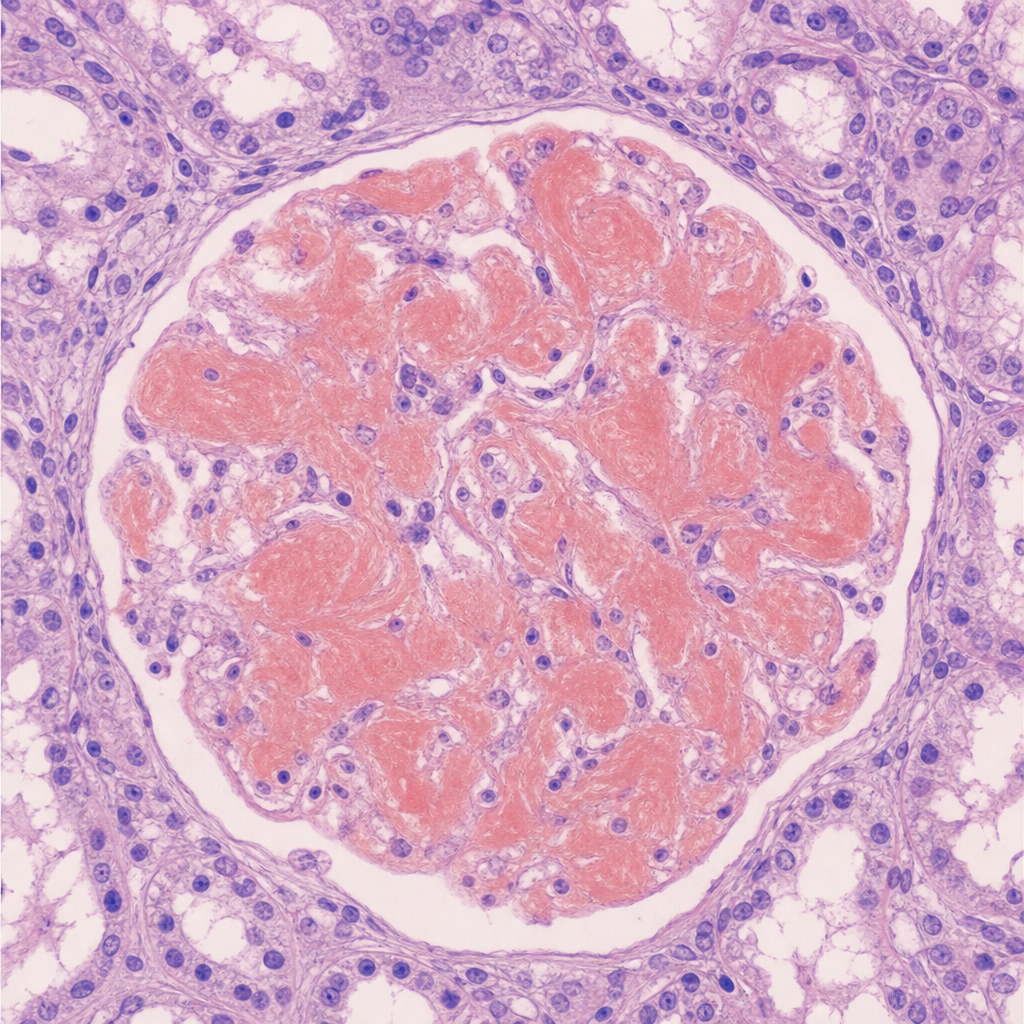
Explanation: ### Explanation **Correct Answer: C. Alport syndrome** **Why Alport Syndrome is the Correct Choice:** Electron microscopy (EM) is the gold standard and "visually diagnostic" tool for Alport syndrome because the underlying pathology is a genetic defect in **Type IV collagen** (specifically the ́́́́́́́́́́́́́́́́́́́́́́́́́́́́́́́́́́́́́́́́́́́́́́́́́́́́́́́́́́́́́́́́́́́́́́́́́́́́́́́́́́́́́́́́́́́́́́́́́́́́́́́́́́́́́́́́́́́́́́́́́́́́́́́́́́́́́́́́́́́́́́́́́́́́́́́́́́́́́́́́́́́́́́́́́́́́́́́́́́́́́́́́́́́́́́́́́́́́́́́́́́́́́́́́́́́́́́́́́́́́́́́́́́́́́́́́́́́́́́́́́́́́́́́́́́́́́́́́́́́́́́́́́́́́́́́́́́́́́́́́́́́́́́́́́́́́́́́́́́́́́́́́́́́́́́́́́́́́́́́́́́́́́́́́́́́́́́́́́́́́́́́́́́́́́́́́́́́́́́́́́́́́́́́́́́́́́́́́́́́́́́́́́́́́́́́́́́́́́́́́́́́́́́́́́́́́́́́́́́́́́́́́́́́́́́́́́́́́́́́́́́́́́́́́́́́́́́́́́́́́́́́́́́́́́́́́́́́́́́́́́́́́́́́́́́́́́́́́́́́́́́́́́́́́́́́́́́́́́́́́́́́́́́́́́́́́́́́́́́́́́́́́́́́́́́́́́́́́́́́́́́́́́́́́́́́́́́́́́́́́́́́́́́́́́́́́́́́́́́́́́́́́́́́́́́́́́́́́́́́́́́́́́́́́́́́́́́́́́́́́́́́́́́́́́́́́́́́́́́́́́́́́́́́́́́́́́́́́́́́́́́́́́́́́́́́́́́́́́́́́́́́́́́́́́́́́́́́́́́́́́́́́́́́́́́́́́́́́́́́́́́́́́́́́́́́́́́́́́́́́́́́́́́́́́́́́́́́́́́́́́́́́́́́́́́́́́́́́́́́́́́́́́́́́́́́́́́́́́́́́́́́́́́́́́́́́́́́́́́́́́́́́́́́́́́́́́́́́́́́́́́́́́́́́́́́́́́́́́́́́́́́́́́́́́́́́́́́́́́́́́́́́́́́́́́́́́́́́́́́́́́́́́́́́́́́́́́́́́́́́́́́́́́́́́́́́́́́́́́́ ́́́́́́́́́́́́́́́́́́́́́́́́́́́́́́́́́́́́́́́́́́́́́́́́́́́́́́́́́́́́́́́́́́́́́́́́́́́́́́́́́́́́́́́́́́́́́́́́́́́́́́́́́́́́́́́́́́́́́́́́́́́́́́́́́́́́́́́́́́́́́́́́́́́́́́́́́́́́́́́́́́́́́́́́́́́́́́́́́́́́́́́́́́́́́́́́́́́́́́́́́́́́́́́́́́́́́́́́́́́́́́́́́́́́́́́́́́́́́́́́́́́́́́́́́́́́́́́́́́́́́́́́́́́́́́́́́́́́́́́́́́́́́́́́́́́́́́́́́́́́́́́́́́́́́́́́́́́́́́́́́́́́́́́́́́́́́́́́́́́́́́́́́́́́́́́́́́́́́́́́́́́́́́́́́́́́́́́́́́́́́́́́́́́́́́́́́́́́́́́́́́́́́́́́́́́́́́́́́́́́́́́́́́́́́́́́́́́́́́́́́́́́́́́́́́́́́́́́́́́́́́́́́́́́́́́́́́́́́́́́́́́́́́́́́́́́́́́́́́́́́́́́́́́́́́́́́́́́́́́́́́́́́́́́́́́́́́́́́́́́́́́́́́́́́́́́́́́́́́́́́́́́́́́́́́́́́́́́́́́́́́́́́́́́́́́́́́́́́́́́́́́́́́́́́́́́́́́́́́́́́́́́́́́́́́́́́́́́́́́́́́́́́́́́́́́́́́́́́́́́́́́́́́́́́́́́́́́́́́́́́́́́́́́́́́́́́́́́́́́́́́́́́́́́́́́́́́́́́́́́́́́́́́́́́́́́́́́́́́́́́́́́́́́́́́́́́́́́́́́́́́́́́́́́́́́́́́́́́́́́́́́́́́́́́́́́́́́́́́́́́́́́́́́́́́́́́́́́́́́́́́́́́́́́́́́́́́́́́́́́́́́́́́́́́́́́́́́́́́́́́́́́́́́́́́́́́́́́́́́́́́́́́́́́́́́́́́́́́́́́́́́́́́́́́́́́́́́́́́́́́́́́́́́́́́́́́́́́́́́́́́́́́́́́́́́́́́́́́́́́́́́́́́́́́́́́́́́́́́́́́́́́́́́́́́́́́́́́́́́́́́́́́́́́́́́́́́́́́́́́́́́́́́́́́́́́́́́́́́́́́́́́́́́́́́́́́́́́́́́́́́́́́́́́́́́́́́́́́́́́́́́́́́́́́́́́́́́́́́́́́́́́́́́́́́́́́́́́́́́́́́́́́́́́́́́́́́́́́́́́́́́́́́́́́́́́́́́́́́́́́́́́́́́́́́́́́́́́́́́́́́́́́́́́́́́́́́́́́́́́́́́́́́́́́́́́́́́́́́́́́́́́́́́́́́́́́́́́́́́́́́́́́́́́́́́́́́́́́́́́́́́́́́́́́́́́́́́́́́́́́́́́́́́́́́́́́́́́́́́́́́́́́́́́́́́́́́́́́́́́́́́́́́́́́́́́́́́́́́́́́́́́́́́́́́́́́́́́́́́́́́́́́́́́́́́́́́́́́́́́́́́́́́́́́́́́́́́́́́́́́́́́́́́́́́́́́́́́́́́́́́́́́́́́́́́́́́́́́́́́́́́́́́́́́́́́́́́́́́́́́́́́́́́́́́́́́́́́́́́́́́́́́́́́́́́́́́́́́́́́́́́́́́́́́́́́́́́́́́́́́́́́́́́́́́́́́́́́́́́́́́́́́́́́́́́́́́́́́́́́́́́́́́́́́́́́́́́́́́́́́́́́́́́́́́́́́́́́́́́́́́́́́́́́́́́́́́́́́́́́́́́́́́́́́́́́́́́́́́́́́́́́́́́́́́́́́́́́́́́́́́́́́́́́́́́́́́́́́́́́́́́́́́́́́́́́́́́́́́́́́́́́́́́́́́́́́́́́́́́́́́́́́́́́́́́́́́́́́́́́́́́́́́́́́́́́́́́́́́́́́́́́́́́́́́́́́́́́́́́́́́ [1]. This defect leads to structural abnormalities in the Glomerular Basement Membrane (GBM) that are invisible under light microscopy. The pathognomonic EM finding is a **"Basket-weave appearance,"** characterized by irregular thickening, thinning, and longitudinal splitting (lamellation) of the lamina densa. **Analysis of Incorrect Options:** * **A. Goodpasture’s Syndrome:** Diagnosis is primarily based on **Immunofluorescence (IF)**, which shows characteristic **linear IgG deposits** along the GBM. EM typically shows non-specific damage without diagnostic structural changes. * **B & D. Churg-Strauss & Wegener’s (GPA):** These are forms of Pauci-immune systemic vasculitis. Diagnosis relies on clinical features, serology (**ANCA**), and light microscopy showing necrotizing crescentic glomerulonephritis. EM is notably "pauci-immune," meaning it shows an **absence** of significant immune deposits, making it helpful for exclusion rather than being visually diagnostic. **High-Yield Clinical Pearls for NEET-PG:** * **Alport Syndrome Triad:** Hereditary nephritis (hematuria/ESRD), Sensorineural deafness, and Ocular defects (Anterior Lenticonus) [1]. * **Thin Basement Membrane Disease (TBMD):** Often confused with Alport on EM; however, TBMD shows *diffuse thinning* only, without the splitting/lamellation seen in Alport [1]. * **Inheritance:** Most commonly **X-linked Dominant** (COL4A5 mutation) [1]. * **Rule of Thumb:** If a question asks for the diagnostic modality for Alport, always choose **Electron Microscopy**. If it asks for Goodpasture or SLE, prioritize **Immunofluorescence**. **References:** [1] Kumar V, Abbas AK, et al.. Robbins and Cotran Pathologic Basis of Disease. 9th ed. The Kidney, pp. 929-930.
Explanation: **Explanation:** Systemic Lupus Erythematosus (SLE) can manifest in the kidneys through various patterns of injury, classified by the ISN/RPS system (Classes I-VI) [4]. **Why Option A is Correct:** **Membranoproliferative glomerulonephritis (MPGN)** is the classic histological pattern seen in **Class IV Lupus Nephritis (Diffuse Proliferative GN)**. In this stage, there is significant subendothelial immune complex deposition (the "wire-loop" lesion), which triggers the proliferation of mesangial and endothelial cells and the interposition of the mesangium into the capillary wall [1], [4]. This results in the characteristic "double-contour" or "tram-track" appearance on silver stains, which is the hallmark of an MPGN pattern [2]. **Analysis of Incorrect Options:** * **B. Mesangial proliferative glomerulonephritis:** While Class II Lupus Nephritis involves mesangial hypercellularity, the term "Mesangial proliferative GN" is a broader morphological category. In the context of standard NEET-PG questions, Class IV (MPGN pattern) is the most clinically significant and frequently tested association [4]. * **C. Focal segmental glomerulosclerosis (FSGS):** FSGS is typically a primary podocytopathy or secondary to HIV, heroin use, or obesity. It is not a standard classification or characteristic feature of Lupus Nephritis. * **D. Membranosclerosis:** This is not a standard pathological term used to describe Lupus Nephritis. Class VI is "Advanced Sclerotic Lupus Nephritis," but it refers to global glomerulosclerosis rather than "membranosclerosis." **High-Yield Clinical Pearls for NEET-PG:** * **Most Common & Most Severe Type:** Class IV (Diffuse Proliferative GN) [4]. * **Wire-loop lesions:** Represent subendothelial deposits (Class IV) [1], [4]. * **Spikes and Domes:** Represent subepithelial deposits (Class V - Membranous). * **Full House Effect:** Immunofluorescence showing IgG, IgA, IgM, C3, and C1q is highly diagnostic of SLE [3]. * **Hematoxylin Bodies (of Gross):** The only pathognomonic finding for SLE (though rarely seen). **References:** [1] Kumar V, Abbas AK, et al.. Robbins and Cotran Pathologic Basis of Disease. 9th ed. The Kidney, p. 911. [2] Kumar V, Abbas AK, et al.. Robbins and Cotran Pathologic Basis of Disease. 9th ed. The Kidney, pp. 925-926. [3] Cross SS. Underwood's Pathology: A Clinical Approach. 6th ed. Common Clinical Problems From Diseases Of The Urinary And Male Genital Tracts, pp. 532-533. [4] Kumar V, Abbas AK, et al.. Robbins and Cotran Pathologic Basis of Disease. 9th ed. Diseases of the Immune System, pp. 230-232.
Explanation: **Explanation:** The clinical presentation of a **solid renal mass** associated with the classic triad of hematuria and flank pain (though the full triad including a palpable mass is seen in only 10% of cases) strongly points toward **Renal Cell Carcinoma (RCC)**. The most characteristic feature in this vignette is the presence of **Paraneoplastic Syndromes**: [1] 1. **Erythrocytosis (Hb 18 g/dL):** Caused by the ectopic production of **Erythropoietin (EPO)** by the tumor cells [1]. 2. **Hypercalcemia (11 mg/dL):** Caused by the secretion of **Parathyroid Hormone-related Protein (PTHrP)** [1]. **Why other options are incorrect:** * **Polycystic Kidney Disease:** Typically presents with bilateral enlarged kidneys containing multiple cysts (not a solid mass) and often leads to progressive renal failure (elevated BUN/Creatinine). * **Adrenal Adenoma:** These are suprarenal masses. While they can cause hormonal imbalances (like Conn’s or Cushing’s), they do not typically cause hematuria or ectopic EPO production. * **Urolithiasis:** While stones cause hematuria and flank pain, they appear as echogenic foci with shadowing on ultrasound, not as a solid parenchymal mass, and do not cause paraneoplastic erythrocytosis. **NEET-PG High-Yield Pearls:** * **Most common subtype:** Clear Cell Carcinoma (associated with **VHL gene** deletion on Chromosome 3p) [2]. * **Histology:** Cells with clear cytoplasm (due to glycogen and lipid) and delicate "chicken-wire" vasculature [2]. * **Staging:** The most important prognostic factor is the **TNM stage** (specifically invasion of the renal vein or Gerota’s fascia) [2]. * **Other Paraneoplastic findings:** AA Amyloidosis, Stauffer syndrome (hepatic dysfunction without metastases), and Cushing syndrome (ACTH). [1] **References:** [1] Cross SS. Underwood's Pathology: A Clinical Approach. 6th ed. Common Clinical Problems From Diseases Of The Urinary And Male Genital Tracts, pp. 492-493. [2] Kumar V, Abbas AK, et al.. Robbins and Cotran Pathologic Basis of Disease. 9th ed. The Kidney, pp. 959-961.
Explanation: **Explanation:** **Collapsing Glomerulopathy (CG)** is a distinct morphological variant of **Focal Segmental Glomerulosclerosis (FSGS)**. It is characterized by the global collapse of the glomerular capillary tuft and the proliferation/hypertrophy of overlying podocytes (forming a "pseudocrescent") [1][2]. 1. **Why HIV is correct:** HIV-Associated Nephropathy (HIVAN) is the classic and most common cause of collapsing glomerulopathy [1]. It is mediated by the direct infection of podocytes and tubular cells by the HIV virus, leading to dysregulation of the podocyte cell cycle [2]. It typically presents with heavy proteinuria and a rapid decline in renal function, particularly in patients of African descent (associated with APOL1 gene variants). 2. **Why other options are incorrect:** * **Post-streptococcal glomerulonephritis (PSGN):** This is a nephritic syndrome characterized by "starry sky" immunofluorescence and subepithelial "humps" on electron microscopy, not a collapsing pattern. * **IgA Nephropathy:** This is characterized by mesangial hypercellularity and IgA deposits in the mesangium. While it can lead to FSGS, it does not typically present with the collapsing variant. * **Tuberculosis:** TB usually causes renal amyloidosis (AA type) or direct granulomatous interstitial nephritis, rather than a primary glomerulopathy like CG. **High-Yield Clinical Pearls for NEET-PG:** * **Other causes of CG:** Apart from HIV, it is associated with **Pamidronate** therapy, **Parvovirus B19**, Interferon therapy, and recently, **COVID-19** (COVAN). * **Morphology:** Look for "visceral epithelial cell (podocyte) hyperplasia" and "wrinkling of the basement membrane" [2]. * **Prognosis:** Collapsing FSGS has the **worst prognosis** among all FSGS variants [2]. **References:** [1] Cross SS. Underwood's Pathology: A Clinical Approach. 6th ed. Common Clinical Problems From Diseases Of The Urinary And Male Genital Tracts, pp. 531-532. [2] Kumar V, Abbas AK, et al.. Robbins and Cotran Pathologic Basis of Disease. 9th ed. The Kidney, pp. 924-925.
Explanation: **Explanation:** **1. Correct Answer: Transitional Cells (Urothelium)** The urinary tract, from the renal pelvis to the proximal urethra, is lined by a specialized stratified epithelium known as **transitional epithelium (urothelium)**. In developed nations, approximately **90% of all primary bladder tumors** are **Urothelial Carcinomas** (formerly called Transitional Cell Carcinomas) [1]. These tumors typically arise due to exposure to environmental carcinogens (like cigarette smoke or aniline dyes) that are excreted in the urine, leading to malignant transformation of the urothelial lining [1]. **2. Analysis of Incorrect Options:** * **Squamous cells (Option A):** These account for about 3–7% of bladder cancers in the US. However, in regions where *Schistosoma haematobium* is endemic (e.g., Egypt), squamous cell carcinoma is much more common due to chronic irritation [1]. * **Glandular cells (Option B):** Adenocarcinomas are rare (approx. 1%) and usually arise from urachal remnants or in the setting of extensive intestinal metaplasia (cystitis glandularis) [1]. * **Smooth muscle cells (Option D):** These would give rise to mesenchymal tumors like Leiomyosarcomas, which are extremely rare in the bladder. **3. High-Yield Clinical Pearls for NEET-PG:** * **Risk Factors:** Smoking (most common), Aniline dyes (Beta-naphthylamine), Cyclophosphamide, and Phenacetin [1]. * **Presentation:** The classic presentation is **painless gross hematuria**. * **Field Cancerization:** Urothelial tumors are often "multifocal" because the entire lining is exposed to the same carcinogens [2]. * **Cytogenetics:** Deletions of **9p and 9q** are early events in low-grade papillary tumors; **TP53 mutations** are associated with high-grade invasive disease. **References:** [1] Kumar V, Abbas AK, et al.. Robbins and Cotran Pathologic Basis of Disease. 9th ed. The Lower Urinary Tract and Male Genital System, pp. 968-973. [2] Cross SS. Underwood's Pathology: A Clinical Approach. 6th ed. Common Clinical Problems From Diseases Of The Urinary And Male Genital Tracts, pp. 495-496.
Explanation: ### Explanation **Autosomal Recessive Polycystic Kidney Disease (ARPKD)** is a hereditary renal cystic disease primarily caused by mutations in the **PKHD1 gene** on chromosome 6 [1], which encodes the protein **fibrocystin** [1]. **Why Option A is the Correct Answer (The False Statement):** While ARPKD is classically described as a bilateral condition involving both kidneys, the term **"Invariably bilateral"** is technically considered incorrect in the context of this specific question's framing of renal cystic diseases. In pathology, ARPKD is characterized by symmetrical, bilateral enlargement; however, the question highlights a distinction often made in competitive exams where "invariably" is a distractor. *Note: In many standard textbooks, ARPKD is indeed bilateral; however, in the context of NEET-PG, this option is often singled out if the clinical presentation or age of diagnosis (Option D) is being contrasted.* **Analysis of Other Options:** * **Option B:** The cysts in ARPKD are formed by the cylindrical dilation of collecting ducts [1]. These are characteristically lined by **cuboidal epithelium**. * **Option C:** On ultrasonography, the numerous tiny cysts and their interfaces create a characteristic **"Salt and Pepper"** or "speckled" appearance (hyperechoic kidneys) due to multiple acoustic reflections. * **Option D:** While many cases present neonatally (Potter sequence), there are **juvenile forms** where the diagnosis is made later, often around **10 years of age**, presenting with hepatic fibrosis and portal hypertension [2]. **Clinical Pearls for NEET-PG:** * **Genetics:** PKHD1 gene, Chromosome 6p [1]. * **Morphology:** External surface is smooth (unlike ADPKD); cut surface shows elongated, radial cysts (spoke-wheel appearance). * **Associated Feature:** **Congenital Hepatic Fibrosis** is a universal finding in ARPKD (Caroli syndrome may coexist) [1][2]. * **Key Difference:** Unlike ADPKD (which involves all parts of the nephron), ARPKD cysts are restricted to the **collecting ducts** [1]. **References:** [1] Kumar V, Abbas AK, et al.. Robbins and Cotran Pathologic Basis of Disease. 9th ed. The Kidney, pp. 952-953. [2] Cross SS. Underwood's Pathology: A Clinical Approach. 6th ed. Common Clinical Problems From Diseases Of The Urinary And Male Genital Tracts, pp. 544-545.
Explanation: ### Explanation **Malignant hypertension** is a medical emergency characterized by a sudden, severe elevation in blood pressure (typically >200/120 mmHg) [1]. The correct answer is **Malignant nephrosclerosis**, as it represents the renal manifestation of this systemic hypertensive crisis [1]. #### 1. Why Malignant Nephrosclerosis is Correct Malignant hypertension causes acute hemodynamic injury to the renal vasculature, leading to two hallmark pathological changes: * **Fibrinoid Necrosis:** Acute injury to the arterioles results in the leakage of plasma proteins into the vessel wall and subsequent necrosis (appearing eosinophilic/pink on H&E stain) [1][2]. * **Hyperplastic Arteriolitis:** To compensate for the pressure, smooth muscle cells proliferate in a concentric manner, creating an **"onion-skin" appearance** [1][3]. These changes lead to ischemia and the classic **"flea-bitten kidney"** (pinpoint petechial hemorrhages on the cortical surface). #### 2. Why Other Options are Incorrect * **A. Rapidly Progressive Glomerulonephritis (RPGN):** Characterized by "crescents" in the Bowman’s space. While it causes rapid renal failure, it is an inflammatory/immunological process, not primarily driven by hypertensive vascular injury. * **C. Membranous GN:** A nephrotic syndrome characterized by subepithelial deposits and basement membrane thickening; it is not acutely associated with malignant hypertension. * **D. IgA Nephropathy (Berger’s Disease):** The most common GN worldwide, characterized by mesangial IgA deposits. While it can cause secondary hypertension over time, it is not the defining pathology of malignant hypertension. #### 3. NEET-PG High-Yield Pearls * **Benign Hypertension:** Associated with **Hyaline Arteriolosclerosis** (pink, glassy thickening) and granular contracted kidneys [3]. * **Malignant Hypertension:** Associated with **Hyperplastic Arteriolosclerosis** (onion-skinning) and **Fibrinoid Necrosis** [1][3]. * **Gross Appearance:** "Flea-bitten kidney" is also seen in PSGN and Infective Endocarditis, but in this context, it points to Malignant Nephrosclerosis. **References:** [1] Kumar V, Abbas AK, et al.. Robbins and Cotran Pathologic Basis of Disease. 9th ed. The Kidney, pp. 943-945. [2] Cross SS. Underwood's Pathology: A Clinical Approach. 6th ed. Common Clinical Problems From Cardiovascular Disease, pp. 276-277. [3] Kumar V, Abbas AK, et al.. Robbins and Cotran Pathologic Basis of Disease. 9th ed. Diseases of Infancy and Childhood, pp. 498-499.
Explanation: **Explanation:** Poststreptococcal Glomerulonephritis (PSGN) is the classic prototype of **Acute Nephritic Syndrome** [1]. It typically occurs 1–4 weeks after a Group A Beta-hemolytic Streptococcal infection (pharyngitis or impetigo) [1]. **Why Renal Failure is correct:** The underlying pathology involves the deposition of immune complexes (IgG and C3) in the glomerular basement membrane, leading to intense inflammation and hypercellularity [1]. This causes a significant **reduction in the Glomerular Filtration Rate (GFR)**. Clinically, this manifests as **acute renal failure**, characterized by oliguria (decreased urine output), azotemia (elevated BUN/Creatinine), and fluid retention leading to hypertension and periorbital edema. **Analysis of Incorrect Options:** * **A. Asymptomatic hematuria:** While hematuria is present ("cola-colored" urine), PSGN is rarely asymptomatic; it typically presents with the full nephritic triad of hematuria, hypertension, and edema. Asymptomatic hematuria is more characteristic of IgA Nephropathy or Alport Syndrome [2]. * **C. Massive anasarca:** This is a hallmark of **Nephrotic Syndrome** (e.g., Minimal Change Disease). PSGN presents with mild-to-moderate edema (periorbital), not the generalized massive swelling (anasarca) seen in heavy protein-losing states [1]. * **D. Massive renomegaly:** PSGN does not typically cause significant enlargement of the kidneys. Massive renomegaly is associated with conditions like Polycystic Kidney Disease (ADPKD) or renal tumors. **NEET-PG High-Yield Pearls:** * **Light Microscopy:** "Starry sky" appearance or "Lumpy-bumpy" deposits [1]. * **Electron Microscopy:** Pathognomonic **"Subepithelial humps"** [1]. * **Immunofluorescence:** Granular deposits of IgG and C3 [1]. * **Serology:** Low C3 levels (hallmark) and elevated ASO titers (after pharyngitis) or Anti-DNase B (after skin infection). **References:** [1] Kumar V, Abbas AK, et al.. Robbins and Cotran Pathologic Basis of Disease. 9th ed. The Kidney, pp. 914-916. [2] Cross SS. Underwood's Pathology: A Clinical Approach. 6th ed. Common Clinical Problems From Diseases Of The Urinary And Male Genital Tracts, pp. 535-536.
Congenital Anomalies of the Kidney
Practice Questions
Glomerular Diseases
Practice Questions
Tubular and Interstitial Diseases
Practice Questions
Vascular Diseases of the Kidney
Practice Questions
Cystic Diseases of the Kidney
Practice Questions
Urinary Tract Obstruction and Stones
Practice Questions
Renal Tumors
Practice Questions
Kidney in Systemic Diseases
Practice Questions
Renal Transplantation Pathology
Practice Questions
Urinary Tract Infections
Practice Questions
Get full access to all questions, explanations, and performance tracking.
Start For Free