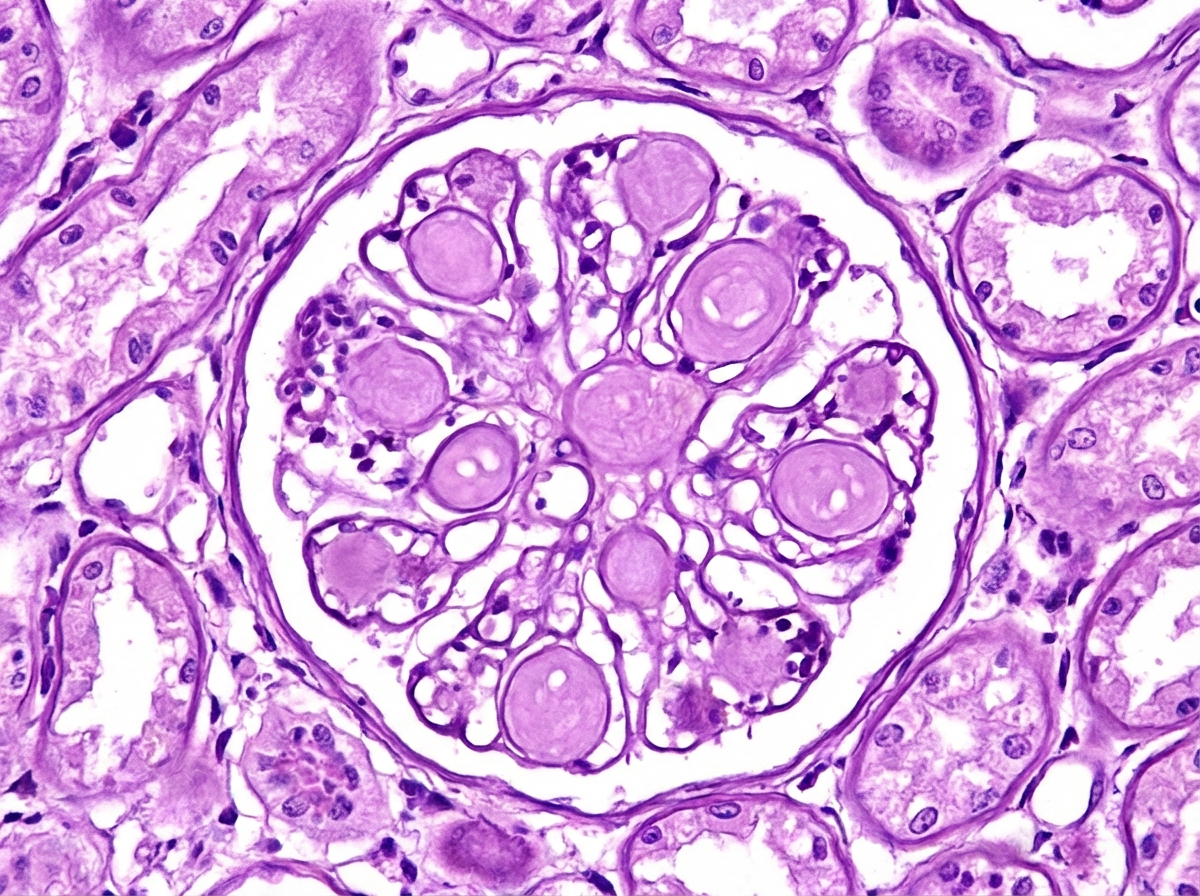
A mutation in the alpha 5 chain of collagen 4 leads to which diagnosis?
Nephrotic syndrome is characterized by
In an adult, unilateral smooth contracted kidney with hypertension is seen in which condition?
What is true about Minimal change disease?
All are features of hemolytic uremic syndrome, EXCEPT?
Which of the following is a characteristic feature of collapsing glomerulopathy?
On electron microscopy, what characteristic splitting of the glomerular basement membrane (GBM) with subepithelial deposits is seen in most cases?
A 28-year-old man presents with a large amount of blood and protein in his urine. He has had sensorineural hearing loss since his teen years and anterior lenticonus. The physician suspects a genetic disorder that may lead to eventual kidney failure. If this is the case, the patient most likely has a mutation in which one of the following proteins?
Silver stain performed on renal biopsy shows characteristic findings. Immunostaining for Anti-PLA2R is positive. Based on the given findings, what is the likely diagnosis?

Dysmorphic RBCs are seen in which of the following conditions?
Explanation: **Explanation:** **Correct Option: A. Alport’s Syndrome** Alport’s syndrome is a hereditary nephritis caused by mutations in the genes encoding the **Type IV collagen** chains, which are essential components of the glomerular basement membrane (GBM), cochlea, and lens [1]. The most common form (85% of cases) is **X-linked dominant**, resulting from a mutation in the **COL4A5 gene**, which encodes the **alpha-5 (α5) chain** of Type IV collagen [1]. This leads to a defective GBM that appears thin initially but progresses to a characteristic "basket-weave" appearance (irregular thickening and splitting of the lamina densa) on electron microscopy. **Incorrect Options:** * **B. Thin Basement Membrane Disease (TBMD):** While also a Type IV collagen disorder, it most commonly involves mutations in the **COL4A3 or COL4A4** genes (alpha-3 or alpha-4 chains). It presents as isolated benign hematuria with diffuse thinning of the GBM. * **C. Nodular Glomerulosclerosis:** Also known as Kimmelstiel-Wilson lesions, this is pathognomonic for **Diabetic Nephropathy**. It involves the accumulation of mesangial matrix, not a primary genetic collagen mutation. * **D. Goodpasture Syndrome:** This is an autoimmune condition caused by **anti-GBM antibodies** directed against the non-collagenous (NC1) domain of the **alpha-3 chain** of Type IV collagen. It is not caused by a genetic mutation of the alpha-5 chain. **NEET-PG High-Yield Pearls:** * **Clinical Triad of Alport’s:** Sensorineural deafness, eye anomalies (Anterior Lenticonus), and progressive renal failure [1]. * **Electron Microscopy (EM):** "Basket-weave appearance" is the classic buzzword for Alport’s. * **Inheritance:** Most common is X-linked (COL4A5); Autosomal recessive/dominant forms involve COL4A3/A4 [1]. **References:** [1] Kumar V, Abbas AK, et al.. Robbins and Cotran Pathologic Basis of Disease. 9th ed. The Kidney, pp. 928-930.
Explanation: ### Explanation The question asks for the feature that is **NOT** typically a defining characteristic of Nephrotic Syndrome, as the provided answer key identifies **Hematuria** as the correct choice (the "odd one out"). **1. Why Hematuria is the Correct Answer:** Nephrotic syndrome is primarily a disorder of **glomerular permselectivity** (basement membrane damage), leading to massive protein loss [2]. **Hematuria** is the hallmark of **Nephritic Syndrome**, which involves glomerular inflammation and endocapillary proliferation, leading to the physical rupture of capillaries and the presence of RBCs in urine [2]. While microscopic hematuria can occasionally occur in some nephrotic conditions (like FSGS) [3] or MPGN [1], it is not a defining diagnostic criterion. **2. Why the Other Options are Incorrect (Features of Nephrotic Syndrome):** * **Massive Proteinuria:** Defined as >3.5 g/24 hours. This is the primary event caused by the loss of negative charge (heparan sulfate) or structural integrity of the podocytes [4]. * **Edema:** A direct consequence of hypoalbuminemia (due to proteinuria), which decreases plasma oncotic pressure, leading to fluid shift into the interstitium. * **Hyperlipidemia:** The liver increases synthesis of lipoproteins (LDL, VLDL) to compensate for low plasma oncotic pressure, coupled with decreased catabolism of lipids. **3. NEET-PG High-Yield Pearls:** * **The Nephrotic Tetrad:** Massive proteinuria, Hypoalbuminemia (<3g/dL), Generalized Edema (Anasarca), and Hyperlipidemia/Lipiduria [4]. * **Most common cause in children:** Minimal Change Disease (MCD) – characterized by effacement of podocyte foot processes on Electron Microscopy [1]. * **Most common cause in adults:** Membranous Nephropathy (associated with PLA2R antibodies) [4]. * **Hypercoagulability:** Patients are at high risk for Renal Vein Thrombosis due to the loss of Antithrombin III in urine. **References:** [1] Kumar V, Abbas AK, et al.. Robbins and Cotran Pathologic Basis of Disease. 9th ed. The Kidney, pp. 922-923. [2] Cross SS. Underwood's Pathology: A Clinical Approach. 6th ed. Common Clinical Problems From Diseases Of The Urinary And Male Genital Tracts, pp. 527-528. [3] Cross SS. Underwood's Pathology: A Clinical Approach. 6th ed. Common Clinical Problems From Diseases Of The Urinary And Male Genital Tracts, pp. 530-531. [4] Kumar V, Abbas AK, et al.. Robbins and Cotran Pathologic Basis of Disease. 9th ed. The Kidney, pp. 919-921.
Explanation: ### Explanation **Correct Answer: A. Stenosis of renal artery** The hallmark of **Renal Artery Stenosis (RAS)** in an adult is a **unilateral, smooth, contracted kidney**. This occurs due to chronic ischemia, leading to diffuse atrophy of the renal parenchyma [1]. Because the ischemia is global and uniform across the kidney, the surface remains **smooth** (unlike the scarred surface of pyelonephritis). The resulting activation of the Renin-Angiotensin-Aldosterone System (RAAS) leads to **Goldblatt hypertension** (renovascular hypertension) [1]. **Why the other options are incorrect:** * **B. Chronic Glomerulonephritis:** This typically presents with **bilateral**, symmetrically contracted kidneys with a finely granular surface. It is a systemic process, not unilateral. * **C. Renal Cell Carcinoma:** This usually presents as a **large, distorted mass** or a "bulge" on the kidney, often leading to nephromegaly (enlargement) rather than contraction. * **D. Pyelonephritis (Chronic):** While it can be unilateral and cause a contracted kidney, the surface is **irregularly scarred** with U-shaped depressions overlying blunted calyces. It is not "smooth." **High-Yield Clinical Pearls for NEET-PG:** * **Goldblatt Kidney:** The stenotic kidney is small and protected from high pressure, while the contralateral (non-stenotic) kidney may show hypertensive changes (hyaline arteriolosclerosis). * **Etiology:** In older males, the most common cause is **Atherosclerosis** (proximal 1/3rd of the artery) [1]. In young females, it is **Fibromuscular Dysplasia** (distal 2/3rd, "string of beads" appearance) [1]. * **Diagnosis:** Digital Subtraction Angiography (DSA) is the gold standard; Doppler Ultrasound is the initial screening tool. * **Key Distinction:** Smooth contraction = Ischemia (RAS); Rough/Scarred contraction = Inflammation (Chronic Pyelonephritis). **References:** [1] Kumar V, Abbas AK, et al.. Robbins and Cotran Pathologic Basis of Disease. 9th ed. The Kidney, pp. 945-946.
Explanation: **Explanation:** **Minimal Change Disease (MCD)** is the most common cause of nephrotic syndrome in children [1]. The hallmark of this condition is the absence of significant changes under light microscopy, which gives the disease its name [2]. 1. **Why Option A is correct:** Under **Light Microscopy (LM)**, the glomeruli appear completely normal [2]. However, **Electron Microscopy (EM)** reveals the characteristic diagnostic feature: **diffuse effacement (fusion) of podocyte foot processes** [1]. This occurs due to T-cell-mediated cytokine injury to the glomerular filtration barrier, leading to massive selective proteinuria (mainly albumin) [2]. 2. **Why other options are incorrect:** * **Option B:** Mesangial deposits are characteristic of conditions like IgA Nephropathy or Lupus Nephritis, not MCD. Immunofluorescence (IF) in MCD is typically negative [1]. * **Option C:** The 'tram track' or double-contour appearance of the glomerular basement membrane is the classic finding in **Membranoproliferative Glomerulonephritis (MPGN)** [1], caused by mesangial cell interposition. * **Option D:** MCD typically presents with **pure nephrotic syndrome** (massive edema, heavy proteinuria). Gross hematuria is rare [2] and more suggestive of nephritic conditions like Post-Streptococcal Glomerulonephritis (PSGN) or IgA Nephropathy. **High-Yield Clinical Pearls for NEET-PG:** * **Treatment:** Highly responsive to **Corticosteroids** (Steroid-sensitive) [2]. * **Association:** In adults, MCD can be associated with **Hodgkin’s Lymphoma**. * **Biochemical marker:** Loss of **polyanionic charge** (heparan sulfate) on the basement membrane leads to selective proteinuria. * **Staining:** Periodic Acid-Schiff (PAS) and Silver stains will show normal basement membranes [2]. **References:** [1] Kumar V, Abbas AK, et al.. Robbins and Cotran Pathologic Basis of Disease. 9th ed. The Kidney, pp. 927-928. [2] Kumar V, Abbas AK, et al.. Robbins and Cotran Pathologic Basis of Disease. 9th ed. The Kidney, pp. 922-923.
Explanation: **Explanation:** Hemolytic Uremic Syndrome (HUS) is a clinical triad of **Microangiopathic Hemolytic Anemia (MAHA)**, **Thrombocytopenia**, and **Acute Kidney Injury (AKI)** [4]. It primarily affects the renal vasculature. **Why Option D is the correct answer:** Neuropsychiatric disturbances (such as seizures, coma, or focal deficits) are the hallmark of **Thrombotic Thrombocytopenic Purpura (TTP)**, not HUS [1]. While TTP and HUS share similar features (the "Pentad" of TTP includes the HUS triad plus fever and neurological symptoms), HUS is characterized by a relative **absence** of neurological involvement, as the pathology is predominantly localized to the glomerular capillaries [4]. **Why other options are incorrect:** * **A. Hyperkalemia:** This is a common complication of Acute Kidney Injury (AKI). Since HUS causes acute renal failure due to glomerular damage, hyperkalemia frequently occurs. * **B. Anemia:** MAHA is a defining feature of HUS [4]. Mechanical destruction of RBCs as they pass through fibrin-rich microthrombi leads to schistocytes (fragmented cells) and severe anemia [2]. * **C. Renal microthrombi:** The core pathology of HUS is **Thrombotic Microangiopathy (TMA)**. Endothelial injury leads to the formation of platelet-fibrin hyaline thrombi within the glomerular capillaries and afferent arterioles [3]. **Clinical Pearls for NEET-PG:** * **Typical HUS (D+ HUS):** Associated with Shiga-like toxin from *E. coli* **O157:H7** [3]. It usually follows an episode of bloody diarrhea. * **Atypical HUS:** Associated with genetic mutations in **Complement Factor H** or Factor I [3]. * **Peripheral Smear:** Look for **Schistocytes** (helmet cells) and decreased platelets. * **Key Distinction:** HUS = Renal failure > CNS symptoms; TTP = CNS symptoms > Renal failure [1]. **References:** [1] Kumar V, Abbas AK, et al.. Robbins and Cotran Pathologic Basis of Disease. 9th ed. The Kidney, pp. 947-948. [2] Kumar V, Abbas AK, et al.. Robbins and Cotran Pathologic Basis of Disease. 9th ed. Red Blood Cell and Bleeding Disorders, pp. 667-668. [3] Kumar V, Abbas AK, et al.. Robbins and Cotran Pathologic Basis of Disease. 9th ed. The Kidney, pp. 946-947. [4] Cross SS. Underwood's Pathology: A Clinical Approach. 6th ed. Common Clinical Problems From Diseases Of The Urinary And Male Genital Tracts, pp. 540-541.
Explanation: **Explanation:** **Collapsing Glomerulopathy (CG)** is a distinct, aggressive morphological variant of Focal Segmental Glomerulosclerosis (FSGS). It is characterized by the global collapse of the glomerular capillary tuft and a striking proliferation of overlying podocytes [1], [2]. 1. **Why Option D is Correct:** The hallmark of CG is the **hypertrophy and hyperplasia of visceral epithelial cells (podocytes)** [2]. These cells lose their foot processes, detach from the basement membrane, and fill the urinary space, often containing protein resorption droplets [1]. While "necrosis" is sometimes used to describe the severe podocyte injury and loss, the defining feature is the **"pseudocrescent"** formation caused by this massive podocyte proliferation and hypertrophy [2]. 2. **Why Other Options are Incorrect:** * **A. Tuft Necrosis:** This is characteristic of necrotizing glomerulonephritis (e.g., ANCA-associated vasculitis or Anti-GBM disease), not the non-inflammatory collapse seen in CG. * **B. Mesangiolysis:** This refers to the dissolution of the mesangial matrix, typically seen in Thrombotic Microangiopathy (TMA) or Diabetic Nephropathy, rather than CG. * **C. Parietal Epithelial Proliferation:** This is the hallmark of **true crescents** (e.g., RPGN). In CG, the proliferation involves *visceral* epithelial cells (podocytes), not parietal cells. **High-Yield Clinical Pearls for NEET-PG:** * **Associations:** Most strongly associated with **HIV-associated nephropathy (HIVAN)** [1], Parvovirus B19, and drugs like **Pamidronate** or Interferon. * **Genetics:** Strongly linked to **APOL1** high-risk variants in patients of African descent [3]. * **Prognosis:** CG has the **worst prognosis** among all FSGS variants, often presenting with massive proteinuria and rapid progression to End-Stage Renal Disease (ESRD) [2]. * **Microscopy:** Look for "wrinkling" and thickening of the basement membrane with total collapse of capillary lumina [2]. **References:** [1] Cross SS. Underwood's Pathology: A Clinical Approach. 6th ed. Common Clinical Problems From Diseases Of The Urinary And Male Genital Tracts, pp. 531-532. [2] Kumar V, Abbas AK, et al.. Robbins and Cotran Pathologic Basis of Disease. 9th ed. The Kidney, pp. 924-925. [3] Kumar V, Abbas AK, et al.. Robbins and Cotran Pathologic Basis of Disease. 9th ed. The Kidney, pp. 923-924.
Explanation: ### Explanation **Membranous Nephropathy (MN)** is characterized by the accumulation of immune complexes in the **subepithelial** space (between the podocytes and the GBM) [1], [2]. On Electron Microscopy (EM), these deposits appear as electron-dense masses [2]. Over time, the GBM reacts by growing new basement membrane material around these deposits to incorporate them, creating a **"Spike and Dome"** appearance [1], [2]. As these "spikes" fuse over the deposits, the GBM appears thickened and **split/lamellated**, which is a hallmark of the disease. #### Analysis of Incorrect Options: * **A. RPGN:** Characterized by the formation of **crescents** (proliferation of parietal epithelial cells and monocytes) in Bowman’s space. EM findings vary depending on the underlying cause (e.g., linear IgG in Anti-GBM disease), but it does not show the classic subepithelial splitting seen in MN. * **C. FSGS:** The primary pathology is the **effacement of podocyte foot processes** and segmental sclerosis (hyalinosis) of the capillary loops. There are typically no immune complex deposits. * **D. Minimal Change Disease:** Shows **diffuse effacement of podocyte foot processes** on EM. The GBM appears structurally normal, and there are no electron-dense deposits. #### High-Yield Pearls for NEET-PG: * **Light Microscopy (MN):** Diffuse thickening of the capillary wall; Silver stain (Jones) highlights the "spikes" [2]. * **Immunofluorescence (MN):** Granular IgG and C3 along the GBM [2]. * **Primary MN Marker:** Antibodies against **Phospholipase A2 Receptor (PLA2R)** are found in ~70% of cases. * **Secondary Causes:** Associated with SLE (Class V), Hepatitis B/C, NSAIDs, and occult solid tumors (Carcinoma of lung/colon). * **Rule of Thumb:** If the question mentions "Spikes," "Domes," or "Subepithelial deposits," think Membranous Nephropathy. **References:** [1] Cross SS. Underwood's Pathology: A Clinical Approach. 6th ed. Common Clinical Problems From Diseases Of The Urinary And Male Genital Tracts, pp. 529-530. [2] Kumar V, Abbas AK, et al.. Robbins and Cotran Pathologic Basis of Disease. 9th ed. The Kidney, p. 921.
Explanation: **Explanation:** The clinical triad of **hematuria** (nephritic syndrome), **sensorineural hearing loss**, and **ocular abnormalities** (specifically anterior lenticonus) is pathognomonic for **Alport Syndrome**. **1. Why Collagen is Correct:** Alport syndrome is caused by mutations in the genes encoding the **α-3, α-4, or α-5 chains of Type IV collagen** [1]. Type IV collagen is a crucial structural component of the **basement membranes** in the glomerulus, the cochlea (inner ear), and the lens of the eye. Defective collagen leads to a thinning and splitting of the Glomerular Basement Membrane (GBM), classically described as a **"basket-weave appearance"** on electron microscopy. **2. Why the Other Options are Incorrect:** * **Spectrin (A):** Mutations in spectrin (or ankyrin) lead to **Hereditary Spherocytosis**, characterized by hemolytic anemia and splenomegaly, not renal failure or hearing loss. * **α1-Antitrypsin (B):** Deficiency leads to **panacinar emphysema** and **liver cirrhosis** due to the accumulation of misfolded proteins in hepatocytes [2]. * **Fibrillin (D):** Mutations in Fibrillin-1 cause **Marfan Syndrome**, which presents with ectopia lentis (upward lens dislocation), arachnodactyly, and aortic root dilation. **Clinical Pearls for NEET-PG:** * **Inheritance:** Most commonly **X-linked Dominant** (COL4A5 mutation) [1]. * **Electron Microscopy (Gold Standard):** Irregular thickening and thinning of GBM with "lamellation" (splitting) of the lamina densa (Basket-weave). * **Ocular Sign:** **Anterior lenticonus** (conical protrusion of the lens) is highly specific for Alport syndrome. * **Differential:** Thin Basement Membrane Nephropathy (Benign Familial Hematuria) also involves Type IV collagen but lacks the extra-renal features and progressive renal failure [1]. **References:** [1] Kumar V, Abbas AK, et al.. Robbins and Cotran Pathologic Basis of Disease. 9th ed. The Kidney, pp. 929-930. [2] Kumar V, Abbas AK, et al.. Robbins and Cotran Pathologic Basis of Disease. 9th ed. Genetic Disorders, pp. 152-153.
Explanation: ***Membranous nephropathy*** - **Anti-PLA2R antibody** positivity is highly specific for **primary membranous nephropathy**, making it the diagnostic marker of choice. - Silver stain reveals the characteristic **spike-and-dome pattern** with thickened basement membrane projections between immune deposits. *Focal segmental glomerulosclerosis (FSGS)* - Shows **segmental sclerosis** and **hyalinosis** on silver stain, not the spike-and-dome pattern seen in membranous nephropathy. - **Anti-PLA2R** is typically negative in FSGS, as it lacks the characteristic immune complex deposits of membranous disease. *Membranoproliferative glomerulonephritis (MPGN)* - Silver stain demonstrates **double contour** or **tram-track** appearance of the basement membrane, distinct from spike-and-dome. - **Anti-PLA2R** is negative in MPGN, which involves different complement-mediated pathways and immune complex patterns. *Crescentic glomerulonephritis* - Characterized by **epithelial crescents** filling Bowman's space on silver stain, not basement membrane thickening. - **Anti-PLA2R** is not associated with crescentic GN, which typically involves **ANCA** or **anti-GBM antibodies** instead.
Explanation: **Explanation:** The presence of **dysmorphic Red Blood Cells (RBCs)** in urine is a hallmark of **glomerular hematuria**. When RBCs pass through the damaged glomerular filtration barrier and the subsequent osmotic gradients of the renal tubules, they undergo mechanical and chemical stress, leading to variations in size and shape (e.g., blebs, protrusions, or fragmented membranes). 1. **Why IgA Glomerulopathy is correct:** IgA nephropathy (Berger’s disease) is a type of **nephritic syndrome** characterized by mesangial IgA deposits and glomerular inflammation [1]. This inflammation disrupts the glomerular basement membrane, allowing RBCs to leak into the tubular system. The most specific type of dysmorphic RBC seen here is the **Acanthocyte (G1 cell)**, which features ring-shaped vesicles. 2. **Why Membranous Glomerulopathy is incorrect:** This is a classic **nephrotic syndrome** characterized by subepithelial deposits and basement membrane thickening [2]. While it causes heavy proteinuria, it typically does not cause significant glomerular inflammation or hematuria [2]. 3. **Why Nil Lesion (Minimal Change Disease) is incorrect:** This condition involves the effacement of podocyte foot processes leading to selective proteinuria. The glomerular capillary wall remains intact to cells; therefore, hematuria (and dysmorphic RBCs) is characteristically absent [2]. **High-Yield Clinical Pearls for NEET-PG:** * **Acanthocytes:** If >5% of total urinary RBCs are acanthocytes, it is highly predictive of glomerular disease. * **RBC Casts:** These are the most specific indicators of glomerular hematuria (Nephritic syndrome). * **Isomorphic RBCs:** Uniformly shaped RBCs suggest **non-glomerular (post-renal) bleeding**, such as stones, trauma, or malignancy in the ureter or bladder. * **Phase-contrast microscopy** is the gold standard for identifying dysmorphic RBCs. **References:** [1] Cross SS. Underwood's Pathology: A Clinical Approach. 6th ed. Common Clinical Problems From Diseases Of The Urinary And Male Genital Tracts, pp. 528-529. [2] Cross SS. Underwood's Pathology: A Clinical Approach. 6th ed. Common Clinical Problems From Diseases Of The Urinary And Male Genital Tracts, pp. 527-528.
Congenital Anomalies of the Kidney
Practice Questions
Glomerular Diseases
Practice Questions
Tubular and Interstitial Diseases
Practice Questions
Vascular Diseases of the Kidney
Practice Questions
Cystic Diseases of the Kidney
Practice Questions
Urinary Tract Obstruction and Stones
Practice Questions
Renal Tumors
Practice Questions
Kidney in Systemic Diseases
Practice Questions
Renal Transplantation Pathology
Practice Questions
Urinary Tract Infections
Practice Questions
Get full access to all questions, explanations, and performance tracking.
Start For Free