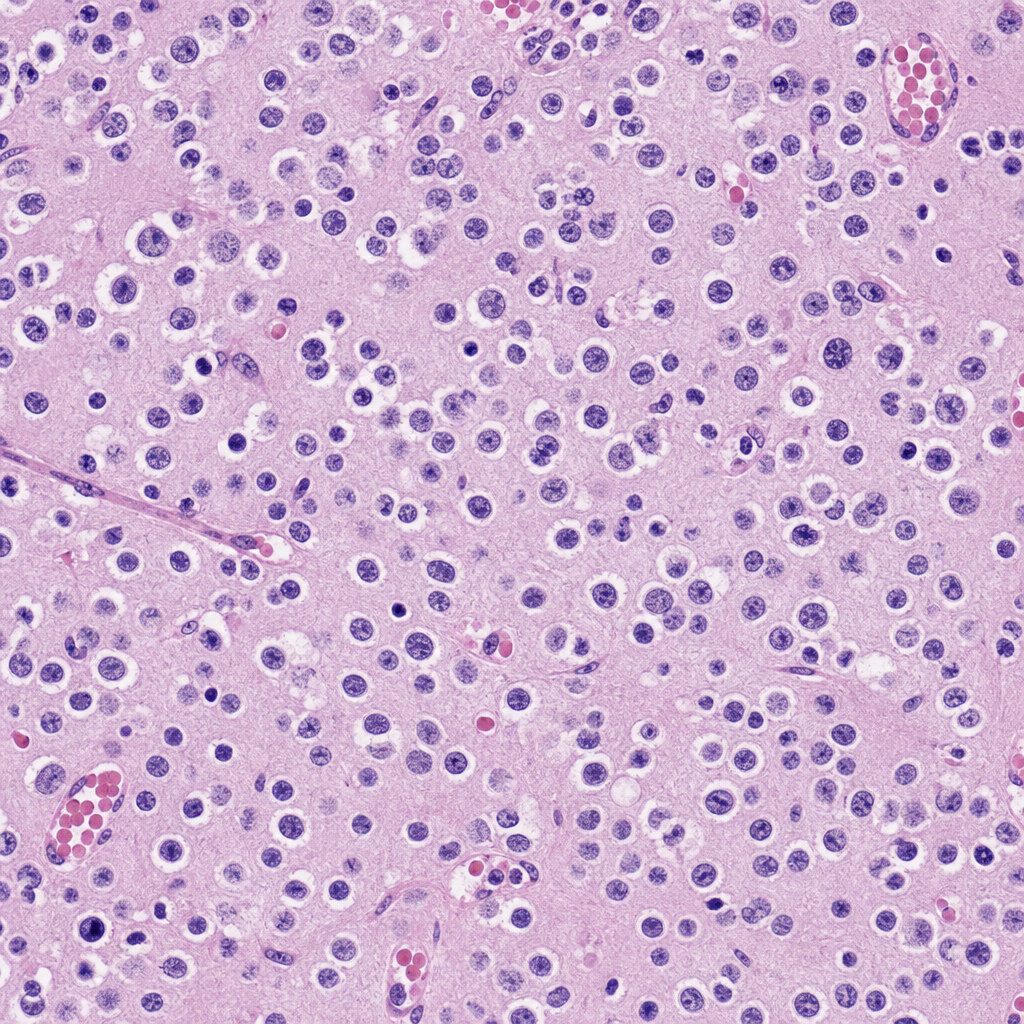
Varrocay bodies are present in which of the following conditions?
A 60-year-old woman has a history of being treated for endometrial cancer with surgery and radiation 5 years ago. She now presents with a large necrotic tumor that follows the course of the sciatic nerve. What is the most likely diagnosis?
Physical examination of a 14-year-old boy demonstrates six coffee-colored skin macules up to 3 cm in diameter. No other skin lesions are noted, but a small mass lesion is felt in the subcutaneous tissues below two of the macules. These masses are most likely closely associated with which of the following structures?
Dawson disease is also known as which of the following?
The most common site of Berry aneurysm is:
Which of the following is not a histological feature of adamantinomatous craniopharyngioma?
Which of the following is NOT a pathological finding seen in Alzheimer's disease?
What is the probable diagnosis for a cyst in a child that is located at and associated with vertebral defects?
a-synuclein, a lipid-binding protein, is a major component of what?
Neurofibrillary tangles are a deposition of which of the following substances?
Explanation: **Explanation:** **Verocay bodies** are a classic histopathological hallmark of **Schwannomas** (Neurilemmomas) [1]. They consist of two compact rows of well-aligned, palisading nuclei separated by an intervening acellular zone of eosinophilic fibrillar processes [1]. These structures are found within **Antoni A** (hypercellular) areas of the tumor [1]. **Why the correct answer is "None":** The question lists Periapical granuloma and Multiple myeloma, neither of which feature Verocay bodies. * **Option A (Periapical granuloma):** This is a mass of chronically inflamed granulation tissue at the apex of a non-vital tooth. Histologically, it shows fibroblasts, capillaries, and inflammatory cells (lymphocytes, plasma cells). It does not exhibit neural palisading. * **Option B (Multiple myeloma):** This is a plasma cell dyscrasia [2]. The characteristic histological finding is a dense infiltration of **malignant plasma cells** (with "clock-face" nuclei and perinuclear halos) [2]. Other associated findings include **Russell bodies** (intracytoplasmic) and **Dutcher bodies** (intranuclear) immunoglobulin inclusions, but not Verocay bodies. **High-Yield Clinical Pearls for NEET-PG:** * **Schwannoma:** Usually a solitary, encapsulated tumor. It is S-100 positive [1]. * **Antoni A vs. Antoni B:** Antoni A is dense/cellular with Verocay bodies; Antoni B is loose/myxoid [1]. * **Acoustic Neuroma:** A Schwannoma of the CN VIII (vestibulocochlear nerve), often associated with Neurofibromatosis Type 2 (NF2) if bilateral. * **Differential Diagnosis:** Do not confuse Verocay bodies with **Psammoma bodies** (Meningioma) or **Negri bodies** (Rabies). **References:** [1] Kumar V, Abbas AK, et al.. Robbins and Cotran Pathologic Basis of Disease. 9th ed. Peripheral Nerves and Skeletal Muscles, p. 1250. [2] Cross SS. Underwood's Pathology: A Clinical Approach. 6th ed. Common Clinical Problems From Blood And Bone Marrow Disease, pp. 617-618.
Explanation: ### Explanation **Correct Option: A. Malignant peripheral nerve sheath tumor (MPNST)** The clinical presentation points strongly toward **Malignant Peripheral Nerve Sheath Tumor (MPNST)**. MPNSTs are aggressive sarcomas that typically arise from a major nerve trunk (like the sciatic nerve) [1]. **Key Diagnostic Clues:** 1. **Radiation History:** While 50% of MPNSTs occur in patients with Neurofibromatosis Type 1 (NF1), a significant portion arises **de novo** or as a **post-radiation complication** (often with a latency of several years), as seen in this patient treated for endometrial cancer [1], [3]. 2. **Gross Appearance:** These are large, poorly defined, fleshy masses with frequent areas of **necrosis** and hemorrhage, reflecting their high-grade nature [1]. 3. **Location:** They characteristically follow the course of large nerves [1], [2]. --- ### Why the other options are incorrect: * **B. Solitary neurofibroma:** These are benign, slow-growing tumors. They do not typically present with extensive necrosis or a rapid clinical course following radiation. * **C. Neurofibromatosis type 2 (NF2):** NF2 is characterized by bilateral vestibular schwannomas, meningiomas, and ependymomas (MISME syndrome) [2]. It is not typically associated with large necrotic sciatic nerve tumors. * **D. Schwannoma:** These are benign, encapsulated tumors that are usually eccentric to the nerve fiber [4]. They rarely undergo malignant transformation and do not typically present as large necrotic masses following radiation. --- ### High-Yield Clinical Pearls for NEET-PG: * **Origin:** MPNSTs most commonly arise from the transformation of a **Plexiform Neurofibroma** (pathognomonic for NF1) [1]. * **Histology:** Look for "Triton tumor" in descriptions—this is an MPNST with rhabdomyoblastic differentiation. * **Immunohistochemistry:** S100 expression is often focal or lost in MPNST, unlike Schwannomas which show strong, diffuse S100 positivity. * **Radiation-induced Sarcomas:** Always consider MPNST or Angiosarcoma in a patient with a new mass at a prior site of therapeutic radiation [3]. **References:** [1] Kumar V, Abbas AK, et al.. Robbins and Cotran Pathologic Basis of Disease. 9th ed. Peripheral Nerves and Skeletal Muscles, pp. 1250-1251. [2] Kumar V, Abbas AK, et al.. Robbins and Cotran Pathologic Basis of Disease. 9th ed. Peripheral Nerves and Skeletal Muscles, pp. 1248-1249. [3] Kumar V, Abbas AK, et al.. Robbins and Cotran Pathologic Basis of Disease. 9th ed. The Central Nervous System, pp. 1307-1308. [4] Kumar V, Abbas AK, et al.. Robbins and Cotran Pathologic Basis of Disease. 9th ed. Peripheral Nerves and Skeletal Muscles, p. 1250.
Explanation: ### Explanation **Diagnosis: Neurofibromatosis Type 1 (NF1 / von Recklinghausen Disease)** The clinical presentation of a young patient with multiple **café-au-lait spots** (coffee-colored macules) and subcutaneous masses is classic for **Neurofibromatosis Type 1** [1]. **Why Peripheral Nerves is Correct:** The subcutaneous masses described are **neurofibromas**. These are benign nerve sheath tumors composed of a mixture of Schwann cells, perineurial cells, and fibroblasts [1]. Because neurofibromas arise directly from the connective tissue of **peripheral nerves**, they are anatomically and pathologically associated with them [1]. In NF1, these can present as discrete cutaneous/subcutaneous nodules or as diffuse "plexiform" neurofibromas [1]. **Why Other Options are Incorrect:** * **A, B, and D (Arrector pili, Hair follicles, Sebaceous glands):** These are adnexal structures of the skin. While various tumors can arise from these (e.g., pilomatricoma, leiomyoma), they are not associated with café-au-lait spots or the systemic manifestations of NF1. Neurofibromas originate from neural crest-derived cells, not epidermal or follicular appendages. **High-Yield Clinical Pearls for NEET-PG:** * **Genetics:** NF1 is autosomal dominant, caused by a mutation in the *NF1* gene on **Chromosome 17** (encodes Neurofibromin, a GTPase-activating protein that regulates RAS). * **Diagnostic Criteria (NIH):** Requires $\geq$ 2 of the following: 1. $\geq$ 6 Café-au-lait spots ($>$15mm in adults, $>$5mm in children). 2. $\geq$ 2 Neurofibromas or 1 Plexiform neurofibroma. 3. Axillary or inguinal freckling (**Crowe sign**). 4. Optic gliomas. 5. $\geq$ 2 **Lisch nodules** (iris hamartomas). 6. Distinctive osseous lesions (e.g., sphenoid dysplasia). 7. First-degree relative with NF1. * **Pathology:** Neurofibromas show a "shredded carrot" appearance on histology due to disorganized collagen bundles [1]. **References:** [1] Kumar V, Abbas AK, et al.. Robbins and Cotran Pathologic Basis of Disease. 9th ed. Peripheral Nerves and Skeletal Muscles, pp. 1248-1250.
Explanation: **Explanation:** **Subacute sclerosing panencephalitis (SSPE)**, also known as **Dawson disease**, is a rare, progressive, and fatal neurodegenerative disease caused by a persistent infection with a mutant strain of the **Measles virus**. It typically occurs years after an initial measles infection, usually in children who were infected before the age of two. The term "Dawson disease" refers to James Dawson, who first described the characteristic **Cowdry type A intranuclear inclusion bodies** found in the neurons and glial cells. **Analysis of Options:** * **Option A (Correct):** SSPE is characterized by widespread inflammation (panencephalitis) and demyelination. Pathologically, it shows viral inclusions, microglial nodules, and perivascular cuffing. * **Option B (Incorrect):** ADEM is an immune-mediated demyelinating disease that typically follows a viral infection or vaccination (monophasic), but it is not caused by persistent viral replication. * **Option C (Incorrect):** NMO (Devic disease) is an autoimmune inflammatory disorder targeting **Aquaporin-4 (AQP4)** channels, primarily affecting the optic nerves and spinal cord [1]. * **Option D (Incorrect):** Paralysis agitans is the historical name for Parkinson’s disease, a degenerative disorder of the dopaminergic system in the substantia nigra. **High-Yield Clinical Pearls for NEET-PG:** * **EEG Finding:** Periodic, high-voltage slow-wave complexes (Radermecker complexes). * **CSF Finding:** Significantly elevated titers of anti-measles antibodies (**Oligoclonal bands** are present). * **Pathology:** Cowdry type A eosinophilic intranuclear inclusions (Dawson bodies). * **Clinical Stages:** Progresses from behavioral changes to myoclonic jerks, followed by dementia and eventually a vegetative state. **References:** [1] Kumar V, Abbas AK, et al.. Robbins and Cotran Pathologic Basis of Disease. 9th ed. The Central Nervous System, pp. 1287-1288.
Explanation: **Explanation:** Berry (saccular) aneurysms are thin-walled outpocketings of the cerebral arteries, typically occurring at arterial bifurcations in the Circle of Willis [1]. They arise due to a congenital deficiency in the **tunica media** (muscular layer), which makes these sites vulnerable to hemodynamic stress. **1. Why Option A is correct:** The **Anterior Communicating Artery (ACoA)**, specifically at its junction with the Anterior Cerebral Artery, is the single most common site for Berry aneurysms, accounting for approximately **40%** of all cases [1]. This site experiences significant turbulent flow, leading to the weakening of the internal elastic lamina. **2. Analysis of Incorrect Options:** * **Option B:** The junction of the **Posterior Communicating Artery (PCoA)** and the Internal Carotid Artery is the second most common site (~20-30%) [1]. Aneurysms here are clinically significant as they can cause **third nerve palsy** (mydriasis and ptosis) due to compression. * **Option C:** The bifurcation of the **Middle Cerebral Artery (MCA)** is the third most common site (~20%) [1]. * **Option D:** The **Vertebrobasilar system** is a much less common site, accounting for only about 4-10% of all Berry aneurysms. **High-Yield Clinical Pearls for NEET-PG:** * **Rupture:** The most common cause of non-traumatic **Subarachnoid Hemorrhage (SAH)** [2]. Patients present with a "thunderclap headache" (worst headache of life) [2]. * **Risk Factors:** Polycystic Kidney Disease (ADPKD), Ehlers-Danlos Syndrome, Marfan Syndrome, Coarctation of the Aorta, and Hypertension [2]. * **Morphology:** They lack a tunica media; the wall is composed of thickened hyalinized intima and adventitia [1]. * **Diagnosis:** Digital Subtraction Angiography (Gold Standard) or CT Angiography. **References:** [1] Kumar V, Abbas AK, et al.. Robbins and Cotran Pathologic Basis of Disease. 9th ed. The Central Nervous System, pp. 1272-1273. [2] Cross SS. Underwood's Pathology: A Clinical Approach. 6th ed. Common Clinical Manifestations Of Central And Peripheral Nervous System Disease, pp. 705-706.
Explanation: **Explanation:** Craniopharyngiomas are benign tumors arising from remnants of **Rathke’s pouch**. They exist in two distinct clinico-pathological variants: **Adamantinomatous** (common in children) and **Papillary** (common in adults). **Why Option D is the correct answer:** Option D describes the hallmark of the **Papillary Craniopharyngioma**, not the adamantinomatous type. Papillary variants lack the complex architecture of the adamantinomatous type and are characterized by solid sheets and **papillae** lined by well-differentiated, mature squamous epithelium. They notably lack "wet keratin," calcification, and stellate reticulum. **Analysis of Incorrect Options (Features of Adamantinomatous type):** * **Option A:** This variant typically shows peripheral palisading of squamous cells surrounding a loose, mesh-like center known as **stellate (spongy) reticulum**, mimicking the enamel organ of a developing tooth. * **Option B:** A pathognomonic feature is the presence of **"wet keratin"**—large, nodules of compact, lamellar keratin that often undergo secondary changes. * **Option C:** The "wet keratin" frequently undergoes **dystrophic calcification** (visible on CT scans). When keratin cells degenerate, they release **cholesterol crystals**, giving the cyst fluid a characteristic "machinery oil" appearance. **NEET-PG High-Yield Pearls:** * **Bimodal Distribution:** Peaks at 5–15 years (Adamantinomatous) and 45–60 years (Papillary). * **Imaging:** Adamantinomatous types are typically cystic and **calcified** (90%); Papillary types are usually solid/mixed and rarely calcified. * **Molecular Marker:** Adamantinomatous craniopharyngiomas are associated with **CTNNB1 (β-catenin)** mutations, while Papillary types often harbor **BRAF V600E** mutations. * **Location:** Most common suprasellar tumor in children, often causing bitemporal hemianopia and endocrine dysfunction.
Explanation: **Explanation:** **Alzheimer’s Disease (AD)** is the most common cause of dementia in the elderly. The correct answer is **Lewy body**, as these are the hallmark pathological findings of **Parkinson’s Disease** [1] and **Lewy Body Dementia**, not Alzheimer’s. 1. **Why Lewy Bodies are NOT seen in AD:** Lewy bodies are intracellular inclusions of **alpha-synuclein** [1]. While they can occasionally coexist in advanced neurodegenerative overlap syndromes, they are not a diagnostic or primary pathological feature of Alzheimer’s Disease [2]. 2. **Analysis of Incorrect Options:** * **Cortical Atrophy:** AD is characterized by gross brain atrophy, particularly in the hippocampus and temporal lobes, leading to widened sulci and narrowed gyri (compensatory ventricular enlargement is called *hydrocephalus ex vacuo*) [3]. * **Neurofibrillary Tangles (NFTs):** These are intracellular bundles of filaments composed of **hyperphosphorylated Tau protein** [2]. The density of NFTs correlates strongly with the degree of clinical dementia [3]. * **Neuritic (Senile) Plaques:** These are extracellular deposits consisting of a central core of **Amyloid-beta (Aβ)** surrounded by dystrophic neurites [2]. **High-Yield Clinical Pearls for NEET-PG:** * **Amyloid Precursor Protein (APP):** Encoded on **Chromosome 21**, explaining why Down Syndrome patients develop AD early [3]. * **Genetic Risk Factors:** **ApoE4** increases risk/decreases age of onset; **ApoE2** is protective. * **Hirano Bodies:** Eosinophilic, actin-rich inclusions found in the hippocampus of AD patients. * **Staining:** Amyloid plaques are visualized using **Congo Red** (apple-green birefringence) or Silver stains. **References:** [1] Kumar V, Abbas AK, et al.. Robbins and Cotran Pathologic Basis of Disease. 9th ed. The Central Nervous System, pp. 1296-1297. [2] Kumar V, Abbas AK, et al.. Robbins and Cotran Pathologic Basis of Disease. 9th ed. The Central Nervous System, pp. 1292-1294. [3] Cross SS. Underwood's Pathology: A Clinical Approach. 6th ed. Common Clinical Manifestations Of Central And Peripheral Nervous System Disease, pp. 720-722.
Explanation: **Explanation:** The correct answer is **Neuroenteric cyst**. **1. Why Neuroenteric Cyst is correct:** A neuroenteric cyst (also known as a gastrocytoma of the spinal cord) is a rare congenital lesion resulting from the failure of the **notochordal canal** to separate from the **endoderm** (primitive foregut) during the third week of embryogenesis. This persistent connection results in a cyst lined by mucin-secreting alimentary or respiratory epithelium. Characteristically, these cysts are associated with **vertebral anomalies** (such as hemivertebrae, butterfly vertebrae, or spina bifida) because the abnormal connection interferes with the normal development of the vertebral bodies. **2. Why other options are incorrect:** * **Myelocele:** While associated with vertebral defects (spina bifida aperta), a myelocele is a form of neural tube defect where the spinal cord is exposed to the surface. It is not a "cyst" lined by epithelium but rather a failure of neural tube closure. * **Bronchogenic cyst:** These are also foregut derivatives but are typically located in the mediastinum. While they share similar histology, they are not classically associated with vertebral defects. * **Neuroblastoma:** This is a solid malignant tumor derived from neural crest cells (adrenal medulla or sympathetic chain). It is not a cystic lesion and does not typically cause congenital vertebral body malformations. **3. High-Yield Pearls for NEET-PG:** * **Location:** Most commonly found in the **cervical or upper thoracic** spine, usually intradural-extramedullary. * **Histology:** Lined by simple or pseudostratified columnar/cuboidal epithelium (often with goblet cells). * **Triad:** Think of Neuroenteric cyst when you see: **Intraspinal cyst + Vertebral defect + Foregut-derived lining.** * **Imaging:** Often presents as a well-circumscribed cyst on MRI; look for associated "split cord" or vertebral anomalies.
Explanation: **Explanation:** **α-Synuclein** is a soluble, lipid-binding protein normally found at presynaptic terminals [1]. In certain neurodegenerative diseases, known as **synucleinopathies**, this protein undergoes misfolding and aggregation [2]. The most characteristic pathological hallmark of these conditions is the **Lewy body**—an eosinophilic, cytoplasmic inclusion found in neurons [1], [4]. * **Why Option A is correct:** Lewy bodies are primarily composed of aggregated α-synuclein, along with other proteins like ubiquitin and neurofilaments [1]. They are the diagnostic marker for **Parkinson’s Disease** (found in the substantia nigra) and **Dementia with Lewy Bodies (DLB)** (found in the cerebral cortex) [4]. **Analysis of Incorrect Options:** * **Option B (Amyloid):** Amyloid refers to extracellular aggregates of misfolded proteins. In Alzheimer’s disease, the specific protein involved is **Amyloid-beta (Aβ)**, derived from Amyloid Precursor Protein (APP) [1], [3]. * **Option C & D (Tau/Neurofibrillary Tangles):** Tau is a microtubule-associated protein. When hyperphosphorylated, it forms intracellular **Neurofibrillary Tangles (NFTs)**. These are characteristic of "Tauopathies," such as Alzheimer’s disease, Pick’s disease, and Progressive Supranuclear Palsy (PSP). **High-Yield Clinical Pearls for NEET-PG:** * **Synucleinopathies include:** Parkinson’s Disease, Dementia with Lewy Bodies, and Multiple System Atrophy (MSA) [2]. * **MSA Distinction:** In MSA, α-synuclein aggregates are found in the cytoplasm of oligodendrocytes (called **Glial Cytoplasmic Inclusions** or Papp-Lantos bodies) rather than neurons [2]. * **Staining:** α-synuclein immunostaining is more sensitive than H&E for identifying these inclusions [4]. * **Genetics:** Mutations or amplification of the **SNCA gene** (which encodes α-synuclein) are linked to rare familial forms of Parkinson’s disease [1]. **References:** [1] Kumar V, Abbas AK, et al.. Robbins and Cotran Pathologic Basis of Disease. 9th ed. The Central Nervous System, pp. 1296-1297. [2] Kumar V, Abbas AK, et al.. Robbins and Cotran Pathologic Basis of Disease. 9th ed. The Central Nervous System, pp. 1298-1299. [3] Cross SS. Underwood's Pathology: A Clinical Approach. 6th ed. Common Clinical Manifestations Of Central And Peripheral Nervous System Disease, pp. 719-720. [4] Kumar V, Abbas AK, et al.. Robbins and Cotran Pathologic Basis of Disease. 9th ed. The Central Nervous System, pp. 1297-1298.
Explanation: **Explanation:** **Neurofibrillary Tangles (NFTs)** are a hallmark pathological feature of Alzheimer’s disease. They are intracellular inclusions found within the cytoplasm of neurons [1]. 1. **Why Tau protein is correct:** Tau is a **microtubule-associated protein (MAP)** that normally functions to stabilize axonal microtubules. In neurodegenerative conditions (Tauopathies), Tau undergoes **hyperphosphorylation**. This causes it to lose its affinity for microtubules and aggregate into insoluble **paired helical filaments (PHFs)**, which form the neurofibrillary tangles [1]. On H&E staining, these appear as "flame-shaped" basophilic inclusions. 2. **Why other options are incorrect:** * **Amyloid-beta (Aβ) peptide:** These are the primary components of **Senile (Neuritic) Plaques**, which are *extracellular* deposits [1]. While also seen in Alzheimer’s, they are distinct from the intracellular tangles. * **Lewy bodies:** These are eosinophilic cytoplasmic inclusions composed of **alpha-synuclein**, characteristic of Parkinson’s disease and Lewy Body Dementia [2]. * **Hirano bodies:** These are eosinophilic, actin-rich, rod-like intracellular bodies found primarily in the hippocampus of Alzheimer’s patients. **High-Yield Clinical Pearls for NEET-PG:** * **Silver Stains:** Both NFTs and Senile Plaques are best visualized using silver stains (e.g., Bielschowsky or Gallyas stain). * **Progression:** The density of NFTs correlates better with the **degree of cognitive decline/dementia** than the density of amyloid plaques. * **Other Tauopathies:** Besides Alzheimer’s, Tau accumulation is seen in Pick’s disease (Pick bodies), Progressive Supranuclear Palsy (PSP), and Corticobasal Degeneration [3]. **References:** [1] Kumar V, Abbas AK, et al.. Robbins and Cotran Pathologic Basis of Disease. 9th ed. The Central Nervous System, pp. 1292-1293. [2] Kumar V, Abbas AK, et al.. Robbins and Cotran Pathologic Basis of Disease. 9th ed. The Central Nervous System, pp. 1297-1298. [3] Kumar V, Abbas AK, et al.. Robbins and Cotran Pathologic Basis of Disease. 9th ed. The Central Nervous System, pp. 1294-1295.
Cellular Pathology of the Nervous System
Practice Questions
Cerebrovascular Diseases
Practice Questions
Trauma to the Central Nervous System
Practice Questions
Infections of the Nervous System
Practice Questions
Demyelinating Diseases
Practice Questions
Neurodegenerative Diseases
Practice Questions
CNS Tumors
Practice Questions
Peripheral Nerve Disorders
Practice Questions
Neuromuscular Junction Diseases
Practice Questions
Congenital and Developmental Disorders
Practice Questions
Get full access to all questions, explanations, and performance tracking.
Start For Free