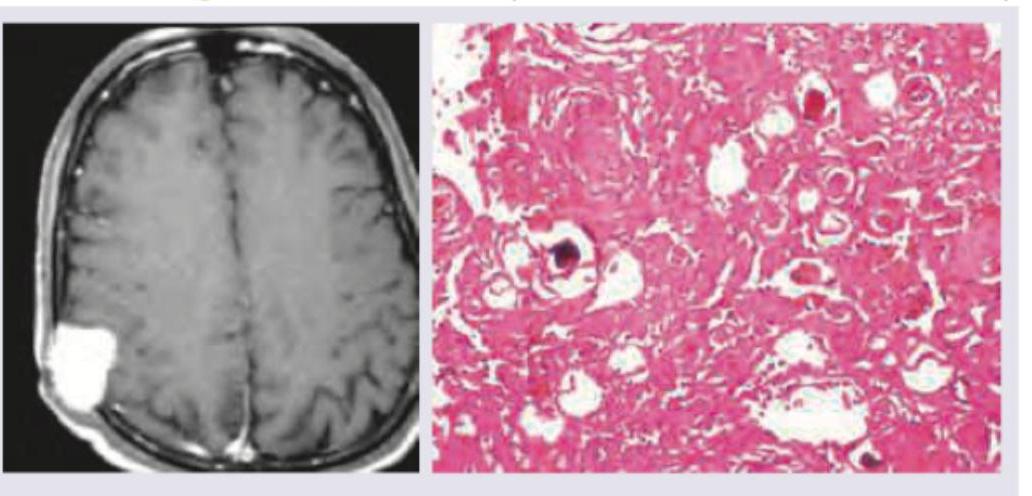
What is the commonest spinal tumour?
In Alzheimer's disease, what is the characteristic pathological finding in the brain?
In cases of non-hemorrhagic infarct in the cerebrum, reactive astrocytes can be seen as early as what time period after the insult?
A retraction ball is seen after injury to which organ?
Neurofibrillary tangles with senile plaques are seen in which of the following conditions?
Laminar necrosis and watershed infarcts are most suggestive of which of the following conditions?
What are the pathological lesions in the CNS in rabies?
Senile plaques in the brain are a characteristic feature of which of the following conditions?
Duret hemorrhage is typically seen in which anatomical location?
Which type of herniation leads to brain stem injury?
Explanation: **Explanation:** The classification of spinal tumors is divided into three compartments: Extradural (most common overall, usually metastases), Intradural-Extramedullary, and Intramedullary. **Why Neurofibroma is correct:** Among primary spinal tumors, **Neurofibroma** (nerve sheath tumor) is considered the most common [1]. These are typically **intradural-extramedullary** in location [2]. They arise from the spinal nerve roots and often present with radicular pain [1]. While Schwannomas are also frequent, in many standard pathology textbooks and epidemiological data used for competitive exams, nerve sheath tumors (specifically Neurofibromas) are cited as the most frequent primary spinal neoplasm [2]. **Analysis of Incorrect Options:** * **Meningioma (A):** These are the second most common intradural-extramedullary tumors. They are more common in females and typically occur in the thoracic spine [2]. * **Ependymoma (B):** This is the most common **intramedullary** (within the cord) tumor in adults, particularly in the filum terminale. However, intramedullary tumors are rarer than extramedullary ones. * **Neuroblastoma (D):** This is a common extracranial solid tumor in children, often arising from the adrenal medulla or sympathetic chain; it is not a primary spinal cord tumor. **High-Yield Clinical Pearls for NEET-PG:** * **Most common spinal tumor overall:** Metastatic deposits (Extradural). * **Most common primary Intramedullary tumor (Adults):** Ependymoma. * **Most common primary Intramedullary tumor (Children):** Astrocytoma. * **Dumbbell-shaped tumor:** Characteristic of nerve sheath tumors (Neurofibroma/Schwannoma) as they exit the neural foramina [1]. * **Myxopapillary Ependymoma:** A specific variant found exclusively in the Conus Medullaris/Filum Terminale. **References:** [1] Kumar V, Abbas AK, et al.. Robbins and Cotran Pathologic Basis of Disease. 9th ed. Peripheral Nerves and Skeletal Muscles, pp. 1248-1250. [2] Cross SS. Underwood's Pathology: A Clinical Approach. 6th ed. Common Clinical Manifestations Of Central And Peripheral Nervous System Disease, pp. 727-728.
Explanation: **Explanation:** Alzheimer’s Disease (AD) is characterized by progressive cortical atrophy, primarily driven by the accumulation of amyloid-beta plaques and tau-associated neurofibrillary tangles [1]. **Why Option A is Correct:** The atrophy in AD typically begins in the **hippocampus and entorhinal cortex** (medial temporal lobe) and spreads to the **parietal and temporal lobes** [2]. This results in narrowed gyri and widened sulci, particularly in these regions. The involvement of the temporal lobe explains the early memory deficits, while parietal involvement leads to visuospatial dysfunction and apraxia. **Analysis of Incorrect Options:** * **Option B:** While temporal lobe atrophy is a hallmark, it is not isolated. The disease characteristically involves the parietal lobes as well [2]. * **Options C & D:** The **occipital lobe** (primary visual cortex) and the motor/sensory strips are characteristically **spared** in Alzheimer’s disease until the very late stages [2]. Involvement of the occipital lobe is more suggestive of other pathologies, such as Dementia with Lewy Bodies (DLB). **High-Yield Facts for NEET-PG:** * **Gross Findings:** Hydrocephalus ex-vacuo (ventricular enlargement due to tissue loss) and "knife-edge" atrophy (though more classic for Pick’s disease) [2]. * **Microscopic Hallmarks:** 1. **Neuritic (Senile) Plaques:** Extracellular A̢-amyloid [1]. 2. **Neurofibrillary Tangles (NFTs):** Intracellular hyperphosphorylated **Tau protein**. The number of NFTs correlates better with the degree of dementia than plaques [1]. * **Hirano Bodies:** Eosinophilic, actin-rich inclusions found in hippocampal pyramidal cells. * **Amyloid Angiopathy:** Deposition of A̢-amyloid in cerebral vessel walls, increasing the risk of lobar hemorrhage [1]. **References:** [1] Kumar V, Abbas AK, et al.. Robbins and Cotran Pathologic Basis of Disease. 9th ed. The Central Nervous System, pp. 1292-1294. [2] Cross SS. Underwood's Pathology: A Clinical Approach. 6th ed. Common Clinical Manifestations Of Central And Peripheral Nervous System Disease, pp. 720-721.
Explanation: **Explanation:** The evolution of a cerebral infarct follows a predictable chronological sequence of morphological changes. The correct answer is **1 week** because reactive gliosis—the brain's equivalent of scar formation—begins to manifest prominently during the subacute phase. **1. Why "1 week" is correct:** Following an ischemic insult, the initial response involves neuronal death and inflammatory infiltration [1]. By **1 week**, the necrotic tissue is being cleared by macrophages (gitter cells), and the surrounding astrocytes undergo **hypertrophy and hyperplasia** [1]. These "reactive astrocytes" develop enlarged nuclei, prominent nucleoli, and expanded eosinophilic cytoplasm with stout processes (gemistocytic astrocytes). This process marks the beginning of the repair phase. **2. Why the other options are incorrect:** * **1 hour:** At this stage, no light microscopic changes are visible. The earliest ultrastructural changes (mitochondrial swelling) only begin after 30 minutes. * **1 day:** Between 12–24 hours, the characteristic finding is **"Red Neurons"** (eosinophilic degeneration, pyknosis, and karyorrhexis) [1]. Reactive astrocytes have not yet developed. * **1 month:** By this time, the reactive gliosis is well-established or complete. The necrotic tissue has been removed, leaving a cystic cavity (liquefactive necrosis) surrounded by a dense network of glial fibers (glial scar). **High-Yield Clinical Pearls for NEET-PG:** * **12–24 hours:** Red Neurons (earliest light microscopic sign). * **24–72 hours:** Neutrophilic infiltration. * **3–7 days:** Macrophage (microglial) infiltration; liquefactive necrosis begins. * **1–2 weeks:** **Reactive gliosis** and vascular proliferation (granulation-like tissue) [1]. * **>2 weeks:** Glial scar formation and cystic cavity expansion. * **Key Concept:** Unlike systemic healing, the CNS repairs via **gliosis**, not fibroblast collagen deposition (except in cases of abscess or trauma involving the meninges). **References:** [1] Kumar V, Abbas AK, et al.. Robbins and Cotran Pathologic Basis of Disease. 9th ed. The Central Nervous System, pp. 1268-1269.
Explanation: **Explanation:** **Retraction balls** (also known as axonal bulbs) are the hallmark histopathological feature of **Diffuse Axonal Injury (DAI)** in the **Brain**. [1] 1. **Why Brain is Correct:** When the brain undergoes sudden acceleration or deceleration (as seen in motor vehicle accidents or falls), shearing forces act on the long white matter tracts. This mechanical stress causes the stretching and tearing of axons. The damage disrupts the normal axoplasmic flow; proteins and organelles transported from the cell body begin to accumulate at the site of the break. This leads to the focal swelling of the proximal axonal stump, which appears microscopically as an eosinophilic, rounded, or club-shaped structure called a **retraction ball**. These are best visualized using **Silver stains** or **Beta-Amyloid Precursor Protein (̢̢β-APP)** immunohistochemistry. 2. **Why Incorrect Options are Wrong:** * **Liver, Spleen, and Kidney:** These are solid visceral organs. Injury to these organs typically results in hemorrhage, infarction, or laceration. They do not contain long, myelinated axonal processes that exhibit the specific physiological "retraction" and swelling seen in neural tissue. **NEET-PG High-Yield Pearls:** * **DAI Locations:** Most commonly involves the **Corpus Callosum** and the **Dorsolateral Pons**. [1] * **Clinical Correlation:** DAI is a frequent cause of persistent vegetative state or immediate post-traumatic coma despite a normal initial CT scan. * **Staining:** While H&E shows them after 24–48 hours, **β-APP staining** can detect axonal damage as early as 2–3 hours post-injury. **References:** [1] Kumar V, Abbas AK, et al.. Robbins and Cotran Pathologic Basis of Disease. 9th ed. The Central Nervous System, pp. 1261-1264.
Explanation: **Explanation:** The presence of **Neurofibrillary Tangles (NFTs)** and **Senile (Neuritic) Plaques** is the hallmark histopathological feature of **Alzheimer’s Disease (AD)** [1]. 1. **Senile Plaques:** These are extracellular deposits consisting of a central core of **Amyloid-beta (Aβ) peptide**, surrounded by dystrophic neurites [3]. They result from the improper cleavage of Amyloid Precursor Protein (APP). 2. **Neurofibrillary Tangles:** These are intracellular inclusions composed of bundles of filaments made of **hyperphosphorylated Tau protein** [3]. Tau normally stabilizes microtubules; when hyperphosphorylated, it dissociates and aggregates, leading to neuronal death [2]. **Analysis of Incorrect Options:** * **Parkinson’s Disease:** Characterized by the loss of dopaminergic neurons in the substantia nigra and the presence of **Lewy Bodies** (intracytoplasmic inclusions of α-synuclein). * **Schizophrenia:** This is a functional psychiatric disorder. While neurochemical changes (dopamine hypothesis) exist, it lacks specific diagnostic gross or microscopic protein aggregates like plaques or tangles. * **Tuberous Sclerosis:** A neurocutaneous syndrome characterized by "tubers" (hamartomas) in the cortex, subependymal nodules, and **giant cell astrocytomas**, not amyloid plaques. **High-Yield Clinical Pearls for NEET-PG:** * **Hirano Bodies:** Eosinophilic, rod-like inclusions (actin-rich) also seen in Alzheimer’s. * **Amyloid Angiopathy:** Aβ deposition in cerebral vessel walls, increasing the risk of lobar hemorrhage [1]. * **Genetics:** Early-onset AD is associated with mutations in **APP (Chr 21)**, **Presenilin 1 (Chr 14)**, and **Presenilin 2 (Chr 1)**. Late-onset is associated with the **ApoE4** allele. * **Brain Atrophy:** AD shows "hydrocephalus ex vacuo" due to narrowing of gyri and widening of sulci, especially in the hippocampus and temporal lobe. **References:** [1] Kumar V, Abbas AK, et al.. Robbins and Cotran Pathologic Basis of Disease. 9th ed. The Central Nervous System, pp. 1292-1294. [2] Kumar V, Abbas AK, et al.. Robbins and Cotran Pathologic Basis of Disease. 9th ed. The Central Nervous System, pp. 1292-1293. [3] Cross SS. Underwood's Pathology: A Clinical Approach. 6th ed. Common Clinical Manifestations Of Central And Peripheral Nervous System Disease, pp. 721-722.
Explanation: **Explanation:** The correct answer is **Shock (Option A)**. This question tests the concept of **Global Hypoxic-Ischemic Encephalopathy**, which occurs during severe systemic hypotension (as seen in shock, cardiac arrest, or severe dehydration) [1], [2]. **Why Shock is correct:** When systemic blood pressure drops significantly, the brain experiences generalized hypoperfusion [2]. This leads to two classic patterns of injury: 1. **Watershed (Border Zone) Infarcts:** These occur at the distal-most territories of major cerebral arteries (e.g., the area between the ACA and MCA) [1]. These regions are the first to suffer when perfusion pressure falls. 2. **Laminar Necrosis:** The cerebral cortex has varying metabolic demands [1]. Layers III, V, and VI are highly sensitive to hypoxia. In global ischemia, these specific layers undergo necrosis, creating a "laminar" (layered) appearance of cell death. **Why the other options are incorrect:** * **Hypertension (B):** Typically leads to **lacunar infarcts** (small vessel disease) or **intracerebral hemorrhages** (e.g., Charcot-Bouchard aneurysms in the basal ganglia), not global watershed patterns [3]. * **Fat Emboli (C):** Characterized by a "starfield" pattern of **petechial hemorrhages** and micro-infarcts in the white matter, usually following long-bone fractures. * **Vascular Thrombosis (D):** Usually causes a **focal ischemic stroke** localized to the specific territory of the occluded vessel (e.g., a wedge-shaped MCA infarct), rather than global laminar or watershed patterns. **NEET-PG High-Yield Pearls:** * **Most sensitive cells to hypoxia:** Purkinje cells of the cerebellum > Pyramidal cells of the Hippocampus (Sommer sector/CA1) > Pyramidal cells of the Neocortex. * **Red Neurons:** The earliest microscopic sign of irreversible hypoxic injury (seen 12–24 hours after the insult). * **Watershed location:** The most common site is the border between the Anterior and Middle Cerebral Arteries [1]. **References:** [1] Cross SS. Underwood's Pathology: A Clinical Approach. 6th ed. (Basic Pathology) introduces the student to key general principles of pathology, both as a medical science and as a clinical activity with a vital role in patient care. Part 2 (Disease Mechanisms) provides fundamental knowledge about the cellular and molecular processes involved in diseases, providing the rationale for their treatment. Part 3 (Systematic Pathology) deals in detail with specific diseases, with emphasis on the clinically important aspects., pp. 150-151. [2] Kumar V, Abbas AK, et al.. Robbins and Cotran Pathologic Basis of Disease. 9th ed. The Central Nervous System, pp. 1265-1266. [3] Kumar V, Abbas AK, et al.. Robbins and Cotran Pathologic Basis of Disease. 9th ed. The Central Nervous System, pp. 1269-1270.
Explanation: **Explanation:** **Rabies** is caused by a neurotropic RNA virus (Lyssavirus) transmitted via the saliva of an infected animal [1]. The virus travels via retrograde axonal transport from the peripheral nerves to the Central Nervous System (CNS) [1]. 1. **Why Brainstem Encephalitis is Correct:** The hallmark of Rabies is a severe, necrotizing **encephalitis**. While the virus affects the entire brain, it shows a predilection for the **brainstem**, hippocampus (Ammon’s horn), and cerebellum [1]. The inflammation in the brainstem is responsible for the classic clinical symptoms of "hydrophobia" and "aerophobia" due to painful spasms of the pharyngeal and laryngeal muscles triggered by the involvement of cranial nerve nuclei. 2. **Why Incorrect Options are Wrong:** * **Cranial nerve arteritis:** Rabies is a neuronal infection, not a vascular one. It does not typically cause inflammation of the arterial walls (vasculitis/arteritis). * **Neuronal loss:** Interestingly, despite the dramatic clinical presentation and fatality, there is often **minimal neuronal loss** or structural damage visible on routine microscopy [1]. The dysfunction is primarily functional/biochemical rather than destructive. * **Neurofibrillary tangles:** These are characteristic of neurodegenerative diseases like Alzheimer’s disease or CTE, not acute viral encephalitis. **High-Yield Clinical Pearls for NEET-PG:** * **Negri Bodies:** The pathognomonic finding. These are **eosinophilic, intracytoplasmic inclusions** found most commonly in the **Pyramidal cells of the Hippocampus** and **Purkinje cells of the Cerebellum** [1]. * **Babes Nodes:** Microglial nodules (clusters of microglia) found around degenerating neurons. * **Incubation Period:** Usually 1–3 months, depending on the distance of the bite site from the CNS. **References:** [1] Kumar V, Abbas AK, et al.. Robbins and Cotran Pathologic Basis of Disease. 9th ed. The Central Nervous System, pp. 1279-1280.
Explanation: **Explanation:** **Alzheimer’s Disease (Correct Answer):** Senile plaques (also known as neuritic plaques) are a hallmark pathological feature of Alzheimer’s disease. These are extracellular deposits primarily composed of **Amyloid-beta (Aβ) peptides**, derived from the cleavage of Amyloid Precursor Protein (APP) [1], [2]. They are typically found in the hippocampus, amygdala, and neocortex. Along with intracellular **Neurofibrillary Tangles (NFTs)**—composed of hyperphosphorylated **Tau protein**—they lead to progressive neuronal loss and cognitive decline [2]. **Why the other options are incorrect:** * **Multiple Sclerosis:** This is an autoimmune demyelinating disorder of the CNS. The characteristic lesion is the **MS Plaque**, which represents an area of demyelination and perivascular inflammation (Dawson’s fingers), not amyloid deposition. * **Parkinsonism:** The pathological hallmark is the **Lewy body**, which is an intracellular inclusion made of **alpha-synuclein**, found predominantly in the substantia nigra [2]. * **Wilson’s Disease:** This is a disorder of copper metabolism. Brain pathology typically involves atrophy and cavitation of the **putamen** (basal ganglia) and the presence of **Alzheimer Type II astrocytes** (not to be confused with Alzheimer’s disease). **NEET-PG High-Yield Pearls:** * **Hirano Bodies:** Eosinophilic, rod-like inclusions found in the hippocampus of Alzheimer’s patients [1]. * **Cerebral Amyloid Angiopathy (CAA):** Amyloid deposition in the walls of cerebral vessels, increasing the risk of lobar hemorrhage [1]. * **Staining:** Senile plaques are best visualized using **Silver stains** (e.g., Bielschowsky) or **Congo Red** (showing apple-green birefringence under polarized light) [1]. * **Genetics:** Mutations in **APP** (Chr 21), **Presenilin 1** (Chr 14), and **Presenilin 2** (Chr 1) are linked to familial early-onset Alzheimer’s [3]. **References:** [1] Kumar V, Abbas AK, et al.. Robbins and Cotran Pathologic Basis of Disease. 9th ed. The Central Nervous System, pp. 1290-1294. [2] Cross SS. Underwood's Pathology: A Clinical Approach. 6th ed. Common Clinical Manifestations Of Central And Peripheral Nervous System Disease, pp. 721-722. [3] Kumar V, Abbas AK, et al.. Robbins and Cotran Pathologic Basis of Disease. 9th ed. The Central Nervous System, pp. 1290-1292.
Explanation: **Explanation:** **Duret hemorrhages** are small, linear or flame-shaped hemorrhages occurring in the **brainstem**, specifically the midbrain and upper pons [1]. **Why the Brainstem is Correct:** The underlying mechanism is **transtentorial (uncal) herniation** [1]. When a space-occupying lesion (like an epidural hematoma or tumor) causes the brain to shift downward through the tentorial notch, it leads to the stretching and tearing of the **perforating branches of the basilar artery** [1]. This vascular disruption results in linear hemorrhages within the midline of the brainstem [1]. It is a sign of severe intracranial pressure and often indicates a fatal prognosis. **Analysis of Incorrect Options:** * **A. Brain:** While the brainstem is part of the brain, this option is too non-specific. NEET-PG requires choosing the most precise anatomical site. * **C. Eye:** Hemorrhages in the eye (e.g., Roth spots or retinal hemorrhages) are associated with conditions like endocarditis or hypertension, not transtentorial herniation. * **D. Medulla:** While the medulla is part of the brainstem, Duret hemorrhages are classically localized higher up, in the **midbrain and pons** [1]. **High-Yield Clinical Pearls for NEET-PG:** * **Mechanism:** Downward displacement of the brainstem → stretching of **pontine perforating arteries** [1]. * **Associated Sign:** Often seen in the late stages of **uncal herniation**, which also presents with an ipsilateral dilated pupil (CN III compression) and contralateral hemiparesis. * **Kernohan’s Notch:** A related concept where herniation pushes the contralateral cerebral peduncle against the tentorium, causing "false localizing signs." * **Morphology:** Grossly appears as multiple small, linear streaks of blood in the midline of the tegmentum [1]. **References:** [1] Kumar V, Abbas AK, et al.. Robbins and Cotran Pathologic Basis of Disease. 9th ed. Peripheral Nerves and Skeletal Muscles, pp. 1257-1258.
Explanation: **Explanation:** Brain herniation occurs when increased intracranial pressure (ICP) forces brain tissue across rigid dural structures [1]. **Correct Answer: D. Cerebellar tonsils (Tonsillar Herniation)** Tonsillar herniation involves the displacement of the cerebellar tonsils through the **foramen magnum** [1],[2]. This is the most life-threatening form of herniation because it causes direct compression of the **medulla oblongata** (lower brainstem) [2]. The medulla contains vital respiratory and cardiac centers; its compression leads to sudden respiratory arrest and death [2]. **Incorrect Options:** * **A & C. Cingulate / Subfalcine Herniation:** These are synonymous. The cingulate gyrus is pushed under the falx cerebri [1]. While it can compress the anterior cerebral artery (causing leg weakness), it does not typically involve the brainstem directly. * **B. Hippocampal (Uncal) Herniation:** This involves the medial aspect of the temporal lobe (uncus) moving over the tentorium cerebelli [1]. While it can lead to brainstem compression in later stages (Duret hemorrhages), the primary initial features are CN III palsy and ipsilateral hemiparesis (Kernohan’s notch) [2]. Tonsillar herniation is the classic answer for direct, terminal brainstem (medullary) injury. **High-Yield NEET-PG Pearls:** 1. **Duret Hemorrhages:** Small linear hemorrhages in the midbrain and pons caused by the downward displacement of the brainstem (often seen in uncal herniation) [2]. 2. **Cushing’s Triad:** A sign of increased ICP consisting of hypertension, bradycardia, and irregular respirations. 3. **Kernohan’s Notch:** A false localizing sign where uncal herniation compresses the contralateral cerebral peduncle, causing hemiparesis on the *same* side as the lesion. **References:** [1] Cross SS. Underwood's Pathology: A Clinical Approach. 6th ed. Common Clinical Manifestations Of Central And Peripheral Nervous System Disease, pp. 699-700. [2] Kumar V, Abbas AK, et al.. Robbins and Cotran Pathologic Basis of Disease. 9th ed. Peripheral Nerves and Skeletal Muscles, pp. 1257-1258.
Cellular Pathology of the Nervous System
Practice Questions
Cerebrovascular Diseases
Practice Questions
Trauma to the Central Nervous System
Practice Questions
Infections of the Nervous System
Practice Questions
Demyelinating Diseases
Practice Questions
Neurodegenerative Diseases
Practice Questions
CNS Tumors
Practice Questions
Peripheral Nerve Disorders
Practice Questions
Neuromuscular Junction Diseases
Practice Questions
Congenital and Developmental Disorders
Practice Questions
Get full access to all questions, explanations, and performance tracking.
Start For Free