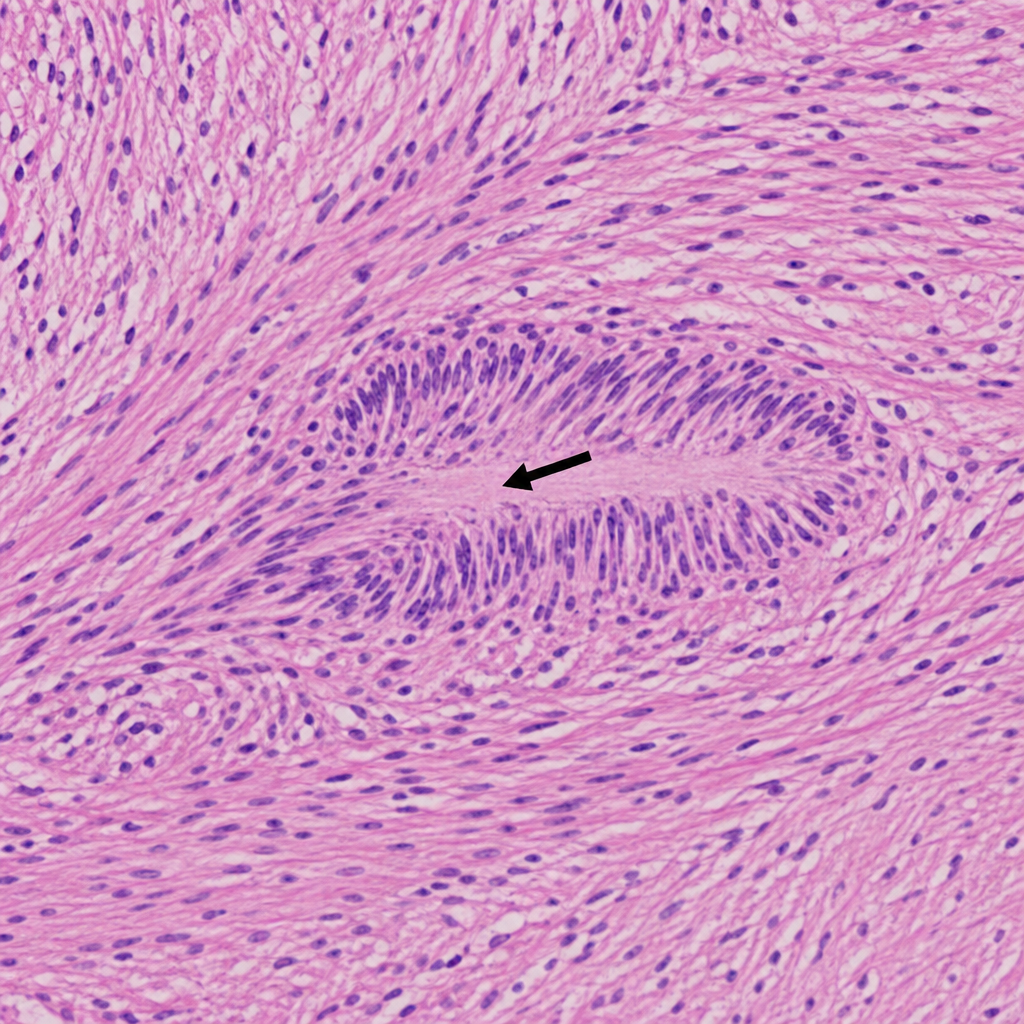
Pseudolaminar necrosis is a feature of which of the following?
Homer Wright rosettes are seen in which of the following neoplasms?
A 45-year-old male patient with Down syndrome has experienced severe cognitive decline over several years and is now completely dependent on others for basic activities of daily living. What histopathologic findings are most likely to be seen in the cortical neurons of this patient?
In diffuse axonal injury, what are the typical locations of lesions in the brain?
Which of the following conditions are characterized by trinucleotide repeats?
Which type of meningioma has the worst prognosis?
What is the most common glial tumor?
Subdural hematoma most commonly results from which of the following?
Which of the following are seen in Alzheimer disease?
What is the defect in berry aneurysms?
Explanation: **Explanation:** **Pseudolaminar necrosis** is a specific pattern of neuronal death seen in the brain following a period of severe hypoxia or global ischemia [1]. It is a hallmark of **Cerebral Infarction**. **Why Cerebral Infarct is correct:** The cerebral cortex consists of six layers of neurons. These layers have varying metabolic demands; specifically, layers **III, IV, and V** are the most metabolically active and sensitive to oxygen deprivation [2]. In conditions like severe hypotension or global ischemia, these specific layers undergo selective necrosis while other layers may remain relatively preserved. This "layer-by-layer" destruction gives a "laminar" (layered) appearance under the microscope, hence the term pseudolaminar necrosis. **Why other options are incorrect:** * **Renal, Hepatic, and Cardiac Infarcts:** These organs undergo **coagulative necrosis** (except in the brain where liquefactive necrosis occurs). While they suffer from ischemia, they do not possess the specific stratified neuronal architecture that leads to the "laminar" pattern seen in the brain [2]. **High-Yield Clinical Pearls for NEET-PG:** * **Vulnerable Areas:** The most sensitive cells to hypoxia in the CNS are the **Pyramidal cells** of the Hippocampus (Sommer sector/CA1) and the **Purkinje cells** of the Cerebellum. * **Necrosis Type:** Brain infarcts initially show features of cell death but eventually result in **Liquefactive necrosis**, unlike most other solid organs which show Coagulative necrosis. * **Red Neurons:** The earliest microscopic change (12–24 hours) in a cerebral infarct is the appearance of "Red Neurons" (eosinophilic cytoplasm and pyknotic nuclei). **References:** [1] Cross SS. Underwood's Pathology: A Clinical Approach. 6th ed. Common Clinical Manifestations Of Central And Peripheral Nervous System Disease, pp. 704-705. [2] Cross SS. Underwood's Pathology: A Clinical Approach. 6th ed. (Basic Pathology) introduces the student to key general principles of pathology, both as a medical science and as a clinical activity with a vital role in patient care. Part 2 (Disease Mechanisms) provides fundamental knowledge about the cellular and molecular processes involved in diseases, providing the rationale for their treatment. Part 3 (Systematic Pathology) deals in detail with specific diseases, with emphasis on the clinically important aspects., pp. 150-151.
Explanation: **Explanation:** **Homer Wright Rosettes** are a hallmark histopathological feature of primitive neuroectodermal tumors. They consist of a circular cluster of tumor cells surrounding a central **fibrillar core** (neuropil), without a central lumen or blood vessel [1]. 1. **Neuroblastoma (Correct):** This is a classic example of a small round blue cell tumor where Homer Wright rosettes are frequently seen [1]. The central "pinkish" area represents neuritic processes (neuropil). These rosettes are also characteristic of **Medulloblastoma** and **Retinoblastoma**. 2. **Incorrect Options:** * **Astrocytoma:** Characterized by fibrillary backgrounds and Rosenthal fibers (in pilocytic types), but not Homer Wright rosettes. * **Meningioma:** Classically shows **Psammoma bodies** (laminated calcifications) and whorled patterns of spindle cells. * **Pinealoma:** While Pineoblastomas can show Homer Wright rosettes, "Pinealoma" is a non-specific term; Pineocytomas typically show larger, more irregular **Pineocytomatous rosettes**. **High-Yield Clinical Pearls for NEET-PG:** * **True Rosettes (Flexner-Wintersteiner):** Contain a central **lumen**; pathognomonic for **Retinoblastoma**. * **Pseudorosettes (Perivascular):** Cells arrange around a **blood vessel**; characteristic of **Ependymoma** [2]. * **Neuroblastoma Markers:** Elevated urinary catecholamines (VMA/HVA) and N-myc amplification (poor prognosis) [1]. * **Bombesin & NSE:** Positive immunohistochemical markers for Neuroblastoma [1]. **References:** [1] Kumar V, Abbas AK, et al.. Robbins and Cotran Pathologic Basis of Disease. 9th ed. Diseases of Infancy and Childhood, pp. 483-485. [2] Kumar V, Abbas AK, et al.. Robbins and Cotran Pathologic Basis of Disease. 9th ed. The Central Nervous System, pp. 1312-1313.
Explanation: **Explanation:** The clinical presentation describes a patient with **Down Syndrome (Trisomy 21)** developing early-onset dementia. By the age of 40, almost all individuals with Down syndrome develop the neuropathological hallmarks of **Alzheimer’s Disease (AD)** [1]. **Why Neurofibrillary Tangles (NFTs) are correct:** The gene for **Amyloid Precursor Protein (APP)** is located on **chromosome 21** [4]. The extra copy of this chromosome leads to the overexpression of APP, resulting in the accumulation of Amyloid-beta plaques and subsequent formation of **Neurofibrillary Tangles** [1]. NFTs are intracellular aggregates of hyperphosphorylated **tau protein** (a microtubule-associated protein) [2]. These are characteristic histopathologic findings in Alzheimer's disease, which is the cause of cognitive decline in this patient [5]. **Analysis of Incorrect Options:** * **Pick bodies:** These are round, silver-staining cytoplasmic inclusions of tau protein seen in **Pick Disease** (Frontotemporal Dementia), characterized by early personality changes rather than the typical progression seen here [3]. * **Psammoma bodies:** These are laminated calcifications seen in specific tumors like **Meningiomas**, papillary thyroid carcinoma, or ovarian serous cystadenocarcinoma, not in degenerative cortical neurons. * **Lewy bodies:** These are alpha-synuclein inclusions found in **Parkinson’s Disease** and Lewy Body Dementia. While they cause cognitive decline, they are not the primary pathology associated with Down syndrome. **NEET-PG High-Yield Pearls:** * **APP Gene:** Located on Chromosome 21 (Link between Down syndrome and AD) [1]. * **Hirano Bodies:** Eosinophilic, rod-like inclusions in hippocampus (also seen in AD). * **Senile Plaques:** Extracellular $A\beta$ amyloid deposits (the other hallmark of AD) [4]. * **Tau Protein:** Associated with NFTs; its normal function is stabilizing microtubules. **References:** [1] Kumar V, Abbas AK, et al.. Robbins and Cotran Pathologic Basis of Disease. 9th ed. The Central Nervous System, pp. 1290-1292. [2] Kumar V, Abbas AK, et al.. Robbins and Cotran Pathologic Basis of Disease. 9th ed. The Central Nervous System, pp. 1292-1293. [3] Kumar V, Abbas AK, et al.. Robbins and Cotran Pathologic Basis of Disease. 9th ed. The Central Nervous System, pp. 1294-1295. [4] Cross SS. Underwood's Pathology: A Clinical Approach. 6th ed. Common Clinical Manifestations Of Central And Peripheral Nervous System Disease, pp. 720-721. [5] Kumar V, Abbas AK, et al.. Robbins and Cotran Pathologic Basis of Disease. 9th ed. The Central Nervous System, p. 1292.
Explanation: **Explanation:** **Diffuse Axonal Injury (DAI)** is a form of traumatic brain injury caused by rapid acceleration/deceleration or rotational forces (e.g., motor vehicle accidents). These forces result in **shearing and stretching of axons**, leading to immediate structural damage and subsequent biochemical cascades that impair axonal transport [1]. **1. Why Option D is Correct:** The lesions in DAI typically occur at the interface between tissues of different densities. The most vulnerable areas are the deep-seated white matter tracts. The characteristic distribution follows a hierarchical pattern of severity: * **Cerebral Hemispheres:** Specifically the gray-white matter junction [1]. * **Corpus Callosum:** Often involves the posterior body and splenium [1]. * **Upper Brainstem:** Particularly the dorsolateral sectors of the midbrain and superior cerebellar peduncles [1]. **2. Why Other Options are Incorrect:** * **A. Para-sagittal region:** This is the classic site for **subdural hematomas** (due to bridging vein rupture) or focal cortical contusions, rather than diffuse axonal damage. * **B. Cerebral cortex:** DAI primarily affects the **white matter**. The cortex (gray matter) is more susceptible to focal contusions or hypoxic-ischemic injury. * **C. Ventricles:** While intraventricular hemorrhage can occur in severe trauma, the ventricles are fluid-filled spaces and not the primary site of axonal shearing. **NEET-PG High-Yield Pearls:** * **Microscopic Hallmark:** Presence of **axonal swellings (spheroids)**, best visualized with **Silver stains** or **Beta-Amyloid Precursor Protein (̢-APP)** immunohistochemistry (the gold standard for early detection) [1]. * **Imaging:** CT is often normal despite a poor clinical state (coma). **MRI (especially Susceptibility Weighted Imaging - SWI)** is the investigation of choice to see "petechial hemorrhages" in the white matter. * **Clinical:** DAI is a common cause of persistent vegetative state following head trauma. **References:** [1] Kumar V, Abbas AK, et al.. Robbins and Cotran Pathologic Basis of Disease. 9th ed. The Central Nervous System, pp. 1261-1264.
Explanation: **Explanation:** Trinucleotide repeat disorders are a group of genetic conditions caused by the expansion of specific three-nucleotide sequences within certain genes. [1] When the number of repeats exceeds a critical threshold, it leads to gene instability and protein dysfunction. **Why Option D is Correct:** * **Huntington’s Disease (HD):** Characterized by an expansion of **CAG** repeats (encoding Glutamine) in the *HTT* gene on chromosome 4. It presents with the classic triad of chorea, dementia, and psychiatric symptoms. * **Spinocerebellar Ataxias (SCA):** This is a heterogeneous group of autosomal dominant disorders. [3] Many subtypes (like SCA1, 2, 3, 6, and 7) are caused by **CAG** expansions, leading to progressive cerebellar ataxia and oculomotor dysfunction. **Why Other Options are Incorrect:** * **Amyotrophic Lateral Sclerosis (ALS):** While most cases are sporadic, familial ALS is most commonly associated with a **hexanucleotide** (GGGGCC) repeat expansion in the *C9orf72* gene, not a trinucleotide repeat. [2] * **Sclerosis:** This is a general pathological term (e.g., Multiple Sclerosis, Tuberous Sclerosis) referring to tissue scarring or hardening. These conditions are autoimmune or caused by different genetic mutations (TSC1/TSC2), not triplet repeats. **High-Yield NEET-PG Pearls:** 1. **Anticipation:** This is the hallmark of triplet repeat disorders, where the disease manifests at an earlier age and with increased severity in successive generations due to further expansion of the repeats during gametogenesis. 2. **Friedreich’s Ataxia:** An important **Autosomal Recessive** triplet repeat disorder (**GAA** repeat in the *Frataxin* gene). [3] 3. **Fragile X Syndrome:** Caused by **CGG** repeats; it is the most common inherited cause of intellectual disability. [2] 4. **Myotonic Dystrophy:** Caused by **CTG** repeats; presents with **References:** [1] Kumar V, Abbas AK, et al.. Robbins and Cotran Pathologic Basis of Disease. 9th ed. Genetic Disorders, pp. 177-181. [2] Cross SS. Underwood's Pathology: A Clinical Approach. 6th ed. Common Clinical Manifestations Of Central And Peripheral Nervous System Disease, pp. 722-723. [3] Kumar V, Abbas AK, et al.. Robbins and Cotran Pathologic Basis of Disease. 9th ed. The Central Nervous System, pp. 1300-1301.
Explanation: Explanation: Meningiomas are classified by the WHO into three grades based on their histological features, mitotic activity, and clinical behavior [2]. The prognosis is directly correlated with these grades. 1. Why Anaplastic is Correct: Anaplastic (Malignant) Meningioma is classified as WHO Grade III. It is the most aggressive form, characterized by high mitotic rates (≥20 mitoses per 10 HPF) and/or overt malignancy resembling carcinoma, melanoma, or sarcoma. These tumors have the worst prognosis, with high rates of local recurrence and a significant risk of distant metastasis [1]. 2. Analysis of Incorrect Options: * Syncytial (Meningotheliomatous) and Fibroblastic: These are subtypes of WHO Grade I meningiomas. They are benign, slow-growing, and have an excellent prognosis following surgical resection [1]. * Atypical: This is classified as WHO Grade II. While more aggressive than Grade I (showing 4–19 mitoses per 10 HPF or brain invasion), it has a better prognosis than the Grade III Anaplastic variety. 3. High-Yield Clinical Pearls for NEET-PG: * Most Common Site: Parasagittal region (falcine). * Psammoma Bodies: Most commonly seen in the Psammomatous subtype (Grade I) [1]. * Genetic Association: Loss of chromosome 22q (NF2 gene) is the most frequent genetic alteration [1]. * Progesterone Receptors: Many meningiomas express PR; they may enlarge during pregnancy. * Radiology: Characterized by a "Dural Tail" sign on MRI. * WHO Grading Summary: * Grade I: Syncytial, Fibroblastic, Transitional, Psammomatous. * Grade II: Atypical, Clear cell, Chordoid. * Grade III: Anaplastic, Rhabdoid, Papillary. **References:** [1] Kumar V, Abbas AK, et al.. Robbins and Cotran Pathologic Basis of Disease. 9th ed. The Central Nervous System, pp. 1316-1317. [2] Cross SS. Underwood's Pathology: A Clinical Approach. 6th ed. (Basic Pathology) introduces the student to key general principles of pathology, both as a medical science and as a clinical activity with a vital role in patient care. Part 2 (Disease Mechanisms) provides fundamental knowledge about the cellular and molecular processes involved in diseases, providing the rationale for their treatment. Part 3 (Systematic Pathology) deals in detail with specific diseases, with emphasis on the clinically important aspects., pp. 207-208.
Explanation: **Explanation:** **1. Why Astrocytoma is correct:** Glial tumors (gliomas) are the most common primary intracranial tumors, and among them, **Astrocytomas** are the most frequent [1]. They originate from astrocytes, the star-shaped glial cells that support neurons. Astrocytomas represent approximately 75–80% of all adult gliomas [1]. They range from low-grade (e.g., Pilocytic Astrocytoma) to the highly aggressive Grade IV **Glioblastoma Multiforme (GBM)**, which is the most common malignant primary brain tumor in adults [2]. **2. Why other options are incorrect:** * **Ependymomas:** These arise from the lining of the ventricular system. While they are common in the spinal cord of adults and the 4th ventricle in children, they are significantly less common than astrocytomas overall. * **Meningioma:** This is the most common **overall** primary intracranial tumor [2]. However, it arises from the arachnoid cap cells of the meninges, not from glial cells. Therefore, it is not classified as a "glial tumor." * **Neurofibroma:** These are benign nerve sheath tumors of the peripheral nervous system (PNS), not the central nervous system (CNS) glia. **High-Yield Clinical Pearls for NEET-PG:** * **Most common primary brain tumor (Overall):** Meningioma [2]. * **Most common primary malignant brain tumor (Adults):** Glioblastoma Multiforme (GBM) [2]. * **Most common brain tumor (Overall):** Metastasis (usually from Lung, Breast, or Melanoma) [2]. * **Most common CNS tumor in children:** Pilocytic Astrocytoma (Grade I) [2]. * **Molecular Marker:** IDH mutation status is now the gold standard for classifying astrocytomas (IDH-mutant vs. IDH-wildtype). **References:** [1] Cross SS. Underwood's Pathology: A Clinical Approach. 6th ed. Common Clinical Manifestations Of Central And Peripheral Nervous System Disease, pp. 725-726. [2] Kumar V, Abbas AK, et al.. Robbins and Cotran Pathologic Basis of Disease. 9th ed. The Central Nervous System, pp. 1308-1320.
Explanation: **Explanation:** **Subdural Hematoma (SDH)** occurs due to the accumulation of blood between the **dura mater** and the **arachnoid mater** [1]. **Why Option C is Correct:** The primary mechanism is the **tearing of cortical bridging veins** as they travel from the surface of the cerebral hemispheres through the subarachnoid space and the subdural space to empty into the superior sagittal sinus [1]. Because veins are under low pressure, the bleeding is typically slow, leading to a gradual onset of symptoms [2]. This is especially common in elderly patients and chronic alcoholics, where brain atrophy increases the distance these veins must travel, making them more susceptible to shear forces during minor trauma [1]. **Why Other Options are Incorrect:** * **Option A & B:** Rupture of an intracranial (Berry) aneurysm or an Arteriovenous Malformation (AVM) typically results in a **Subarachnoid Hemorrhage (SAH)**, characterized by blood in the CSF and a "thunderclap headache." * **Option D:** While Hemophilia is a bleeding diathesis that can predispose a patient to intracranial bleeds, it is a systemic risk factor rather than the direct anatomical cause of the hematoma. **High-Yield Clinical Pearls for NEET-PG:** * **Radiology:** SDH appears as a **crescent-shaped (concave)** opacity on CT that can cross suture lines but is limited by dural reflections (e.g., falx cerebri). * **Demographics:** Most common in the elderly, alcoholics, and "shaken baby syndrome." [1] * **Contrast with Epidural Hematoma (EDH):** EDH is usually arterial (Middle Meningeal Artery), associated with skull fractures, and shows a **biconvex (lens-shaped)** appearance on CT. **References:** [1] Kumar V, Abbas AK, et al.. Robbins and Cotran Pathologic Basis of Disease. 9th ed. The Central Nervous System, p. 1264. [2] Kumar V, Abbas AK, et al.. Robbins and Cotran Pathologic Basis of Disease. 9th ed. The Central Nervous System, pp. 1264-1265.
Explanation: **Explanation:** Alzheimer Disease (AD) is characterized by the accumulation of amyloid-beta (A̢β) peptides and tau protein. While multiple options listed are associated with AD, the question asks to identify a characteristic feature among the choices provided. **1. Why Amyloid Angiopathy is correct:** Cerebral Amyloid Angiopathy (CAA) is a nearly universal finding in Alzheimer Disease [1]. It involves the deposition of **A̢β40** (and A̢β42) within the walls of small to medium-sized cortical and leptomeningeal arteries [1]. This weakens the vessel walls, increasing the risk of lobar hemorrhages. In the context of NEET-PG, CAA is a high-yield vascular manifestation of AD pathology. **2. Analysis of Incorrect Options:** * **Neurofibrillary Tangles (NFTs):** These are intracellular aggregates of **hyperphosphorylated tau protein** [3]. While they are a hallmark of AD, their density correlates better with the severity of cognitive decline than plaques [1]. * **Neuritic (Senile) Plaques:** These are extracellular deposits of **A̢β42** peptides [3]. Along with NFTs, they form the classic "plaques and tangles" pathology [1]. * **Pick’s Protein (Pick Bodies):** These are round, silver-staining cytoplasmic inclusions of tau protein seen in **Pick Disease** (Frontotemporal Dementia), not Alzheimer Disease [4]. *Note: In many versions of this specific MCQ, if multiple options are correct (A, B, and D), the question follows a "Multiple Correct" format. However, if forced to choose the most specific vascular association or if the question implies a "check all that apply" logic, Amyloid Angiopathy is a definitive pathological component.* **High-Yield Clinical Pearls for NEET-PG:** * **Hirano Bodies:** Eosinophilic, rod-like inclusions (actin) found in the hippocampus of AD patients. * **Granulovacuolar Degeneration:** Clear cytoplasmic vacuoles seen in hippocampal pyramidal cells. * **Genetics:** Early-onset AD is linked to **APP** (Chr 21), **PSEN1** (Chr 14), and **PSEN2** (Chr 1) [2]. Late-onset is linked to **ApoE4**. * **Brain Atrophy:** Most prominent in the **hippocampus** and entorhinal cortex initially. **References:** [1] Kumar V, Abbas AK, et al.. Robbins and Cotran Pathologic Basis of Disease. 9th ed. The Central Nervous System, pp. 1292-1294. [2] Kumar V, Abbas AK, et al.. Robbins and Cotran Pathologic Basis of Disease. 9th ed. The Central Nervous System, pp. 1290-1292. [3] Cross SS. Underwood's Pathology: A Clinical Approach. 6th ed. Common Clinical Manifestations Of Central And Peripheral Nervous System Disease, pp. 721-722. [4] Kumar V, Abbas AK, et al.. Robbins and Cotran Pathologic Basis of Disease. 9th ed. The Central Nervous System, pp. 1294-1295.
Explanation: **Explanation:** Berry (saccular) aneurysms are the most common cause of non-traumatic subarachnoid hemorrhage [1]. The fundamental pathogenesis involves a **structural defect in the tunica media** of the arterial wall [1]. **1. Why "Degeneration of Media" is correct:** Berry aneurysms occur at the bifurcations of the Circle of Willis (most commonly the Anterior Communicating Artery) [2]. At these branching points, there is a congenital or acquired **absence/thinning of the muscular media** [1]. Under the stress of hemodynamic pressure, the remaining layers (internal elastic lamina and adventitia) bulge outward, eventually leading to the fragmentation of the elastic lamina as well [1]. **2. Why other options are incorrect:** * **Option A:** While the internal elastic lamina (IEL) is often absent or fragmented in the aneurysmal sac, this is a *consequence* of the bulging caused by the medial defect, not the primary initiating defect [1]. * **Option C:** This describes **cystic medial necrosis**, which is characteristic of aortic dissections (e.g., in Marfan syndrome), not berry aneurysms. * **Option D:** Berry aneurysms are non-inflammatory in nature [2]. Inflammation is a feature of mycotic aneurysms (caused by infection) or vasculitis [4]. **Clinical Pearls for NEET-PG:** * **Most common site:** Junction of Anterior Communicating Artery (A-com) and Anterior Cerebral Artery [2]. * **Associated conditions:** Autosomal Dominant Polycystic Kidney Disease (ADPKD), Ehlers-Danlos syndrome, and Coarctation of the aorta [3]. * **Clinical presentation:** "Worst headache of life" (Thunderclap headache) [3]. * **Risk factors:** Hypertension and smoking (major acquired factors) [3]. **References:** [1] Kumar V, Abbas AK, et al.. Robbins and Cotran Pathologic Basis of Disease. 9th ed. The Central Nervous System, pp. 1272-1273. [2] Kumar V, Abbas AK, et al.. Robbins and Cotran Pathologic Basis of Disease. 9th ed. The Central Nervous System, p. 1272. [3] Cross SS. Underwood's Pathology: A Clinical Approach. 6th ed. Common Clinical Manifestations Of Central And Peripheral Nervous System Disease, pp. 705-706. [4] Kumar V, Abbas AK, et al.. Robbins and Cotran Pathologic Basis of Disease. 9th ed. Diseases of Infancy and Childhood, pp. 510-511.
Cellular Pathology of the Nervous System
Practice Questions
Cerebrovascular Diseases
Practice Questions
Trauma to the Central Nervous System
Practice Questions
Infections of the Nervous System
Practice Questions
Demyelinating Diseases
Practice Questions
Neurodegenerative Diseases
Practice Questions
CNS Tumors
Practice Questions
Peripheral Nerve Disorders
Practice Questions
Neuromuscular Junction Diseases
Practice Questions
Congenital and Developmental Disorders
Practice Questions
Get full access to all questions, explanations, and performance tracking.
Start For Free