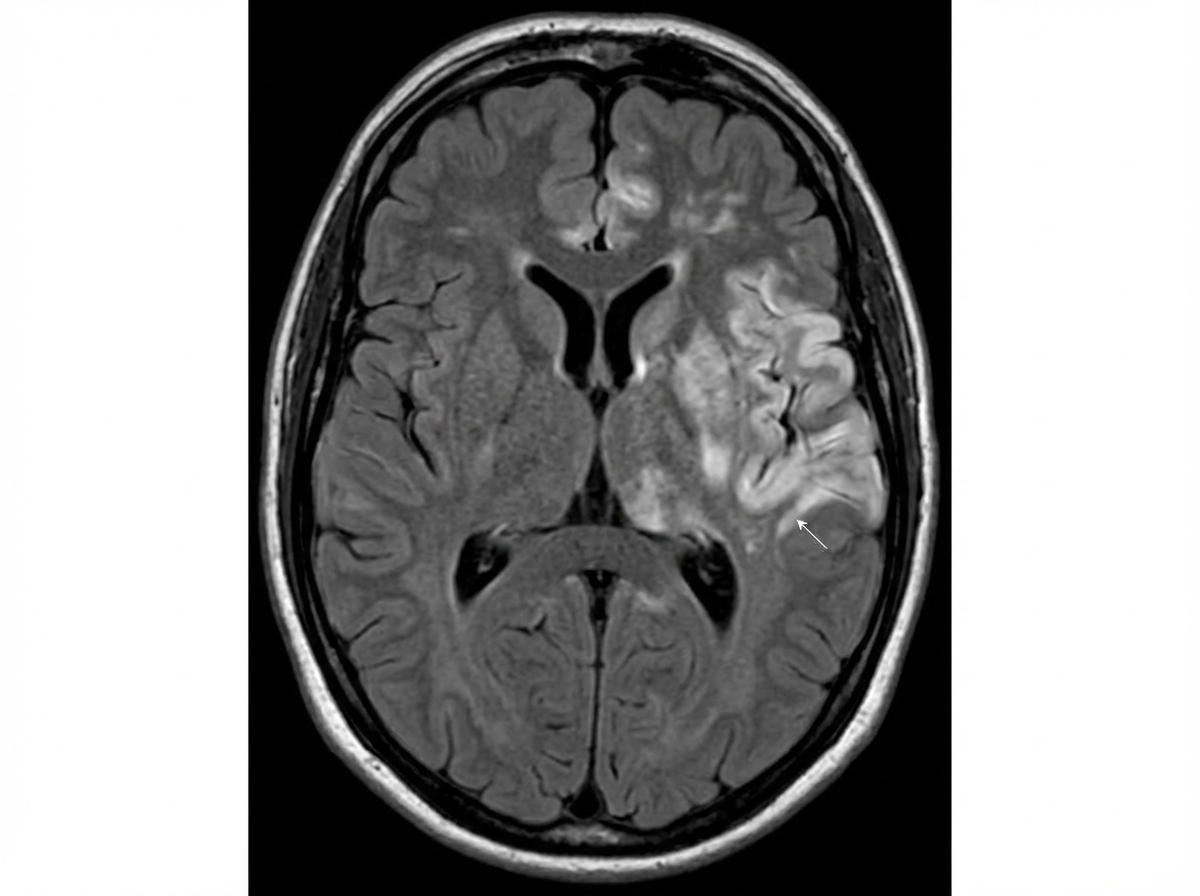
A patient with Neurofibromatosis, type 1 is at increased risk of developing which of the following malignant neoplasms?
Rosenthal fibers are characteristically seen in which of the following?
Target fibres are characteristically seen in a muscle biopsy of which condition?
All of the following are neuronal tumors, EXCEPT:
Sudden onset of massive bleeding from which organ is called apoplexy?
Which chromosome mutation is associated with medulloblastoma?
A 10-year-old girl has exhibited muscular weakness since early childhood that has not worsened. She can ambulate unassisted but does not participate in strenuous physical activities. On examination, she has 4/5 motor strength in proximal muscles and 5/5 in distal muscles. There is no muscle pain on palpation. A biopsy of the deltoid muscle is obtained, and with Gomori trichrome stain, microscopic analysis shows subsarcolemmal aggregates of rod-shaped intracytoplasmic inclusions. Laboratory studies show a normal serum creatine kinase. Which of the following is the most likely form of muscle disease she has?
Glioma of the optic nerve is usually?
Which of the following is NOT a characteristic feature of Alzheimer's disease?
Medulloblastoma most commonly metastasizes to which location?
Explanation: **Explanation:** **Neurofibromatosis Type 1 (NF1)**, also known as von Recklinghausen disease, is an autosomal dominant disorder caused by a mutation in the *NF1* gene on chromosome 17. This gene encodes **neurofibromin**, a tumor suppressor that negatively regulates the RAS signaling pathway [1]. **Why the correct answer is right:** Patients with NF1 have a significant predisposition to developing both benign and malignant tumors of the neural crest origin. **Neurofibrosarcoma**, now more commonly referred to as a **Malignant Peripheral Nerve Sheath Tumor (MPNST)**, is the most feared malignant complication [1]. These typically arise from the malignant transformation of pre-existing **plexiform neurofibromas** (a pathognomonic feature of NF1) [1]. The lifetime risk of developing MPNST in NF1 patients is approximately 8–13% [1]. **Analysis of incorrect options:** * **A. Ganglioneuroma:** These are benign tumors of the sympathetic nervous system. While they are neural crest-derived, they are more commonly associated with the maturation of neuroblastomas rather than NF1. * **B. Glioblastoma Multiforme (GBM):** While NF1 patients are at increased risk for CNS gliomas, the most characteristic one is the **Optic Nerve Glioma** (usually a low-grade Pilocytic Astrocytoma), not GBM. * **D. Serous cystadenocarcinoma:** This is a common malignant ovarian tumor and has no established syndromic association with NF1. **High-Yield Clinical Pearls for NEET-PG:** * **NF1 Genetics:** Chromosome **17** (Mnemonic: 17 letters in Neurofibromatosis). * **Diagnostic Criteria:** Café-au-lait spots (≥6), Lisch nodules (iris hamartomas), Axillary/Inguinal freckling (Crowe sign), and Optic gliomas. * **Plexiform Neurofibroma:** These carry a high risk of transformation to **MPNST**; they are described as a "bag of worms" on palpation [1]. * **Pheochromocytoma:** NF1 is a known (though less common) association alongside MEN 2 and VHL syndromes. **References:** [1] Kumar V, Abbas AK, et al.. Robbins and Cotran Pathologic Basis of Disease. 9th ed. Peripheral Nerves and Skeletal Muscles, pp. 1248-1251.
Explanation: **Explanation:** **Rosenthal fibers** are elongated, eosinophilic, corkscrew-shaped inclusion bodies found within the processes of astrocytes. 1. **Why Option C is Correct:** Rosenthal fibers are primarily composed of **Glial Fibrillary Acidic Protein (GFAP)**, which is the intermediate filament characteristic of astrocytes. These fibers represent a degenerative change or a chronic reactive state where GFAP, along with heat shock proteins (like αB-crystallin and HSP27) and ubiquitin, undergoes cross-linking and aggregation. 2. **Why Other Options are Incorrect:** * **Option A (Heat shock proteins):** While heat shock proteins (αB-crystallin) are *present* within Rosenthal fibers, the primary structural backbone and the defining diagnostic component is GFAP. * **Option B (Fibrillar proteins):** This is a generic term. While GFAP is a type of intermediate filament, "Fibrillar proteins" is too non-specific for a pathology exam. * **Option D (Globulins):** Globulins are plasma proteins (like immunoglobulins) and are not associated with the intracellular cytoskeletal pathology of astrocytes. **High-Yield Clinical Pearls for NEET-PG:** * **Classic Association:** Rosenthal fibers are the hallmark of **Alexander Disease** (a leukodystrophy caused by mutations in the *GFAP* gene). * **Tumor Association:** They are most characteristically seen in **Pilocytic Astrocytoma** (WHO Grade I), typically found in the cerebellum of children. * **Other Conditions:** They can also be seen in chronic reactive gliosis (e.g., around a syrinx or a slow-growing tumor) and Craniopharyngiomas. * **Staining:** They are intensely **Eosinophilic** on H&E stain and strongly positive for **GFAP** on immunohistochemistry.
Explanation: **Explanation:** **Target fibers** are a classic histopathological hallmark of **denervation and reinnervation** of skeletal muscle [1]. They are characterized by a "bull’s eye" appearance on NADH-TR staining, consisting of three distinct zones: a pale central zone (devoid of oxidative enzymes), a dark intermediate rim, and a normal peripheral zone. **Why Motor Neuron Disease (MND) is correct:** MND (like Amyotrophic Lateral Sclerosis) involves the degeneration of lower motor neurons [1]. When a muscle fiber loses its nerve supply (denervation) and is subsequently reinnervated by a neighboring healthy axon, the internal architecture of the fiber is remodeled, leading to the formation of target fibers [2]. These are almost exclusively seen in **chronic neurogenic atrophy**. **Analysis of Incorrect Options:** * **Dermatomyositis:** Characterized by **perifascicular atrophy** and inflammatory infiltrates (CD4+ T-cells) in the perimysium. It is an autoimmune inflammatory myopathy, not a primary neurogenic process. * **Myasthenia Gravis:** A neuromuscular junction disorder caused by antibodies against acetylcholine receptors. Muscle biopsies are typically **normal** or show non-specific type II fiber atrophy; target fibers are absent. * **Drug-induced Myopathy:** Usually presents with vacuolar changes (e.g., statins or chloroquine) or generalized atrophy, but does not involve the reinnervation process required to form target fibers. **High-Yield Pearls for NEET-PG:** 1. **Target Fibers = Neurogenic Atrophy** (MND, Peripheral Neuropathy) [2]. 2. **Ragged Red Fibers** = Mitochondrial Myopathies (Gomori Trichrome stain). 3. **Perifascicular Atrophy** = Dermatomyositis. 4. **Rimmed Vacuoles** = Inclusion Body Myositis. 5. **Group Aggregation/Grouping** = Reinnervation marker in chronic neurogenic injury [1]. **References:** [1] Cross SS. Underwood's Pathology: A Clinical Approach. 6th ed. Common Clinical Manifestations Of Central And Peripheral Nervous System Disease, pp. 730-732. [2] Kumar V, Abbas AK, et al.. Robbins and Cotran Pathologic Basis of Disease. 9th ed. Peripheral Nerves and Skeletal Muscles, pp. 1239-1240.
Explanation: ### Explanation The classification of Central Nervous System (CNS) tumors is based on the cell of origin [1]. To answer this question, one must distinguish between **neuronal/glioneuronal tumors** and **glial tumors**. **Why Ependymoma is the Correct Answer:** **Ependymoma** is a **glial tumor**, not a neuronal one [2]. It arises from the ependymal cells that line the ventricular system of the brain and the central canal of the spinal cord. Histologically, it is characterized by **perivascular pseudorosettes** and **ependymal rosettes** (True rosettes) [2]. **Analysis of Incorrect Options (Neuronal/Glioneuronal Tumors):** * **Gangliocytoma (Option A):** A rare, slow-growing tumor composed entirely of neoplastic mature ganglion cells (neurons). * **Ganglioglioma (Option B):** A mixed tumor containing both neoplastic ganglion cells (neuronal component) and neoplastic glial cells (usually astrocytic) [1]. It is the most common tumor associated with chronic temporal lobe epilepsy [1]. * **Neurocytoma (Option C):** Specifically "Central Neurocytoma," this is a benign neuronal tumor typically located in the lateral ventricles near the Foramen of Monro [1]. It is composed of uniform, small, round cells with neuronal differentiation (synaptophysin positive). **NEET-PG High-Yield Pearls:** 1. **Markers:** Neuronal tumors are typically positive for **Synaptophysin**, NeuN, and Chromogranin. Glial tumors (like Ependymoma) are positive for **GFAP** (Glial Fibrillary Acidic Protein) [2]. 2. **Ependymoma Location:** In children, they most commonly occur in the **fourth ventricle**; in adults, they are most common in the **spinal cord** (especially in NF-2 patients) [2]. 3. **Blepharoplasts:** Electron microscopy of ependymomas may show **basal bodies** (blepharoplasts) at the base of cilia. **References:** [1] Kumar V, Abbas AK, et al.. Robbins and Cotran Pathologic Basis of Disease. 9th ed. The Central Nervous System, pp. 1313-1314, 1319-1320. [2] Kumar V, Abbas AK, et al.. Robbins and Cotran Pathologic Basis of Disease. 9th ed. The Central Nervous System, pp. 1312-1313.
Explanation: ### Explanation **1. Why Brain is Correct:** The term **"Apoplexy"** is derived from the Greek word *apoplēxia*, meaning "to strike down." In modern medical terminology, it refers to sudden neurological impairment caused by a cerebrovascular accident, most commonly a **massive intracranial hemorrhage** [1]. While the term was historically used for any sudden loss of consciousness followed by paralysis, it is now specifically synonymous with **Hemorrhagic Stroke** [2] or **Pituitary Apoplexy** (bleeding into a pituitary tumor). The sudden increase in intracranial pressure and tissue destruction leads to the classic "stroke" presentation [1]. **2. Why Other Options are Incorrect:** * **Kidney:** Bleeding from the kidney is termed **Hematuria** (if in urine) or a **Renal Hematoma** (if contained). While conditions like Angiomyolipoma can cause massive retroperitoneal hemorrhage (Wunderlich syndrome), it is never called apoplexy. * **Lungs:** Massive bleeding from the respiratory tract is termed **Hemoptysis**. Common causes include TB, bronchiectasis, or aspergilloma. * **Heart:** Bleeding into the pericardial sac leads to **Cardiac Tamponade**. While a myocardial infarction is a "heart attack," the term apoplexy is not used for cardiac events. **3. NEET-PG High-Yield Pearls:** * **Pituitary Apoplexy:** A life-threatening emergency characterized by sudden headache, visual field defects (bitemporal hemianopia), and ophthalmoplegia due to hemorrhage into a pituitary adenoma. * **Most common site for Hypertensive Brain Apoplexy:** The **Putamen** (Charcot-Bouchard aneurysms of the lenticulostriate arteries) [2]. * **Waterhouse-Friderichsen Syndrome:** Sometimes referred to as "Adrenal Apoplexy," involving massive bilateral adrenal hemorrhage associated with *Neisseria meningitidis* sepsis. * **Uteroplacental Apoplexy:** Also known as **Couvelaire Uterus**, seen in severe Abruptio Placentae where blood infiltrates the myometrium. **References:** [1] Cross SS. Underwood's Pathology: A Clinical Approach. 6th ed. Common Clinical Manifestations Of Central And Peripheral Nervous System Disease, pp. 704-707. [2] Kumar V, Abbas AK, et al.. Robbins and Cotran Pathologic Basis of Disease. 9th ed. The Central Nervous System, pp. 1270-1273.
Explanation: **Explanation:** **Medulloblastoma** is the most common malignant brain tumor in children, typically arising in the cerebellum. The most characteristic cytogenetic abnormality associated with this tumor is **Isochromosome 17q (i17q)**. This mutation involves the loss of the short arm (17p) and the duplication of the long arm (17q). The loss of 17p is significant because it houses the **TP53** tumor suppressor gene (though TP53 mutations are specifically linked to the SHH subgroup), and i17q is a hallmark of the Group 3 and Group 4 molecular subtypes of medulloblastoma, carrying a poorer prognosis. **Analysis of Incorrect Options:** * **Chromosome 16:** Mutations here are more commonly associated with renal pathologies (like ADPKD - PKD1) or certain leukemias, but not classically with medulloblastoma. * **Chromosome 18:** Trisomy 18 (Edwards Syndrome) is a multisystem genetic disorder. While it increases the risk of some tumors (like Wilms tumor), it is not the primary association for medulloblastoma. * **Chromosome 19:** Codeletion of 1p/19q is the diagnostic molecular marker for **Oligodendrogliomas**, not medulloblastoma. **High-Yield Clinical Pearls for NEET-PG:** * **Location:** Always arises in the **cerebellum** (vermis in children, hemispheres in adults). * **Histology:** Characterized by **Homer-Wright Rosettes** and "small round blue cells." * **Drop Metastasis:** It has a high propensity to spread via CSF to the spinal cord [2]. * **Molecular Subgroups:** WNT (best prognosis), SHH, Group 3 (worst prognosis), and Group 4. * **Genetic Syndromes:** Associated with **Turcot Syndrome** (APC gene) and **Gorlin Syndrome** (PTCH1 gene) [1]. **References:** [1] Kumar V, Abbas AK, et al.. Robbins and Cotran Pathologic Basis of Disease. 9th ed. Neoplasia, pp. 306-307. [2] Kumar V, Abbas AK, et al.. Robbins and Cotran Pathologic Basis of Disease. 9th ed. The Central Nervous System, pp. 1314-1315.
Explanation: **Explanation:** The clinical presentation and histopathology point toward **Nemaline Myopathy**, which is a classic subtype of **Congenital Myopathy**. **1. Why Congenital Myopathy is correct:** Congenital myopathies typically present in early childhood with **static or slowly progressive** proximal muscle weakness and hypotonia ("floppy infant"). Key diagnostic features in this case include: * **Clinical Course:** Non-progressive weakness since childhood with normal serum Creatine Kinase (CK) levels (unlike dystrophies where CK is elevated). * **Histopathology:** The pathognomonic finding of **rod-shaped intracytoplasmic inclusions** (Nemaline bodies) that appear red/purple on **Gomori trichrome stain**. These rods are derived from Z-band material (α-actinin). **2. Why other options are incorrect:** * **Channelopathy:** These usually present with episodic/periodic paralysis or myotonia (e.g., Hyperkalemic periodic paralysis) rather than static proximal weakness. Biopsy does not show rod bodies. * **Glycogen Storage Disease (GSD):** Type II (Pompe) or Type V (McArdle) would typically present with exercise intolerance, cramps, or progressive weakness [1]. Biopsy would show vacuolation (PAS-positive material), not nemaline rods [1]. * **Inflammatory Myopathy:** Conditions like Dermatomyositis or Polymyositis present with **elevated CK**, muscle pain (often), and biopsy findings of inflammatory infiltrates (perimysial/endomysial) and fiber necrosis, which are absent here. **High-Yield Clinical Pearls for NEET-PG:** * **Nemaline Myopathy:** Most common congenital myopathy; associated with mutations in *ACTA1* or *NEB* genes. * **Gomori Trichrome Stain:** Essential for identifying Nemaline rods (red) and Ragged Red Fibers (mitochondrial myopathies). * **Central Core Disease:** Another congenital myopathy (associated with *RYR1* gene) linked to **Malignant Hyperthermia** risk. * **Differentiating Feature:** Congenital myopathies are defined by specific structural abnormalities on biopsy, whereas muscular dystrophies are defined by ongoing fiber necrosis and regeneration [2]. **References:** [1] Kumar V, Abbas AK, et al.. Robbins and Cotran Pathologic Basis of Disease. 9th ed. Peripheral Nerves and Skeletal Muscles, pp. 1246-1247. [2] Kumar V, Abbas AK, et al.. Robbins and Cotran Pathologic Basis of Disease. 9th ed. Peripheral Nerves and Skeletal Muscles, pp. 1244-1245.
Explanation: **Explanation:** Optic nerve gliomas are most commonly **Pilocytic Astrocytomas** (WHO Grade I). These are slow-growing, relatively benign tumors that typically occur in children and young adults [1]. **Why Pilocytic is correct:** Pilocytic astrocytomas have a predilection for the optic pathway (optic nerve, chiasm, and hypothalamus). When associated with **Neurofibromatosis Type 1 (NF1)**, they are frequently bilateral. Histologically, they are characterized by "hair-like" bipolar cells, **Rosenthal fibers** (eosinophilic corkscrew-shaped inclusions), and eosinophilic granular bodies. **Analysis of Incorrect Options:** * **Gemistocytic Astrocytoma:** This is a variant of diffuse astrocytoma (Grade 2) characterized by large, eosinophilic cell bodies with eccentric nuclei. It has a high rate of progression to glioblastoma and is not typical for the optic nerve. * **Fibrillary Astrocytoma:** This refers to the most common subtype of low-grade diffuse astrocytoma. It typically involves the cerebral hemispheres in adults [2], not the optic nerve in children. * **Lamellar:** This is not a recognized histological subtype of glioma. **High-Yield Clinical Pearls for NEET-PG:** * **Association:** 15–30% of children with NF1 develop optic pathway gliomas. * **Imaging:** Classic "fusiform" enlargement of the optic nerve on MRI. * **Histology Keyword:** Rosenthal fibers (made of GFAP and heat shock proteins). * **Prognosis:** Excellent; these are Grade I tumors and often remain stable for years [1]. **References:** [1] Kumar V, Abbas AK, et al.. Robbins and Cotran Pathologic Basis of Disease. 9th ed. The Central Nervous System, pp. 1319-1320. [2] Cross SS. Underwood's Pathology: A Clinical Approach. 6th ed. Common Clinical Manifestations Of Central And Peripheral Nervous System Disease, pp. 725-726.
Explanation: **Explanation:** Alzheimer’s Disease (AD) is the most common cause of dementia in the elderly. The correct answer is **Option D** because Alzheimer’s is a progressive neurodegenerative disorder. While it typically begins with **recent memory loss** (anterograde amnesia), as the disease advances, it inevitably involves **remote memory loss**, cognitive decline, and behavioral changes. The word "Only" makes the statement incorrect. **Analysis of Options:** * **A. Intranuclear neurofibrillary tangles (NFTs):** This is a characteristic pathological hallmark [1]. NFTs are composed of **hyperphosphorylated Tau protein**. Note: While they are intracytoplasmic, they are often loosely referred to as "intranuclear" in some older texts/question banks to denote their internal cellular location compared to extracellular plaques. * **B. Amyloid plaques extracellularly:** These are "Senile Plaques" composed of **Aβ-amyloid** (derived from Amyloid Precursor Protein) [5]. They deposit in the extracellular space of the gray matter [3]. * **C. Decreased acetylcholine in Meynert's nucleus:** AD is characterized by the atrophy of cholinergic neurons. The **Nucleus Basalis of Meynert** is the primary source of acetylcholine in the brain; its depletion correlates with the severity of cognitive impairment [4]. **NEET-PG High-Yield Pearls:** * **Gross Pathology:** Symmetrical cortical atrophy, widened sulci, and narrowed gyri ("Walnut brain"), with compensatory **Hydrocephalus ex-vacuo**. * **Microscopy:** Silver stains (Bielschowsky/Bodian) are used to visualize plaques and tangles [2]. * **Hirano Bodies:** Eosinophilic, actin-rich inclusions found in hippocampal pyramidal cells. * **Genetics:** Early-onset is linked to **APP (Chr 21)**, **Presenilin 1 (Chr 14)**, and **Presenilin 2 (Chr 1)** [5]. Late-onset is associated with **ApoE4**. **References:** [1] Kumar V, Abbas AK, et al.. Robbins and Cotran Pathologic Basis of Disease. 9th ed. The Central Nervous System, pp. 1292-1293. [2] Kumar V, Abbas AK, et al.. Robbins and Cotran Pathologic Basis of Disease. 9th ed. The Central Nervous System, pp. 1292-1294. [3] Cross SS. Underwood's Pathology: A Clinical Approach. 6th ed. Common Clinical Manifestations Of Central And Peripheral Nervous System Disease, pp. 721-722. [4] Kumar V, Abbas AK, et al.. Robbins and Cotran Pathologic Basis of Disease. 9th ed. The Central Nervous System, p. 1292. [5] Kumar V, Abbas AK, et al.. Robbins and Cotran Pathologic Basis of Disease. 9th ed. The Central Nervous System, pp. 1290-1292.
Explanation: **Explanation:** Medulloblastoma is a highly malignant, Grade 4 embryonal tumor arising in the cerebellum (most commonly the vermis in children) [1]. It is characterized by its tendency to spread via the **cerebrospinal fluid (CSF) pathways**, a process known as **"drop metastasis"** [1][2]. 1. **Why CNS is Correct:** Medulloblastoma is a "small round blue cell tumor" that frequently sheds cells into the subarachnoid space. These cells travel through the CSF and seed other parts of the **Central Nervous System**, particularly the spinal cord (cauda equina) [1]. This pattern of dissemination is so characteristic that imaging of the entire neuraxis (brain and spine) is mandatory for staging. 2. **Why Incorrect Options are Wrong:** * **Lung, Liver, and Spleen:** While medulloblastoma can occasionally spread outside the CNS (extracranial metastasis), this is rare (occurring in <5% of cases). When it does occur, the most common site for systemic spread is actually the **bone**, followed by lymph nodes. Spread to the lung, liver, or spleen is significantly less common than seeding within the CNS. **High-Yield Clinical Pearls for NEET-PG:** * **Homer-Wright Rosettes:** Seen in 40% of cases (pseudorosettes with a central fibrillar core). * **Molecular Subtypes:** WNT (best prognosis), SHH, Group 3 (worst prognosis), and Group 4. * **Classic Imaging Finding:** A contrast-enhancing midline mass in the fourth ventricle causing obstructive hydrocephalus. * **"Zuckerguss" (Icing):** A term used to describe the thick, white "sugar-coating" of the leptomeninges caused by metastatic tumor spread. **References:** [1] Kumar V, Abbas AK, et al.. Robbins and Cotran Pathologic Basis of Disease. 9th ed. The Central Nervous System, pp. 1314-1315. [2] Cross SS. Underwood's Pathology: A Clinical Approach. 6th ed. Common Clinical Manifestations Of Central And Peripheral Nervous System Disease, pp. 725-726.
Cellular Pathology of the Nervous System
Practice Questions
Cerebrovascular Diseases
Practice Questions
Trauma to the Central Nervous System
Practice Questions
Infections of the Nervous System
Practice Questions
Demyelinating Diseases
Practice Questions
Neurodegenerative Diseases
Practice Questions
CNS Tumors
Practice Questions
Peripheral Nerve Disorders
Practice Questions
Neuromuscular Junction Diseases
Practice Questions
Congenital and Developmental Disorders
Practice Questions
Get full access to all questions, explanations, and performance tracking.
Start For Free