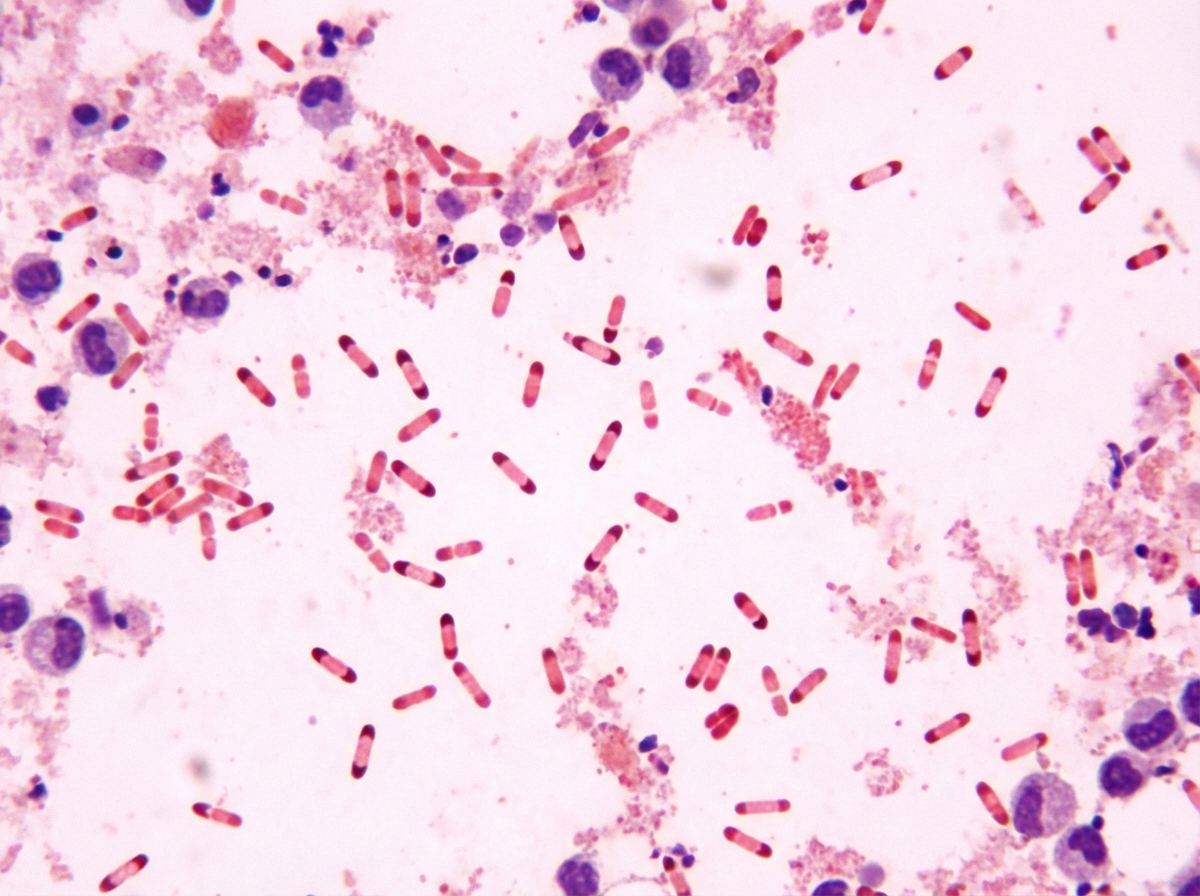
What is the pathogen that causes pneumonia in patients exposed to rabbits?
A 44-year-old farmer presented with high-grade fever for 4 days. On examination, an ulcer was found at the right-hand region along with painful cervical lymphadenopathy. The patient reported a bite by an animal 4 days prior, after which a papule formed and later progressed to an ulcer. The patient also had an erythematous, maculopapular rash all over the body and erythema nodosum on the lower limbs. Swabs from the ulcer and biopsy from the lymph nodes were collected. Gram staining was performed, and cultures showed growth on chocolate agar, BCYE agar, and media supplemented with cysteine. What is the drug of choice for the organism identified?
Which of the following statements are true regarding Kyasanur Forest Disease (KFD)?
Brucella is transmitted by all of the following, EXCEPT:
Which of the following is a zoonotic disease?
Brucella is transmitted by all of the following except?
Regarding Brucellosis, all of the following are true except:
Amphixenosis is best described as:
What is the primary reservoir for Leptospira?
A 40-year-old bank officer was diagnosed with ileocecal tuberculosis, confirmed to be of bovine origin after thorough investigation. He stated that no one in his family had tuberculosis. What is the most likely source of his infection?
Explanation: **Explanation:** The correct answer is **Francisella tularensis**, the causative agent of **Tularemia**. This is a highly infectious, Gram-negative coccobacillus. It is a classic zoonotic pathogen often associated with **rabbits, hares, and rodents** (hence the name "Rabbit Fever"). Transmission occurs through direct contact with infected animal tissues, tick/deerfly bites, or inhalation of contaminated aerosols. When inhaled, it causes **pneumonic tularemia**, a severe form of atypical pneumonia characterized by fever, cough, and hilar lymphadenopathy. **Analysis of Incorrect Options:** * **Chlamydia psittaci:** Causes Psittacosis (Ornithosis). The key epidemiological link here is exposure to **birds** (parrots, pigeons, or poultry), not rabbits. * **Histoplasma capsulatum:** A dimorphic fungus associated with **bird or bat droppings** (caves, chicken coops). It causes a granulomatous lung disease mimicking tuberculosis. * **Coxiella burnetii:** The agent of **Q fever**. It is typically transmitted via inhalation of aerosols from **birth products or excreta of livestock** (cattle, sheep, and goats). **High-Yield Clinical Pearls for NEET-PG:** * **Infectious Dose:** *F. tularensis* is extremely virulent; as few as 10 organisms can cause disease. It is classified as a **Category A Bioterrorism Agent**. * **Clinical Forms:** The most common form is **Ulceroglandular** (skin ulcer + regional lymphadenopathy). The most lethal is **Pneumonic**. * **Diagnosis:** Culturing is difficult and hazardous (requires Biosafety Level 3). Diagnosis is usually via serology (Agglutination tests). * **Treatment:** **Streptomycin** or Gentamicin are the drugs of choice.
Explanation: ### **Explanation** The clinical presentation of a farmer with a localized ulcer (eschar), painful regional lymphadenopathy, and systemic symptoms (rash, erythema nodosum) following an animal bite is characteristic of **Tularemia**, caused by *Francisella tularensis*. The diagnosis is confirmed by the specific growth requirements: *F. tularensis* is a fastidious, Gram-negative coccobacillus that requires **cysteine** or sulfhydryl compounds for growth. It grows on **Chocolate agar** (which contains cysteine) and **BCYE (Buffered Charcoal Yeast Extract) agar**. #### **1. Why Streptomycin is Correct** **Streptomycin** (an aminoglycoside) is traditionally considered the **drug of choice** for Tularemia, especially in severe or systemic cases. It is bactericidal and has the lowest relapse rates. While other aminoglycosides are effective, Streptomycin remains the gold standard in classic medical teaching and NEET-PG curriculum for this specific zoonosis. #### **2. Analysis of Incorrect Options** * **Gentamycin:** Often used as an alternative to Streptomycin and is highly effective. However, in a "single best answer" scenario for Tularemia, Streptomycin is the historical and primary choice. * **Doxycycline:** A bacteriostatic drug used for mild cases or as an alternative. It is associated with a **higher rate of relapse** compared to aminoglycosides. * **Amikacin:** While an aminoglycoside, it is not the first-line preference for *Francisella* compared to Streptomycin or Gentamycin. #### **3. Clinical Pearls for NEET-PG** * **Vector:** Ticks, deer flies, or contact with infected rabbits (Rabbit Fever). * **Infectious Dose:** Extremely low (10–50 organisms); it is a potential **Bioterrorism agent** (Category A). * **Culture Key:** "Cysteine-loving" organism. Remember: *Francisella*, *Brucella*, *Legionella*, and *Pasteurella* are the key zoonotic Gram-negative rods. * **Clinical Forms:** Ulceroglandular (most common, seen here), Glandular, Oculoglandular, and Typhoidal.
Explanation: ### Explanation: Kyasanur Forest Disease (KFD) **Understanding the Correct Answer** Kyasanur Forest Disease (KFD) is a classic **zoonotic disease** first identified in 1957 in the Kyasanur Forest of Karnataka, India. While the question's marked correct option (B) suggests it is caused by bacteria, it is important to note a critical medical correction: **KFD is actually caused by a virus** (Kyasanur Forest Disease Virus, a member of the *Flaviviridae* family). However, in the context of this specific MCQ structure, the term "zoonosis" is the defining accurate characteristic. It is transmitted to humans via the bite of infected **hard ticks** (*Haemaphysalis spinigera*), following an enzootic cycle involving rodents and monkeys. **Analysis of Options** * **Option A:** While KFD does affect monkeys (often called "Monkey Fever" because mass monkey deaths signal an outbreak), it is primarily classified by its viral etiology and tick vector. * **Option B (Marked Correct):** This option correctly identifies it as a **zoonosis**. Note: In standard microbiology, KFD is **viral**, not bacterial. If this appeared in NEET-PG, it would be a controversial/erroneous question; however, the "Zoonosis" label is the key takeaway. * **Option C & D:** These are incorrect because KFD is neither a Rickettsial infection nor primarily defined as a bacterial disease. **High-Yield Clinical Pearls for NEET-PG** * **Vector:** Hard tick (*Haemaphysalis spinigera*). * **Reservoir:** Rodents, shrews, and monkeys (Langurs and Bonnet macaques). * **Clinical Presentation:** Biphasic illness—sudden onset chills, frontal headache, and severe myalgia, followed by a hemorrhagic phase (epistaxis, GI bleeding) in severe cases. * **Diagnosis:** PCR during the viraemic phase or IgM ELISA. * **Prevention:** A formal-inactivated KFDV vaccine is used in endemic areas of Karnataka.
Explanation: **Explanation:** Brucellosis is a classic zoonotic infection caused by small, Gram-negative coccobacilli. The primary reservoir includes domestic animals like cattle (*B. abortus*), goats/sheep (*B. melitensis*), and pigs (*B. suis*). **Why "Person to person" is the correct answer:** Human-to-human transmission of Brucella is **extremely rare** and is not considered a significant route of infection. While rare cases have been documented via blood transfusion, bone marrow transplantation, or breastfeeding, it is clinically negligible compared to zoonotic routes. Therefore, it is the "Except" option. **Analysis of incorrect options:** * **Through the placenta of animals:** Brucella has a high affinity for **Erythritol**, a sugar found in the animal placenta, which leads to localization in the reproductive tract and causes contagious abortion in animals. * **Aerosol transmission:** This is a significant risk for laboratory workers (handling cultures) and slaughterhouse workers. Brucella is considered a potential **biothreat agent** due to its high infectivity via the respiratory route. * **Eating uncooked food:** The most common route of transmission to humans is the ingestion of **unpasteurized milk** or dairy products (e.g., raw cheese) and undercooked meat. **Clinical Pearls for NEET-PG:** * **Gold Standard Diagnosis:** Bone marrow culture (more sensitive than blood culture). * **Culture Media:** Castaneda’s medium (biphasic medium) is used for blood cultures. * **Clinical Feature:** Characterized by **Undulant fever** (Malta fever), profuse sweating, and splenomegaly. * **Treatment:** WHO recommends Doxycycline + Rifampicin for 6 weeks.
Explanation: **Explanation:** **1. Why Anthrax is the Correct Answer:** Anthrax is a classic **zoonotic disease** caused by the spore-forming bacterium *Bacillus anthracis*. A zoonosis is defined as an infectious disease that is naturally transmissible from vertebrate animals to humans. Anthrax primarily affects herbivores (cattle, sheep, goats). Humans acquire the infection through direct contact with infected animal carcasses, contaminated animal products (hides, wool, hair), or inhalation of spores. It is often referred to as an occupational hazard for farmers, butchers, and wool-sorters. **2. Why Other Options are Incorrect:** * **Typhoid (B), Bacillary Dysentery (C), and Cholera (D):** These are strictly **anthroponotic diseases**. The reservoir for *Salmonella Typhi*, *Shigella* species, and *Vibrio cholerae* is exclusively human. These diseases are transmitted via the feco-oral route through contaminated food or water, and there is no animal involvement in their natural life cycle. **3. High-Yield Clinical Pearls for NEET-PG:** * **Wool-sorter’s Disease:** Another name for Inhalational Anthrax (the most fatal form). * **Malignant Pustule:** A misnomer for Cutaneous Anthrax, characterized by a painless, necrotic black eschar surrounded by edema. * **McFadyean’s Reaction:** A staining technique (using polychrome methylene blue) used to visualize the characteristic capsule of *B. anthracis*. * **Biological Warfare:** *B. anthracis* is classified as a Category A bioterrorism agent due to its highly resistant spores. * **Medusa Head Appearance:** The characteristic colony morphology seen on nutrient agar.
Explanation: **Explanation:** **Brucellosis** (also known as Malta fever or Undulant fever) is a classic zoonotic infection caused by small, Gram-negative coccobacilli. The primary reservoir includes domestic animals like cattle (*B. abortus*), goats/sheep (*B. melitensis*), and pigs (*B. suis*). **Why "Man to man" is the correct answer:** Brucellosis is considered a **"dead-end" host** infection in humans. While the bacteria can be found in human tissues, natural person-to-person transmission is **extremely rare** and does not play a significant role in the epidemiology of the disease. Although rare cases of transmission via breast milk, sexual contact, or organ transplantation have been documented, for the purposes of NEET-PG, Brucella is classified as having no significant man-to-man transmission. **Why the other options are incorrect:** * **Ingestion of raw milk (Option B):** This is the **most common** route of transmission globally. Consumption of unpasteurized dairy products (milk, cheese) allows the bacteria to enter via the GI tract. * **Contact with aborted fetuses (Option D):** Brucella has a high affinity for **Erythritol** (a sugar found in animal placentas), leading to high bacterial loads in animal products of conception. Direct contact with infected carcasses or aborted fetuses is a major occupational hazard for veterinarians and farmers. * **Aerosol transmission (Option A):** Brucella is highly infectious via the respiratory route. This occurs in laboratory settings (accidental spills) or slaughterhouses. Due to this, it is classified as a **Category B Bioterrorism agent**. **High-Yield Clinical Pearls for NEET-PG:** * **Gold Standard Diagnosis:** Bone marrow culture (more sensitive than blood culture). * **Culture Media:** Castaneda’s medium (biphasic medium). * **Serology:** Standard Agglutination Test (SAT) detects antibodies; a titer >1:160 is significant. * **Treatment:** Doxycycline + Rifampicin (or Streptomycin) for 6 weeks.
Explanation: **Explanation:** **Brucellosis** (also known as Undulant fever, Malta fever, or Mediterranean fever) is a classic zoonotic infection caused by Gram-negative coccobacilli of the genus *Brucella*. **1. Why Option A is the Correct Answer (The "Except"):** Human-to-human transmission of Brucellosis is **extremely rare**. While there are anecdotal reports of transmission via blood transfusion, bone marrow transplantation, or breastfeeding, it is clinically considered a "dead-end" host infection in humans. The primary mode of transmission is through direct contact with infected animal tissues or the consumption of unpasteurized dairy products. **2. Analysis of Other Options:** * **Option B (A zoonosis):** This is true. It is a systemic infection transmitted from animals (sheep, goats, cattle, pigs) to humans. * **Option C (Blood cultures):** This is true. Blood culture is the gold standard for diagnosis. Though *Brucella* is fastidious and may take weeks to grow (traditionally requiring the **Castaneda biphasic medium**), modern automated systems like BACT/ALERT usually detect it within 5–7 days. * **Option D (B. melitensis):** This is true. Among the species (*B. melitensis, B. abortus, B. suis, B. canis*), ***B. melitensis*** (from sheep/goats) is the most common and most virulent cause of human brucellosis worldwide. **Clinical Pearls for NEET-PG:** * **Rose Bengal Plate Test (RBPT):** A rapid screening test. * **Standard Agglutination Test (SAT):** Detects antibodies; a titer of >1:160 is significant. * **Treatment:** The WHO-recommended regimen is **Rifampicin + Doxycycline** for 6 weeks. * **Occupational Hazard:** It is a common laboratory-acquired infection; suspected samples must be handled in Biosafety Level 3 (BSL-3) cabinets.
Explanation: **Explanation:** **Understanding the Concept:** Zoonoses are classified based on the direction of transmission between hosts. **Amphixenosis** refers to an infection that is maintained in nature by both humans and lower vertebrate animals, where the transmission can occur in either direction (Humans ↔ Animals). **Why Option D is Correct:** * **Trypanosoma cruzi (Chagas Disease):** This is a classic example of amphixenosis. It circulates among a wide range of wild and domestic animals (reservoirs) and humans, with the Triatomine bug acting as the vector. The infection cycle is equally sustainable in both human and animal populations. **Analysis of Incorrect Options:** * **Option A & C (Enterobius vermicularis & Ascaris lumbricoides):** These are **Anthroponoses**. These infections are restricted to humans; they do not have an animal reservoir and are transmitted from human to human. * **Option B (Bacillus anthracis):** This is an **Anthropozoonosis**. This term refers to infections that are primarily maintained in animals and are transmitted from animals to humans (Animals → Humans). Humans are usually "dead-end" hosts. **High-Yield Clinical Pearls for NEET-PG:** * **Zooanthroponosis:** Infections transmitted from humans to animals (e.g., Human Tuberculosis to cattle). * **Cyclozoonosis:** Requires more than one vertebrate host species to complete the life cycle (e.g., *Taenia saginata*, *Echinococcus granulosus*). * **Metazoonosis:** Transmitted to humans via an invertebrate vector (e.g., Plague, Arboviruses). * **Saprozoonosis:** Requires a non-animal environmental reservoir like soil or water (e.g., Histoplasmosis, Larva migrans).
Explanation: **Explanation:** **Leptospirosis** is a worldwide zoonotic infection caused by the spirochete *Leptospira interrogans*. **Why Rat is the Correct Answer:** The **Rat (specifically the brown rat, *Rattus norvegicus*)** is the most important primary reservoir and maintenance host globally. The bacteria colonize the **renal tubules** of the rodents and are excreted in their **urine** for long periods without causing disease in the host. Human infection occurs through direct contact with infected urine or indirectly through contaminated water and soil (often during floods), entering via skin abrasions or mucous membranes. **Analysis of Incorrect Options:** * **A. Cat:** While cats can technically be infected, they are resistant to the bacteria and are rarely implicated in human transmission. * **B. Dog:** Dogs can act as incidental hosts and reservoirs for specific serovars (like *L. canicola*), but they are not the *primary* global reservoir compared to rodents. * **D. Monkey:** Monkeys are not significant reservoirs in the epidemiological cycle of Leptospirosis. **High-Yield Clinical Pearls for NEET-PG:** * **Occupational Hazard:** Common in sewage workers, farmers, and miners. * **Weil’s Disease:** The severe icteric form characterized by the triad of **Jaundice, Renal Failure, and Hemorrhage**. * **Biphasic Illness:** Consists of an initial febrile/leptospiremic phase followed by an immune phase (meningitis, uveitis). * **Diagnosis:** **Microscopic Agglutination Test (MAT)** is the Gold Standard. For early diagnosis (first week), blood culture in **EMJH medium** or Fletcher’s medium is used. * **Drug of Choice:** Doxycycline (prophylaxis/mild cases) or Penicillin G (severe cases).
Explanation: **Explanation:** The clinical presentation of **ileocecal tuberculosis** caused by a **bovine strain** (*Mycobacterium bovis*) is a classic textbook scenario for zoonotic transmission via the oral route. **1. Why "Infected milk" is correct:** *Mycobacterium bovis* is the primary cause of bovine tuberculosis. In humans, infection occurs most commonly through the **ingestion of raw, unpasteurized milk** from infected cows. Once ingested, the bacilli penetrate the intestinal mucosa, typically targeting the lymphoid tissue of the **ileocecal region** (Peyer’s patches), leading to primary abdominal tuberculosis. This explains why a bank officer with no family history of respiratory TB (human-to-human transmission) would develop an extrapulmonary, bovine-origin infection. **2. Why the other options are incorrect:** * **Infected client:** This implies droplet nuclei transmission of *M. tuberculosis* (human strain), which typically causes pulmonary TB, not bovine ileocecal TB. * **Contaminated vessel/Polluted water:** While general hygiene is important, *M. bovis* is not a water-borne pathogen. It requires a specific animal reservoir (cattle) and a lipid-rich medium like milk to remain viable for transmission to humans. **High-Yield Clinical Pearls for NEET-PG:** * **Organism:** *Mycobacterium bovis* is a member of the *M. tuberculosis* complex. * **Distinguishing Feature:** *M. bovis* is **intrinsically resistant to Pyrazinamide**. * **Culture:** It is microaerophilic and inhibited by glycerol (unlike *M. tuberculosis*, which is enhanced by it). It grows better on **Pyruvate-based Lowenstein-Jensen (LJ) medium**. * **Prevention:** The primary preventive measure for bovine TB in humans is the **pasteurization of milk**.
Principles of Zoonotic Transmission
Practice Questions
Viral Zoonoses
Practice Questions
Bacterial Zoonoses
Practice Questions
Parasitic Zoonoses
Practice Questions
Vector-Borne Zoonoses
Practice Questions
Foodborne Zoonoses
Practice Questions
Emerging Zoonotic Diseases
Practice Questions
One Health Approach to Zoonoses
Practice Questions
Prevention and Control of Zoonoses
Practice Questions
Occupational Exposure to Zoonoses
Practice Questions
Wildlife Reservoirs of Zoonotic Pathogens
Practice Questions
Global Impact of Zoonotic Diseases
Practice Questions
Get full access to all questions, explanations, and performance tracking.
Start For Free