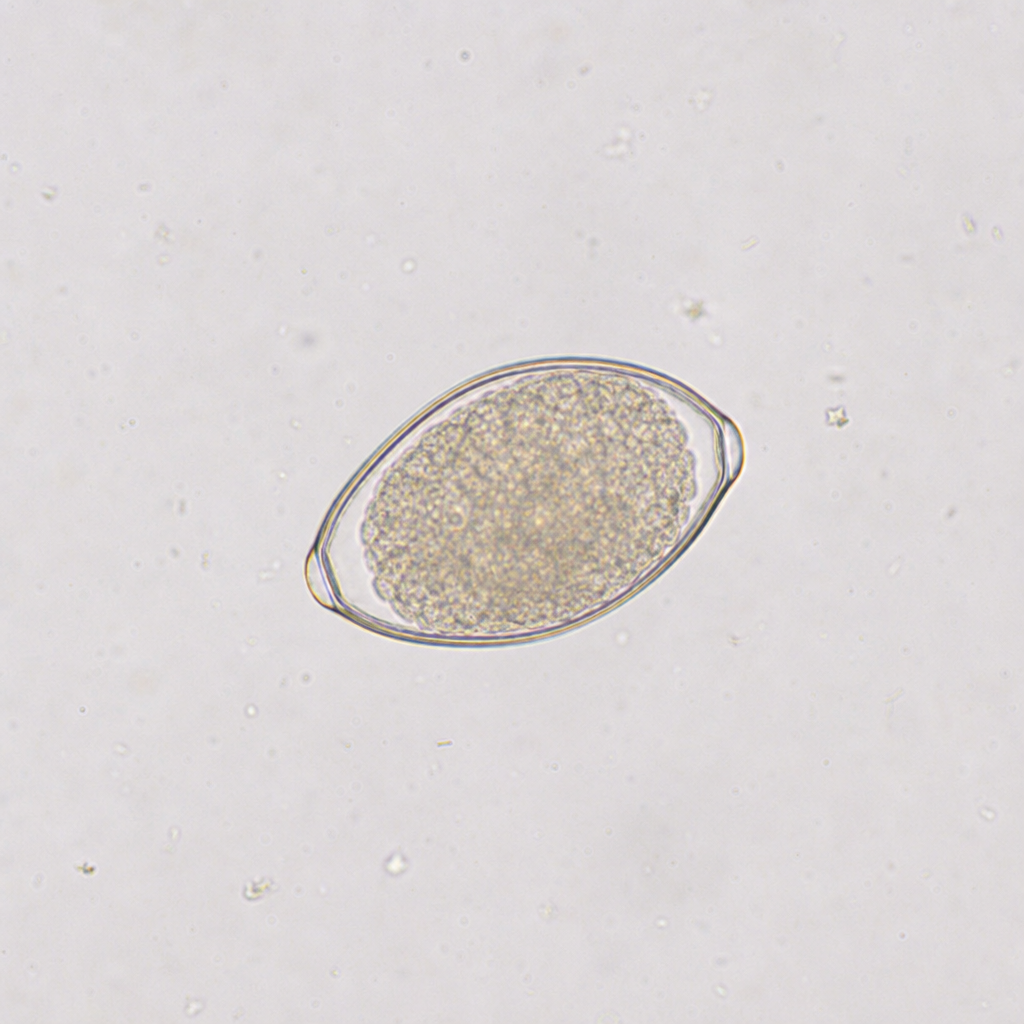
Which parasite has humans as its definitive host?
Entamoeba histolytica belongs to which of the following taxonomic groups?
What is the definitive host for the Guinea worm?
Microfilariae of which of the following parasites are found in blood?
Radical cure is required for malaria caused by which species of Plasmodium?
Amoebiasis is transmitted by all except?
Chlonorchis sinensis infection is acquired by the ingestion of what?
Which test, performed on jejunal mucus, is used for the diagnosis of giardiasis?
A patient presented with diarrhea. Stool examination shows an egg. What is the treatment of choice for this patient?

All of the following infections are caused by nematodes resulting from ingestion of infective eggs, except?
Explanation: ### Explanation In parasitology, the **definitive host** is defined as the host in which the parasite reaches sexual maturity and undergoes sexual reproduction. **Why Filaria is the Correct Answer:** For filarial nematodes (such as *Wuchereria bancrofti* and *Brugia malayi*), **humans are the definitive host** because the adult worms reside in the human lymphatic system, where they mate and produce microfilariae. The intermediate host (and vector) is the mosquito (*Culex*, *Anopheles*, or *Aedes*), where the parasite undergoes larval development but no sexual reproduction. **Analysis of Incorrect Options:** * **A. Malaria (*Plasmodium*):** In malaria, the **Female Anopheles mosquito is the definitive host** because the sexual cycle (sporogony) occurs within the mosquito. Humans are the intermediate hosts where the asexual cycle (schizogony) takes place. * **C. Measles:** This is a viral infection caused by the Morbillivirus. The concept of "definitive" or "intermediate" hosts applies to parasites with complex life cycles, not viruses. Humans are the natural reservoir for Measles. * **D. Tapeworm (*Taenia*):** While humans are the definitive host for *Taenia saginata* and *Taenia solium*, this option is less specific than Filaria in many exam contexts. However, if *Echinococcus granulosus* (Dog Tapeworm) is considered, humans are the **accidental intermediate host**, while dogs are the definitive host. **NEET-PG High-Yield Pearls:** * **Rule of Thumb:** For most protozoa, the vector is the definitive host (e.g., Malaria). For most helminths, humans are the definitive host (e.g., Filaria, Hookworm, Ascaris). * **Exception:** In *Toxoplasma gondii*, the definitive host is the **Cat**. * **Hydatid Disease:** Humans are a "dead-end" host for *Echinococcus granulosus*. * **Filaria Diagnosis:** The best time to collect a blood sample for *W. bancrofti* is between **10 PM and 2 AM** due to nocturnal periodicity.
Explanation: **Explanation:** The classification of protozoa has evolved from traditional morphological systems to modern molecular phylogenetics. **Entamoeba histolytica**, the causative agent of amoebiasis, is now classified under the **Supergroup Amoebozoa**. **1. Why "Supergroup Amoebozoa" is correct:** Modern taxonomy (Adl et al.) replaces the traditional Phylum/Class system with "Supergroups" based on genetic and ultrastructural similarities. The Supergroup Amoebozoa includes organisms that move via pseudopodia (lobose, filose, or reticulose) and possess mitochondria with tubular cristae. *E. histolytica* is the most clinically significant human pathogen in this group. **2. Analysis of Incorrect Options:** * **Phylum Protozoa:** This is an obsolete taxonomic rank. In modern biological classification, "Protozoa" is considered a diverse group of eukaryotic microorganisms rather than a single formal Phylum. * **Subphylum Sarcomastigophora:** This was part of the older 1964/1980 Honigberg classification. It grouped amoebae (Sarcodina) and flagellates (Mastigophora) together. While historically used in textbooks, it has been superseded by molecular classification. * **Subphylum Sporozoa:** This group (now often referred to as Apicomplexa) consists of obligate intracellular parasites that possess an apical complex and lack specialized locomotor organelles (e.g., *Plasmodium*, *Toxoplasma*). **Clinical Pearls for NEET-PG:** * **Infective Stage:** Mature quadrinucleated cyst. * **Diagnostic Stage:** Trophozoite (containing ingested RBCs/erythrophagocytosis—a pathognomonic feature) or cyst in stool. * **Key Lesion:** "Flask-shaped" ulcers in the colon. * **Most Common Extra-intestinal Site:** Liver (Amoebic Liver Abscess), typically presenting with "anchovy sauce" pus.
Explanation: **Explanation:** The definitive host is defined as the host in which the parasite reaches maturity and, if applicable, undergoes sexual reproduction. In the life cycle of **Dracunculus medinensis (Guinea worm)**, **Man** is the only definitive host. * **Why Option A is Correct:** Humans acquire the infection by drinking water containing **Cyclops** (the intermediate host) infected with L3 larvae. Once inside the human body, the larvae penetrate the intestinal wall, migrate to the retroperitoneal space, and mature into adults. Fertilization occurs, and the gravid female migrates to the subcutaneous tissues (usually the lower limbs) to release larvae through a skin ulcer. * **Why Option B is Incorrect:** **Cyclops** (water flea) serves as the **intermediate host**. It ingests the L1 larvae, which then develop into the infective L3 stage within its body. * **Why Option C is Incorrect:** Snails are common intermediate hosts for trematodes (flukes) like *Schistosoma* or *Fasciola*, but they play no role in the life cycle of the Guinea worm. * **Why Option D is Incorrect:** A parasite cannot have two definitive hosts in this context; the roles of the human (definitive) and the Cyclops (intermediate) are distinct and biological stages differ in each. **High-Yield Clinical Pearls for NEET-PG:** * **Infective Form:** L3 larvae within the Cyclops. * **Diagnosis:** Usually clinical; the "string sign" or visual confirmation of the worm emerging from a blister. * **Treatment:** Slow extraction of the worm by winding it around a small stick (the "Caduceus" symbol origin). * **Epidemiology:** India was declared **Guinea Worm Free** by the WHO in February 2000 (last case reported in 1996).
Explanation: ### Explanation The correct answer is **C. Onchocerca volvulus**. **1. Underlying Medical Concept:** The classification of filarial nematodes is based on the primary anatomical site where the adult worms reside and where the microfilariae (larvae) are released. While most pathogenic filarial parasites release microfilariae into the **peripheral blood**, *Onchocerca volvulus* is unique because its microfilariae are found in the **skin (dermis)** and the **connective tissues of the eye**. Diagnosis is typically made via a "skin snip" biopsy rather than a blood film. **2. Analysis of Options:** * **A. Brugia malayi:** This is a lymphatic filarial parasite. The microfilariae are found in the **peripheral blood** and exhibit nocturnal periodicity. * **B. Loa loa (African Eye Worm):** Adult worms migrate through subcutaneous tissues, but the microfilariae circulate in the **peripheral blood** (diurnal periodicity). * **D. Wuchereria bancrofti:** The most common cause of lymphatic filariasis. Its microfilariae are found in the **peripheral blood**, usually showing nocturnal periodicity (maximum density between 10 PM and 2 AM). **3. High-Yield Clinical Pearls for NEET-PG:** * **Onchocerca volvulus:** Transmitted by the **Blackfly (*Simulium*)**. It causes "River Blindness" and "Hanging Groin." * **Diagnostic Test of Choice:** Skin snip method (placed in saline to observe emerging microfilariae). * **Treatment:** **Ivermectin** is the drug of choice (it kills microfilariae but not adults). Note: Diethylcarbamazine (DEC) is contraindicated in Onchocerciasis due to the risk of a severe **Mazzotti reaction**. * **Wolbachia:** Most filarial worms harbor this endosymbiotic bacteria; Doxycycline can be used to sterilize adult female worms.
Explanation: ### Explanation **1. Why the Correct Answer is Right:** The term **"Radical Cure"** in malaria refers to the elimination of both the erythrocytic stages (which cause clinical symptoms) and the **exo-erythrocytic (latent) stages** in the liver. Only **_Plasmodium vivax_** and **_Plasmodium ovale_** possess a unique dormant liver stage known as **hypnozoites**. These hypnozoites can remain quiescent in hepatocytes for weeks, months, or even years, later "awakening" to cause a clinical **relapse**. To achieve a radical cure and prevent these relapses, drugs like **Primaquine** or **Tafenoquine** must be administered to clear the liver of hypnozoites. **2. Why Other Options are Wrong:** * **_P. falciparum_:** This species does not have a hypnozoite stage. Once the parasite leaves the liver to enter the red blood cells, no dormant forms remain in the liver. Therefore, standard schizonticidal treatment (like ACT) is sufficient to clear the infection. * **_P. malariae_:** Similar to _P. falciparum_, it lacks a hypnozoite stage. While it can cause "recrudescence" (due to low-level persistent parasitemia in the blood), it does not cause "relapse" from the liver. * **_P. knowlesi_:** (Though not in options) Also lacks a hypnozoite stage. **3. Clinical Pearls for NEET-PG:** * **Drug of Choice for Radical Cure:** **Primaquine** (14 days). * **Contraindication:** Before starting Primaquine, always test for **G6PD deficiency** to avoid life-threatening acute hemolysis. It is also contraindicated in **pregnancy**. * **Relapse vs. Recrudescence:** * **Relapse:** Re-activation of hypnozoites in the liver (_P. vivax, P. ovale_). * **Recrudescence:** Survival of erythrocytic parasites due to inadequate treatment or drug resistance (_P. falciparum, P. malariae_). * **Schüffner’s dots:** Characteristically seen in RBCs infected with _P. vivax_ and _P. ovale_.
Explanation: **Explanation:** Amoebiasis, caused by the protozoan parasite *Entamoeba histolytica*, is primarily transmitted through the ingestion of mature, quadrinucleate cysts. **Why "Vesicular Transmission" is the correct answer:** Vesicular transmission refers to the spread of pathogens via skin vesicles or blisters (common in viral infections like Varicella or Herpes). *E. histolytica* is an intestinal parasite; it does not reside in or spread through skin vesicles. Therefore, this is not a recognized mode of transmission for Amoebiasis. **Analysis of other options:** * **Faeco-oral route:** This is the **most common** mode of transmission. It occurs through the ingestion of contaminated food or water containing mature cysts. * **Cockroach (and Houseflies):** These act as **mechanical vectors**. They carry the cysts from feces to food surfaces on their legs or through regurgitation, facilitating indirect transmission. * **Oro-rectal route:** This refers to sexual transmission (common among men who have sex with men). Direct oral-anal contact can lead to the accidental ingestion of cysts. **NEET-PG Clinical Pearls:** * **Infective Form:** Mature quadrinucleate cyst. * **Diagnostic Form:** Trophozoite (in acute dysentery) or Cyst (in chronic/carrier states). * **Pathognomonic Feature:** Trophozoites containing ingested RBCs (Erythrophagocytosis). * **Quadrinucleate cysts** are resistant to gastric acid and standard chlorination but are killed by boiling. * **Treatment of choice:** Metronidazole/Tinidazole (for tissue trophozoites) followed by a luminal amebicide like Paromomycin or Diloxanide furoate (to eradicate cysts).
Explanation: **Explanation:** *Clonorchis sinensis*, also known as the **Chinese Liver Fluke**, is a trematode that primarily infects the biliary tract. The infection is acquired by the ingestion of undercooked or raw **freshwater fish** containing the infectious stage, the **metacercariae**. **Life Cycle and Pathogenesis:** The life cycle involves two intermediate hosts: 1. **First Intermediate Host:** Freshwater snails (e.g., *Parafossarulus*), where miracidia develop into cercariae. 2. **Second Intermediate Host:** Freshwater fish (Cyprinidae family), where cercariae encyst to become **metacercariae**. When humans (definitive hosts) eat the infected fish, the metacercariae excyst in the duodenum and migrate to the bile ducts, causing inflammation and hyperplasia. **Analysis of Incorrect Options:** * **B. Pork:** Associated with *Taenia solium* (Pork tapeworm) and *Trichinella spiralis*. * **C. Snail:** Snails are the *first* intermediate host. While they release cercariae, humans do not acquire *Clonorchis* by eating snails. (Note: *Fasciola* is acquired by eating aquatic plants like watercress). * **D. Beef:** Associated with *Taenia saginata* (Beef tapeworm). **High-Yield Clinical Pearls for NEET-PG:** * **Classic Presentation:** Right upper quadrant pain, jaundice, and hepatomegaly. * **Major Complication:** Chronic infection is a strong risk factor for **Cholangiocarcinoma** (Bile duct cancer). * **Diagnosis:** Identification of characteristic "operculated eggs with an abopercular knob" (resembling a light bulb) in stool or bile. * **Drug of Choice:** Praziquantel.
Explanation: **Explanation:** The correct answer is **Giardiasis**. The test referred to in the question is the **Entero-test (String Test)**. **Why Giardiasis is correct:** *Giardia lamblia* primarily inhabits the duodenum and upper jejunum. In cases where routine stool examinations (for cysts or trophozoites) are negative but clinical suspicion remains high, the **Entero-test** is employed. In this procedure, a patient swallows a gelatin capsule containing a weighted nylon string. The string uncoils in the upper GI tract; after a few hours, it is withdrawn. The adherent **jejunal mucus** is then scraped from the string and examined microscopically for motile pear-shaped trophozoites. This is considered more sensitive than a single stool exam for detecting the parasite in the biliary tract or upper intestine. **Why other options are incorrect:** * **Amoebiasis:** *Entamoeba histolytica* primarily affects the colon (large intestine). Diagnosis is typically made via stool microscopy for quadrinucleate cysts/trophozoites or colonoscopic biopsy, not jejunal aspiration. * **Strongyloidiasis:** While *Strongyloides stercoralis* larvae can be found in the duodenum, the gold standard is stool examination (Baermann technique) or agar plate culture. The String Test can detect it, but it is classically associated with Giardia in exams. * **Cyclosporiasis:** This is diagnosed via stool examination using modified acid-fast staining to identify oocysts. **NEET-PG High-Yield Pearls:** * **Giardiasis** is the most common cause of water-borne parasitic diarrhea and causes **steatorrhea** (foul-smelling, floating stools) due to malabsorption. * It does **not** cause tissue invasion or hematogenous spread (no eosinophilia). * **Antigen detection (ELISA)** for GSA-65 is now preferred over the String Test due to being non-invasive. * **Drug of choice:** Tinidazole or Metronidazole.
Explanation: ***Praziquantel*** - **Praziquantel** is the drug of choice for **tapeworm infections** (Taenia species), causing paralysis and tegument damage to the worm. - It effectively treats both **intestinal tapeworms** and **cysticercosis**, making it the most appropriate choice for Taenia eggs found in stool. *Mebendazole* - Primarily effective against **roundworms** like Ascaris, Enterobius, and hookworms, not tapeworms. - Works by inhibiting **microtubule synthesis** in nematodes but has limited efficacy against **cestodes** (tapeworms). *Albendazole* - While it has some activity against tapeworms, it's primarily used for **roundworm infections** and **hydatid cysts**. - **Praziquantel remains superior** for intestinal tapeworm infections due to better efficacy and tolerability. *Pyrantel pamoate* - Specifically targets **nematodes** (roundworms) like Ascaris and Enterobius by causing neuromuscular blockade. - Has **no activity against cestodes** (tapeworms) and would be ineffective for Taenia infections.
Explanation: **Explanation:** The mode of transmission for intestinal nematodes is a high-yield topic for NEET-PG. These parasites are generally classified based on whether they infect humans via **ingestion of eggs** or **larval skin penetration**. **1. Why Strongyloides stercoralis is the correct answer:** Unlike the other options, *Strongyloides stercoralis* (Threadworm) is transmitted via the **penetration of intact skin** by **filariform larvae** (L3) present in contaminated soil. It does not involve the ingestion of eggs. A unique feature of *Strongyloides* is its ability for **autoinfection**, where rhabditiform larvae transform into filariform larvae within the host's intestine, leading to chronic infection and potentially fatal hyperinfection syndrome in immunocompromised patients. **2. Analysis of Incorrect Options (Transmission via Egg Ingestion):** The mnemonic **"EAT"** is commonly used to remember nematodes transmitted by egg ingestion: * **Ascaris lumbricoides (Roundworm):** Infection occurs by ingesting embryonated eggs from soil-contaminated food or water. * **Enterobius vermicularis (Pinworm):** Transmission is via ingestion of eggs, often through fof-hand contact (autoinfection) or contaminated linens. * **Trichuris trichiura (Whipworm):** Infection occurs through the ingestion of embryonated eggs from the soil. **3. NEET-PG Clinical Pearls:** * **Skin Penetrators:** Remember **"Strong Hook"** — *Strongyloides stercoralis* and Hookworms (*Ancylostoma duodenale*, *Necator americanus*). * **Larva Currens:** A pathognomonic rapidly moving serpiginous cutaneous eruption associated with *Strongyloides*. * **Diagnosis:** *Strongyloides* is diagnosed by finding **larvae** in stool, whereas *Ascaris*, *Trichuris*, and Hookworms are diagnosed by finding **eggs** in stool. * **Drug of Choice:** Ivermectin is the preferred treatment for *Strongyloides*, while Albendazole is used for most other intestinal nematodes.
Classification of Parasites
Practice Questions
Intestinal Protozoa
Practice Questions
Blood and Tissue Protozoa
Practice Questions
Malaria Parasites
Practice Questions
Leishmaniasis
Practice Questions
Intestinal Helminths: Nematodes
Practice Questions
Tissue Nematodes
Practice Questions
Trematodes
Practice Questions
Cestodes
Practice Questions
Ectoparasites
Practice Questions
Antiparasitic Drugs
Practice Questions
Laboratory Diagnosis of Parasitic Infections
Practice Questions
Get full access to all questions, explanations, and performance tracking.
Start For Free