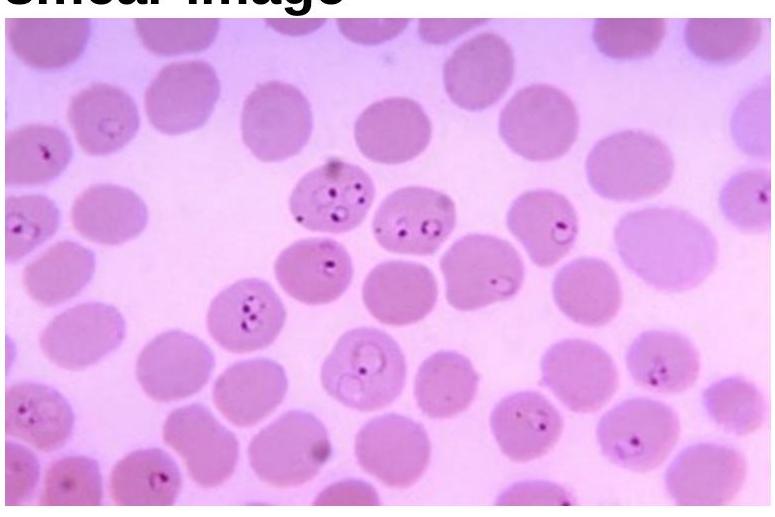
A 15-year-old boy presented with fever and chills for 3 days. On examination, he was found to have delayed skin pinch time and dry oral mucosa. A peripheral blood smear revealed multiple delicate ring forms within red blood cells, with some red blood cells containing more than one ring form. No other developmental stages were observed. Identify the pathogen involved.
Identify the organism related to the blood smear image.
Cutaneous larva migrans is caused by which organism?
A 36-year-old male patient complaining of cough, cold, fever, and rusty sputum, with a history of travel to China and consumption of crab. Name the infection.
A patient is having gastrointestinal problems including abdominal pain and distension, bloody or mucus-filled diarrhea, and tenesmus, with rectal prolapse. A stool, ova and parasites exam reveals the presence of typical barrel-shaped eggs. What is the possible causative agent?
A woman traveling from Bihar to Delhi is suspected to have Kala-azar. Suitable investigation is?
River blindness is caused by?
Trypanosoma cruzi is transmitted by which of the following?
Duodenal aspirate is used in diagnosis of:
Incubation period of *Plasmodium vivax* is:
Explanation: ***Plasmodium falciparum*** - The presence of **multiple delicate ring forms** with **multiply infected red blood cells** (more than one ring per RBC) on peripheral blood smear is characteristic of *Plasmodium falciparum* infection. - A key distinguishing feature of *P. falciparum* is that **only ring forms** are typically seen in peripheral blood due to **sequestration of mature stages** (trophozoites and schizonts) in deep capillaries of internal organs. - The clinical presentation with fever, chills, and signs of dehydration is consistent with falciparum malaria, which can progress to severe complications. *Plasmodium vivax* - *Plasmodium vivax* also causes malaria and shows ring forms, but typically presents with **enlarged red blood cells** (due to preferential infection of reticulocytes) and **all developmental stages visible** in peripheral blood, including trophozoites, schizonts, and gametocytes. - The absence of enlarged RBCs and other developmental stages, combined with multiply infected cells, makes *P. vivax* less likely. *Babesia* - While **Babesia** also infects red blood cells and can show ring forms, its characteristic finding is **pear-shaped trophozoites** arranged in **tetrads (Maltese cross appearance)**. - **Babesiosis** is typically transmitted by ticks and is more common in immunocompromised individuals or in specific geographic regions (e.g., northeastern United States). *Salmonella typhi* - **Salmonella typhi** causes **typhoid fever**, which presents with prolonged fever, headache, and gastrointestinal symptoms, but it is a **bacterial infection** and does not involve infection of red blood cells. - Diagnosis is made by **blood culture** or **bone marrow culture**, not by microscopic examination of red blood cells for parasites.
Explanation: ***Plasmodium falciparum*** - The image clearly displays multiple **ring-form trophozoites** within red blood cells, some of which are *appliqué* or *accolade* forms (rings on the periphery of the red blood cell) and **multiple rings per red blood cell**, which are characteristic of *P. falciparum*. - Presence of **multiple parasites per red blood cell** and various developmental stages including occasional **banana-shaped gametocytes**, though not prominent in this specific field, are key indicators of *P. falciparum* infection, differentiating it from other malarial species. - *P. falciparum* is the most dangerous malarial species and can cause **cerebral malaria** and other severe complications. *Salmonella Typhi* - This bacterium causes **typhoid fever** and is typically identified through **blood culture** or serological tests (Widal test), not by direct visualization within red blood cells on a peripheral blood smear. - *Salmonella Typhi* is an **intracellular bacterium** that primarily infects phagocytic cells (macrophages), not erythrocytes, and does not present as ring forms or other parasitic stages in blood smears. *Toxoplasma gondii* - This parasite causes **toxoplasmosis** and is typically found as **tachyzoites** or **bradyzoites** (within cysts) in tissue samples or less commonly in macrophages in disseminated disease, but not as ring forms within red blood cells on a peripheral blood smear. - Diagnosis usually involves **serological testing** for IgM/IgG antibodies or PCR, as opposed to direct visualization of unique forms in blood smears. *Treponema pallidum* - This is the spirochete responsible for **syphilis** and is too small and thin (0.1-0.2 μm diameter) to be seen with standard light microscopy on routine blood smears. - It is best identified using **dark-field microscopy** or serological tests (VDRL, RPR, TPPA, FTA-ABS) and does not infect red blood cells in the manner shown.
Explanation: ***Ancylostoma braziliense*** - This **hookworm** species commonly found in dogs and cats is the most frequent cause of **cutaneous larva migrans** in humans. - The larvae penetrate the skin but cannot complete their life cycle in humans, instead migrating aimlessly creating **serpiginous tracks**. *Strongyloides* - **_Strongyloides stercoralis_** causes **strongyloidiasis**, which presents with a rapidly advancing (up to 10 cm/hr) migratory rash known as **larva currens**, and not the slower cutaneous larva migrans. - It differs from cutaneous larva migrans in its ability to complete its life cycle in humans, leading to **autoinfection**. *Toxocara canis* - **_Toxocara canis_** is the causative agent of **visceral larva migrans** and **ocular larva migrans**, not cutaneous larva migrans. - In visceral larva migrans, larvae migrate through internal organs, causing symptoms like **hepatomegaly** and **eosinophilia**. *Necator americanus* - This is a human hookworm that can cause **iron deficiency anemia** due to chronic blood loss in the intestines. - While its larvae can penetrate the skin, causing a transient itchy rash known as **ground itch**, they do not cause the prolonged, migratory cutaneous larva migrans.
Explanation: ***Paragonimus westermani*** - This patient's symptoms of **cough**, **fever**, and **rusty sputum**, combined with a history of **travel to China** and consumption of **crab**, are highly suggestive of **paragonimiasis**. - *Paragonimus westermani* is a **lung fluke** endemic to East Asia, and its larvae are acquired by ingesting undercooked **crabs** or **crayfish**. *Fasciola hepatica* - *Fasciola hepatica* causes **fascioliasis**, primarily affecting the **liver** and **biliary ducts**, leading to symptoms like **fever**, **abdominal pain**, and **hepatomegaly**. - It is acquired by consuming **contaminated watercress** or other aquatic plants, not crabs. *Fasciolopsis buski* - *Fasciolopsis buski* causes **fasciolopsiasis**, an **intestinal fluke infection** presenting with **abdominal pain**, **diarrhea**, and **malabsorption**. - It is transmitted through ingestion of **contaminated aquatic plants**, and does not typically cause respiratory symptoms or "rusty sputum." *Entamoeba histolytica* - *Entamoeba histolytica* is a **protozoan** that causes **amoebiasis**, primarily presenting as **dysentery** or **amoebic liver abscess**. - While it can manifest as fever and liver involvement, it does not cause respiratory symptoms like "rusty sputum" and is not acquired from crabs.
Explanation: ***Trichuris trichiura*** - The presence of **barrel-shaped eggs with polar plugs** in a stool exam is pathognomonic for **Trichuris trichiura (whipworm)** infection. - **Heavy infections** can lead to symptoms like **abdominal pain, bloody/mucus-filled diarrhea, tenesmus**, and sometimes **rectal prolapse**, especially in children. *Campylobacter* - This bacterium causes **bacterial gastroenteritis** with symptoms like **bloody diarrhea**, fever, and abdominal pain. - However, the diagnostic method involves **stool culture** for the bacteria, not the identification of barrel-shaped eggs. *Clostridium difficile* - This bacterium causes **pseudomembranous colitis**, typically following antibiotic use, with symptoms ranging from mild diarrhea to severe colitis. - Diagnosis is usually made by detecting **toxins (A and B)** in the stool, not via ova and parasite examination. *Giardia lamblia* - This parasite causes **giardiasis**, characterized by **malabsorptive diarrhea**, abdominal cramps, nausea, and bloating, usually without blood or mucus. - Stool examination would reveal **cysts or trophozoites** with a characteristic "falling leaf" motility, not barrel-shaped eggs.
Explanation: ***Rk-39 test*** - The **Rk-39 test** is a rapid diagnostic test highly sensitive and specific for detecting antibodies against the **kinesin-related protein K39** of *Leishmania donovani*, the causative agent of **Kala-azar (visceral leishmaniasis)**. - It is particularly useful in **endemic regions** like Bihar for quick and accurate diagnosis, especially in patients with suspected Kala-azar presenting with fever, splenomegaly, and pancytopenia. *P24 antigen* - **P24 antigen** testing is primarily used for the diagnosis of **HIV infection**. - It detects the **core protein p24** of the HIV virus, which is not relevant for the diagnosis of Kala-azar. *Combo RDT* - A **Combo RDT** (Rapid Diagnostic Test), without further specification, typically refers to tests for **malaria**, which detect antigens like **HRP-2** and **aldolase**. - While RDTs are used for parasitic diseases, this general term does not specifically refer to a test for **Kala-azar**. *HRP-2 antigen* - **HRP-2 (Histidine-rich protein 2) antigen** is a specific marker for **Plasmodium falciparum**, used in the diagnosis of **malaria**. - It is not associated with the diagnosis of **Kala-azar**, which is caused by *Leishmania donovani*.
Explanation: ***Onchocerca volvulus*** - **River blindness**, or **onchocerciasis**, is caused by the parasitic nematode *Onchocerca volvulus*. - This parasite is transmitted by the bite of infected **blackflies** (genus *Simulium*), which breed in fast-flowing rivers. *Loa loa* - *Loa loa* causes **Loiasis**, also known as African eye worm disease. - While it can manifest as an eye worm and cause itching and swelling, it does not typically lead to permanent blindness or the widespread skin lesions associated with river blindness. *Ascaris* - *Ascaris lumbricoides* causes **ascariasis**, an intestinal infection. - Symptoms are primarily gastrointestinal, such as abdominal pain, malnutrition, and, in severe cases, intestinal obstruction; it does not affect the eyes or cause blindness. *B. malayi* - *Brugia malayi* is one of the causes of **lymphatic filariasis**, also known as **elephantiasis**. - This disease primarily affects the lymphatic system, causing severe swelling in the limbs and genitals, but it does not cause blindness.
Explanation: ***Reduviid bug*** - *Trypanosoma cruzi*, the causative agent of **Chagas disease**, is primarily transmitted to humans through the feces of infected **reduviid bugs**, also known as **kissing bugs**. - The bug typically bites a person, often around the face, and then defecates near the bite wound, allowing the parasite to enter when the person scratches or rubs the area. *Tse tse fly* - The **tsetse fly** is the vector for **African trypanosomiasis** (sleeping sickness), caused by *Trypanosoma brucei*. - This fly is geographically restricted to sub-Saharan Africa, whereas *Trypanosoma cruzi* is prevalent in the Americas. *Culex mosquito* - **Culex mosquitoes** are known vectors for various diseases, including **West Nile virus**, **Japanese encephalitis**, and **filariasis**. - They are not involved in the transmission of *Trypanosoma cruzi*. *Sand fly* - **Sand flies** transmit **Leishmaniasis**, a parasitic disease caused by various species of *Leishmania*. - They are also responsible for transmitting **Bartonellosis** and some types of **Arboviruses**, but not Chagas disease.
Explanation: ***Giardia lamblia*** - **Duodenal aspiration** is a highly sensitive method for detecting **Giardia lamblia trophozoites** or cysts, especially in cases where stool examination is inconclusive. - This parasite primarily inhabits the **duodenum** and **upper jejunum**, making aspirate from this region an ideal diagnostic sample. *E histolytica* - **Entamoeba histolytica** (causes amoebiasis) is typically diagnosed by identifying **trophozoites** or **cysts** in **stool samples**, or through serology for invasive disease. - While it can affect the gastrointestinal tract, its primary site of colonization and pathology is the **colon**, not the duodenum. *Taenia solium* - **Taenia solium** (pork tapeworm) is diagnosed by identifying **proglottids** or **eggs** in **stool samples**. - It resides in the **small intestine**, but **duodenal aspirate** is not a standard diagnostic method for its detection. *Leishmania* - **Leishmania species** cause **leishmaniasis**, a disease diagnosed by detecting **amastigotes** in tissue biopsies (e.g., bone marrow, spleen, skin lesions) or through serological tests. - These parasites are intracellular and do not inhabit the **duodenal lumen**, making duodenal aspirate irrelevant for diagnosis.
Explanation: ***10-14 days*** - The typical incubation period for **_Plasmodium vivax_** is **10 to 14 days**, though it can sometimes be shorter or longer. - This period includes the time from the mosquito bite to the appearance of clinical symptoms, involving **hepatic schizogony** and early erythrocytic stages. *5-7 days* - An incubation period of 5-7 days is **unusually short** for _Plasmodium vivax_ and is more characteristic of **_Plasmodium falciparum_** in some cases. - While possible in rare instances due to a high inoculum, it's not the average or most common presentation for _P. vivax_. *7-10 days* - This duration is **shorter than the average** for _Plasmodium vivax_ and might be seen in cases with high parasitic load or specific endemic regions. - However, the most commonly cited average incubation period extends beyond this range. *15-30 days* - While _Plasmodium vivax_ can have **prolonged incubation periods** due to the presence of **hypnozoites** that can delay primary attacks, 15-30 days is a longer range. - Such longer periods are often associated with **relapses** or **delayed primary attacks**, rather than the typical initial symptomatic presentation.
Classification of Parasites
Practice Questions
Intestinal Protozoa
Practice Questions
Blood and Tissue Protozoa
Practice Questions
Malaria Parasites
Practice Questions
Leishmaniasis
Practice Questions
Intestinal Helminths: Nematodes
Practice Questions
Tissue Nematodes
Practice Questions
Trematodes
Practice Questions
Cestodes
Practice Questions
Ectoparasites
Practice Questions
Antiparasitic Drugs
Practice Questions
Laboratory Diagnosis of Parasitic Infections
Practice Questions
Get full access to all questions, explanations, and performance tracking.
Start For Free