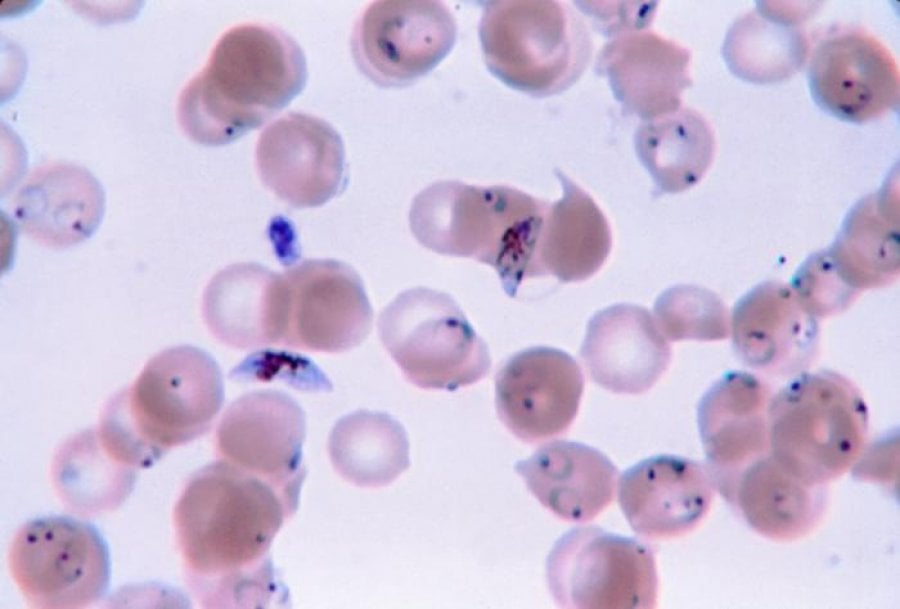
A 24-year-old patient presents with a high-grade fever, headache, and weakness since 5 days. He gives a history of blood transfusion 4 months back. The microscopic examination of the thin blood smear is given below. What is the most probable causative agent?
Sabin Feldman dye test is used for:
An Egyptian fisherman develops lower abdominal pain and pain on urination, and reports seeing blood in his urine. Which of the following parasites is the most likely cause of urinary symptoms in this patient?
Peripheral blood smear in Plasmodium falciparum infection may show all of the following except -
Man is the only host for
The life cycle of filaria in the mosquito is described as:
Cyclodevelopmental life cycle is seen in:
Cyclopropagative type of life cycle is seen in?
A man on return from East Asia complains of pain in abdomen, jaundice, with increased alkaline phosphatase and conjugated hyperbilirubinemia. Ultrasound shows blockage in the biliary tree. What could be the cause?
Chagas disease is transmitted by the following:
Explanation: ***Babesia microti*** - The image displays **intraerythrocytic pleomorphic ring forms** and classic **tetrad formations (Maltese cross)**, which are pathognomonic for **Babesia microti** infection. - The patient's history of **blood transfusion** 4 months prior is highly suggestive, as babesiosis can be transmitted through contaminated blood products with an incubation period fitting this timeline. - Clinical features include high-grade fever, headache, and weakness, consistent with babesiosis. *Leishmania donovani* - This parasite exists as **amastigotes within macrophages** and does not infect red blood cells or form ring structures as seen in the image. - While it causes fever and weakness (**visceral leishmaniasis/kala-azar**), its microscopic appearance on blood smear shows amastigotes in macrophages, not intraerythrocytic forms. *Plasmodium vivax* - While *P. vivax* infects red blood cells and forms ring stages, it is typically characterized by **enlarged infected RBCs with Schüffner's dots**, which are not seen here. - The **tetrad formations (Maltese cross)** seen in the image are pathognomonic for Babesia, not Plasmodium species. *Plasmodium falciparum* - This parasite typically presents with **multiple small ring forms per RBC** and **applique or "accole" forms** at the periphery of red blood cells. - While *P. falciparum* can cause high fever and severe disease, the specific **tetrad configuration (Maltese cross)** is characteristic of Babesia, not Plasmodium.
Explanation: ***Toxoplasma*** - The **Sabin-Feldman dye test** is a **serological assay** used to detect specific antibodies against *Toxoplasma gondii*. - This test measures the ability of antibodies in the patient's serum to prevent the cytoplasmic staining of live *Toxoplasma gondii* parasites by a basic dye. *Herpes* - Herpes simplex virus (HSV) infections are typically diagnosed using **viral culture**, **PCR**, or **antigen detection**, not the Sabin-Feldman dye test. - Serological tests for herpes usually involve detecting **IgG or IgM antibodies** to specific HSV glycoproteins. *Syphilis* - Syphilis, caused by *Treponema pallidum*, is diagnosed using **non-treponemal tests** (e.g., RPR, VDRL) and confirmed by **treponemal tests** (e.g., TP-PA, FTA-ABS). - The Sabin-Feldman dye test has no role in the diagnosis of syphilis. *Plasmodium* - *Plasmodium* species are the causative agents of malaria, diagnosed primarily by **microscopic examination of Giemsa-stained blood smears** to identify parasites. - **Rapid Diagnostic Tests (RDTs)** detecting *Plasmodium* antigens are also commonly used.
Explanation: ***Schistosoma haematobium*** - The patient's presentation with **lower abdominal pain**, **dysuria**, and **hematuria** is highly characteristic of urinary schistosomiasis, caused by *Schistosoma haematobium*. - The patient's origin as an **Egyptian fisherman** places him in an **endemic area** where contact with contaminated fresh water containing the parasite's larval forms (cercariae) is common. *Clonorchis sinensis* - This parasite causes **clonorchiasis**, an infection primarily affecting the **biliary tract** and liver, leading to symptoms like cholangitis, cholecystitis, and hepatomegaly. - It is typically acquired by consuming **raw or undercooked freshwater fish**, but does not cause urinary symptoms. *Fasciola hepatica* - *Fasciola hepatica* causes **fascioliasis**, a **liver fluke infection** that primarily affects the **biliary ducts** leading to symptoms like right upper quadrant pain, fever, and jaundice. - It is acquired by ingesting **metacercariae on aquatic plants**, particularly watercress, and does not cause urinary manifestations. *Diphyllobothrium latum* - This is the **fish tapeworm**, which causes **diphyllobothriasis**, an intestinal infection. - Symptoms are usually mild or asymptomatic, but can include abdominal discomfort, nausea, and notably **vitamin B12 deficiency** leading to megaloblastic anemia, not urinary symptoms.
Explanation: ***Schizont*** - While schizonts are a stage in the *Plasmodium falciparum* life cycle, **mature schizonts** (containing merozoites) are typically not seen in peripheral blood smears of infected patients. - They tend to **sequester in deep capillaries** of organs, making their detection in circulating blood extremely rare. *Female gametocyte* - **Crescent-shaped gametocytes** (both male and female) are a characteristic feature of *Plasmodium falciparum* infection that are readily identified in peripheral blood smears. - These forms are responsible for transmission to the mosquito vector. *Trophozoite* - **Ring-form trophozoites** are the most commonly seen stage of *P. falciparum* in peripheral blood smears. - They are typically thin, delicate rings, often with **double chromatin dots** or appliqué forms. *Male gametocyte* - Similar to female gametocytes, **crescent-shaped male gametocytes** are routinely observed in peripheral blood smears of *Plasmodium falciparum* infected individuals. - They are essential for sexual reproduction within the mosquito.
Explanation: ***Wuchereria bancrofti*** - This parasite is largely **restricted to humans** as its definitive host, causing **lymphatic filariasis**. - Its life cycle involves transmission via mosquitoes, but it relies solely on humans for the maturation of adult worms and the production of microfilariae. *Onchocerca volvulus* - While humans are the primary definitive hosts for **Onchocerca volvulus**, leading to **onchocerciasis** or **river blindness**, certain **simian primates** have also been found to harbor the parasite, making humans not the *exclusive* host. - The parasite is transmitted by **blackflies**. *Trichuris trichiura* - This parasite, commonly known as the **human whipworm**, primarily infects humans. - However, **other primates** like monkeys and apes can also be infected, thus humans are not the sole host. *Dracunculus medinensis* - While humans are the main and most well-known definitive host for **Dracunculus medinensis** (guinea worm), **dogs** and **other carnivores** have also been identified as hosts. - The infection is acquired by ingesting **copepods** containing larvae in contaminated water.
Explanation: ***Cyclodevelopmental*** - In a **cyclodevelopmental** life cycle, the parasite undergoes essential **developmental changes** within the vector without increasing significantly in number. - This precisely describes the filaria's existence in the mosquito, where microfilariae develop into infective larvae. *Propagative* - A **propagative** life cycle involves the parasite multiplying within the intermediate host or vector. - This is not characteristic of filaria in mosquitoes, as their primary goal is development, not proliferation, within the vector. *Cyclopropagative* - A **cyclopropagative** life cycle involves both **developmental changes** and **multiplication** of the parasite within the vector. - While there is development, significant multiplication does not occur in the mosquito vector for filarial worms, distinguishing it from this type. *None of the options* - This option is incorrect because the life cycle of filaria in the mosquito specifically fits the definition of **cyclodevelopmental**. - The other terms describe different patterns of parasite-vector interaction that do not apply here.
Explanation: ***Filaria*** - The **cyclodevelopmental life cycle** refers to parasites that undergo **developmental changes** through distinct larval stages within the vector. - Filarial nematodes, such as *Wuchereria bancrofti* and *Brugia malayi*, undergo **developmental transformation** in the mosquito vector: microfilariae (L1) → L2 stage → infective L3 stage. - The L3 larvae then migrate to the mosquito's proboscis and are transmitted to the human host during a blood meal. - This developmental progression through larval stages in the vector characterizes the cyclodevelopmental pattern. *Malaria* - Malaria parasites (*Plasmodium* species) exhibit a **cyclopropagative life cycle** in the mosquito vector. - They undergo both **development** (gametocytes → ookinete → oocyst → sporozoites) and **multiplication** (sporogony produces thousands of sporozoites from one oocyst). - This combination of development with extensive multiplication distinguishes it from purely cyclodevelopmental transmission. *Plague* - Plague is caused by *Yersinia pestis*, transmitted by fleas. - This represents **propagative transmission** where bacteria multiply in the flea's gut but do not undergo developmental stage changes. - The bacteria block the flea's proventriculus, causing mechanical transmission during feeding attempts. *Yellow fever* - Yellow fever virus is transmitted by *Aedes* mosquitoes. - This is a **propagative life cycle** where the virus replicates within the mosquito vector. - Viruses do not undergo morphological developmental stages like parasites, only multiplication through replication.
Explanation: ***Malaria*** - The **cyclopropagative** life cycle involves both reproduction (propagation) and developmental changes (cyclic) within the **arthropod vector**. - In malaria, the *Plasmodium* parasite undergoes asexual reproduction in the human host and then **sexual reproduction** (sporogony) with **developmental changes** in the **Anopheles mosquito**. - This combination of multiplication and development in the vector defines cyclopropagative transmission. *Filaria* - Filarial parasites, such as *Wuchereria bancrofti*, exhibit a **cyclodevelopmental** life cycle in the arthropod vector, meaning they undergo developmental changes but **do not reproduce** within the vector. - The microfilariae ingested by the mosquito develop into infective larvae, which are then transmitted to a new human host without multiplying inside the mosquito. *Cholera* - **Cholera** is caused by the bacterium *Vibrio cholerae*, which has a **direct life cycle** and is primarily transmitted through contaminated water or food. - There is no arthropod vector involved in the transmission or part of its life cycle. *Plague* - **Plague** is caused by the bacterium *Yersinia pestis*, primarily transmitted by **flea vectors** (e.g., *Xenopsylla cheopis*). - In the flea, the bacteria multiply in the gut (propagative transmission), but there is **no developmental/cyclic change** in the pathogen's form. - This is **propagative only**, not cyclopropagative, as it lacks the developmental component required for cyclopropagative transmission.
Explanation: ***Clonorchis sinensis*** - This parasitic fluke, common in East Asia, infects the **biliary ducts**, causing **cholangitis**, obstruction, and the symptoms described. - The combination of travel history, abdominal pain, jaundice, increased alkaline phosphatase, and conjugated hyperbilirubinemia, along with a blocked biliary tree on ultrasound, is highly suggestive of **clonorchiasis**. *Strongyloides* - This nematode primarily infects the **small intestine** and can cause abdominal pain, diarrhea, and malabsorption. - It does not typically cause biliary obstruction with jaundice and increased alkaline phosphatase. *Fasciola buski* - This fluke primarily infects the **small intestine** and causes symptoms like abdominal pain, diarrhea, and malabsorption, similar to Strongyloides. - While other Fasciola species (e.g., *F. hepatica*) can affect the biliary tree, *F. buski* is not known for causing biliary obstruction leading to jaundice. *Ancylostoma* - This hookworm primarily causes **iron-deficiency anemia** due to chronic blood loss in the intestines. - It does not typically cause symptoms related to biliary obstruction or jaundice.
Explanation: ***Kissing bugs*** - Chagas disease is primarily transmitted by the feces of infected **triatomine bugs**, commonly known as **kissing bugs**, which typically feed at night. - These bugs transmit the parasite *Trypanosoma cruzi* when they defecate near the bite wound or mucous membranes. *Birds* - Birds are not known vectors for the transmission of **Chagas disease**. - While some birds can carry other diseases, they do not carry the **triatomine bug** or the *Trypanosoma cruzi* parasite. *Tsetse flies* - **Tsetse flies** are the primary vectors for **African trypanosomiasis** (sleeping sickness), caused by *Trypanosoma brucei*. - They are not involved in the transmission of **Chagas disease** (*Trypanosoma cruzi*). *Dogs* - While dogs can be reservoirs for the *Trypanosoma cruzi* parasite and can become infected with **Chagas disease**, they are not directly responsible for transmitting the disease to humans. - Transmission to dogs and humans occurs through the bite of an infected **kissing bug**.
Classification of Parasites
Practice Questions
Intestinal Protozoa
Practice Questions
Blood and Tissue Protozoa
Practice Questions
Malaria Parasites
Practice Questions
Leishmaniasis
Practice Questions
Intestinal Helminths: Nematodes
Practice Questions
Tissue Nematodes
Practice Questions
Trematodes
Practice Questions
Cestodes
Practice Questions
Ectoparasites
Practice Questions
Antiparasitic Drugs
Practice Questions
Laboratory Diagnosis of Parasitic Infections
Practice Questions
Get full access to all questions, explanations, and performance tracking.
Start For Free