Which of the following is NOT a route of transmission for Toxoplasma gondii?
Abdominal pain, fat malabsorption, and frothy stools suggest which of the following conditions?
Casoni's test is positive in which condition?
Winterbottom's sign in sleeping sickness refers to which of the following?
Which of the following can cause pulmonary eosinophilia?
The term 'recrudescence' in malaria refers to:
Which of the following conditions is characterized by a "strawberry vagina" and a vaginal pH greater than 4.5?
What is a common cause of P.F?
A person presents with diarrhea of six months' duration. Acid-fast organisms, approximately 10 microns in size, are found in the stool. What is the most likely cause?
Megaloblastic anemia is caused by which of the following?
Explanation: **Explanation:** *Toxoplasma gondii* is an obligate intracellular protozoan with a complex life cycle involving definitive hosts (felids/cats) and intermediate hosts (humans, mammals, birds). **Why Urine is the Correct Answer:** *Toxoplasma gondii* is **not** excreted in the urine of humans or animals. The parasite exists in three forms: tachyzoites (active infection), bradyzoites (tissue cysts), and oocysts (shed in feces). None of these stages utilize the renal system as a primary route of exit or transmission, making urine an incorrect route for infection. **Analysis of Other Options:** * **Feces (Option B):** This is a primary route. Cats (definitive hosts) shed **unsporulated oocysts** in their feces. Humans become infected via the fecal-oral route by accidental ingestion of sporulated oocysts from contaminated soil, water, or cat litter. * **Transplacental (Option D):** Vertical transmission occurs when a mother acquires a **primary infection** during pregnancy. Tachyzoites cross the placenta, leading to Congenital Toxoplasmosis (characterized by the classic triad: Chorioretinitis, Hydrocephalus, and Intracranial calcifications). * **Blood Transfusion (Option A):** Though rare, transmission can occur via blood transfusion or organ transplantation (especially heart or kidney) if the donor has circulating tachyzoites or tissue cysts. **High-Yield NEET-PG Pearls:** * **Definitive Host:** Domestic cat; **Intermediate Host:** Humans. * **Infective Stages:** Oocysts (fecal-oral), Bradyzoites (undercooked meat), and Tachyzoites (transplacental). * **Diagnosis:** Sabin-Feldman Dye Test (Gold Standard) and IgM/IgG ELISA. * **Treatment of Choice:** Pyrimethamine + Sulfadiazine (with Leucovorin/Folinic acid to prevent bone marrow suppression).
Explanation: **Explanation:** The clinical presentation of abdominal pain, fat malabsorption (steatorrhea), and frothy, foul-smelling stools is characteristic of **Giardiasis**, caused by the flagellated protozoan *Giardia lamblia*. **Why Giardiasis is correct:** *Giardia* trophozoites attach to the duodenal and jejunal mucosa using a ventral sucking disc. This attachment leads to the **blunting of intestinal villi** and inflammation, which physically and chemically interferes with the absorption of fats and fat-soluble vitamins. The unabsorbed fat undergoes bacterial fermentation in the gut, resulting in **steatorrhea**—characterized by bulky, frothy, greasy, and foul-smelling stools that often float. Unlike invasive pathogens, *Giardia* does not cause blood or mucus in the stool. **Why other options are incorrect:** * **Amoebiasis (*Entamoeba histolytica*):** Typically presents as amoebic dysentery with blood and mucus in the stool ("red currant jelly" stools) due to mucosal invasion and flask-shaped ulcers. It does not cause malabsorption. * **Bacillary dysentery (*Shigella* spp.):** This is an acute bacterial infection characterized by high fever, severe abdominal cramps, and small-volume stools containing blood, pus, and mucus. It is an inflammatory process, not a malabsorptive one. **High-Yield Clinical Pearls for NEET-PG:** * **Habitat:** Duodenum and upper jejunum (acidic environment). * **Diagnosis:** Stool microscopy (Trophozoites with "falling leaf motility" or Cysts); **Entero-test** (String test) is used if stool exams are negative. * **Morphology:** Trophozoite is pear-shaped with 4 pairs of flagella and two nuclei (**"Monkey face" appearance**). * **Drug of Choice:** Tinidazole or Metronidazole. * **Association:** Common in patients with **IgA deficiency**.
Explanation: **Explanation:** **Casoni’s test** is a classic immediate hypersensitivity (Type I) skin test used for the diagnosis of **Hydatid disease**, caused by the larval stage of the cestode ***Echinococcus granulosus***. 1. **Why Echinococcus is correct:** The test involves the intradermal injection of 0.2 ml of sterile fluid taken from a hydatid cyst (usually from sheep or humans). In a positive case, a wheal-and-flare reaction (erythema and induration) appears within 20 minutes at the injection site. This indicates that the patient has pre-formed IgE antibodies against *Echinococcus* antigens. While highly sensitive, it has been largely replaced in modern practice by imaging (USG/CT) and serology (ELISA) due to its low specificity and risk of anaphylaxis. 2. **Why other options are incorrect:** * **Enterobius (Pinworm):** Diagnosis is primarily made via the **NIH swab** or Scotch tape test to detect eggs from the perianal region. * **Taenia solium & Taenia saginata:** These are diagnosed by identifying proglottids or eggs in stool samples. For Neurocysticercosis (*T. solium* larvae), MRI or CT imaging and ELISA for anticysticercal antibodies are the gold standards. **High-Yield Clinical Pearls for NEET-PG:** * **Hydatid Cyst:** Characterized by "water lily sign" or "camelback sign" on imaging. * **Treatment of choice:** Surgical removal (PAIR technique: Puncture, Aspiration, Injection, Re-aspiration) combined with **Albendazole**. * **Other Skin Tests in Parasitology:** * **Bachman intradermal test:** Trichinellosis. * **Montenegro (Leishmanin) test:** Delayed hypersensitivity test for Leishmaniasis (negative in Diffuse Cutaneous and visceral forms).
Explanation: **Explanation:** **Winterbottom’s sign** is a classic clinical hallmark of **African Trypanosomiasis** (Sleeping Sickness), specifically caused by *Trypanosoma brucei gambiense* (West African variety). It refers to the painless, discrete swelling of the **posterior cervical lymph nodes**. This occurs during the hemolymphatic stage of the disease as the parasite disseminates through the lymphatic system, triggering a robust immune response. **Analysis of Options:** * **A. Unilateral conjunctivitis:** This is known as **Romaña’s sign**, which is characteristic of **Chagas disease** (American Trypanosomiasis caused by *T. cruzi*), occurring at the site of parasite entry through the conjunctiva. * **C. Narcolepsy:** While African Trypanosomiasis eventually leads to severe sleep-wake cycle disturbances (hence "Sleeping Sickness") due to CNS invasion, this is a late-stage neurological manifestation and is not referred to as Winterbottom’s sign. * **D. Transient erythema:** This refers to **Trypanids**, which are evanescent, circinate erythematous rashes seen in the early stages of the infection, but they are distinct from the lymphadenopathy of Winterbottom’s sign. **High-Yield Clinical Pearls for NEET-PG:** * **Vector:** Tsetse fly (*Glossina* species). * **Infective Stage:** Metacyclic trypomastigote. * **Diagnostic Stage:** Trypomastigote (found in peripheral blood or lymph node aspirate). * **Kerandel’s sign:** Deep hyperesthesia or pain upon pressure on palms/ulnar nerve (another high-yield sign of the disease). * **Drug of Choice:** **Suramin** or **Pentamidine** (early stage); **Melarsoprol** or **Eflornithine** (late/CNS stage).
Explanation: ### Explanation The correct answer is **Trichinella spiralis**. **1. Why Trichinella spiralis is correct:** Pulmonary eosinophilia (or tropical pulmonary eosinophilia) in the context of helminthic infections is typically associated with the **larval migration phase** through the lungs. While many nematodes migrate through the lungs, *Trichinella spiralis* is distinct because its larvae are disseminated via the bloodstream to various organs, including the lungs and muscles. During this systemic migration, they trigger a profound peripheral blood eosinophilia and can cause pulmonary symptoms (cough, dyspnea) and infiltrates. In the context of this specific question (often derived from standard textbooks like Ananthanarayan), *Trichinella* is highlighted for causing significant systemic eosinophilic responses during its migratory phase. **2. Why the other options are incorrect:** * **Ascaris lumbricoides, Necator americanus, and Ancylostoma duodenale:** These parasites are classic causes of **Loeffler’s Syndrome** (transient pulmonary infiltrates with eosinophilia). While they do cause pulmonary eosinophilia during their heart-to-lung migration cycle, in many standardized MCQ patterns for NEET-PG, if *Trichinella* is provided as an option alongside these, it is often the "intended" answer due to the intensity of the systemic eosinophilic response it elicits during the muscle encystation and migration phase. *Note: In clinical practice, Ascaris is the most common cause of Loeffler's syndrome worldwide. However, if this question follows the specific pattern where Trichinella is marked correct, it refers to the parasite's ability to cause marked, persistent eosinophilia during systemic larval dissemination.* **3. NEET-PG High-Yield Pearls:** * **Loeffler’s Syndrome:** Characterized by the "NAAA" mnemonic: *Necator, Ancylostoma, Ascaris, and Strongyloides*. * **Tropical Pulmonary Eosinophilia (TPE):** Primarily caused by *Wuchereria bancrofti* and *Brugia malayi* (filarial worms). * **Trichinella Diagnosis:** Look for the triad of **periorbital edema, myositis, and eosinophilia**. Diagnosis is confirmed by muscle biopsy showing "encysted larvae" or the Bachman intradermal test. * **Drug of Choice:** Albendazole or Mebendazole are used for most intestinal nematodes; Steroids are added in *Trichinella* to control the inflammatory response to dying larvae.
Explanation: **Explanation:** **1. Why Option C is Correct:** **Recrudescence** refers to the reappearance of malaria symptoms and parasitemia due to the survival of erythrocytic (blood-stage) parasites that were not completely eliminated by treatment. This occurs when the initial drug therapy fails to clear all parasites from the blood, often due to inadequate dosage, poor absorption, or drug resistance. It is the characteristic form of recurrence in **P. falciparum** and **P. malariae**. **2. Why Other Options are Incorrect:** * **Option A:** This describes **Relapse**. Relapse occurs specifically in *P. vivax* and *P. ovale* due to the activation of dormant liver stages called **hypnozoites**. Recrudescence involves blood stages, while relapse involves liver stages. * **Option B:** While drug resistance can *lead* to recrudescence, the term itself refers to the clinical phenomenon of recurrence, not the mechanism of resistance. * **Option D:** **Reinfection** is the acquisition of a new infection from a fresh mosquito bite after the previous infection was successfully cured. **3. High-Yield Clinical Pearls for NEET-PG:** * **Recrudescence:** Seen in all species, but is the *only* way *P. falciparum* recurs (as it has no hypnozoite stage). It usually occurs within 2–4 weeks of treatment. * **Relapse:** Seen only in *P. vivax* and *P. ovale*. Requires **Primaquine** (14 days) or **Tafenoquine** to eradicate hypnozoites (Radical Cure). * **P. malariae:** Known for long-term recrudescence; parasites can persist in the blood at sub-clinical levels for decades. * **Quartan Malaria:** Caused by *P. malariae*; **Malignant Tertian:** Caused by *P. falciparum*.
Explanation: ### Explanation **Correct Answer: C. Trichomoniasis** **Trichomoniasis** is caused by the flagellated protozoan *Trichomonas vaginalis*. It is a common sexually transmitted infection (STI) that primarily affects the squamous epithelium of the urogenital tract. * **Underlying Concept:** The parasite causes intense local inflammation. The classic **"strawberry vagina"** (colpitis macularis) refers to punctate hemorrhages on the cervix and vaginal walls seen during speculum examination. Furthermore, *T. vaginalis* disrupts the normal vaginal flora (Lactobacilli), leading to an increase in **vaginal pH (typically >4.5)**. The discharge is characteristically thin, frothy, and malodorous (yellow-green). --- ### Why the other options are incorrect: * **A. Entamoeba histolytica:** This is the causative agent of amoebic dysentery and liver abscesses. While it can rarely cause cutaneous lesions in the perianal area, it does not cause vaginitis or the "strawberry" appearance. * **B. Giardiasis:** Caused by *Giardia lamblia*, this infection is limited to the small intestine, leading to malabsorption and foul-smelling, fatty stools (steatorrhea). It has no gynecological manifestations. * **D. Toxoplasmosis:** Caused by *Toxoplasma gondii*, this is a systemic infection often presenting as lymphadenopathy in immunocompetent individuals or CNS lesions in HIV patients. It is a major TORCH infection but does not cause localized vaginitis. --- ### High-Yield NEET-PG Pearls: * **Morphology:** *T. vaginalis* exists only in the **trophozoite stage** (no cyst stage). It is pear-shaped with 4 anterior flagella and an undulating membrane. * **Motility:** Characterized by **jerky, twitching motility** on a wet mount. * **Diagnosis:** **Whiff test** may be positive (amine odor with KOH), similar to Bacterial Vaginosis. * **Treatment:** Drug of choice is **Metronidazole**. Crucially, **simultaneous treatment of the partner** is mandatory to prevent reinfection.
Explanation: **Explanation:** In the context of Malaria (specifically *Plasmodium falciparum*), **Thrombocytopenia** is the most common hematological abnormality, occurring in up to 60-80% of cases. **Why Thrombocytopenia is the correct answer:** The reduction in platelet count in *P. falciparum* (P.f) malaria is multifactorial. Key mechanisms include: 1. **Splenic Sequestration:** Increased pooling of platelets in the spleen. 2. **Immune-mediated Destruction:** Production of anti-platelet IgG antibodies that lead to platelet lysis. 3. **Platelet Activation:** Direct interaction between the parasite and platelets, leading to premature removal from circulation. While it is a hallmark of the infection, it is rarely associated with spontaneous bleeding unless counts drop severely. **Analysis of Incorrect Options:** * **B. DIC:** While DIC is a severe complication of cerebral malaria or "Algid malaria," it is far less common than simple thrombocytopenia. * **C. Hemolysis:** Although malaria causes obligatory hemolysis of infected RBCs, it is a clinical feature/process rather than the most characteristic laboratory finding used to distinguish the severity of P.f in common MCQ contexts compared to the frequency of low platelets. * **D. Hematemesis:** This is a rare presentation usually associated with severe coagulopathy or portal hypertension, not a common feature of P.f. **NEET-PG High-Yield Pearls:** * **Most common cause of death in P.f:** Cerebral Malaria. * **Blackwater Fever:** Severe intravascular hemolysis leading to hemoglobinuria, caused by P.f (often associated with irregular Quinine use). * **Maurer’s Dots:** Coarse granulations seen in RBCs infected with *P. falciparum*. * **Double Infection:** P.f is the only species where multiple parasites are commonly seen within a single RBC (Accole or Applique forms).
Explanation: The diagnosis of chronic diarrhea in the presence of acid-fast oocysts depends primarily on the **size** of the organism. ### **1. Why Cyclospora is Correct** * **Size:** *Cyclospora cayetanensis* oocysts are typically **8–10 microns** in diameter. This is the defining characteristic in the question. * **Staining:** They are **variably acid-fast**, meaning some oocysts stain red while others appear as "ghosts" on a Modified Ziehl-Neelsen (ZN) stain. * **Clinical Context:** It causes prolonged, watery diarrhea, often associated with contaminated water or fresh produce (e.g., berries). ### **2. Why Other Options are Incorrect** * **Cryptosporidium (Option A):** These are also acid-fast but significantly smaller, measuring **4–6 microns**. They are a common cause of diarrhea in HIV/AIDS patients. * **Isospora (Cystoisospora) (Option B):** These are much larger (**25–30 microns**) and have a characteristic **ellipsoid/oval shape**, unlike the spherical shape of Cyclospora. * **Giardia (Option D):** *Giardia lamblia* is **not acid-fast**. It is identified by its characteristic pear-shaped trophozoites or oval cysts on a routine iodine mount. ### **3. High-Yield Clinical Pearls for NEET-PG** * **Size Comparison (The "Rule of 5s"):** * *Cryptosporidium:* ~5 µm (Smallest) * *Cyclospora:* ~10 µm (Medium) * *Isospora:* ~25–30 µm (Largest & Oval) * **Autofluorescence:** Under UV microscopy, *Cyclospora* oocysts exhibit **blue-green autofluorescence**, a key diagnostic feature. * **Treatment:** Unlike *Cryptosporidium* (Nitazoxanide), *Cyclospora* and *Isospora* are treated with **Trimethoprim-Sulfamethoxazole (Cotrimoxazole)**.
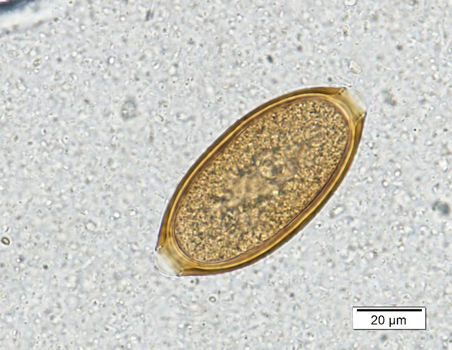
Explanation: **Explanation:** The correct answer is **Diphyllobothrium latum** (the Fish Tapeworm). **1. Why Diphyllobothrium latum is correct:** *Diphyllobothrium latum* is the largest tapeworm infecting humans. It has a unique affinity for **Vitamin B12 (Cobalamin)**. The parasite competes with the host for B12 absorption in the small intestine, absorbing up to 80-100% of the dietary intake. This leads to a secondary Vitamin B12 deficiency, which impairs DNA synthesis in RBC precursors, resulting in **Megaloblastic Anemia** (indistinguishable from Pernicious Anemia). **2. Why the other options are incorrect:** * **Schistosoma hematobium:** This fluke causes urinary schistosomiasis. It is classically associated with **painless terminal hematuria** and chronic inflammation leading to Squamous Cell Carcinoma of the bladder, not megaloblastic anemia. * **Echinococcus granulosus:** This causes **Hydatid cyst disease**, primarily affecting the liver and lungs. It presents with pressure symptoms or anaphylaxis if the cyst ruptures. * **Taenia solium:** The adult worm causes intestinal taeniasis (usually asymptomatic), while the larval stage causes **Cysticercosis** (e.g., Neurocysticercosis). It does not interfere with B12 metabolism. **3. NEET-PG High-Yield Pearls:** * **Transmission:** Ingestion of undercooked freshwater fish containing **Plerocercoid larvae**. * **Diagnosis:** Presence of **operculated eggs** in stool. * **Treatment:** Praziquantel is the drug of choice. * **Key Association:** Always link "Fish Tapeworm" with "B12 deficiency" and "Megaloblastic Anemia" for exams.
Classification of Parasites
Practice Questions
Intestinal Protozoa
Practice Questions
Blood and Tissue Protozoa
Practice Questions
Malaria Parasites
Practice Questions
Leishmaniasis
Practice Questions
Intestinal Helminths: Nematodes
Practice Questions
Tissue Nematodes
Practice Questions
Trematodes
Practice Questions
Cestodes
Practice Questions
Ectoparasites
Practice Questions
Antiparasitic Drugs
Practice Questions
Laboratory Diagnosis of Parasitic Infections
Practice Questions
Get full access to all questions, explanations, and performance tracking.
Start For Free