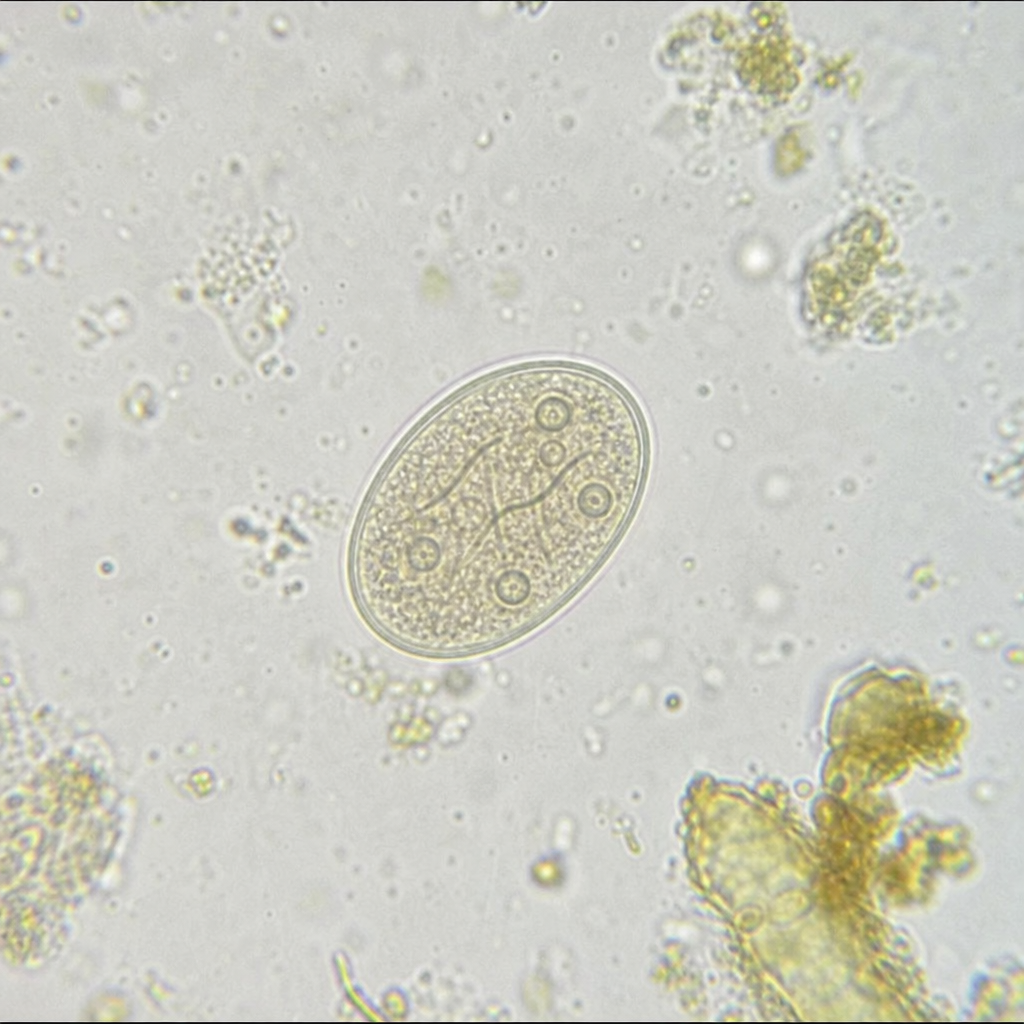
Which of the following is false regarding Trichomonas vaginalis?
L.D. bodies are seen in which of the following conditions?
A 32-year-old man presented with various signs and symptoms after consuming crab from a local restaurant. Which parasite can be transmitted through consuming crab?
What is the primary route of transmission for Toxoplasma gondii?
Which of the following diseases is NOT transmitted by hard ticks?
Barrel-shaped eggs are seen in which of the following parasites?
A stool examination reveals acid-fast organisms with oocytes measuring 5 micrometers, causing diarrhea in an HIV-positive patient. What is the causative organism?
Cutaneous larva migrans is caused by which organism?
A HIV-positive individual has diarrheal episodes. Stool examination reveals oocysts of size 8-10 microns. What is the most likely diagnosis?
"Flask shaped" ulcers in the intestine are characteristic of which condition?
Explanation: **Explanation:** The correct answer is **C (Mature cysts are passed in feces)** because *Trichomonas vaginalis* is unique among pathogenic protozoa as it **does not have a cyst stage**. It exists only as a trophozoite. Furthermore, it is a urogenital parasite, not an intestinal one; therefore, it is not passed in feces but is transmitted primarily through sexual contact. **Analysis of Options:** * **A. Trophozoites have 5 anterior flagella:** This is a common point of confusion. *T. vaginalis* actually possesses **4 anterior flagella** and a **5th flagellum** that forms the outer edge of the undulating membrane. (Note: Some texts refer to the total flagellar count, but the classic description is 4 free anterior flagella). * **B. Exhibits twitching motility:** This is a classic diagnostic feature. In a wet mount of vaginal or urethral discharge, the trophozoites exhibit a characteristic jerky, **twitching motility**, which is a high-yield fact for identification. * **D. Drug of choice is metronidazole:** Metronidazole (or Tinidazole) is the gold standard treatment. It is crucial to treat both the patient and the **sexual partner** simultaneously to prevent "ping-pong" reinfection. **Clinical Pearls for NEET-PG:** * **Habitat:** Female vagina and male urethra/prostate. * **Clinical Presentation:** Causes "Strawberry Cervix" (colpitis macularis) due to punctate hemorrhages. * **Diagnosis:** Gold standard is **Whiff Test** (amine odor with KOH) and **Diamond’s Medium** for culture. * **pH:** It thrives in an alkaline vaginal pH (>4.5), unlike the normal acidic environment.
Explanation: **Explanation:** **L.D. Bodies (Leishman-Donovan bodies)** are the **amastigote stage** of the protozoan parasite *Leishmania donovani*. This stage is found intracellularly within the reticuloendothelial system (macrophages, liver, spleen, and bone marrow) of the human host. 1. **Why Kala-azar is correct:** Kala-azar, also known as Visceral Leishmaniasis, is caused by *L. donovani*. In the human host, the parasite exists as an ovoid, non-flagellated amastigote (L.D. body) measuring 2–4 µm. Demonstration of these bodies in splenic or bone marrow aspirates remains the **gold standard for diagnosis**. 2. **Why other options are incorrect:** * **Toxoplasmosis:** Caused by *Toxoplasma gondii*. It presents as tachyzoites (active infection) or bradyzoites (tissue cysts), not L.D. bodies. * **Malaria:** Caused by *Plasmodium* species. Diagnostic stages include ring forms, trophozoites, schizonts, and gametocytes within RBCs. * **Sleeping sickness (African Trypanosomiasis):** Caused by *Trypanosoma brucei*. It exists only in the **trypomastigote** stage (extracellular flagellates) in human blood and CSF; it does not have an amastigote stage. **High-Yield Clinical Pearls for NEET-PG:** * **Vector:** Sandfly (*Phlebotomus argentipes*). * **Infective stage:** Promastigote (found in the sandfly). * **Diagnostic stage:** Amastigote (L.D. body). * **Morphology of L.D. Body:** Contains a nucleus and a rod-shaped **kinetoplast**. * **Culture:** NNN (Novy-MacNeal-Nicolle) medium. * **Drug of Choice:** Liposomal Amphotericin B.
Explanation: **Explanation:** The correct answer is **Paragonimus westermanii**, also known as the **Oriental Lung Fluke**. **1. Why Paragonimus westermanii is correct:** The life cycle of *Paragonimus westermanii* involves two intermediate hosts. The first is a snail, and the second is a **crustacean (crab or crayfish)**. Humans become infected by ingesting raw or undercooked crabs containing the infective stage, the **metacercariae**. Once ingested, the larvae excyst in the duodenum, penetrate the intestinal wall, migrate through the diaphragm, and eventually mature in the lungs, leading to symptoms like hemoptysis (mimicking tuberculosis). **2. Why other options are incorrect:** * **A. Diphyllobothrium latum:** This is the fish tapeworm. Infection occurs via the consumption of undercooked **freshwater fish** containing plerocercoid larvae. * **B. Clonorchis sinensis:** Known as the Chinese Liver Fluke. While it also uses a snail as the first intermediate host, the second intermediate host is **freshwater fish**, not crabs. * **C. Enterobius vermicularis:** This is the pinworm. Transmission is primarily via the **fecal-oral route** (ingestion of embryonated eggs) or autoinfection; it does not involve an aquatic intermediate host. **Clinical Pearls for NEET-PG:** * **Classic Presentation:** A patient with a history of crab consumption presenting with chronic cough and "rusty-brown" sputum (containing eggs). * **Radiology:** May show ring-shadows or "cotton-wool" opacities in the lungs, often confused with TB. * **Diagnosis:** Identification of operculated eggs in sputum or feces. * **Drug of Choice:** Praziquantel.
Explanation: **Explanation:** *Toxoplasma gondii* is an obligate intracellular protozoan with a complex life cycle involving multiple modes of transmission. While ingestion of oocysts is the most common epidemiological route, the question asks for the **primary route** in a specific clinical context or as defined by the provided answer key (often reflecting the most direct systemic entry). 1. **Why Option A is Correct:** While ingestion is common, **Blood transfusion** (and organ transplantation) represents a direct parenteral route where tachyzoites are introduced into the host. In the context of certain medical examinations, this is highlighted to emphasize the risk of iatrogenic transmission, especially in immunocompromised recipients. (Note: In general epidemiology, ingestion is most frequent, but if the key specifies A, it focuses on the direct systemic inoculation). 2. **Why other options are incorrect:** * **Option B (Ingestion of oocysts):** This occurs via soil or water contaminated by cat feces. While it is the most common way humans are infected globally, it is technically an indirect route compared to direct blood inoculation. * **Option C (Vertical transmission):** This occurs only when a mother acquires a *primary* infection during pregnancy. While clinically devastating (causing the Sabin Shanz triad), it is not the "primary" or most frequent route of transmission in the general population. * **Option D (All of the above):** While all are valid routes, the question asks for the "primary" route. If the examiner identifies blood/tissue transfer as the most direct path for the tachyzoite stage, A is selected. **NEET-PG High-Yield Pearls:** * **Definitive Host:** Domestic cat (and other felids). * **Infective Stages:** Oocysts (from cat feces), Tissue cysts (in undercooked meat), and Tachyzoites (transplacental/blood). * **Congenital Toxoplasmosis Triad:** Chorioretinitis, Hydrocephalus, and Intracranial calcifications. * **Diagnosis:** Sabin-Feldman Dye Test (Gold Standard) and PCR. * **Treatment:** Sulfadiazine + Pyrimethamine.
Explanation: **Explanation:** The correct answer is **Relapsing fever**. In medical parasitology, it is crucial to distinguish between diseases transmitted by **Hard ticks (Ixodidae)** and **Soft ticks (Argasidae)**. 1. **Why Relapsing Fever is the correct answer:** Relapsing fever exists in two forms: **Epidemic** (transmitted by body lice) and **Endemic** (transmitted by **Soft ticks** of the genus *Ornithodoros*). Both are caused by *Borrelia* species. Since it is transmitted by soft ticks, it is not associated with hard ticks. 2. **Analysis of Incorrect Options:** * **Hemorrhagic fever:** Specifically, **Crimean-Congo Hemorrhagic Fever (CCHF)** is a viral disease transmitted primarily by *Hyalomma* ticks (a genus of hard ticks). Kyasanur Forest Disease (KFD) is also transmitted by hard ticks (*Haemaphysalis*). * **Tick typhus:** Also known as Indian Tick Typhus (caused by *Rickettsia conorii*), it is transmitted by hard ticks like *Rhipicephalus sanguineus*. * **Tularemia:** Caused by *Francisella tularensis*, this zoonosis can be transmitted by various routes, but hard ticks (*Dermacentor* and *Amblyomma*) are major biological vectors. **High-Yield Clinical Pearls for NEET-PG:** * **Mnemonic for Hard Tick diseases:** "**I**ndian **T**ick **T**yphus, **K**FD, **B**abesiosis, **T**ularemia, **B**ull’s eye rash (Lyme), **C**CHF" (**I T**ake **K**ids **B**ack **T**o **B**ig **C**ities). * **Soft Tick (Argasidae):** Primarily transmits **Endemic Relapsing Fever** (*Borrelia duttoni*). * **Hard Tick (Ixodidae):** Characterized by a dorsal **scutum**, anterior capitulum, and slow feeding (days). * **Lyme Disease:** Transmitted by *Ixodes* (Hard tick); look for Erythema Chronicum Migrans in clinical vignettes.
Explanation: **Explanation:** The correct answer is **Whipworm (*Trichuris trichiura*)**. **1. Why Whipworm is correct:** The eggs of *Trichuris trichiura* possess a highly characteristic morphology often described as **barrel-shaped**, lemon-shaped, or tea-tray shaped. Key diagnostic features include a thick, smooth brown shell (bile-stained) and the presence of **prominent clear mucoid bipolar plugs** at both ends. These eggs are unembryonated when passed in feces. **2. Why other options are incorrect:** * **Hookworm (*Ancylostoma duodenale/Necator americanus*):** Eggs are oval or elliptical, colorless (non-bile stained), and surrounded by a thin, transparent hyaline shell. They typically contain a segmented ovum (usually 4–8 blastomeres) with a clear space between the shell and the embryo. * **Pinworm (*Enterobius vermicularis*):** Eggs are characterized by a unique **planoconvex** shape (one side flattened, the other convex), resembling the letter ‘D’. They are non-bile stained and contain a fully formed tadpole-like larva. * **Roundworm (*Ascaris lumbricoides*):** Fertilized eggs are typically round or oval with a thick, lumpy, outer **mammillated (albuminous) coat** stained golden-brown by bile. **3. NEET-PG Clinical Pearls:** * **Habitat:** *Trichuris trichiura* lives in the **caecum** and large intestine. * **Clinical Presentation:** Heavy infestation in children can lead to **rectal prolapse** due to mucosal irritation and increased peristalsis. * **Morphology:** The adult worm has a thin, thread-like anterior end and a thick posterior end, resembling a whip. * **Treatment:** Albendazole or Mebendazole are the drugs of choice.
Explanation: ### Explanation The correct answer is **Cryptosporidium parvum**. This is a classic presentation of opportunistic diarrhea in immunocompromised patients, particularly those with HIV/AIDS. #### Why Cryptosporidium is Correct: 1. **Size:** The oocysts of *Cryptosporidium* are characteristically small, measuring **4–6 µm** (average 5 µm). This is the most defining morphological feature in the question. 2. **Staining:** It is an **acid-fast** organism. On Modified Ziehl-Neelsen (kinyoun) stain, they appear as bright red, spherical bodies against a blue/green background. 3. **Clinical Context:** It is a leading cause of chronic, voluminous, watery diarrhea in HIV patients with CD4 counts <200 cells/mm³. #### Why Other Options are Incorrect: * **Isospora belli (Cystoisospora):** While also acid-fast and common in HIV, its oocysts are much larger (**25–30 µm**) and typically **ellipsoidal/oval** in shape. * **Microsporidia:** These are the smallest (1–3 µm). Crucially, they are **not** typically identified by standard acid-fast staining; they require specialized stains like Chromotrope 2R or Calcofluor White. * **Blastocystis hominii:** This is a polymorphic protozoan (often seen in vacuolar form). It is **not acid-fast** and its role as a primary pathogen is often debated. #### NEET-PG High-Yield Pearls: * **Morphology Trick:** Remember the "Rule of Sizes" for acid-fast oocysts: *Cryptosporidium* (5 µm) < *Cyclospora* (10 µm) < *Isospora* (25 µm). * **Diagnosis:** Stool examination using **Modified Acid-Fast stain** is the gold standard. * **Treatment:** In HIV patients, the most effective treatment is **HAART** (to restore CD4 count). **Nitazoxanide** is the drug of choice in immunocompetent patients. * **Transmission:** Frequently associated with waterborne outbreaks due to its resistance to chlorination.
Explanation: **Explanation:** **Cutaneous Larva Migrans (CLM)**, also known as "creeping eruption," is a zoonotic infection caused by the larvae of animal hookworms. 1. **Why Ancylostoma braziliense is correct:** The most common cause of CLM is **Ancylostoma braziliense** (the hookworm of cats and dogs). When humans come into contact with soil contaminated by animal feces, the filariform larvae penetrate the skin. Because humans are accidental, non-definitive hosts, the larvae lack the enzymes (collagenases) necessary to penetrate the basement membrane and reach the circulation. Consequently, they remain trapped in the epidermis, migrating aimlessly and creating characteristic **serpiginous, erythematous, pruritic tracks.** 2. **Why the other options are incorrect:** * **Anisakis simplex:** Causes **Anisakiasis**, a gastrointestinal infection acquired by consuming raw or undercooked seafood containing the larvae. * **Toxocara species:** Causes **Visceral Larva Migrans (VLM)** and **Ocular Larva Migrans (OLM)**. Unlike CLM, these larvae migrate through deeper internal organs (liver, lungs, eyes) because they are ingested rather than penetrating the skin. * **Necator americanus:** This is a human hookworm. While it can cause a transient "ground itch" at the site of entry, it successfully penetrates the dermis to complete its life cycle in the human intestine, rather than remaining confined to the skin as a migrating larva. **High-Yield NEET-PG Pearls:** * **Clinical Presentation:** Intensely itchy, snake-like tracks, most commonly on the feet (sand-box exposure). * **Treatment of Choice:** Topical or oral **Albendazole** or **Ivermectin**. * **Key Distinction:** CLM = *Ancylostoma braziliense* (Skin); VLM = *Toxocara canis* (Viscera). * **Larva Currens:** A similar but much faster-moving eruption caused by *Strongyloides stercoralis*.
Explanation: ### **Explanation** The clinical presentation of chronic diarrhea in an HIV-positive patient points toward opportunistic coccidian parasites. The definitive diagnostic feature in this question is the **size of the oocyst (8–10 µm).** **1. Why Cyclospora is Correct:** * **Cyclospora cayetanensis** produces spherical oocysts that measure **8–10 µm** in diameter. * They are acid-fast (variable) and typically appear as "wrinkled" spheres. * In HIV patients, they cause prolonged, watery diarrhea similar to Cryptosporidium but are distinguished primarily by their larger size. **2. Why Other Options are Incorrect:** * **Cryptosporidium parvum:** This is the most common cause of diarrhea in AIDS patients, but its oocysts are significantly smaller, measuring **4–6 µm**. * **Isospora (Cystoisospora) belli:** These oocysts are much larger (**25–30 µm**) and have a characteristic elliptical/oval shape, unlike the spherical shape of Cyclospora. * **Cryptococcus:** This is a fungus, not a coccidian parasite. While it can cause disseminated disease in HIV, it typically presents as meningitis and is identified by India Ink staining of CSF, not as oocysts in stool. **3. High-Yield Clinical Pearls for NEET-PG:** * **Size Comparison (The "Rule of 5s"):** * *Cryptosporidium:* ~5 µm (Smallest) * *Cyclospora:* ~10 µm (Double the size of Cryptosporidium) * *Isospora:* ~25–30 µm (Largest, oval) * **Autofluorescence:** *Cyclospora* oocysts exhibit blue-green autofluorescence under UV microscopy, a key diagnostic feature. * **Staining:** All three (Cryptosporidium, Cyclospora, Isospora) are **Modified Acid-Fast positive**. * **Treatment:** While *Cryptosporidium* is difficult to treat (Nitazoxanide), both *Cyclospora* and *Isospora* respond well to **Cotrimoxazole (TMP-SMX)**.
Explanation: **Explanation:** **Correct Answer: C. Amoebic infection** The characteristic "flask-shaped" ulcer is the hallmark of intestinal amoebiasis caused by **_Entamoeba histolytica_**. The pathogenesis begins when the trophozoites penetrate the intestinal epithelium (via the secretion of histolytic enzymes like cysteine proteases). Once they reach the **submucosa**, they spread laterally because the submucosal layer is more lax and offers less resistance than the muscularis mucosa. This results in an ulcer with a narrow neck (at the site of entry) and a broad base (in the submucosa), resembling a flask or a "button-hole." **Analysis of Incorrect Options:** * **A. Typhoid:** Characterized by longitudinal ulcers along the long axis of the ileum, primarily involving the **Peyer’s patches**. * **B. Intestinal tuberculosis:** Typically presents with **transverse (circumferential) ulcers** because the bacilli spread via the lymphatics, which encircle the bowel. * **D. Malignancy:** Usually presents with irregular, heaped-up margins, an indurated base, or "napkin-ring" constrictions rather than discrete flask-shaped lesions. **High-Yield Clinical Pearls for NEET-PG:** * **Site:** The most common site for amoebic ulcers is the **caecum** and ascending colon. * **Microscopy:** Look for trophozoites containing **ingested RBCs** (erythrophagocytosis), which is pathognomonic for _E. histolytica_ and distinguishes it from the non-pathogenic _E. dispar_. * **Complication:** The most common extra-intestinal site is the liver (**Amoebic Liver Abscess**), characterized by "anchovy sauce" pus. * **Stool Examination:** "Quadrinucleated cysts" are the infective form found in chronic cases/carriers.
Classification of Parasites
Practice Questions
Intestinal Protozoa
Practice Questions
Blood and Tissue Protozoa
Practice Questions
Malaria Parasites
Practice Questions
Leishmaniasis
Practice Questions
Intestinal Helminths: Nematodes
Practice Questions
Tissue Nematodes
Practice Questions
Trematodes
Practice Questions
Cestodes
Practice Questions
Ectoparasites
Practice Questions
Antiparasitic Drugs
Practice Questions
Laboratory Diagnosis of Parasitic Infections
Practice Questions
Get full access to all questions, explanations, and performance tracking.
Start For Free