Which of the following parasites penetrate the skin for entry into the body?
What is a highly specific and sensitive test for diagnosing kala-azar?
The amastigote form is seen in which of the following cell types?
In a case of Kala-azar, the aldehyde test becomes positive after what duration?
Which of the following is NOT a major criterion for the diagnosis of neurocysticercosis?
Which of the following does NOT cause malabsorption?
Pernicious malaria is a complication seen in infection with which Plasmodium species?
Man is the definitive host for which of the following parasites?
Aedes aegypti transmits which of the following?
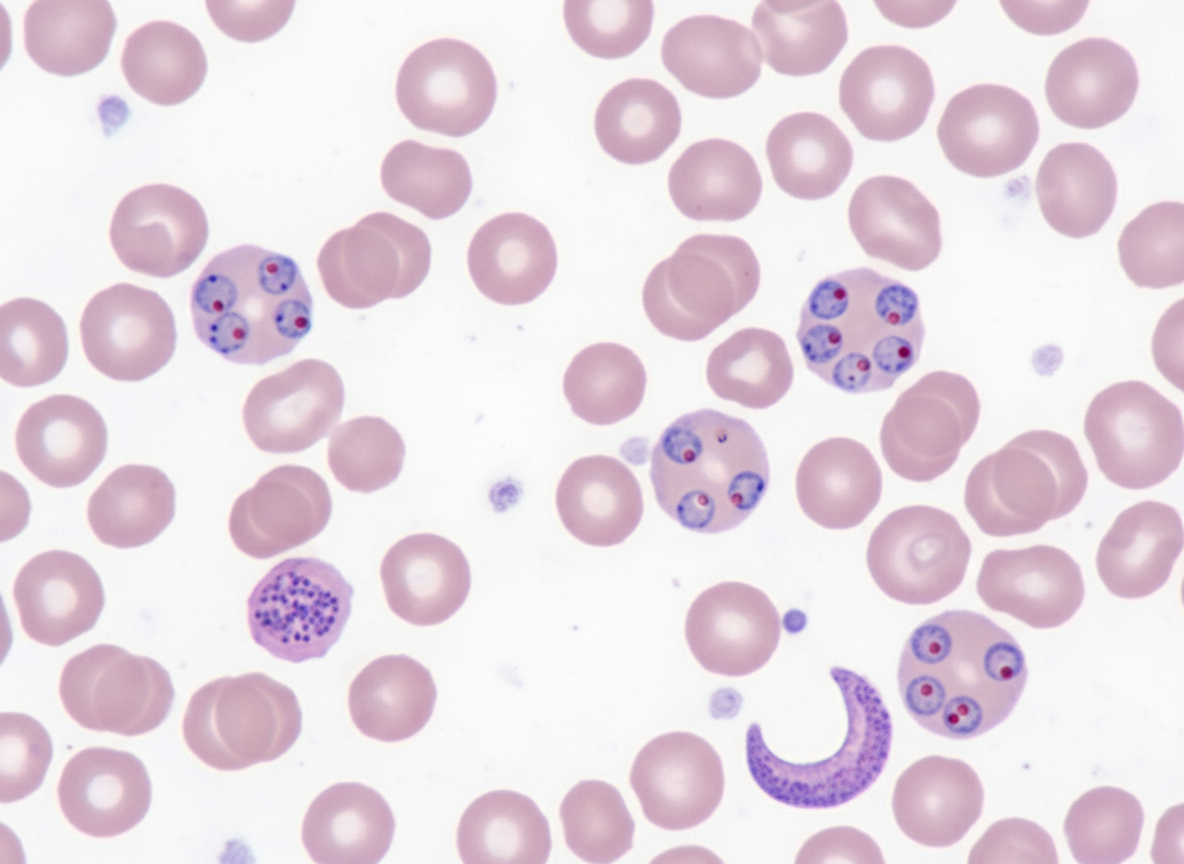
Maltese cross appearance in peripheral blood smear is characteristic of which parasitic infection?
Explanation: **Explanation** In medical parasitology, the mode of entry into the host is a high-yield topic. Parasites typically enter the human body via ingestion (fecal-oral), skin penetration, or insect vectors. **Why the Correct Answer is Roundworm (*Ascaris lumbricoides*):** The question asks to identify which parasite **penetrates the skin**. However, based on standard parasitology, *Ascaris lumbricoides* (Roundworm) is actually transmitted via the **fecal-oral route** (ingestion of embryonated eggs). *Note on Question Context:* In many competitive exams like NEET-PG, if this specific question appears with "Roundworm" marked as correct, it is often a "controversial" or "recall error" key. In standard textbooks (KD Chatterjee/Paniker), the classic mnemonic for skin-penetrating larvae is **S-A-N-D**: * **S**trongyloides stercoralis * **A**ncylostoma duodenale (Hookworm) * **N**ecator americanus (Hookworm) * **D**ermatobia hominis **Analysis of Options:** * **Ancylostoma duodenale & Strongyloides (Options A & B):** These are the classic examples of parasites that enter via skin penetration (filariform larvae). If the question asks for skin penetration, these are biologically the correct choices. * **Trichuris trichiura (Option D):** Known as Whipworm, it is strictly transmitted via the ingestion of eggs (fecal-oral). **NEET-PG High-Yield Pearls:** 1. **Skin Penetrators (The "S-A-N-D" group):** These parasites often cause **Loeffler’s Syndrome** (transient pulmonary infiltrates and eosinophilia) during their migratory phase through the lungs. 2. **Fecal-Oral Group:** *Ascaris*, *Trichuris*, and *Enterobius* are primarily transmitted by ingestion. 3. **Strongyloides Unique Fact:** It is the only common helminth capable of **autoinfection**, leading to hyperinfection syndrome in immunocompromised patients. 4. **Hookworm:** Associated with **Iron Deficiency Anemia** due to chronic blood loss from the intestinal mucosa.
Explanation: **Explanation:** The diagnosis of **Kala-azar (Visceral Leishmaniasis)** relies on a combination of clinical features, parasitological demonstration, and serological tests. **Why the Correct Answer is Right:** The **Indirect Immunofluorescent Antibody Test (IFAT)** is considered one of the most sensitive and specific serological tests for Kala-azar. It detects specific antibodies against *Leishmania donovani* promastigotes. It has a sensitivity and specificity of nearly **95-98%**, making it a gold standard in serology. It is particularly useful for detecting early infections and subclinical cases where parasites may not be easily seen in smears. **Analysis of Incorrect Options:** * **Option A (WKK Antigen):** This uses a lipid extract from the tubercle bacillus (*Mycobacterium phlei*). While historically used, it is **non-specific** because it cross-reacts with other infections like leprosy and tuberculosis. * **Option B (Napier’s Aldehyde Test):** This is a **non-specific** test that detects hypergammaglobulinemia (elevated IgG). It only becomes positive after 3 months of illness and can be positive in other conditions like Multiple Myeloma or Schistosomiasis. * **Option C (Chopra’s Antimony Test):** Similar to the aldehyde test, this is a **non-specific** test based on the precipitation of serum proteins by stibonic acid compounds. It is less reliable than Napier's test. **High-Yield Clinical Pearls for NEET-PG:** * **Gold Standard Diagnosis:** Demonstration of LD bodies (amastigotes) in **Splenic aspirate** (highest yield >95%) or Bone marrow aspirate. * **rK39 Immunochromatographic Test:** The most common **rapid diagnostic test (RDT)** used in field settings due to high sensitivity and ease of use. * **Montenegro (Leishmanin) Skin Test:** This is **negative** in active Kala-azar (due to deficient cell-mediated immunity) but becomes **positive** in recovered patients or those with Post-Kala-azar Dermal Leishmaniasis (PKDL).
Explanation: **Explanation:** The **amastigote** is the intracellular, non-flagellated stage of parasites belonging to the genera *Leishmania* and *Trypanosoma cruzi*. In the case of *Leishmania donovani* (the causative agent of Kala-azar), the parasite specifically targets and multiplies within the **Reticuloendothelial system (RES)**. **1. Why Reticuloendothelial cells are correct:** The RES consists of phagocytic cells located in the liver (Kupffer cells), spleen, bone marrow, and lymph nodes. Once the promastigote form enters the human body via a sandfly bite, it is engulfed by phagocytes. Inside these cells, it transforms into the amastigote (Leishman-Donovan or LD bodies). While macrophages are the primary host cells, the term "Reticuloendothelial cells" is the most comprehensive and accurate description of the entire system involved in the pathogenesis of Visceral Leishmaniasis. **2. Why other options are incorrect:** * **Macrophages (Option A):** While technically correct as macrophages are the specific cells involved, "Reticuloendothelial cells" is the preferred broader anatomical classification in standard parasitology textbooks for this specific question type. * **Lymphocytes (Option C):** These are part of the adaptive immune system (T and B cells) and are not the primary hosts for amastigote replication. * **Red blood cells (Option D):** RBCs are the target for *Plasmodium* (Malaria) and *Babesia*, but they lack the machinery and phagocytic nature required by *Leishmania*. **High-Yield Clinical Pearls for NEET-PG:** * **Vector:** *Phlebotomus argentipes* (Sandfly). * **Infective stage:** Promastigote (flagellated, found in the sandfly midgut). * **Diagnostic stage:** Amastigote (found in splenic or bone marrow aspirates). * **Culture Medium:** NNN (Novy-MacNeal-Nicolle) medium. * **Gold Standard Diagnosis:** Splenic aspirate (highest sensitivity) showing LD bodies.
Explanation: **Explanation:** The **Aldehyde Test (Napier’s Test)** is a non-specific biochemical test used in the diagnosis of Visceral Leishmaniasis (Kala-azar). Its positivity depends on a significant increase in serum **gamma globulins** (hypergammaglobulinemia), which is a hallmark of the body's immune response to *Leishmania donovani*. **Why 12 weeks is correct:** In Kala-azar, the rise in serum globulins occurs gradually. It takes approximately **3 months (12 weeks)** for the globulin levels to become sufficiently elevated to cause the "jellification" (solidification and opalescence) of serum when mixed with 40% formaldehyde. Therefore, the test is not useful for early diagnosis. **Analysis of incorrect options:** * **2 & 4 weeks:** These durations are too early in the disease course. During the first month, the immune system has not yet produced the massive quantity of globulins required to trigger a positive reaction. * **8 weeks:** While globulin levels are rising, they typically do not reach the threshold for a reliable aldehyde test result until the 12-week mark. **High-Yield Clinical Pearls for NEET-PG:** * **Mechanism:** The test detects a quantitative increase in globulins, not specific antibodies. * **Positive Result:** Serum turns into a stiff, white, opaque gel (resembling the white of a boiled egg) within 2–20 minutes. * **Chopra’s Antimony Test:** Another non-specific test for Kala-azar; it becomes positive earlier than the aldehyde test (around 4 weeks). * **Specific Tests:** For NEET-PG, remember that the **rk39 immunochromatographic test** is the rapid diagnostic test of choice, while **Amastigotes (LD bodies)** in bone marrow or splenic aspirates remain the gold standard for definitive diagnosis.
Explanation: The diagnosis of Neurocysticercosis (NCC) is based on the **Del Brutto Revised Diagnostic Criteria**, which categorizes findings into Absolute, Major, Confirmative, and Suggestive criteria. ### **Why Option A is the Correct Answer** **Detection of cysticerci antigen by ELISA** is considered a **supportive/minor criterion**, not a major one. While ELISA is useful for screening, it lacks the high specificity required for a major diagnostic category due to potential cross-reactivity with other helminthic infections (like Echinococcus). ### **Analysis of Incorrect Options (Major Criteria)** * **Option B (Immunoblot):** Detection of specific anticysticercal antibodies by **Enzyme-linked Immunoelectrotransfer Blot (EITB)** using purified *Taenia solium* antigens is a **Major Criterion**. It is significantly more specific and sensitive than ELISA. * **Option C (MRI Findings):** The presence of cystic lesions without a visible scolex (suggestive of NCC) in the brain parenchyma on MRI is a **Major Criterion**. (Note: If a scolex is visible, it becomes an *Absolute* criterion). * **Option D (CT Findings):** The presence of typical "starry sky" appearances or multiple **calcified lesions** in the brain parenchyma on CT scan is a **Major Criterion**, representing the end-stage of the parasite's life cycle. ### **High-Yield Clinical Pearls for NEET-PG** * **Gold Standard Serology:** EITB (Immunoblot) is the serological test of choice, not ELISA. * **Absolute Criterion:** Visualization of the **scolex** (hole-with-dot appearance) on CT/MRI or histological demonstration of the parasite from a biopsy. * **Most Common Presentation:** New-onset seizures in an adult in endemic areas. * **Drug of Choice:** **Albendazole** is preferred over Praziquantel as it has better CNS penetration and higher efficacy against viable cysts. Steroids must be started *before* antiparasitic drugs to prevent inflammatory edema.
Explanation: **Explanation:** The correct answer is **B. Ascaris lumbricoides**. **1. Why Ascaris lumbricoides is the correct answer:** Malabsorption in parasitic infections typically occurs when the parasite causes significant structural damage to the intestinal mucosa (villous atrophy) or creates a physical barrier over the absorptive surface. *Ascaris lumbricoides* (Roundworm) resides in the lumen of the small intestine. While it competes with the host for nutrients (leading to protein-energy malnutrition and Vitamin A/C deficiency), it does **not** typically cause a malabsorption syndrome. Its primary complications are mechanical, such as intestinal obstruction (at the ileocecal valve) or migration into the biliary tract. **2. Analysis of Incorrect Options:** * **Giardia lamblia:** The classic cause of parasitic malabsorption. It causes "coating" of the intestinal mucosa, villous flattening, and brush border enzyme deficiency (especially lactase), leading to steatorrhea and fat-soluble vitamin deficiency. * **Strongyloides stercoralis:** In heavy infections, the larvae burrow into the duodenal and jejunal mucosa, causing significant inflammation, ulceration, and a secondary malabsorption syndrome. * **Capillaria philippinensis:** This parasite causes "sprue-like" symptoms. It leads to severe mucosal injury, resulting in a protein-losing enteropathy, electrolyte imbalance, and profound malabsorption. **3. NEET-PG High-Yield Pearls:** * **Most common parasite causing malabsorption:** *Giardia lamblia*. * **Parasites causing Autoinfection:** *Strongyloides stercoralis*, *Capillaria philippinensis*, *Enterobius vermicularis*, and *Hymenolepis nana*. * **Ascaris Clinical Sign:** "Loeffler’s Syndrome" (transient pulmonary infiltrates with eosinophilia) occurs during the lung migration phase. * **Diagnosis of Ascaris:** Stool microscopy for bile-stained eggs; "Spaghetti appearance" on Barium meal.
Explanation: **Explanation:** **1. Why Plasmodium falciparum is correct:** Pernicious malaria refers to the life-threatening, severe clinical manifestations of malaria, which are almost exclusively caused by **Plasmodium falciparum**. The underlying pathophysiology is **cytoadherence** and **sequestration**. *P. falciparum* expresses a protein called **PfEMP-1** on the surface of infected RBCs, which forms "knobs." These knobs bind to endothelial receptors (like ICAM-1 and CD36) in deep capillaries. This leads to microvascular obstruction, tissue hypoxia, and organ dysfunction. Common presentations of pernicious malaria include: * **Cerebral malaria** (encephalopathy/coma) * **Algid malaria** (shock and peripheral circulatory failure) * **Blackwater fever** (hemoglobinuria due to massive intravascular hemolysis) * **Septicemic malaria** (high-grade fever with multiorgan failure) **2. Why the other options are incorrect:** * **P. vivax & P. ovale:** These species primarily cause "Benign Tertian Malaria." While *P. vivax* can occasionally cause severe disease (like splenic rupture), it does not typically exhibit the sequestration phenomenon required to be classified as "pernicious." They are known for forming **hypnozoites** in the liver, leading to relapses. * **P. malariae:** This species causes "Quartan Malaria." It is generally the most chronic but least severe form, though it is classically associated with **nephrotic syndrome** in children. **3. NEET-PG High-Yield Pearls:** * **Maurer’s dots:** Seen in RBCs infected with *P. falciparum*. * **Multiple rings and Crescent-shaped gametocytes:** Characteristic morphology of *P. falciparum*. * **Recrudescence:** Seen in *P. falciparum* (due to sub-therapeutic treatment), whereas **Relapse** is seen in *P. vivax/ovale* (due to hypnozoites). * **Drug of choice for Severe Malaria:** Intravenous **Artesunate**.
Explanation: ### Explanation In parasitology, the **Definitive Host (DH)** is the host in which the parasite undergoes its **sexual cycle** or reaches **sexual maturity**. The **Intermediate Host (IH)** is where the asexual cycle or larval stages occur. **1. Why Wuchereria bancrofti is correct:** For *Wuchereria bancrofti* (and most helminths except *Echinococcus* and *Taenia solium* in cysticercosis), **Man is the Definitive Host**. The adult male and female worms reside and mate in the human lymphatic system, producing microfilariae. The intermediate host is the mosquito (*Culex*, *Anopheles*, or *Aedes*), where larval development (L1 to L3) occurs. **2. Analysis of Incorrect Options:** * **Echinococcus granulosus (Hydatid disease):** Man is the **Accidental Intermediate Host** (dead-end host). The definitive host is the **Dog** (adult worm lives in the dog's intestine). * **Plasmodium (Malaria):** Man is the **Intermediate Host** (asexual cycle/schizogony occurs in humans). The **Female Anopheles mosquito** is the Definitive Host because the sexual cycle (sporogony) occurs within the mosquito. * **Rabies virus:** This is a viral pathogen, not a parasite. The concept of definitive/intermediate hosts applies to parasites. Humans are accidental hosts. **3. NEET-PG High-Yield Pearls:** * **Rule of Thumb:** For most protozoa (except *Plasmodium* and *Toxoplasma*), man is the DH. For most helminths (except *Echinococcus*), man is the DH. * **Toxoplasma gondii:** Man is the IH; **Cat** is the DH. * **Taenia solium:** Man is usually the DH (intestinal taeniasis). However, in **Cysticercosis**, man acts as the IH. * **Vector for W. bancrofti in India:** *Culex quinquefasciatus*.
Explanation: **Explanation:** The correct answer is **Yellow fever**. *Aedes aegypti* is a highly efficient vector for several viral diseases, primarily because it is anthropophilic (prefers human blood) and breeds in stagnant water around human dwellings. **1. Why Yellow Fever is Correct:** Yellow fever is caused by a Flavivirus and is transmitted to humans by the bite of infected *Aedes aegypti* mosquitoes (urban cycle) or *Haemagogus* mosquitoes (sylvatic/jungle cycle). *Aedes* mosquitoes are known for being "day-biters" and are characterized by white markings on their legs (lyre-shaped). **2. Analysis of Incorrect Options:** * **Japanese Encephalitis (JE):** Transmitted by **Culex** mosquitoes (primarily *Culex tritaeniorhynchus*). These mosquitoes breed in rice fields and irrigation canals. * **Kyasanur Forest Disease (KFD):** This is a tick-borne viral hemorrhagic fever. The principal vector is the hard tick, **Haemaphysalis spinigera**. * **Filaria:** Lymphatic filariasis in India is primarily transmitted by **Culex quinquefasciatus**. While *Aedes* can transmit certain types of filariasis (like *Brugia*), *Culex* is the classic vector associated with *Wuchereria bancrofti*. **3. NEET-PG High-Yield Pearls:** * **Diseases transmitted by *Aedes aegypti*:** Remember the mnemonic **"DYD"** — **D**engue, **Y**ellow Fever, **D**engue Hemorrhagic Fever, **Chikungunya**, and **Zika** virus. * **Control Measure:** The most effective way to control *Aedes* is "Source Reduction" (eliminating stagnant water). * **Yellow Fever Vaccine:** The **17D vaccine** is a live attenuated vaccine providing immunity for life (as per revised WHO guidelines), though international travel certificates are valid for 10 years to life.
Explanation: **Explanation:** The **Maltese cross appearance** is the pathognomonic morphological feature of **Babesia microti**. This appearance occurs when the parasite undergoes asexual reproduction (merogony) within the host’s red blood cells, resulting in a **tetrad of four daughter merozoites** joined together at their bases. **Why the other options are incorrect:** * **Plasmodium falciparum:** While it also infects RBCs, it typically presents with delicate ring forms, "headphone" shaped trophozoites, and characteristic crescent or **banana-shaped gametocytes**. It does not form tetrads. * **Leishmania chagasi:** This is a tissue parasite. In a smear (usually bone marrow or splenic aspirate), it appears as **amastigotes** (Leishman-Donovan bodies) within macrophages, characterized by a nucleus and a kinetoplast. * **Trypanosoma cruzi:** In peripheral blood during the acute phase, it appears as C-shaped or U-shaped **trypomastigotes** with a prominent kinetoplast. It does not infect the interior of RBCs in a tetrad formation. **High-Yield Clinical Pearls for NEET-PG:** * **Vector:** *Babesia* is transmitted by the **Ixodes tick** (the same vector for Lyme disease and Anaplasmosis). * **Clinical Presentation:** Often presents as a malaria-like illness (fever, hemolytic anemia, jaundice). It is particularly severe or fatal in **asplenic patients**. * **Diagnosis:** Thick and thin peripheral blood smears (Giemsa stain). * **Treatment:** Combination of **Atovaquone + Azithromycin** (preferred) or Quinine + Clindamycin.
Classification of Parasites
Practice Questions
Intestinal Protozoa
Practice Questions
Blood and Tissue Protozoa
Practice Questions
Malaria Parasites
Practice Questions
Leishmaniasis
Practice Questions
Intestinal Helminths: Nematodes
Practice Questions
Tissue Nematodes
Practice Questions
Trematodes
Practice Questions
Cestodes
Practice Questions
Ectoparasites
Practice Questions
Antiparasitic Drugs
Practice Questions
Laboratory Diagnosis of Parasitic Infections
Practice Questions
Get full access to all questions, explanations, and performance tracking.
Start For Free